
Blog Details
Diskava. Beta. Kava
16Aug
SHA + Microhealth Cover in Kenya | Is It Enough?
Already have SHA and wondering whether Microhealth Insurance can replace standard medical cover? Learn how SHA, microhealth and private medical insurance can work together for individuals, families, SMEs and corporate organisations in Kenya.
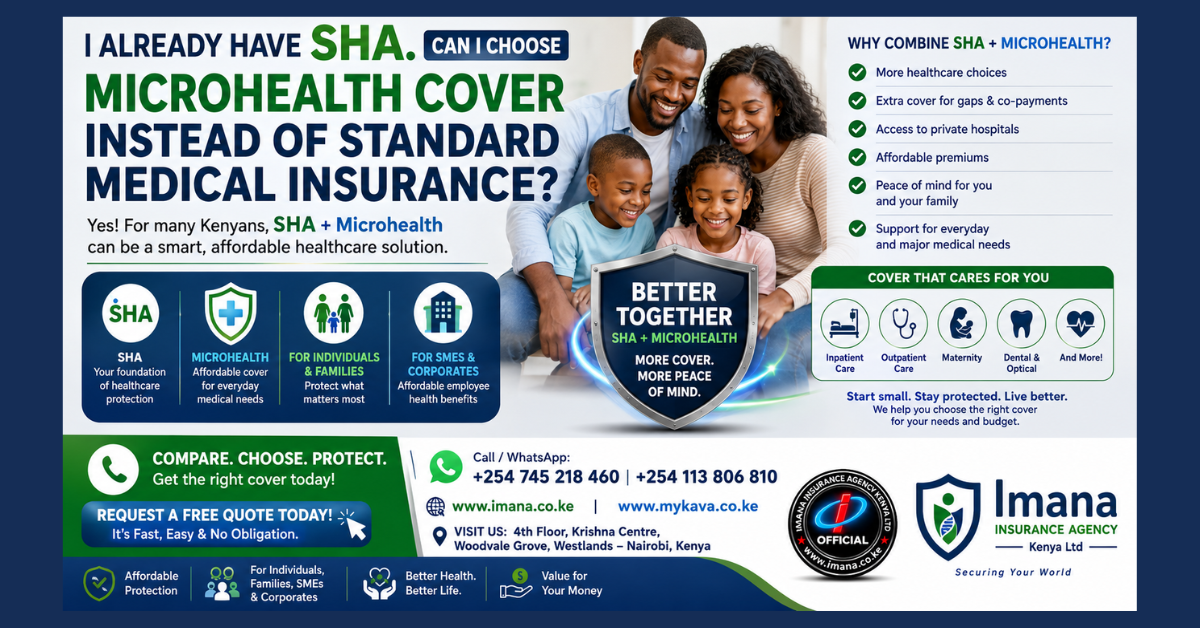
I Already Have SHA. Can I Choose Microhealth Cover Instead of Standard Medical Insurance?
Yes — for some individuals and families, SHA plus a suitable Microhealth Insurance product can be a practical and affordable healthcare-protection strategy.
But the more important question is not simply whether you can choose microhealth over a conventional medical policy.
The right question is:
What healthcare costs could still affect me or my family after considering the benefits available through SHA, and can the microhealth product I am considering reasonably address those gaps?
Kenya's Social Health Authority currently administers the Social Health Insurance Fund, Primary Healthcare Fund and Emergency, Chronic and Critical Illness Fund, with SHA intended to provide financial-risk protection and facilitate access to healthcare for Kenyan residents.
At the same time, private medical insurance exists in many forms — from relatively affordable, targeted products to broader inpatient and outpatient plans.
This means the choice does not always have to be:
SHA OR private insurance.
For many consumers, it can be:
SHA + Microhealth Insurance
or, where broader protection is required:
SHA + Standard Private Medical Insurance
The best combination depends on your healthcare needs, budget, family structure, preferred hospitals and financial capacity.
What Is SHA?
SHA, the Social Health Authority, is the public institution administering Kenya's social health-insurance framework.
The system includes:
- Primary Healthcare Fund
- Social Health Insurance Fund
- Emergency, Chronic and Critical Illness Fund
The Social Health Insurance Fund provides benefits including essential inpatient and outpatient healthcare and other prescribed services under the applicable benefit package and tariffs.
SHA therefore provides an important foundation of healthcare protection.
Consumers can also check their current coverage eligibility through SHA's official eligibility platform.
But having SHA does not necessarily mean that every healthcare expense, hospital preference or financial exposure will be covered exactly as an individual would prefer.
That is where supplementary private insurance can become relevant.
What Is Microhealth Insurance?
Microhealth Insurance is a form of insurance designed to make healthcare protection more accessible through relatively simple benefits, affordable pricing and targeted cover.
Microinsurance is formally recognised within Kenya's insurance regulatory framework. The Insurance Regulatory Authority regulates microinsurance business under the Insurance (Microinsurance) Regulations, 2020.
A Microhealth product may therefore focus on selected healthcare expenses rather than attempting to provide the extensive benefits associated with a traditional high-limit medical policy.
Depending on the insurer and product, it may include benefits such as:
- Inpatient treatment
- Outpatient treatment
- Maternity
- Accidental medical expenses
- Hospital cash
- Last Expense
- Dental or optical benefits
- Other defined medical benefits
Not every Microhealth product provides all these benefits.
The exact:
- Limits
- Waiting periods
- Hospital networks
- Co-payments
- Exclusions
- Family arrangements
must be checked before purchasing.
Is Microhealth the Same as Ordinary Medical Insurance?
Not necessarily.
Both products can protect against healthcare costs, but they may be structured differently.
Standard Medical Insurance
Traditional private Medical Insurance may provide relatively broad protection involving:
- Higher inpatient limits
- Outpatient benefits
- Maternity
- Dental
- Optical
- Chronic-condition treatment
- Cancer and renal benefits
- Larger hospital networks
- Emergency evacuation
- International or regional treatment options
Imana's existing Medical Insurance products, for example, include options involving inpatient, maternity, outpatient, dental, optical and Last Expense benefits.
Microhealth Insurance
Microhealth generally seeks to make insurance:
- More affordable
- Easier to understand
- Easier to purchase
- More focused on defined healthcare needs
It may therefore offer lower or more targeted limits than a broad standard Medical Insurance programme.
Microhealth should not automatically be viewed as “cheap standard Medical Insurance.” It is a different approach to providing financial protection against selected healthcare risks.
So Can SHA + Microhealth Be Enough?
For some consumers, yes.
For others, no.
It depends on what you expect your insurance to achieve.
Consider a person who:
- Already has active SHA coverage
- Has a limited insurance budget
- Mainly wants additional private protection against selected medical expenses
- Is comfortable with the provider network available
- Does not require very high inpatient limits
- Does not require extensive international treatment benefits
For that person:
SHA + Microhealth may provide a sensible layered solution.
Now consider someone who:
- Wants access to a broad private-hospital network
- Has a family with significant healthcare needs
- Wants substantial cancer or chronic-condition benefits
- Travels regularly
- Wants high inpatient limits
- Wants broad outpatient, maternity, dental and optical benefits
That person may find a broader private Medical Insurance policy more suitable.
Why Having SHA and Microhealth Together Can Make Sense
The strongest argument for combining the two is layering.
Instead of expecting one insurance arrangement to solve every healthcare need, different layers can address different exposures.
Think about it this way:
Layer 1: SHA
Provides the statutory social health-insurance foundation.
Layer 2: Microhealth
Adds targeted private benefits according to the product selected.
Layer 3: Standard Private Medical Insurance
Where required, provides broader private protection with higher limits and additional benefits.
Not every person needs all three layers.
The appropriate combination depends on risk and affordability.
Benefit 1: You Do Not Have to Depend on One Healthcare Financing Source
One of the greatest advantages of layered health protection is diversification.
Healthcare bills can arise unexpectedly.
A family relying on only one source of payment may find itself exposed where:
- A service falls outside the applicable package
- A tariff does not meet the entire private-provider charge
- A preferred hospital is not available under the chosen arrangement
- A benefit limit has been exhausted
- An exclusion applies
Having supplementary Microhealth protection may create another source of financial support, subject to its terms.
Benefit 2: Microhealth Can Be More Affordable Than Broad Medical Insurance
One of the main barriers to private Medical Insurance is cost.
A broad family medical plan may require a significant annual premium.
Microhealth seeks to offer a more accessible alternative by concentrating protection around selected risks or lower benefit limits.
This can make it attractive to:
- Young adults
- Informal-sector workers
- Families with limited budgets
- Small businesses
- Start-ups
- SMEs
- Groups seeking entry-level employee benefits
The objective is not necessarily to reproduce every benefit found in a premium Medical Insurance policy.
It is to reduce the financial shock caused by specified healthcare events.
Benefit 3: SHA Can Remain the Foundation While Microhealth Fills Selected Gaps
Having private insurance does not mean SHA becomes irrelevant.
SHA already provides important healthcare protection through Kenya's social health-insurance system.
A Microhealth product can instead be selected according to needs that are important to the consumer.
For example:
A customer may say:
“I already have SHA. I mainly want an affordable additional inpatient benefit.”
Another may say:
“My priority is outpatient treatment for my children.”
Another may be concerned about:
- Maternity
- Accident-related treatment
- Last Expense
- Hospital cash
This makes the conversation more focused.
Rather than asking:
“Which Medical Insurance should I buy?”
ask:
“What healthcare financial gap am I trying to solve?”
Benefit 4: Families Can Build Health Protection Gradually
Not every family can immediately afford a large Comprehensive Medical Insurance policy.
That should not mean doing nothing.
A family can potentially build protection in stages.
For example:
Stage 1
Maintain active SHA coverage.
Stage 2
Add an affordable Microhealth product.
Stage 3
As income improves, review whether higher private medical limits are appropriate.
This creates a pathway from basic healthcare protection toward a more comprehensive family insurance programme.
Benefit 5: It Can Reduce Dependence on Emergency Fundraising
Unexpected illness can create financial pressure quickly.
Families may be forced to:
- Use savings
- Borrow
- Sell assets
- Request contributions from relatives
- Organise fundraising
- Delay other important expenses
Insurance cannot eliminate every healthcare expense, but combining SHA with appropriate supplementary insurance can reduce some of the financial uncertainty.
That is particularly important as families become more geographically dispersed and cannot always depend on traditional community fundraising.
Microhealth Insurance for Individuals
An individual may consider Microhealth where they:
- Already have SHA
- Want affordable supplementary protection
- Are self-employed
- Work in the informal sector
- Are between jobs
- Do not have employer Medical Insurance
- Want to begin building a personal insurance portfolio
Before choosing a plan, ask:
- What is the inpatient limit?
- Is outpatient included?
- Which hospitals can I use?
- Is there a co-payment?
- What waiting period applies?
- Are chronic conditions covered?
- Are there age limits?
- What exclusions apply?
The premium should be one consideration — not the only consideration.
Microhealth Insurance for Families
Families need to look beyond the headline premium.
Consider:
- Ages of parents
- Number of children
- Existing conditions
- Frequency of outpatient visits
- Preferred hospitals
- Maternity plans
- Expected healthcare expenses
A family with young children may value outpatient benefits differently from a single adult.
A couple planning to have a baby may place greater importance on maternity.
An older household may need to examine chronic-condition benefits carefully.
Therefore:
The best Microhealth cover for one family may be unsuitable for another family.
Can Children Have Microhealth Cover?
Product rules differ between insurers.
Some medical products may allow:
- Children under a principal member
- Family arrangements
- Child-only options
Others may require an adult principal member.
This should be checked at quotation stage.
For families already registered under SHA, the comparison should consider how both the public and private arrangements apply to dependants.
Microhealth Insurance for SMEs
Microhealth has significant potential for small and medium-sized businesses.
Many SMEs would like to provide employee Medical Insurance but may find traditional Group Medical programmes expensive.
A Microhealth programme can potentially provide an entry point.
An SME may use it to create an employee package combining:
- SHA
- Microhealth
- WIBA
- Group Personal Accident
- Group Life or Last Expense
This can provide employees with several layers of financial protection without necessarily replicating the medical-benefit structure of a large corporation.
Why SMEs Should Not Treat SHA and Employee Medical Benefits as Competitors
Employers sometimes ask:
“If employees already have SHA, why should the company provide Medical Insurance?”
The answer depends on the organisation's employee-benefits strategy.
SHA creates a social health-insurance foundation.
An employer-provided Microhealth or Medical Insurance product can add benefits and convenience depending on the policy.
Employee health benefits can also contribute to:
- Employee retention
- Recruitment
- Staff wellbeing
- Reduced financial stress
The employer should therefore compare the cost of additional health protection with the value it provides to employees.
Microhealth for Corporate Organisations
Large organisations may also have a role for Microhealth.
It does not have to be limited to very small companies.
Corporate organisations may have:
- Permanent employees
- Contract workers
- Casual employees
- Field agents
- Sales representatives
- Seasonal staff
- Outsourced teams
A full Group Medical programme may be appropriate for one category of employee, while another workforce category may benefit from a simpler Microhealth arrangement.
This allows organisations to build tiered employee-benefit programmes.
For example:
Senior and permanent employees
Group Medical Insurance with broader limits.
Contract and field employees
Microhealth protection alongside SHA.
All eligible employees
WIBA and appropriate accident protection.
The programme should be professionally structured to avoid unnecessary duplication and coverage gaps.
SHA + Microhealth + WIBA: An Important Distinction for Employers
These covers serve different purposes.
SHA
Addresses social health-insurance benefits.
Microhealth
Provides specified private healthcare benefits.
WIBA
Addresses qualifying occupational injuries and diseases within the work-injury framework.
An employer should not assume that Medical Insurance replaces WIBA.
Similarly, WIBA should not be treated as ordinary Medical Insurance.
For many employers, the covers complement one another.
SHA + Microhealth + Group Personal Accident
Another useful combination may be:
SHA + Microhealth + GPA
Each layer addresses a different aspect of financial risk.
SHA
Healthcare foundation.
Microhealth
Selected supplementary healthcare benefits.
GPA
Defined benefits following accidental injury or accidental death, depending on the policy.
A family, SME or corporate organisation should therefore think in terms of a protection portfolio, rather than expecting one policy to do everything.
When Standard Medical Insurance May Still Be Better
Microhealth is not automatically the best option merely because it is affordable.
A broader Medical Insurance programme may be more appropriate where you require:
- High inpatient limits
- Extensive hospital networks
- Broad outpatient benefits
- High maternity limits
- Cancer treatment
- Renal treatment
- Chronic-condition management
- International treatment
- Emergency evacuation
- Dental and optical benefits
- Wider family protection
Imana's standard medical offering currently includes inpatient, maternity, outpatient, dental, optical and Last Expense components, illustrating the broader range of benefits that can exist under conventional Medical Insurance.
When Microhealth May Be a Better Fit
Microhealth may deserve serious consideration if:
- You already have SHA.
- Your budget is limited.
- You want a supplementary layer rather than full private Medical Insurance.
- You prefer simple benefits.
- You mainly want protection against selected medical expenses.
- You are buying cover for a large lower-cost group.
- Your SME wants to begin offering employee health benefits.
The decision should be made after comparing actual benefits, not based solely on the word “micro.”
Is Microhealth Only for Low-Income Consumers?
Microinsurance was developed primarily to make insurance more accessible to underserved and price-sensitive consumers, and Kenya regulates microinsurance as a distinct insurance business category.
But the underlying product concept can also be useful for:
- Young professionals
- Self-employed consumers
- Families seeking targeted protection
- SMEs
- Large groups
- Employers seeking tiered benefits
The question is whether the benefit design suits the customer's risk.
Does Microhealth Cover Every Medical Bill?
No.
Neither Microhealth nor standard Medical Insurance should be assumed to pay every medical expense.
Potential limitations can include:
- Benefit limits
- Waiting periods
- Hospital networks
- Co-payments
- Pre-existing-condition rules
- Specific exclusions
- Treatment sublimits
- Eligibility requirements
Always obtain the product details before purchasing.
What Should I Check Before Choosing a Microhealth Plan?
Before comparing premiums, check:
Inpatient limit
What is the maximum available?
Outpatient
Is it included or optional?
Hospital network
Which facilities can you access?
Co-payment
Will you pay something every time you use the service?
Waiting periods
How long before specified benefits become available?
Chronic conditions
Are they covered?
Maternity
Is maternity included, and what limit applies?
Family structure
Can you insure dependants?
Age limits
What are the minimum and maximum entry ages?
Claims process
How are claims approved or reimbursed?
Exclusions
What will the policy not pay for?
Don't Compare SHA and Microhealth Using Premium Alone
SHA and Microhealth serve different roles.
Consumers should instead consider:
- Benefits available under SHA
- Benefits available under Microhealth
- Areas of overlap
- Potential gaps
- Hospital accessibility
- Out-of-pocket exposure
The ideal outcome is not necessarily to buy more insurance.
It is to achieve the most appropriate protection within your budget.
Can I Have SHA, Microhealth and Standard Medical Insurance at the Same Time?
Potentially, yes.
Having one form of healthcare protection does not necessarily prevent you from holding another policy.
However, you should understand how the benefits coordinate.
Medical Insurance is generally intended to cover actual eligible healthcare expenses rather than allow a consumer to recover the same expense multiple times.
The treatment of overlapping benefits depends on:
- Policy wording
- Provider arrangements
- Claims procedures
- Coordination rules
Tell your insurer or intermediary about any existing health cover so the programme can be structured properly.
Why Microhealth Could Become Important in Kenya
Kenya's healthcare environment is changing.
SHA has created a broad social health-insurance foundation, while private insurers continue developing products for different segments.
At the same time:
- Household budgets remain under pressure.
- Many workers operate outside traditional formal employment.
- SMEs want affordable employee benefits.
- Consumers increasingly buy insurance digitally.
- Families want flexible insurance options.
Microhealth can potentially occupy the space between:
Having only basic public healthcare protection
and
Purchasing a relatively expensive broad private Medical Insurance programme.
This makes it an important part of Kenya's future insurance conversation.
Raymond Momanyi and Team Imana & MyKava: How We Look at Microhealth
At Imana Insurance Agency Kenya Ltd and MyKava, the starting point should not be:
“Which policy can we sell?”
The better starting point is:
“What healthcare protection do you already have, what gaps remain and what can you reasonably afford?”
For a customer who already has SHA, the conversation may therefore compare:
Option 1
SHA only
Option 2
SHA + Microhealth
Option 3
SHA + Standard Medical Insurance
Option 4
SHA + Microhealth + additional Personal Accident or Last Expense protection
Each structure solves a different financial problem.
Health Insurance for Individuals Through Imana and MyKava
Individuals can compare medical protection according to:
- Age
- Budget
- Hospital preference
- Inpatient needs
- Outpatient needs
- Existing SHA protection
The aim is to avoid both:
- Being uninsured
- Paying unnecessarily for benefits that do not match your needs
Health Insurance for Families
Families can review:
- Parent ages
- Child ages
- Maternity needs
- Chronic conditions
- Hospital preferences
- Budget
A family with SHA may decide that Microhealth is sufficient for additional protection.
Another family may need broader private Medical Insurance.
There is no universal answer.
Health Insurance for SMEs
SMEs can work with Imana and MyKava to compare options based on:
- Number of employees
- Employee ages
- Budget per employee
- Required medical benefits
- Existing employee protections
- WIBA requirements
- GPA requirements
This can help businesses move from:
No employee medical benefit
to
Affordable supplementary protection
without immediately committing to a high-cost Group Medical plan.
Health Insurance for Corporate Organisations
Corporate organisations can review:
- Group Medical
- Microhealth
- WIBA
- GPA
- Group Life
- Last Expense
as part of a wider employee-benefits strategy.
Different benefits can potentially be structured for different employee categories while maintaining an overall risk-management framework.
Frequently Asked Questions
I already have SHA. Do I still need private Medical Insurance?
Not necessarily, but supplementary private protection may be useful depending on the healthcare access, benefits and financial protection you want beyond SHA.
Can I choose Microhealth instead of standard Medical Insurance?
Yes, where the Microhealth product provides benefits suitable for your needs and budget.
Is Microhealth better than SHA?
They should not necessarily be compared as substitutes. SHA is part of Kenya's social health-insurance framework, while Microhealth is private insurance that can provide additional defined benefits.
Can SHA and Microhealth work together?
Yes. They can form different layers of healthcare financial protection, subject to the terms and benefit coordination of the particular private product.
Is Microhealth suitable for families?
It can be, particularly where the family wants affordable supplementary protection. Check family eligibility, limits and hospital networks.
Can an SME buy Microhealth for employees?
Depending on the insurer and product, group Microhealth solutions may be structured for employees.
Can large organisations use Microhealth?
Yes, particularly as part of a tiered employee-benefit programme where different workforce groups require different levels of cover.
Does Microhealth replace WIBA?
No. WIBA deals with occupational injury obligations and should be considered separately.
Can I upgrade from Microhealth later?
Depending on the insurer, you can later consider a broader Medical Insurance programme. New underwriting and waiting-period rules may apply.
Is Microhealth regulated in Kenya?
Yes. Microinsurance business is regulated by the Insurance Regulatory Authority under Kenya's Insurance (Microinsurance) Regulations, 2020.
How to Choose Between SHA + Microhealth and SHA + Standard Medical Insurance
Ask yourself five questions.
1. What do I already have through SHA?
Check your current eligibility and applicable benefits. SHA provides an official eligibility-check service.
2. What risks remain important to me?
Consider:
- Private inpatient care
- Outpatient visits
- Maternity
- Chronic conditions
- Children
- Emergency care
3. What can I realistically afford?
Insurance should protect your finances, not create an unaffordable recurring obligation.
4. Which hospitals do I want to access?
Hospital-network differences can be just as important as the premium.
5. How much financial risk can I retain myself?
A consumer with substantial savings may choose a different structure from someone who would struggle to meet a KSh 100,000 unexpected hospital bill.
The Bottom Line
If you already have SHA, you do not automatically need the most expensive private Medical Insurance policy available.
For some people:
SHA + Microhealth may be enough.
For others:
SHA + broader Medical Insurance may be more appropriate.
And for some employers:
SHA + Microhealth + WIBA + GPA may create a practical layered employee-protection programme.
The right decision depends on:
- Your budget
- Family size
- Healthcare needs
- Preferred hospitals
- Existing protection
- Required benefit limits
- Employer arrangements
The key is to stop thinking about health insurance as a choice between only two extremes:
No private insurance
or
Expensive comprehensive medical insurance.
There can be a middle ground.
And Microhealth Insurance may increasingly become that middle ground for many Kenyan households and businesses.
Compare Microhealth and Medical Insurance with Imana & MyKava
Raymond Momanyi and the team at Imana Insurance Agency Kenya Ltd and MyKava help individuals, families, SMEs and corporate organisations understand and compare available healthcare-protection options.
We can help you review:
- SHA + Microhealth
- Individual Medical Insurance
- Family Medical Insurance
- SME health cover
- Corporate Group Medical
- WIBA
- Group Personal Accident
- Group Life
- Last Expense
Imana Insurance Agency Kenya Ltd
Website:
https://imana.co.ke
Health Insurance:
https://imana.co.ke/insurance/imana-health
MyKava Travel and Insurance
Website:
https://mykava.co.ke
Call/WhatsApp
+254 745 218 460 | +254 113 806 810
Physical Office
Imana Insurance Agency Kenya Ltd
4th Floor, Krishna Centre
Woodvale Grove, Westlands
Nairobi, Kenya
Already have SHA? The next question is not simply whether you need more insurance. It is whether an affordable additional layer can protect you from the healthcare costs you are still exposed to.
Learn. Compare. Get a Quote. Buy. Claim. Renew—with Imana & MyKava.
SHA benefit packages, tariffs and implementation arrangements can change. Microhealth and private Medical Insurance benefits, limits, waiting periods, provider networks, exclusions and underwriting conditions vary by insurer and product. Confirm current SHA benefits and obtain the applicable private policy documentation before making a purchase decision.
Author: Raymond Momanyi – Founder & CEO, Imana Insurance Agency Kenya Ltd