
Blog Details
Diskava. Beta. Kava
30Jul
Medical Insurance Waiting Periods in Kenya Explained
Understand medical insurance waiting periods in Kenya for accidents, illness, maternity, surgery, chronic diseases and pre-existing conditions before buying health cover.
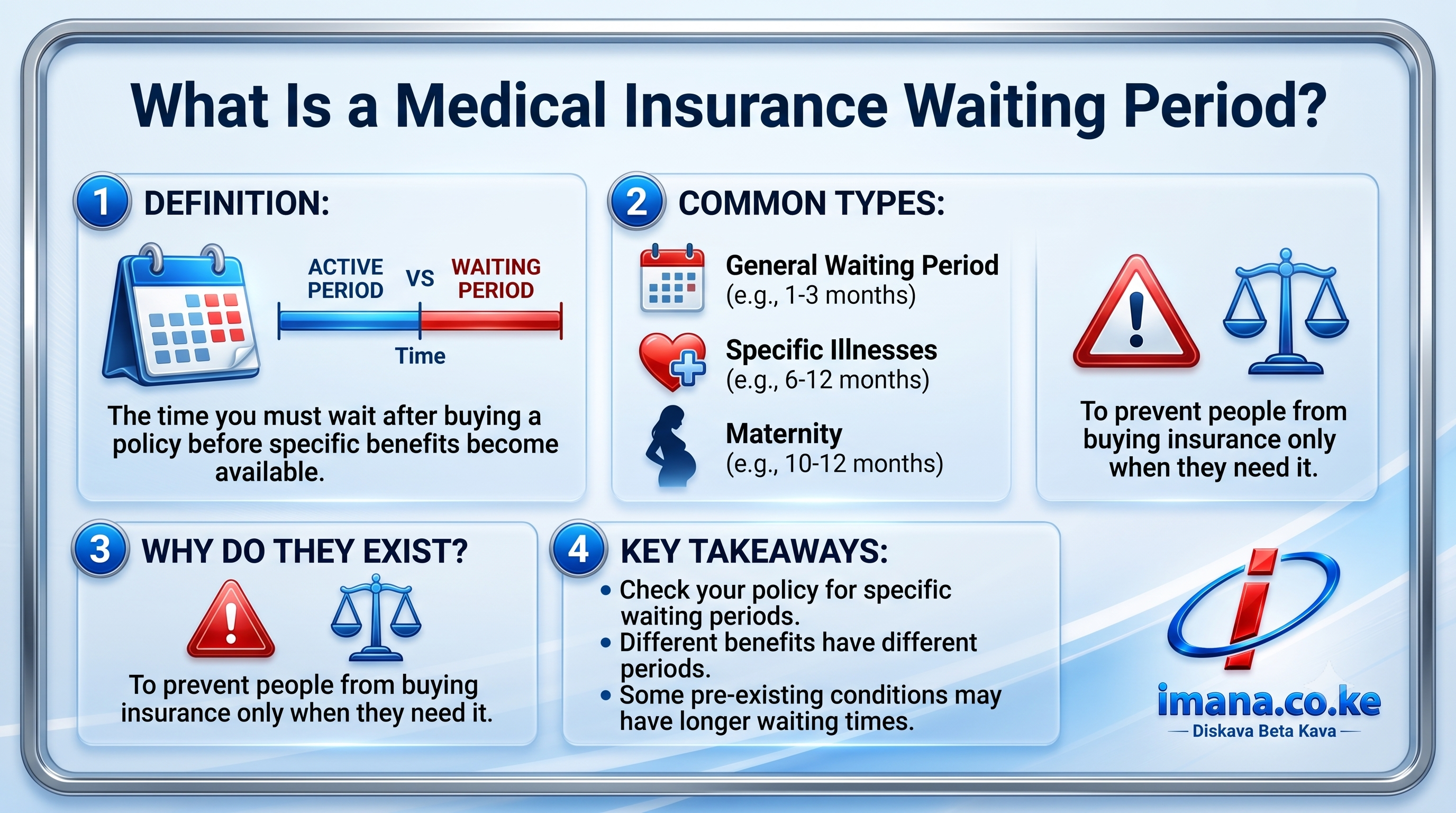
What Is a Medical Insurance Waiting Period?
A medical insurance waiting period is the length of time an insured person must wait after a policy begins before certain benefits become available.
You may have paid the premium, received a membership card and obtained written confirmation of cover—but this does not necessarily mean every medical benefit can be used immediately.
Kenya’s Microinsurance Regulations define a waiting period as the period an insured person must wait before some or all insurance coverage takes effect. (Insurance Regulatory Authority)
Waiting periods are especially common in private medical insurance for:
- General illnesses
- Non-emergency surgery
- Maternity and pregnancy complications
- Chronic diseases
- Pre-existing medical conditions
- Dental surgery
- Optical surgery
- Psychiatric treatment
- Cancer treatment
- Organ transplants
- Last-expense benefits
The exact waiting period depends on the insurer, medical plan, benefit selected and whether the policy is individual, family or corporate.
Never assume that all benefits begin on the day you pay the premium.
Why Do Medical Insurers Have Waiting Periods?
Medical insurance is designed to pool the healthcare risks of many policyholders.
If people were allowed to buy insurance only after discovering that they required an expensive treatment, the insurer would immediately receive a large claim without having collected enough premiums to sustain the risk pool.
This behaviour is known in insurance as adverse selection.
Waiting periods help insurers prevent situations where someone:
- Buys maternity cover after becoming pregnant
- Purchases insurance after being booked for surgery
- Joins a medical plan after receiving a serious diagnosis
- Buys cover immediately before an expensive planned procedure
- Cancels insurance after treatment is completed
Waiting periods are therefore not merely administrative delays. They form part of how insurers manage risk and maintain affordable premiums for the wider insured group.
However, insurers must still disclose waiting periods clearly. IRA market-conduct guidance identifies exclusions, pre-existing-condition restrictions, waiting periods and benefit limits as important information that should be communicated to consumers. (Insurance Regulatory Authority)
Common Medical Insurance Waiting Periods in Kenya
There is no single waiting-period schedule that applies to every insurance company.
However, private medical plans in Kenya commonly use the following broad structures.
1. Accident and Emergency Waiting Period: Usually Zero Days
Many medical insurance policies provide immediate protection for accidental injuries once the policy has been accepted, the premium has been paid and cover has been confirmed.
Examples may include accidental injuries arising from:
- Road accidents
- Falls
- Cuts
- Burns
- Sports accidents
- Workplace incidents, subject to coordination with WIBA
- Other sudden external events
An accident must normally be sudden, unintended and identifiable.
A medical condition that develops gradually is not treated as an accident merely because treatment becomes urgent.
AAR’s published explanation of Kenyan waiting periods identifies accidents and emergencies as commonly having no waiting period. CIC’s senior medical plan also states that accident cases have no waiting period. (AAR Insurance)
Important warning
“Zero-day accident cover” does not necessarily mean that every accident-related bill is automatically payable.
The member must still comply with:
- Policy activation requirements
- Hospital-panel rules
- Emergency-notification procedures
- Benefit limits
- Exclusions
- Pre-authorisation requirements where applicable
2. General Illness Waiting Period: Commonly 14 to 30 Days
General illness refers to ordinary medical conditions that are not caused by an accident and are not classified under longer waiting-period categories.
Examples may include:
- Flu
- Malaria
- Respiratory infections
- Stomach infections
- Minor outpatient illnesses
- Certain acute hospital admissions
Many Kenyan medical plans apply an initial waiting period of approximately two weeks to one month for general illnesses.
AAR describes a typical initial waiting period of 14 to 30 days, while Jubilee notes that general outpatient cover may carry a 30-day waiting period. (AAR Insurance)
Example
Suppose your policy begins on 1 August and has a 30-day general-illness waiting period.
If you require treatment for an ordinary illness on 15 August, the insurer may decline that expense because the waiting period has not ended.
An accidental injury occurring during the same period may be treated differently where accident benefits begin immediately.
3. Inpatient Illness Waiting Period: Commonly Around 30 Days
Some insurers apply one general waiting period to both outpatient illness and inpatient admission. Others treat the two benefits separately.
An inpatient waiting period may apply when admission is caused by illness rather than an accident.
CIC’s senior medical cover, for example, applies a 30-day waiting period to outpatient treatment and acute illness admissions while retaining immediate accident cover. (CIC Kenya)
Before purchasing cover, ask:
- Does inpatient illness begin at the same time as outpatient cover?
- Are emergency illness admissions treated differently?
- Does the waiting period apply to day surgery?
- Are diagnostic procedures included?
- Does the period restart after renewal?
4. Non-Accidental Surgery Waiting Period: From 30 Days to One Year or More
Surgery may have a separate waiting period from ordinary illness treatment.
The applicable period can depend on:
- Type of surgery
- Whether the procedure was planned
- Whether symptoms existed before joining
- Whether the operation is related to a pre-existing condition
- Whether the surgery follows an accident
- The medical plan selected
AAR identifies approximately 60 days as one possible period for certain procedures and surgeries. Britam’s Bima Ya Mwananchi states that accident-related surgery has no waiting period, acute-abdominal surgery may have a one-month period and other non-accidental surgeries may have a one-year waiting period. (AAR Insurance)
Why surgery needs special attention
A policy may advertise immediate inpatient cover while separately restricting scheduled operations.
Always request a written schedule showing the periods applicable to:
- General hospital admission
- Day surgery
- Major surgery
- Gynaecological surgery
- Eye surgery
- Dental surgery
- Orthopaedic surgery
5. Maternity Waiting Period: Commonly 9 to 12 Months
Maternity usually has one of the longest and most strictly enforced waiting periods.
Typical private medical insurance periods range from approximately:
9 to 12 months
Jubilee identifies maternity waiting periods of approximately 9 to 12 months, while AAR describes a common range of 10 to 12 months. (Jubilee Insurance)
Maternity benefits may include eligible costs relating to:
- Normal delivery
- Caesarean-section delivery
- Pregnancy complications
- Hospital accommodation
- Obstetrician’s fees
- Newborn care within stated limits
- Antenatal or postnatal services where included
Can you buy maternity insurance after becoming pregnant?
You can purchase a medical policy while pregnant if the insurer accepts the application, but the current pregnancy will normally not qualify for maternity benefits where the required waiting period cannot be completed before delivery.
For example, buying a policy with a ten-month maternity waiting period during the third month of pregnancy will not ordinarily cover that delivery.
This is why maternity insurance should be arranged before pregnancy.
Do not wait for two lines on the pregnancy test before looking for maternity insurance. Buy early, complete the waiting period and plan calmly.
6. Pregnancy Complications Waiting Period
Some policies treat pregnancy complications under the same waiting period as ordinary maternity. Others apply different conditions depending on whether the complication is directly connected to pregnancy.
Possible pregnancy-related complications may include:
- Ectopic pregnancy
- Miscarriage
- Pregnancy-induced hypertension
- Emergency Caesarean section
- Other obstetric complications
A customer should ask whether:
- Complications follow the maternity waiting period
- Life-threatening emergency treatment is treated differently
- The benefit is paid from the maternity limit or inpatient limit
- Newborn complications have a separate limit
- Pregnancy existing before joining is excluded
The answer must come from the specific policy wording.
7. Chronic-Condition Waiting Period: Commonly 6 to 12 Months or Longer
A chronic condition is an illness that continues over a long period and may require regular treatment, medication or monitoring.
Examples include:
- Diabetes
- High blood pressure
- Asthma
- Epilepsy
- Arthritis
- Certain heart conditions
- Long-term kidney disease
- Thyroid disorders
Jubilee notes typical chronic-condition waiting periods of approximately 6 to 12 months. CIC applies a one-year period to pre-existing and chronic conditions under its senior plan. (Jubilee Insurance)
Even after the waiting period ends, chronic-condition benefits may be restricted by:
- Annual sublimits
- Approved medicines
- Provider-network rules
- Diagnostic-test limits
- Co-payments
- Pre-authorisation
- Disease-management programmes
A policy with a KSh 1 million inpatient limit may still have a much smaller chronic-condition sublimit.
8. Pre-Existing Condition Waiting Period: Commonly 10 to 12 Months or More
A pre-existing condition is generally a medical condition, symptom, diagnosis or health problem that existed before the policy commenced.
It may include a condition:
- Already diagnosed
- Previously treated
- For which medication was being taken
- Producing symptoms before joining
- Awaiting investigation
- Known to the applicant but not yet formally diagnosed
Published Kenyan insurer examples show that pre-existing-condition periods frequently extend to approximately 10 months, 12 months or longer. Britam’s Bima Ya Mwananchi uses a ten-month period for chronic and pre-existing conditions, while Old Mutual’s AfyaImara material refers to a one-year waiting period.
Does completing the period guarantee full cover?
Not necessarily.
After the waiting period, the condition may be covered:
- In full within the main benefit
- Within a separate sublimit
- Subject to co-payment
- Subject to medical review
- Only under specified hospitals
- With certain treatments excluded
Some insurers may exclude a particular pre-existing condition entirely.
9. Cancer Waiting Period
Cancer treatment may have a longer waiting period than general chronic-condition benefits.
CIC’s senior medical plan, for example, identifies a two-year waiting period for cancer and related treatment. (CIC Kenya)
Cancer insurance conditions may vary according to:
- Whether the cancer existed before joining
- Screening history
- Age
- Selected plan
- Annual oncology limit
- Chemotherapy and radiotherapy benefits
- Surgical benefits
- Diagnostic procedures
- Whether treatment is local or overseas
Customers concerned about cancer protection should request a written breakdown rather than relying on the overall inpatient limit.
10. Organ-Transplant Waiting Period
Organ transplants may attract very long waiting periods or may be excluded entirely from entry-level medical plans.
CIC’s senior plan publishes a three-year waiting period for organ transplants. (CIC Kenya)
Where transplant benefits exist, check:
- Overall limit
- Donor expenses
- Recipient expenses
- Post-operative medication
- Overseas treatment
- Travel and accommodation
- Which organs are covered
- Whether the waiting period applies from first joining
11. Dental and Optical Waiting Periods
Routine dental and optical benefits may begin after the general waiting period, but dental or ophthalmic surgery may have a longer period.
Potential dental benefits include:
- Consultations
- Extractions
- Fillings
- Scaling
- Dental X-rays
- Prescribed treatment
Potential optical benefits include:
- Eye examination
- Prescribed lenses
- Frames
- Treatment of covered eye conditions
CIC’s senior plan applies a one-year period to dental and ophthalmologic surgery, illustrating why routine consultations and surgery should not be treated as the same benefit. (CIC Kenya)
12. Psychiatric and Psychotherapy Waiting Periods
Mental-health benefits may carry their own waiting periods and sublimits.
The policy may distinguish between:
- Psychiatric hospital admission
- Outpatient psychiatric consultations
- Psychotherapy
- Medication
- Substance-use treatment
- Counselling
CIC’s published senior plan applies a one-year period to psychiatric illness and psychotherapy. (CIC Kenya)
Customers should also check whether the benefit is:
- Included automatically
- Optional
- Inpatient only
- Restricted to specified providers
- Subject to a limited number of sessions
Do Waiting Periods Apply to SHA?
Private medical waiting periods should not automatically be applied to SHA because SHA operates under a statutory healthcare-financing framework rather than an ordinary private insurance contract.
SHA access depends on factors including:
- Registration
- Active contribution status
- Eligibility
- Empanelled healthcare providers
- Approved tariffs
- Referral requirements
- Applicable benefit rules
The SHA website provides registration, eligibility and healthcare-access resources for members. (Social Health Authority)
A private medical policy may still coordinate with SHA by requiring eligible expenses to be processed under SHA first.
Therefore, ask the private insurer:
- Must my SHA status remain active?
- Does SHA pay first?
- Which costs can the private policy top up?
- Does the private waiting period still apply where SHA pays part of the treatment?
- What documentation is needed from SHA?
Individual Policies vs Corporate Group Schemes
Waiting periods may differ between individual and group medical insurance.
Individual and family policies
These commonly apply standard waiting periods because members can join at any time based on personal circumstances.
Corporate group schemes
An employer-sponsored scheme may receive:
- Reduced waiting periods
- Waived general waiting periods
- Immediate cover for eligible members
- Negotiated maternity terms
- Improved pre-existing-condition benefits
However, concessions depend on:
- Number of members
- Total premium
- Claims history
- Compulsory participation
- Age profile
- Insurer negotiations
- Scheme renewal history
A small group should not assume it will receive the same terms as a large corporate scheme.
What Happens When You Switch Medical Insurers?
Changing insurers may affect your waiting periods.
The new insurer may:
- Apply all waiting periods afresh
- Recognise prior continuous insurance
- Waive selected periods
- Apply waiting periods only to improved benefits
- Exclude existing conditions
- Require proof of previous cover and claims history
Before cancelling the existing policy, obtain written confirmation from the new insurer explaining:
- Which waiting periods are waived
- Which periods restart
- How existing illnesses will be treated
- Whether maternity continuity is recognised
- The date the new policy begins
- Whether there will be a gap in cover
Never cancel your current medical policy based only on a verbal promise.
Do Waiting Periods Restart at Renewal?
Waiting periods do not ordinarily restart where a policy is renewed continuously without a break and the same benefit is maintained.
They may restart or change where:
- The policy lapses
- Premium is paid late
- The member leaves and rejoins
- The member changes insurers
- Benefits are upgraded
- A new dependant is added
- The policyholder changes from corporate to individual cover
- The insurer treats the new policy as fresh business
Always confirm continuity before renewal.
What Happens When You Upgrade Your Medical Limit?
Suppose you move from a KSh 500,000 inpatient limit to KSh 2 million.
The insurer may allow immediate access to the original KSh 500,000 but impose a waiting period on the additional KSh 1.5 million for existing conditions or certain treatments.
The same issue can arise when adding:
- Maternity
- Outpatient treatment
- Dental benefits
- Optical benefits
- International cover
- Chronic-condition limits
Ask whether the upgrade is immediately effective or subject to new waiting periods.
Waiting Period vs Exclusion: What Is the Difference?
These terms are not interchangeable.
Waiting period
The benefit becomes available after a specified time.
Exclusion
The policy does not cover the treatment, condition or event, regardless of how long the member has been insured—unless the insurer later changes the terms in writing.
Sublimit
The benefit is covered, but only up to a smaller amount within the main policy limit.
Co-payment
The insured member pays a stated percentage or fixed amount for treatment.
A condition may be subject to all four:
- A waiting period
- A sublimit
- A co-payment
- Certain exclusions
Read the complete benefit schedule.
Does Paying a Higher Premium Remove Waiting Periods?
Not automatically.
Some insurers may offer enhanced terms, medical underwriting or negotiated waivers for an additional premium, particularly under group schemes.
However, paying more does not create immediate maternity or pre-existing-condition cover unless the insurer expressly confirms the waiver in writing.
Never rely on statements such as:
- “We will sort it out when the claim comes.”
- “The insurer is flexible.”
- “This hospital knows us.”
- “Just pay first.”
The quotation and policy must state the applicable terms.
Can a Claim Be Declined During a Waiting Period?
Yes.
If treatment falls under a benefit whose waiting period has not ended, the insurer may decline the claim even though:
- The premium was fully paid
- The membership card is active
- The hospital is on the panel
- The main annual limit is sufficient
- The illness is genuine
This is why the start date of each benefit matters.
Request a written explanation where a claim is declined and compare the decision against:
- Policy start date
- Waiting-period clause
- Date symptoms began
- Date of treatment
- Medical records
- Insurer’s authorisation
How Do Insurers Determine Whether a Condition Was Pre-Existing?
Insurers may review:
- Proposal-form answers
- Medical reports
- Previous hospital records
- Prescription history
- Diagnostic tests
- Doctors’ notes
- Prior claims
- When symptoms first appeared
A condition may be considered pre-existing even if the formal diagnosis was made after joining, where medical evidence shows that symptoms existed earlier.
Applicants should answer medical questions truthfully.
Non-disclosure may lead to:
- Claim rejection
- Benefit restriction
- Policy cancellation
- Additional premium
- Dispute over the policy
How to Avoid Problems with Medical Insurance Waiting Periods
1. Buy cover before you need treatment
Insurance works best when arranged while the future event remains uncertain.
2. Ask for every waiting period in writing
Do not accept a general statement that the policy “covers everything.”
3. Declare your medical history accurately
Honest disclosure allows the insurer to give clear terms.
4. Maintain continuous cover
Avoid gaps that could restart waiting periods.
5. Plan maternity insurance early
Purchase cover before pregnancy and allow enough time to complete the maternity period.
6. Confirm new-dependant rules
Ask how soon a newborn, spouse or other dependant must be added.
7. Understand upgrade conditions
Higher limits may attract new periods.
8. Obtain pre-authorisation
Completing the waiting period does not remove approval requirements.
9. Confirm the hospital panel
An active benefit may still be unavailable at an unauthorised facility.
10. Keep policy records
Retain quotations, schedules, cards, emails and renewal documents.
Questions to Ask Before Buying Medical Insurance
Ask the insurer or intermediary:
- When does accident cover begin?
- When does general illness cover begin?
- Is outpatient treatment subject to a separate period?
- How long is the maternity waiting period?
- How are pregnancy complications treated?
- When do chronic-condition benefits begin?
- How are pre-existing conditions defined?
- Are any conditions permanently excluded?
- What waiting period applies to surgery?
- Does cancer treatment have a separate period?
- Are dental and optical procedures restricted?
- Will waiting periods restart at renewal?
- What happens if I change insurers?
- Are prior periods recognised?
- Does upgrading benefits create another waiting period?
- Must SHA process treatment first?
- Which benefits have separate sublimits?
- What pre-authorisation is required?
A professional comparison should provide clear answers to these questions before payment.
Comparing Medical Insurance Quotations
When comparing medical insurance, place waiting periods alongside premiums and benefit limits.
Review:
- Annual premium
- Inpatient limit
- Outpatient limit
- Maternity limit
- Chronic-condition sublimit
- Pre-existing-condition terms
- General waiting period
- Surgery waiting period
- Hospital network
- Co-payments
- Dental and optical benefits
- Entry and renewal ages
- SHA coordination
- Claims process
A cheap policy with a long pre-existing-condition period may be unsuitable for a person already managing diabetes or hypertension.
A family planning a pregnancy may prefer a policy with clear maternity benefits and a manageable waiting period.
The best quotation depends on the customer’s circumstances.
How Imana Helps You Compare Medical Insurance Waiting Periods
Imana Insurance Agency Kenya Ltd helps individuals, families, parents, senior citizens and employers compare medical insurance quotations from trusted providers.
The comparison may examine:
- General-illness waiting periods
- Accident cover
- Maternity periods
- Pregnancy-complication terms
- Chronic and pre-existing conditions
- Surgical waiting periods
- Cancer and specialist-treatment conditions
- Inpatient and outpatient limits
- Hospital networks
- Entry and renewal ages
- Family-shared and per-person benefits
- SHA supplementary arrangements
Imana can assist with:
- Individual medical insurance
- Family medical insurance
- Child-only cover
- Maternity insurance
- Senior-citizen medical cover
- Microhealth plans
- Group medical insurance
- Corporate schemes
- SHA top-up options
Insurance companies and medical insurance providers should be verified through the IRA’s current licensing registers. (Insurance Regulatory Authority)
Medical Insurance Services in Westlands, Nairobi and Across Kenya
Visit Imana Insurance Agency Kenya Ltd at:
4th Floor, Krishna Centre
Woodvale Grove, Westlands
Nairobi, Kenya
The agency serves clients around:
- Westlands
- Sarit Centre
- Westgate
- Parklands
- Riverside
- Spring Valley
- Lavington
- Kitisuru
- Gigiri
- Runda
- Muthaiga
- Nairobi CBD
- Embakasi
- Syokimau
- Kajiado
Customers elsewhere in Kenya can request medical insurance comparisons through digital channels.
Call or WhatsApp: +254 796 209 402
Frequently Asked Questions
What is a medical insurance waiting period?
It is the period an insured member must wait before some or all benefits become available. (Insurance Regulatory Authority)
Is there a waiting period for accidents?
Many medical plans provide immediate accidental-injury benefits after cover is activated, although policy conditions still apply. (AAR Insurance)
What is the general illness waiting period?
A common range is approximately 14 to 30 days, but some plans may use longer periods. (AAR Insurance)
How long is the maternity waiting period in Kenya?
Private medical maternity cover commonly has a waiting period of approximately 9 to 12 months. (Jubilee Insurance)
Can I buy maternity insurance when already pregnant?
You may be accepted for a policy, but the existing pregnancy will ordinarily not be covered where the maternity waiting period cannot be completed.
How long is the pre-existing-condition waiting period?
It varies. Published Kenyan examples range from approximately 10 months to one year or longer, depending on the plan and condition.
Does the policy cover chronic diseases after the waiting period?
It may, but usually within defined limits, provider rules and policy conditions.
Does changing insurers restart waiting periods?
It can. Obtain written confirmation of any continuity or waiver before changing providers.
Do waiting periods restart every year?
Normally not where the policy is renewed continuously, but lapses, upgrades or changes in insurer may affect continuity.
Is a waiting period the same as an exclusion?
No. A waiting period delays access to a benefit. An exclusion removes the benefit or circumstance from cover.
Can a corporate medical plan waive waiting periods?
Some corporate or group schemes may receive reduced or waived periods, subject to membership size and insurer negotiations.
Can Imana compare medical plans with different waiting periods?
Yes. Imana helps clients compare waiting periods alongside premiums, limits, hospital networks and exclusions.
The Bottom Line
Medical insurance waiting periods are among the most important conditions to understand before buying health cover.
A policy can be active while specific benefits remain unavailable.
Before paying, confirm:
- What begins immediately
- What begins after 30 days
- What begins after several months
- What has a one-year or longer waiting period
- What is permanently excluded
- What changes after renewal or upgrade
Do not wait until illness, surgery or pregnancy creates urgency. Compare plans early, understand the waiting periods and buy cover while you still have time to complete them.
Imana Insurance Agency Kenya Ltd
4th Floor, Krishna Centre, Woodvale Grove, Westlands, Nairobi
Call or WhatsApp: +254 796 209 402
Compare quotations. Understand the timelines. Choose suitable cover. Let Imana handle the rest.
Waiting periods vary between insurers, products and benefit levels. The periods in this article are general market examples and not guaranteed terms. Always obtain the current quotation, benefit schedule, policy wording and written confirmation from the selected insurer before purchasing or seeking treatment.