
Blog Details
Diskava. Beta. Kava
06Sep
Kenya Insurance Glossary | 28 Terms Explained Simply
Understand 28 insurance terms used in Kenya, including premium, excess, WIBA, GPA, PVT, indemnity, claims and COMESA Yellow Card.
Author: Raymond Momanyi, Founder & CEO, Imana Insurance Agency Kenya Ltd
Insurance language can make a straightforward decision feel harder than it should. A quotation mentions an excess. A medical schedule introduces a sublimit. A motor policy offers PVT and Excess Protector. A business policy applies an average clause. Every word can affect what you pay, what the insurer accepts and what happens when you claim.
This Kenya insurance glossary explains 28 terms in plain language. It is designed for individuals, families, motorists, employers, professionals and businesses comparing insurance quotations in Kenya.
Imana Insurance Agency Kenya Ltd is a Westlands-based insurance intermediary helping individuals, families and businesses compare insurance quotations from licensed Kenyan insurers across Motor, Medical, WIBA, PSV, Travel, Motorcycle, Corporate and other insurance classes.
Visit www.imana.co.ke or www.mykava.co.ke to explore cover and request quotations.
Quick Navigation
- Average clause
- Business interruption
- Claim
- Co-payment
- COMESA Yellow Card
- Deductible
- Excess
- Excess Protector
- Exclusion
- Extension
- GPA
- Indemnity
- Overinsurance
- Passenger liability
- Policy period
- Premium
- Professional Indemnity
- Public Liability
- PVT
- Reinstatement
- Salvage
- Sublimit
- Sum insured
- Total loss
- Underinsurance
- Underwriting
- Waiting period
- WIBA
How to Use This Glossary When Comparing Insurance
- Find the unfamiliar term on your quotation, schedule or policy.
- Read its plain-language meaning and practical example below.
- Open the related Imana product or comparison guide for the relevant insurance class.
- Ask how the term applies to each quotation—not just whether the term appears.
- Confirm the final limit, excess, exclusion or extension in the insurer’s written documents before paying.
The same word can operate differently between policies. This glossary explains the general idea; the quotation, schedule, endorsement and policy wording determine the actual cover.
Average Clause
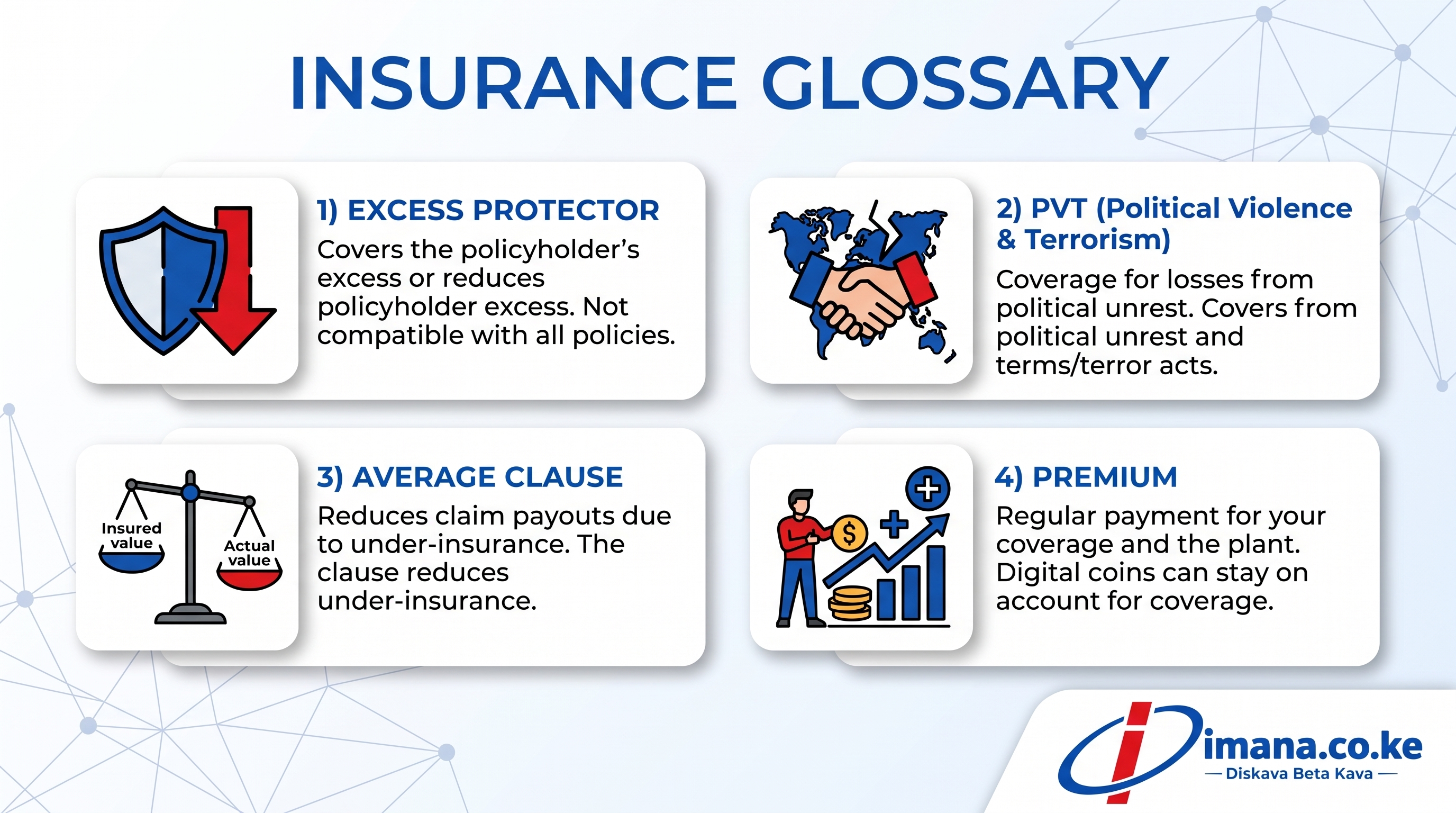
An average clause allows an insurer to reduce a property claim proportionately when the property was insured for less than its correct value at the time of loss.
Suppose business equipment worth KSh 10 million is insured for only KSh 5 million. The business has insured roughly half the value. If covered damage costs KSh 2 million, the insurer may apply the policy’s average formula and treat only a proportion of that loss as payable, before any excess and other conditions.
The usual idea is:
Claim payable before excess = sum insured ÷ value at risk × covered loss
The exact calculation depends on the policy wording. Review asset values and declared sums insured regularly, especially after buying equipment, adding stock or experiencing price inflation.
Explore Business Insurance when reviewing property, stock and interruption risks.
Business Interruption
Business Interruption Insurance—also called Consequential Loss Insurance—can cover specified financial losses after insured physical damage disrupts normal business operations.
A fire policy may pay to repair damaged premises or replace insured equipment. Business interruption cover addresses the financial consequences during the recovery period, subject to the policy. These may include lost gross profit, continuing fixed costs, rent or reasonable additional expenses incurred to keep the business operating.
It normally requires an insured material-damage event. A decline in sales without insured physical damage is not automatically covered. The selected indemnity period and declared financial figures matter greatly.
Learn more through Corporate Insurance or request a Corporate Insurance quotation.
Claim
A claim is a formal request asking an insurer to respond to a loss, injury, liability or other event that may be covered by a policy.
Making a claim does not automatically guarantee payment. The insurer first checks whether the event occurred during the policy period, falls within the insured cover, satisfies policy conditions and is supported by the required documents.
Report incidents promptly. Preserve evidence, take reasonable steps to prevent further loss and avoid admitting liability without guidance where a third-party claim is involved.
Start or follow up an incident through the Imana Claims Centre.
Co-payment
A co-payment is the part of an eligible cost that the insured person pays directly, commonly under medical insurance.
It may be a fixed amount per outpatient visit, a percentage of a hospital bill or an additional contribution when using certain facilities. For example, a KSh 500 outpatient co-payment means the member contributes KSh 500 for an eligible visit while the insurer handles the covered balance, subject to the policy.
A lower premium can come with a higher co-payment. Compare the cost of using the policy, not only the annual premium.
Read Compare Medical Insurance Quotes in Kenya before choosing a medical plan.
COMESA Yellow Card
The COMESA Yellow Card is a regional third-party motor insurance scheme for motorists travelling across participating countries. It provides third-party legal-liability protection and compensation for medical expenses arising from road accidents caused by visiting motorists, within the applicable scheme and national limits.
It is not a replacement for comprehensive insurance on the insured vehicle. It mainly addresses liability to third parties while travelling across participating borders.
Before departure, confirm that every country on the route participates, the vehicle and travel dates are correct, and the Yellow Card period covers the entire journey.
Explore COMESA Yellow Card Insurance.
Deductible
A deductible is an amount or percentage deducted from an otherwise payable claim. The policyholder bears that portion of the loss.
In Kenyan policies, “deductible” and “excess” are sometimes used interchangeably. The wording may also use a deductible for a specific risk while calling the general contribution an excess.
Always ask whether the deductible is a fixed shilling amount, a percentage, a minimum amount or a combination of these.
Excess
An excess is the first portion of an admissible claim that the policyholder must bear. It discourages very small claims and shares part of the risk with the insured.
For example, if covered repairs cost KSh 150,000 and the applicable excess is KSh 30,000, the insurer may pay KSh 120,000, subject to assessment and all other policy terms.
Motor policies can have different excesses for accidental damage, theft, young or inexperienced drivers, total loss and specific vehicle uses. A cheaper quotation with a much higher excess may cost more after an accident.
Compare excess structures in the Motor Insurance comparison guide.
Excess Protector
Excess Protector is an optional motor-insurance extension designed to protect the policyholder from having to bear a specified own-damage excess after an admissible claim.
It does not necessarily remove every excess. Theft, total loss, young-driver, inexperienced-driver or other compulsory excesses may be excluded depending on the insurer. The schedule and endorsement should identify exactly which excess is protected.
Ask three questions before paying for it: Which excess does it protect? Which events are excluded? Is there a maximum amount or number of claims?
Review available options through Motor Insurance.
Exclusion
An exclusion is a circumstance, event, activity, person, property or type of loss that the policy does not cover.
Common examples may include wear and tear under motor cover, cosmetic treatment under medical cover, known circumstances under Professional Indemnity, or losses caused by an undeclared use of property. Exclusions vary; examples from one policy should never be assumed to apply identically to another.
Read exclusions before buying—not after the claim. If an exclusion creates a serious gap, ask whether an extension or a different policy can address it.
Extension
An extension adds defined protection to the standard policy, usually subject to its own limits, exclusions and premium.
Motor examples include PVT, Excess Protector, windscreen cover and road rescue. Business examples may include flood, riot and strike, deterioration of stock or additional liability protection.
An extension is not unlimited. Check its sublimit, excess, territory, conditions and whether it appears on the final schedule or endorsement.
GPA
GPA means Group Personal Accident insurance. It provides stated benefits when an insured member of a group suffers accidental bodily injury, disability or death, subject to the policy.
GPA is commonly arranged by employers, schools, associations, SACCOs and other groups. Depending on the cover, it may operate beyond the workplace and outside working hours.
GPA is not the same as WIBA. WIBA responds within the statutory framework for work-related injury and occupational disease. GPA is a personal-accident policy whose scope and benefits depend on the contract. Employers often compare the two together to understand where protection overlaps and where gaps remain.
Explore WIBA and employee insurance.
Indemnity
Indemnity is the principle of restoring an insured person or business, as far as money can reasonably do so, to the financial position held immediately before an insured loss—without allowing profit from the claim.
If insured equipment is damaged, settlement may consider repair cost, replacement basis, depreciation, policy limits, underinsurance and salvage. The insured should not receive more than the actual covered financial loss.
Not every insurance benefit is a strict indemnity payment. Life and Personal Accident policies may pay agreed benefits rather than reimbursing a measured financial loss.
Overinsurance
Overinsurance occurs when the sum insured is higher than the actual value of the property or financial interest at risk.
Paying premium on an inflated value does not usually entitle the policyholder to profit after a loss. Under an indemnity policy, settlement is generally linked to the actual covered loss and policy basis.
Overinsurance can therefore mean paying for a limit that cannot be fully used. Update insured values using credible valuations, asset registers and current financial records.
Passenger Liability
Passenger liability is protection against the insured vehicle owner’s or operator’s legal liability for injury or death suffered by passengers, subject to the motor policy and applicable law.
It is especially important for taxis, ride-hailing vehicles, matatus, buses, school vehicles, tour vans and boda bodas carrying passengers. Passenger use, seating capacity and whether passengers pay a fare must be declared correctly.
Private motor cover should not be treated as PSV cover simply because the same vehicle can physically carry passengers. The insured use must match the real operation.
Read about passenger-carrying vehicles on the PSV Insurance page.
Policy Period
The policy period is the time between the stated start date and expiry date during which the policy can respond to covered events.
An accident before cover starts or after it expires is normally outside that period. Some policies also include retroactive dates, discovery periods, waiting periods or reporting requirements that affect when protection applies.
Check the dates and times on the certificate, schedule and receipt immediately after purchase. Do not assume payment automatically backdates cover.
Premium
The premium is the amount charged for insurance cover for a stated period and risk.
It may be calculated using vehicle value, age, occupation, payroll, claims history, medical profile, destination, benefit limit, business activity or other underwriting factors. The final amount may also include applicable taxes, levies, policy charges and optional extensions.
The cheapest premium is not automatically the best quotation. Compare the insurer, limits, excesses, exclusions, benefits, service and claims requirements on the same declared risk.
Start comparing at www.imana.co.ke.
Professional Indemnity
Professional Indemnity Insurance protects a professional or firm against covered claims alleging that an error, omission, negligence or breach of professional duty caused a client financial loss.
It may cover defence costs, damages or settlements, subject to the limit, excess, exclusions, retroactive date, notification requirements and policy wording. It is relevant to consultants, accountants, lawyers, engineers, architects, doctors, IT specialists and other professionals whose advice or services can create financial consequences.
It does not guarantee that every complaint or contractual dispute will be covered.
Explore Professional Indemnity Insurance.
Public Liability
Public Liability Insurance protects a business against covered legal liability for accidental bodily injury to members of the public or accidental damage to third-party property arising from its operations.
Examples include a visitor slipping at business premises or an employee accidentally damaging a client’s property while performing covered work. The claimant must generally be a third party, and the event must fall within the insured activity, territory and policy period.
It is different from Professional Indemnity, which focuses on claims arising from professional advice or services, and from WIBA, which concerns employees injured in the course of work.
Explore Business Insurance.
PVT
PVT means Political Violence and Terrorism cover. In motor and property insurance, it is commonly offered as an optional extension for insured damage caused by specified politically motivated violence or terrorism-related events.
Standard policies may exclude some or all of these perils unless the extension is purchased. PVT wording, territory, excess, exclusions and limits vary between insurers. It should not automatically be assumed to include every riot, strike, civil commotion or politically connected incident.
Confirm that PVT appears on the quotation and final schedule if it is required.
Compare motor extensions through Car Insurance.
Reinstatement
Reinstatement can mean either restoring damaged property or restoring insurance protection after it has been reduced, exhausted, cancelled or interrupted. The intended meaning depends on the policy.
Under property insurance, a reinstatement basis may fund repair or replacement with new property of a similar kind, subject to conditions. Under liability insurance, reinstatement of limit may restore an aggregate limit after a claim, sometimes for an additional premium. Under a cancelled or lapsed policy, reinstatement may mean bringing cover back into force after required action.
Never assume reinstatement is automatic. Check the schedule, endorsement and insurer confirmation.
Salvage
Salvage is the remaining value of insured property after a loss.
After settling a total-loss motor claim, the insurer may take ownership of the damaged vehicle or wreck, depending on the settlement terms. If the insured keeps the salvage, its assessed value may be deducted from the settlement.
Do not sell, strip, repair or dispose of damaged insured property before the insurer or appointed assessor gives direction. Doing so can compromise assessment and recovery rights.
Use the Imana Claims Centre when reporting a loss.
Sublimit
A sublimit is a smaller limit applying to one benefit, peril, item or expense within the policy’s wider limit.
A medical plan may have a large overall inpatient limit but a lower maternity, dental, optical, chronic-condition or organ-transplant sublimit. A property policy may place a separate cap on debris removal, professional fees or temporary relocation.
The headline sum insured can therefore look generous while the benefit most likely to be used has a much smaller ceiling.
Compare limits and sublimits through Health and Medical Insurance.
Sum Insured
The sum insured is the maximum value or limit selected for an insured asset, benefit or interest, subject to the policy.
For a vehicle or building, it may represent the declared insured value. In medical insurance, it may be an annual inpatient or outpatient limit. Under liability insurance, the related term may be “limit of indemnity.”
The sum insured is not an automatic payout. Settlement depends on the actual covered loss, policy basis, sublimits, excesses, underinsurance and other terms.
Total Loss
A total loss occurs when insured property is destroyed, stolen and not recovered, or damaged so severely that repair is impossible or uneconomic under the insurer’s assessment and policy rules.
In motor insurance, a vehicle may be treated as a constructive total loss when the assessed repair economics cross the insurer’s applicable threshold. Settlement may consider the insured value, pre-loss market value, excess, outstanding finance, salvage and policy wording.
A damaged vehicle is not a total loss merely because the owner prefers replacement. The insurer’s assessment process determines the treatment of an admissible claim.
Learn more through the Motor Insurance page.
Underinsurance
Underinsurance occurs when the declared sum insured is lower than the correct value at risk.
It can leave the policyholder funding part of a loss. Where an average clause applies, even a partial claim may be reduced in proportion to the underinsurance.
Common causes include outdated valuations, rising construction costs, unrecorded equipment purchases, underestimated stock and failure to include taxes or professional costs where required. Review insured values at renewal and after material changes.
Underwriting
Underwriting is the insurer’s process of evaluating a risk and deciding whether to accept it, on what terms and at what premium.
An underwriter may consider age, use, location, occupation, claims history, health information, security, asset value, payroll, business activity and requested limits. The outcome may be acceptance, revised terms, a higher excess, exclusions, additional information requirements, postponement or decline.
An intermediary can help present and compare the risk, but the insurer makes the underwriting decision.
Waiting Period
A waiting period is a stated period after cover begins during which specified benefits or conditions are not yet covered.
Waiting periods are common in medical insurance for maternity, pre-existing conditions, chronic conditions or certain procedures. A person may hold an active policy but still be within a waiting period for a particular benefit.
Ask when each waiting period starts, which benefits it affects, whether previous continuous cover can be considered and what evidence is required.
Read Medical Insurance Waiting Periods Explained.
WIBA
WIBA refers to Kenya’s Work Injury Benefits Act and the insurance arranged by employers for statutory liability arising from work-related injury, occupational disease, disability or death.
Section 7 of the Work Injury Benefits Act requires every employer to obtain and maintain an insurance policy with an approved insurer for liability the employer may incur under the Act, subject to the law’s terms and exceptions.
WIBA quotations are commonly influenced by annual payroll and employee occupations. Office staff, drivers, security guards, hospitality workers, factory employees and construction workers do not present the same occupational exposure.
WIBA should not be confused with GPA. WIBA follows the statutory employment-injury framework; GPA provides contracted accidental-injury benefits for an insured group.
Explore WIBA Insurance or request a Corporate quotation.
Frequently Asked Questions
Is an insurance excess the same as a deductible?
The terms are often used similarly, but a policy may define and apply them differently. Treat the wording and schedule as the final guide.
Is the premium the amount paid after a claim?
No. The premium is the price charged for cover. The claim settlement is the amount the insurer determines is payable after applying the policy terms.
Is the sum insured guaranteed to be paid?
No. It is a maximum selected value or limit, not an automatic payout. The payable amount depends on the type and size of the covered loss and applicable policy conditions.
Does comprehensive motor insurance cover everything?
No. “Comprehensive” is broader than Third Party Only, but it still has exclusions, excesses, conditions and limits. Optional extensions may be needed.
Does Excess Protector remove every motor excess?
Not necessarily. It protects only the excess described by the endorsement. Confirm whether theft, total loss, young-driver or other excesses remain payable.
Are WIBA and GPA the same?
No. WIBA concerns statutory work-related injury obligations. GPA is a Group Personal Accident policy whose insured events, territorial scope and benefits are defined by the contract.
Does a COMESA Yellow Card insure damage to my own car?
The scheme is principally regional third-party motor cover. Own-vehicle damage requires the appropriate underlying motor cover and any relevant territorial extension.
Who decides whether a claim is payable?
The insurer assesses the claim against the policy. An insurance intermediary can help with documentation, communication and follow-up but does not replace the insurer’s claims decision.
Sources and Further Reading
- Work Injury Benefits Act, Kenya Law
- COMESA Yellow Card scheme overview
- Imana Insurance products and quotations
- MyKava online insurance services
Understand the Words Before You Buy the Promise
Insurance is easier to compare when the language stops being a wall. Ask what each limit covers, which excess applies, what is excluded and who carries the risk. If a term remains unclear, request the explanation in writing before paying.
Imana Insurance Agency Kenya Ltd
4th Floor, Krishna Centre, Woodvale Grove, Westlands, Nairobi
Call/WhatsApp: +254 796 209 402
www.imana.co.ke | www.mykava.co.ke
Disclaimer: This glossary provides general educational information and does not replace legislation, a quotation, policy schedule, endorsement or policy wording. Definitions and cover can vary between insurers and products. Obtain current written terms and professional guidance before purchasing insurance or making a claim.