
Blog Details
Diskava. Beta. Kava
05Aug
International Medical Insurance in Kenya Explained
Compare international medical insurance in Kenya for expatriates, families, professionals and students. Explore worldwide inpatient, outpatient, evacuation and emergency benefits.
International Medical Insurance in Kenya: Who Needs Global Health Cover?
International medical insurance in Kenya provides longer-term healthcare protection for people who live, work, study or regularly spend time in more than one country.
Unlike ordinary travel insurance, which mainly responds to unexpected emergencies during a temporary trip, international medical insurance can provide broader and continuing healthcare benefits. Depending on the chosen plan, these may include inpatient treatment, outpatient consultations, specialist care, maternity, chronic-condition management, evacuation, dental care and worldwide hospital access.
It may be suitable for expatriates living in Kenya, Kenyan professionals working abroad, international students, diplomats, multinational-company employees, frequent travellers and families whose lives cross national borders.
Imana Insurance Agency Kenya Ltd helps clients compare international medical insurance options, while MyKava Travel & Insurance assists with flights, accommodation, airport transfers and other travel arrangements.
What Is International Medical Insurance?
International medical insurance—sometimes called international private medical insurance, global health insurance or worldwide medical insurance—is designed to provide healthcare protection across selected countries or regions.
The policy may remain active throughout a 12-month insurance period rather than covering only one journey.
Depending on the insurer and selected plan, it may provide access to:
- Private hospitals
- General practitioners
- Medical specialists
- Diagnostic services
- Surgery and hospitalisation
- Prescription medication
- Cancer treatment
- Chronic-condition management
- Maternity services
- Mental-health treatment
- Dental and optical care
- Emergency evacuation
- Medical repatriation
The actual benefits depend on the selected policy, geographical area, underwriting terms and benefit limits.
Who Needs International Medical Insurance in Kenya?
International medical insurance may be suitable for people whose healthcare needs extend beyond one country.
Expatriates living in Kenya
An expatriate working, investing or living in Kenya may require access to private hospitals locally, while maintaining medical protection when visiting their home country or travelling elsewhere.
Kenyans working abroad
Kenyan professionals posted overseas may need a policy that remains valid in their country of assignment and during visits home.
International students
Students studying abroad may require access to healthcare throughout the academic year rather than emergency-only travel protection.
Multinational-company employees
Companies with staff working in several countries may arrange international medical insurance as part of their employee-benefits programme.
Diplomats and employees of international organisations
Diplomatic personnel and international-organisation employees often need regional or worldwide medical access that follows them between assignments.
Frequent business travellers
A person who spends substantial time outside Kenya may find ordinary single-trip policies too limited for their longer-term healthcare requirements.
Families living across different countries
A family may have one parent working abroad, children studying overseas and other dependants living in Kenya. An international plan can potentially place eligible members under one coordinated programme.
Remote workers and digital professionals
Professionals who move between countries may need portable healthcare protection that is not tied to one domestic medical network.
What Does International Medical Insurance Cover?
Benefits differ among insurers. A comprehensive plan may include the following.
1. Inpatient medical treatment
Inpatient cover applies when the insured person is admitted to hospital.
It may cover eligible expenses such as:
- Hospital accommodation
- Intensive-care treatment
- Theatre fees
- Surgery
- Specialist fees
- Diagnostic tests
- Nursing care
- Prescription medication
- Cancer treatment
- Organ-transplant treatment, where included
- Rehabilitation after hospitalisation
Check whether the plan provides full cover, a stated annual limit or specific limits for individual treatments.
2. Outpatient medical treatment
Outpatient cover applies when treatment does not require hospital admission.
It may include:
- General-practitioner consultations
- Specialist consultations
- Laboratory tests
- X-rays and scans
- Prescription drugs
- Physiotherapy
- Minor procedures
- Follow-up appointments
- Chronic-condition monitoring
Some policies include outpatient care automatically, while others offer it as an optional benefit.
3. Emergency medical treatment
International medical plans generally include eligible emergency treatment arising from sudden illness or accidental injury.
The insured person should contact the insurer or assistance provider promptly, especially when hospital admission, surgery or expensive treatment is expected.
4. Cancer treatment
Depending on the selected plan, cancer benefits may include:
- Diagnostic investigations
- Specialist consultations
- Chemotherapy
- Radiotherapy
- Surgery
- Approved medication
- Follow-up care
Review whether cancer treatment is covered in full, subject to the overall annual limit or restricted by a separate benefit limit.
5. Chronic-condition management
Some international medical plans cover ongoing treatment for conditions such as:
- Diabetes
- Hypertension
- Asthma
- Thyroid disorders
- Cardiovascular conditions
- Other medically managed illnesses
Pre-existing chronic conditions may be excluded, accepted with restrictions or covered subject to additional underwriting.
Full and accurate disclosure is essential when completing the proposal form.
6. Maternity cover
Maternity may be available as an optional or higher-tier benefit.
Depending on the policy, maternity benefits may include:
- Routine antenatal care
- Diagnostic scans
- Delivery expenses
- Caesarean section
- Pregnancy complications
- Postnatal care
- Newborn care
- Certain congenital conditions
Maternity cover commonly has a waiting period. A person who is already pregnant when applying may not receive cover for that pregnancy.
Confirm the waiting period, benefit limit and newborn-notification requirements before selecting a plan.
7. Dental and optical benefits
Some international plans offer optional dental and optical cover.
Dental benefits may include:
- Routine examinations
- Cleaning
- Fillings
- Extractions
- Emergency dental treatment
- Major restorative procedures, subject to limits
Optical benefits may include:
- Eye examinations
- Prescription lenses
- Frames
- Certain corrective treatments
Routine dental and optical benefits are often subject to annual limits or co-payments.
8. Mental-health treatment
Selected plans may provide benefits for:
- Psychiatric consultations
- Psychological counselling
- Inpatient psychiatric treatment
- Outpatient therapy
- Approved medication
Benefit limits, waiting periods and referral requirements may apply.
9. Medical evacuation
Medical evacuation may be arranged where suitable treatment is not reasonably available at the insured person’s location.
The assistance provider may coordinate transport to the nearest appropriate medical facility. The decision is usually based on medical necessity, not personal preference.
WHO guidance describes medical evacuation as a coordinated medical and logistical process requiring clinical oversight and appropriate patient movement. (World Health Organization)
Never independently arrange an expensive evacuation unless immediate circumstances leave no reasonable alternative. Contact the insurer’s emergency-assistance team first whenever possible.
10. Medical repatriation
Medical repatriation may involve returning the insured person to their home country for continued treatment when medically necessary and approved under the policy.
Some plans may also include repatriation-related services following death, subject to policy terms.
11. Preventive and wellness benefits
Higher-level plans may include selected preventive services such as:
- Routine health screening
- Vaccinations
- Wellness checks
- Cancer screening
- Child immunisation
- Annual medical examinations
These benefits may be subject to age limits, waiting periods or specified schedules.
International Medical Insurance vs Local Medical Insurance
Local and international medical insurance are not interchangeable.
Local medical insurance
A local medical policy is mainly designed to provide treatment within Kenya or a specified East African network.
It may be appropriate for a person who:
- Lives primarily in Kenya
- Rarely travels abroad
- Uses Kenyan medical providers
- Does not require worldwide treatment
- Wants a more affordable domestic solution
International medical insurance
An international plan is designed for people who need treatment across several countries or regions.
It may be more appropriate for a person who:
- Lives or works abroad
- Relocates regularly
- Has dependants in different countries
- Requires worldwide hospital access
- Wants continuity of cover between countries
- Needs evacuation or repatriation benefits
International medical insurance generally costs more because it may provide wider geographical access and higher benefit limits.
International Medical Insurance vs Travel Insurance
The difference is mainly purpose, duration and depth of cover.
Travel insurance
Travel insurance is generally intended for temporary journeys.
It may cover:
- Emergency medical expenses
- Trip cancellation
- Flight delays
- Lost luggage
- Emergency evacuation
- Repatriation
- Loss of passport
- Personal liability
It does not normally provide comprehensive, ongoing healthcare for a person living abroad.
International medical insurance
International medical insurance is generally designed for longer-term healthcare.
It may cover:
- Routine consultations
- Hospitalisation
- Specialist treatment
- Chronic conditions
- Cancer treatment
- Maternity
- Dental and optical services
- Preventive care
- Evacuation
- Ongoing treatment across countries
A two-week holidaymaker may need travel insurance. A professional relocating overseas for two years is more likely to need international medical insurance.
Areas of International Medical Cover
International medical plans are normally issued according to a selected geographical area.
Common options may include:
- Kenya only
- East Africa
- Africa
- Worldwide excluding the United States
- Worldwide including the United States
The exact classifications vary by insurer.
Worldwide cover including the United States may attract a higher premium because of healthcare costs within that market.
Choose the geographical area based on where you:
- Normally live
- Work
- Study
- Travel regularly
- Intend to receive treatment
Do not select a cheaper region that excludes the country in which you are likely to need healthcare.
International Medical Insurance for Expatriates in Kenya
Expatriates in Nairobi, Westlands, Gigiri, Runda, Muthaiga, Rosslyn, Kitisuru, Lavington and other parts of Kenya may require medical cover that provides both local and international access.
An expatriate plan may offer:
- Access to private hospitals in Kenya
- Treatment during travel outside Kenya
- Direct billing within approved networks
- Emergency evacuation
- Home-country treatment
- Family cover
- Maternity benefits
- Chronic-condition management
- Dental and optical options
Before buying, establish whether treatment in the insured person’s home country is included or excluded.
Someone whose home country is within the United States may require a different geographical option from a person whose home country is in Europe, Asia or elsewhere in Africa.
International Medical Insurance for Kenyans Living Abroad
Kenyans who relocate for work, study or family reasons may need protection that remains valid beyond the limited duration of normal travel insurance.
Important considerations include:
- The country of residence
- Visa or employer requirements
- Access to public healthcare
- Local private-hospital costs
- Home-country cover in Kenya
- Emergency evacuation
- Medical repatriation
- Pre-existing conditions
- Family dependants
- Length of assignment
Students should also check whether their university requires a specific minimum level of medical cover.
Individual, Family and Corporate International Medical Plans
Individual plans
An individual policy may suit one professional, student, expatriate or frequent international traveller.
Family plans
A family plan may insure eligible spouses and children under one policy.
Confirm:
- Maximum entry ages
- Dependant eligibility
- Newborn inclusion
- Student-dependant age limits
- Maternity waiting periods
- Family deductibles
Corporate plans
A company can arrange international medical insurance for employees working in Kenya or across several countries.
Corporate arrangements may support:
- Staff recruitment and retention
- Employee mobility
- Regional assignments
- Executive benefits
- Dependants’ medical protection
- Centralised administration
- Consistent benefits across offices
The insurer may apply different underwriting terms depending on the size and composition of the group.
How International Medical Insurance Claims Work
Claims may be handled through direct billing or reimbursement.
Direct billing
With direct billing, an approved hospital or medical provider seeks payment from the insurer or administrator.
Pre-authorisation may be required for:
- Hospital admission
- Surgery
- Advanced scans
- Maternity treatment
- Cancer treatment
- Evacuation
- High-cost procedures
Reimbursement
Where direct billing is unavailable, the insured person may pay for treatment and apply for reimbursement.
Documents may include:
- Completed claim form
- Medical report
- Itemised invoice
- Prescription
- Proof of payment
- Laboratory results
- Referral letter
- Bank details
- Identification documents
Keep original or approved electronic records and submit claims within the policy’s specified period.
What Is Usually Excluded?
International medical insurance does not cover every treatment.
Common exclusions may include:
- Undeclared pre-existing conditions
- Treatment during a waiting period
- Experimental or unproven treatment
- Non-medically necessary procedures
- Cosmetic treatment
- Self-requested treatment without medical indication
- Fertility treatment unless specifically included
- Routine dental or optical care where not selected
- Treatment outside the covered region
- Services exceeding policy limits
- Treatment from unauthorised providers
- Claims arising from deliberate or unlawful acts
- Non-prescribed medication
- Preventive treatment not included in the plan
Exclusions differ among insurers. The policy wording takes precedence over general marketing information.
How Much Does International Medical Insurance Cost in Kenya?
There is no universal price.
Premiums may depend on:
- Age
- Country of residence
- Nationality or home-country arrangements
- Geographical area
- Annual benefit limit
- Inpatient and outpatient benefits
- Maternity cover
- Dental and optical benefits
- Deductible or excess
- Pre-existing medical conditions
- Number of family members
- Medical-provider network
- Worldwide cover with or without the United States
- Individual or corporate membership
A policy with a higher deductible may have a lower premium, but the member will pay more before certain benefits respond.
Compare both the price and the practical value of the benefits.
What Is a Deductible, Excess or Co-Payment?
These terms describe portions of medical expenses that may be payable by the insured person.
Deductible
A deductible is the amount the member must pay before the policy begins paying eligible claims, subject to the plan structure.
Excess
An excess is an amount deducted from an eligible claim.
Co-payment
A co-payment requires the member to contribute a stated percentage or fixed amount toward treatment.
A cheaper policy with a substantial deductible may not be the best option for someone who expects frequent outpatient treatment.
Pre-Existing Conditions and Medical Underwriting
A pre-existing condition is generally a medical condition, symptom or treatment history that existed before the policy started, according to the insurer’s definition.
The insurer may:
- Cover the condition
- Exclude it
- Apply a waiting period
- Charge an additional premium
- Set a special limit
- Request medical reports
- Decline the application
Never omit important medical information to obtain a lower premium. Non-disclosure may affect future claims or policy validity.
How to Compare International Medical Insurance Plans
Do not compare plans using the annual limit alone.
Review the following:
Geographical area
Confirm that the plan covers the countries where you live, work and travel.
Hospital network
Check whether your preferred hospitals and specialists are within the approved network.
Inpatient limit
Review the overall annual maximum and any treatment-specific limits.
Outpatient benefits
Confirm consultation, diagnostic, prescription and specialist limits.
Pre-existing-condition terms
Understand what is included, excluded or subject to underwriting.
Evacuation and repatriation
Check when these services apply and who authorises them.
Maternity
Review waiting periods, normal-delivery limits, Caesarean-section limits and newborn benefits.
Deductibles and co-payments
Understand what you will pay personally when receiving treatment.
Direct billing
Determine where cashless or direct-settlement services are available.
Renewal terms
Ask whether renewal is guaranteed, reviewable or subject to age and claims conditions.
Emergency assistance
Save the insurer’s international emergency contacts before travelling.
Practical International Medical Insurance Checklist
Before selecting a plan, confirm:
- Countries where you live and work
- Countries you visit frequently
- Required annual medical limit
- Preferred hospitals
- Inpatient benefits
- Outpatient benefits
- Chronic-condition cover
- Pre-existing-condition terms
- Maternity requirements
- Dental and optical needs
- Medical evacuation
- Repatriation
- Deductible or co-payment
- Direct-billing network
- Emergency-assistance contacts
- Renewal conditions
- Family-dependant eligibility
- Policy exclusions
Information Needed for a Quotation
To obtain an international medical insurance quotation, you may be asked to provide:
- Full names
- Dates of birth
- Nationalities
- Country of residence
- Countries where cover is required
- Occupation
- Number of dependants
- Medical history
- Current medication
- Required benefit level
- Preferred deductible
- Maternity requirements
- Expected policy-start date
Corporate clients may also be asked for:
- Employee census
- Dates of birth
- Countries of assignment
- Dependant information
- Current benefits
- Claims history
- Preferred provider network
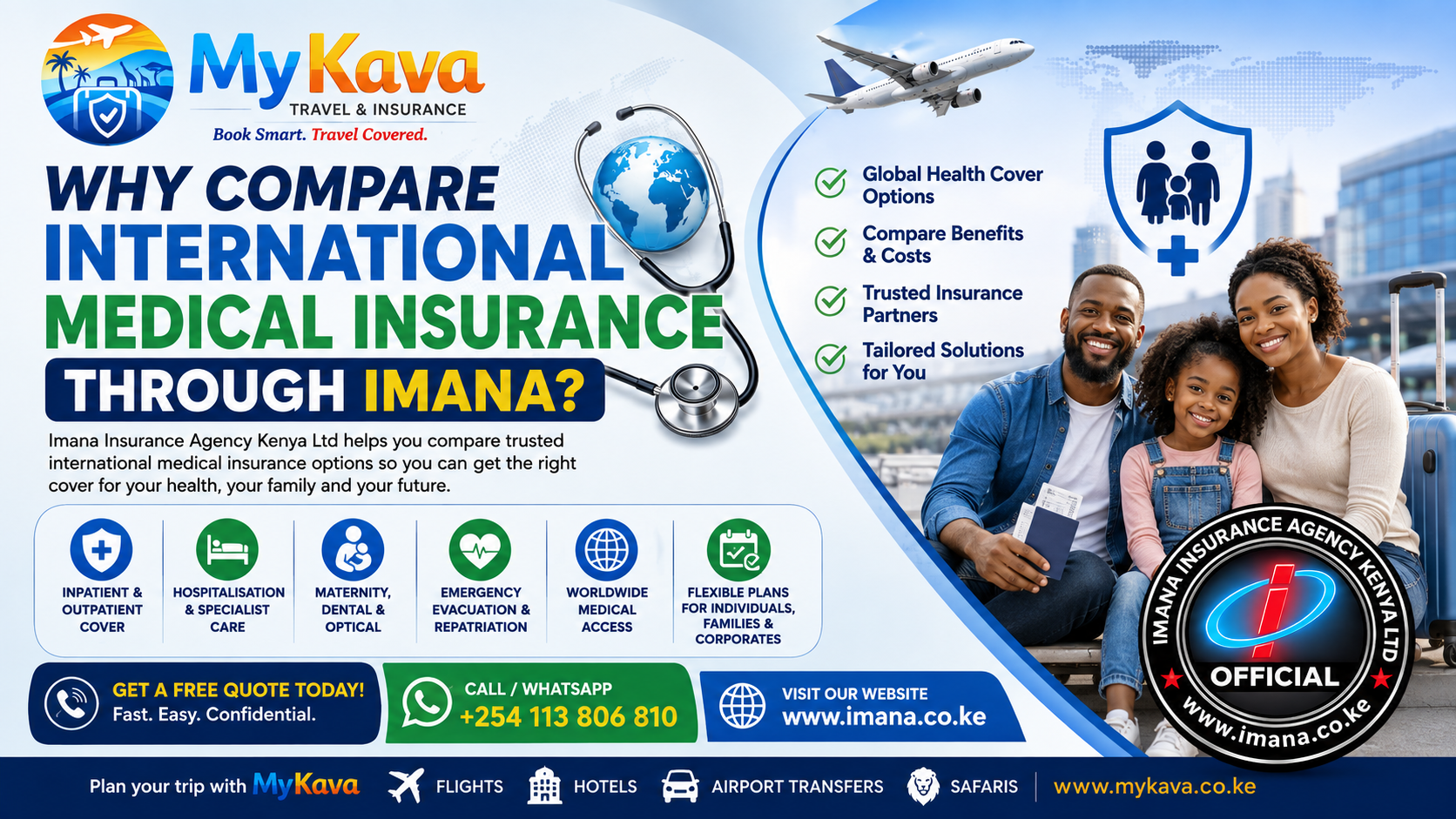
Why Compare International Medical Insurance Through Imana?
The Kenyan insurance industry is regulated by the Insurance Regulatory Authority, which licenses and supervises insurers and insurance intermediaries. (Insurance Regulatory Authority)
Imana Insurance Agency Kenya Ltd can help clients evaluate available international medical insurance options according to:
- Geographical coverage
- Medical limits
- Provider networks
- Evacuation benefits
- Pre-existing-condition terms
- Maternity requirements
- Deductibles
- Family composition
- Budget
The goal is not merely to find the lowest premium. It is to identify a plan that remains useful when actual medical treatment is required.
Get an International Medical Insurance Quote
Share the following with Imana:
- Ages of all applicants
- Country of residence
- Required countries of cover
- Preferred benefits
- Relevant medical history
- Expected policy-start date
Visit Imana Insurance Agency Kenya Ltd or review Imana Travel Insurance for related short-term travel protection.
Planning International Travel? MyKava Can Help
Medical cover protects your health and finances, but a successful international journey also requires proper travel coordination.
MyKava Travel & Insurance can assist with:
- International and local flights
- Hotel accommodation
- Airport transfers
- Local safari arrangements
- Group travel
- Corporate travel planning
Visit MyKava Travel & Insurance to start planning your journey.
Frequently Asked Questions
Is international medical insurance available in Kenya?
Yes. Eligible individuals, families and organisations can obtain international medical insurance through providers and intermediaries serving the Kenyan market. Availability and underwriting terms differ among insurers.
Is international medical insurance the same as travel insurance?
No. Travel insurance is mainly designed for temporary trips and unexpected travel emergencies. International medical insurance provides broader, longer-term healthcare for people living, working or studying across countries.
Can an expatriate obtain medical insurance in Kenya?
Yes, subject to the insurer’s eligibility, residency, age and underwriting requirements.
Can Kenyans living abroad obtain international medical cover?
Potentially, yes. The quotation will depend on the country of residence, required area of cover and the insurer’s eligibility rules.
Does international medical insurance cover treatment in Kenya?
It can, provided Kenya falls within the selected geographical area and the treatment is eligible under the policy.
Can the policy cover my family?
Family plans may cover eligible spouses and dependent children. Age and dependency rules apply.
Are pre-existing conditions covered?
They may be covered, excluded, restricted or subject to additional premium after underwriting.
Does international medical insurance cover maternity?
Maternity may be available on selected plans, usually subject to a waiting period and benefit limit.
Does it cover medical evacuation?
Many plans include or offer emergency medical evacuation. It must usually be medically necessary and coordinated by the assistance provider.
Can I choose any hospital in the world?
Not automatically. Provider-network rules, geographical restrictions, pre-authorisation requirements and reasonable-and-customary cost limits may apply.
Is outpatient cover compulsory?
No. Some plans allow clients to purchase inpatient-only cover or add outpatient benefits at an additional premium.
How quickly can I receive a quotation?
The timeline depends on the information provided and whether medical underwriting is required. Complete applicant details generally support faster processing.
Plan with MyKava. Protect with Imana.
Planning a local or international journey?
MyKava Travel & Insurance can help you compare flights, arrange hotel accommodation, book airport transfers and plan local safaris.
Imana Insurance Agency Kenya Ltd can help you compare international medical insurance, travel insurance and COMESA Yellow Card Insurance options.
Research → Compare → Book → Insure → Travel
Plan with MyKava. Protect with Imana. Travel covered.
Policy benefits, premiums, geographical limits, provider networks, waiting periods, deductibles and exclusions vary among insurers. This article is general information and does not replace the terms of an issued policy.
Written by Imana Insurance Agency Kenya Ltd in collaboration with MyKava Travel & Insurance.
Reviewed by an insurance professional experienced in medical and travel insurance solutions in Kenya.