
Blog Details
Diskava. Beta. Kava
31Jul
Goods in Transit Insurance in Kenya | Protect Cargo on the Move
Learn how Goods in Transit Insurance in Kenya protects stock, equipment and merchandise against loss or damage while being transported. Compare annual and single-transit cover, limits, exclusions and claims requirements.
What Happens When Goods Are Damaged Before Delivery?
A business may manufacture, purchase or sell valuable goods successfully, only to lose them while they are being transported.
A delivery truck may overturn. Goods may be stolen after a vehicle is forcibly entered. A fire may destroy stock before it reaches the customer. Furniture may be damaged during loading, or machinery may be dropped while being unloaded.
Without suitable insurance, the cargo owner, transporter or logistics company may have to meet the loss from its own funds.
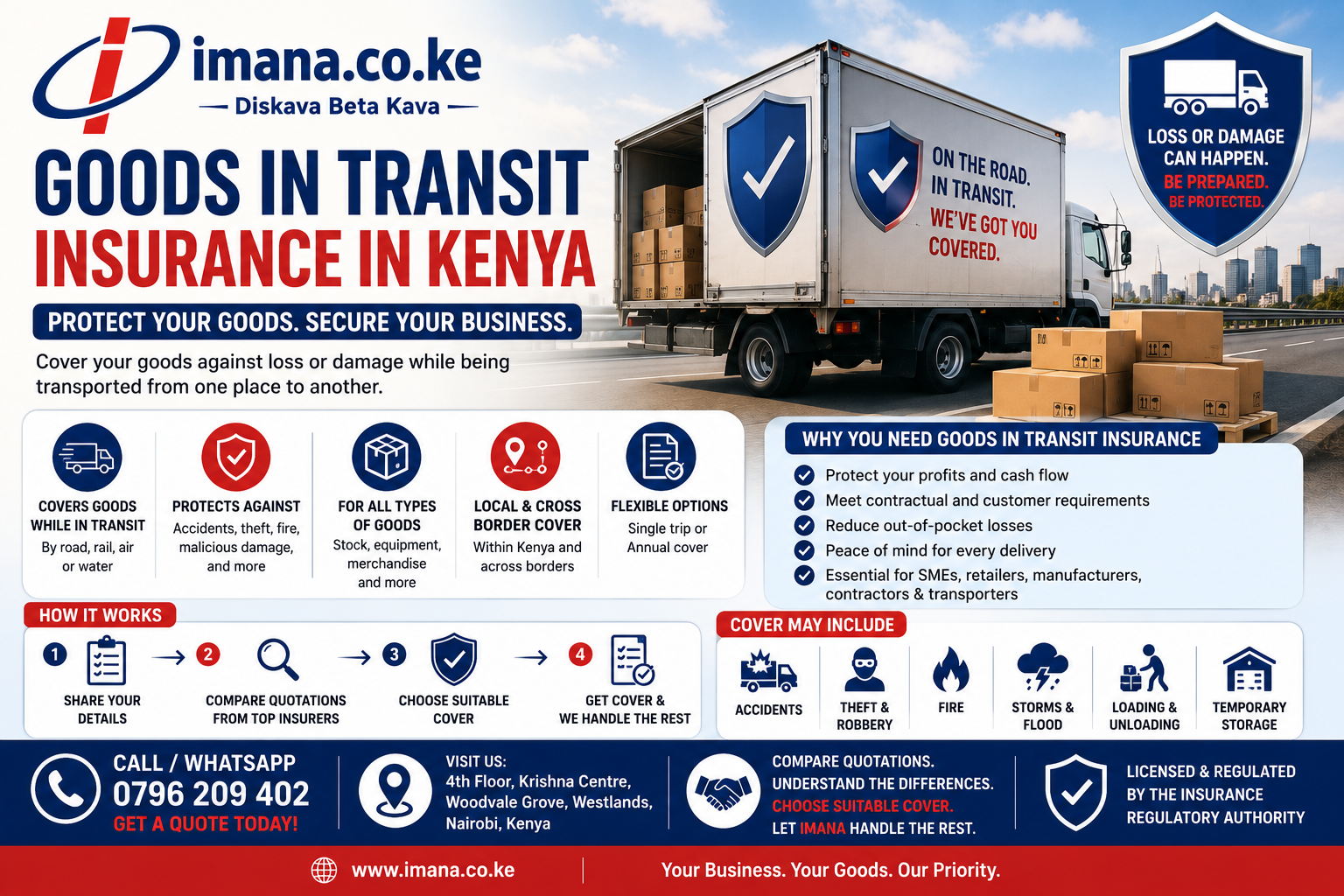
Goods in Transit Insurance, commonly abbreviated as GIT Insurance, protects specified goods against insured accidental loss or damage while they are being transported from one location to another.
Kenya’s Insurance Regulatory Authority publishes a standardised Goods in Transit policy, while Kenyan insurers offer GIT either as a standalone commercial policy or as part of a combined SME insurance package. (ira.go.ke)
Motor insurance protects the vehicle. Goods in Transit Insurance protects the value being carried inside or on it.
What Is Goods in Transit Insurance?
Goods in Transit Insurance is designed to cover specified merchandise, stock, equipment or other property while it is moving between declared locations.
Depending on the policy, cover may apply while goods are:
- Being loaded
- Carried by road, rail, air or inland water
- Temporarily held during an ordinary transit
- Being unloaded
- Delivered to a customer
- Moved between branches
- Transported from a supplier
- Taken to an exhibition or project site
- Returned to the owner
- Carried by the insured’s vehicle or an approved third-party transporter
Kenya’s Insurance Regulations classify transit risks within marine insurance business and recognise that transit may be by sea, inland water, land, air or a combination of these modes. (Kenya Law)
The precise starting and ending points must be confirmed in the policy.
Cover should not be assumed to continue indefinitely after goods arrive at a warehouse, shop, construction site or customer’s premises.
Why Businesses Need Goods in Transit Insurance
Many businesses focus on protecting their premises but overlook the period when goods leave that secure location.
During transport, a business may have less control over:
- Driving standards
- Road conditions
- Weather
- Vehicle security
- Loading and unloading
- Temporary stops
- Overnight parking
- Handling by subcontractors
- Storage at depots
- Theft exposure
The financial loss may affect more than the cargo itself.
A failed delivery can also result in:
- Customer refunds
- Lost sales
- Delayed projects
- Replacement costs
- Contractual disputes
- Damage to business reputation
- Emergency transport expenses
- Production delays
Goods in Transit Insurance provides physical-loss protection under the selected policy. It does not necessarily cover every indirect financial consequence unless the relevant extension is included.
Who Needs Goods in Transit Insurance?
GIT Insurance may be useful for any person or organisation regularly moving valuable goods.
Retailers and wholesalers
Shops and wholesalers may move stock:
- From suppliers
- Between branches
- To customers
- From warehouses
- To temporary sales locations
Manufacturers
Manufacturers may transport:
- Raw materials
- Components
- Packaging
- Finished products
- Machinery parts
Transport and logistics companies
Transporters carry goods belonging to customers and may face liability when cargo is lost or damaged while in their custody.
E-commerce businesses
Online sellers depend on delivery services to move products to customers.
Construction companies
Contractors regularly transport:
- Building materials
- Tools
- Generators
- Equipment
- Fixtures and fittings
- Project supplies
Furniture and appliance businesses
Furniture, refrigerators, televisions and other appliances can be damaged during handling or road transit.
Agricultural businesses
Farmers, cooperatives and distributors transport:
- Produce
- Seeds
- Fertiliser
- Farm inputs
- Packaged food
- Livestock products
Perishable goods may require specialised cover because ordinary deterioration or delay is commonly excluded.
Pharmacies, clinics and medical suppliers
Healthcare businesses may move:
- Medicines
- Laboratory supplies
- Medical equipment
- Temperature-sensitive products
These risks may require cold-chain and temperature-variation extensions.
Courier and delivery businesses
Courier companies may handle many consignments belonging to different customers, requiring clear per-package and per-vehicle limits.
What Goods Can Be Insured?
Subject to the insurer’s acceptance, GIT Insurance may cover:
- Retail stock
- Electronics
- Furniture
- Household appliances
- Construction materials
- Machinery
- Spare parts
- Office equipment
- Agricultural products
- Packaged foods
- Clothing
- Medical equipment
- Commercial documents
- Customer goods
- Exhibition materials
- Tools and equipment
Certain goods require special underwriting or may be excluded.
These can include:
- Cash
- Precious metals
- Jewellery
- Artwork
- Livestock
- Explosives
- Hazardous chemicals
- Temperature-sensitive goods
- Frozen products
- Fragile glass
- Mobile phones
- Tobacco products
- Alcohol
- Used household goods
- Documents with no identifiable replacement value
The full cargo description should be disclosed before the policy is issued.
What Does Goods in Transit Insurance Cover?
The cover varies between insurers, but a GIT policy may respond to sudden and accidental physical loss or damage caused by insured events.
1. Road Accidents
Goods may be damaged following:
- Collision
- Overturning
- Vehicle impact
- Vehicle falling from a bridge
- Accidental departure from the road
The vehicle itself requires appropriate Motor Insurance. The cargo requires GIT protection.
2. Fire
A vehicle fire can destroy both the vehicle and the goods.
The cause may include:
- Collision
- Electrical faults
- Fuel leakage
- Fire spreading from another source
- Accidental ignition
Cargo-fire protection remains subject to the policy’s exclusions and safety conditions.
3. Theft Following an Insured Event
The policy may cover theft under defined circumstances, such as:
- Theft following forcible entry
- Robbery
- Hijacking
- Theft after a vehicle accident
- Theft from an approved storage location during ordinary transit
Ordinary disappearance or unexplained shortages may not qualify.
4. Loading and Unloading Damage
Goods may be dropped, crushed or damaged while being loaded or unloaded.
This exposure should be expressly confirmed because some policies cover the main journey but restrict handling risks.
5. Malicious Damage
Damage deliberately caused by third parties may be covered, subject to the policy wording.
Political violence, riots or terrorism may require a separate extension.
6. Flood, Storm and Other Weather Risks
Goods may be damaged where:
- A vehicle enters floodwater
- Rain enters an inadequately protected load
- A storm overturns a vehicle
- Cargo becomes submerged
Weather-related protection may carry special excesses and packaging requirements.
7. Accidental Damage During Transit
Broader policies may cover accidental physical loss or damage unless excluded.
Restricted policies may cover only listed events.
The customer should confirm whether the quotation is:
- All-risks cover
- Accident-only cover
- Named-peril cover
- Carrier’s liability cover
These options are not identical.
Goods in Transit Insurance vs Carrier’s Liability Insurance
This distinction is extremely important.
Goods in Transit Insurance
GIT Insurance generally protects the owner’s goods against specified physical loss or damage during transit.
The insured party may be:
- The cargo owner
- Manufacturer
- Retailer
- Wholesaler
- Contractor
- Distributor
Carrier’s Liability Insurance
Carrier’s Liability Insurance protects a transporter against eligible legal liability for loss of or damage to customers’ goods while those goods are in the transporter’s custody or control.
Britam describes Carrier’s Liability cover as protection for legal liability arising from accidental loss of or damage to goods in the insured’s custody or control while in transit within the stated policy period and territorial limits.
Why the distinction matters
Suppose a logistics company carries goods worth KSh 5 million.
The cargo owner may arrange GIT Insurance for the full cargo value.
The transporter may arrange Carrier’s Liability Insurance for its legal responsibility under the transport contract.
The transporter’s policy may not automatically compensate the cargo owner for the full value because:
- Liability must be established.
- The transport contract may contain limits.
- An exclusion may apply.
- The transporter may not be legally responsible for the cause.
- The policy limit may be lower than the cargo value.
For valuable shipments, the cargo owner should not rely solely on the transporter’s insurance.
Goods in Transit vs Commercial Motor Insurance
Commercial Motor Insurance covers the insured vehicle and its motor-related third-party liabilities, depending on whether the cover is comprehensive or third party.
It does not ordinarily cover the commercial value of stock carried inside the vehicle.
For example:
- Damaged delivery van: Motor Insurance
- Damaged goods inside the van: Goods in Transit Insurance
- Injury to another motorist: Motor Third-Party section
- Driver injured at work: WIBA or other employee protection
Several policies may respond to different parts of one accident.
Goods in Transit vs Marine Cargo Insurance
Both products protect goods in transit, but they are often used in different contexts.
Goods in Transit Insurance
Commonly used for inland transportation, such as:
- Nairobi to Nakuru
- Mombasa to Nairobi
- Warehouse to customer
- Supplier to shop
- Branch-to-branch deliveries
Marine Cargo Insurance
Often used for international shipments by sea, air, road or multimodal transit.
Kenyan insurance regulations define marine business broadly enough to include transit risks by sea, inland water, land, air or a combination of modes. (Kenya Law)
A shipment imported from China to a warehouse in Nairobi may require Marine Cargo Insurance.
Once the goods are stored and later distributed to customers around Kenya, an annual Goods in Transit policy may be more suitable.
Goods in Transit vs Stock Insurance
Stock insurance protects goods at declared premises against insured risks such as fire, burglary or flood.
Goods in Transit protects them during movement.
A business may need both:
- Stock cover while goods are in the warehouse
- GIT cover when goods leave the warehouse
- Marine cover during international importation
- Business Interruption cover where insured damage stops operations
Types of Goods in Transit Policies
Single-Transit Cover
This protects one specified journey.
It may suit:
- A one-off machinery movement
- Household relocation
- One large customer delivery
- A contractor moving equipment
- An occasional trader
- Special exhibition goods
The policy should state:
- Starting point
- Destination
- Cargo description
- Vehicle or carrier
- Insured value
- Transit date
- Cover conditions
Annual Goods in Transit Cover
An annual policy may suit businesses making frequent deliveries.
The insurer may base the premium on:
- Estimated annual turnover
- Annual value transported
- Maximum value per vehicle
- Number of vehicles
- Type of goods
- Routes
- Claims history
The standardised Kenyan policy contemplates estimated turnover as a premium basis and requires the insured to provide actual figures after the policy period where this basis is used. (ira.go.ke)
Businesses should maintain accurate transit records because the premium may be adjusted after the policy expires.
Own-Goods Cover
This protects goods belonging to the insured business.
Examples include:
- A wholesaler distributing stock
- A retailer transferring goods
- A manufacturer delivering finished products
- A contractor moving materials
Carriers’ Goods Cover
A transporter may arrange protection for customer goods, but the structure must be clear.
The policy may be:
- Direct physical-damage cover
- Carrier’s legal-liability cover
- A combined transporters’ policy
The transporter should not describe customer goods as its own property.
Open or Declaration-Based Cover
Businesses with regular and changing shipments may use a declaration arrangement.
The policyholder declares:
- Each shipment
- Monthly transit values
- Maximum exposure
- Goods categories
- Routes
Failure to declare shipments accurately may affect the policy.
Understanding the Sum Insured
The sum insured should represent the value exposed during transit.
Depending on the policy, this may be based on:
- Invoice value
- Replacement cost
- Manufacturing cost
- Selling price
- Freight and handling costs
- An agreed uplift
- Contract value
The policy may use two important limits.
Maximum Value per Conveyance
This is the most the insurer will consider for goods carried in one vehicle or transport unit.
For example:
- Annual goods transported: KSh 100 million
- Maximum carried in one truck: KSh 5 million
The annual turnover helps calculate the premium, while KSh 5 million may be the maximum amount exposed in a single journey.
Annual Aggregate Limit
Some policies cap the total amount payable during the policy year.
The customer should confirm whether the limit is:
- Per vehicle
- Per journey
- Per occurrence
- Per consignment
- Annual aggregate
These terms should not be treated as interchangeable.
Underinsurance
Underinsurance occurs when the insured value is lower than the actual value at risk.
Suppose a truck carries goods worth KSh 4 million, but the policy declares a maximum load of KSh 2 million.
The insurer may:
- Limit the settlement to KSh 2 million
- Apply an average condition
- Reduce a partial claim proportionately
- Reject the undeclared excess exposure
The business should monitor:
- Increased stock prices
- Inflation
- Exchange rates
- Larger orders
- Peak-season deliveries
- New products
- Additional branches
The maximum load should be reviewed before renewal and whenever the business grows.
What Is an Excess?
An excess is the amount the insured contributes towards an approved claim.
A policy may apply:
- A fixed excess
- A percentage of the loss
- A minimum excess
- A theft excess
- A flood excess
- A fragile-goods excess
- A claims-history excess
For example:
- Approved loss: KSh 500,000
- Excess: KSh 50,000
- Insured contribution: KSh 50,000
- Eligible insurer contribution: KSh 450,000
This simplified example remains subject to the policy conditions.
A quotation with a low premium but a high excess may be difficult for an SME to use.
Loading and Unloading Cover
Loading and unloading are among the most dangerous stages of transit.
Goods may be:
- Dropped from a forklift
- Crushed by other cargo
- Damaged by lifting equipment
- Exposed to rain
- Incorrectly stacked
- Scratched or broken
- Stolen during handling
Before purchasing GIT Insurance, ask:
- When does loading cover begin?
- Does it include manual handling?
- Does it cover cranes and forklifts?
- When does unloading cover end?
- Is damage caused by poor handling excluded?
- Does cover apply at both customer and supplier premises?
A policy may define transit as beginning when goods are lifted for loading and ending when they are unloaded at the final destination. Another may apply narrower terms.
Temporary Storage During Transit
Goods may be temporarily stored at:
- A depot
- A transporter’s warehouse
- A border point
- A distribution centre
- A secure overnight facility
- A customer collection point
Temporary storage may be covered only where it forms part of the ordinary transit.
Ask:
- How many days of storage are permitted?
- Must the storage facility be declared?
- Are fire and burglary covered?
- Are security guards required?
- Does cover continue after the goods are available for collection?
- Does deliberate storage end the transit?
A warehouse delay lasting several weeks may require separate property insurance.
Common Goods in Transit Exclusions
Exclusions differ between insurers, but commonly restricted risks may include:
- Wear and tear
- Gradual deterioration
- Ordinary leakage
- Ordinary loss in weight
- Inherent vice
- Poor packaging
- Delay
- Loss of market
- Mechanical or electrical failure without external damage
- Unexplained disappearance
- Inventory shortages
- Employee dishonesty
- Wilful misconduct
- Fraud
- Illegal goods
- War
- Terrorism
- Political violence unless extended
- Confiscation by authorities
- Nuclear risks
- Temperature variation
- Vermin
- Unattended vehicle theft
- Overloading
- Unroadworthy vehicles
- Undeclared goods
- Transit outside the territorial limits
The policy wording—not the sales summary—determines what is excluded.
What Is Inherent Vice?
Inherent vice refers to the natural tendency of goods to deteriorate or become damaged without an external insured event.
Examples may include:
- Fruit ripening
- Metal rusting naturally
- Liquids evaporating
- Goods spoiling because of their nature
- Poorly cured agricultural produce deteriorating
Ordinary GIT Insurance generally does not compensate for natural deterioration.
Poor Packaging
Goods must be packed appropriately for the journey.
Insurers may expect:
- Strong cartons
- Suitable crates
- Waterproof covering
- Pallets
- Protective padding
- Correct stacking
- Sealed containers
- Appropriate refrigeration
- Load restraints
Where damage results directly from insufficient packaging, the claim may be restricted or declined.
Theft and Unattended Vehicles
Theft protection often contains strict requirements.
A policy may require:
- Vehicle doors to be locked
- Keys to be removed
- Overnight parking in an approved compound
- Tracking systems
- Alarm or immobiliser
- Security escort
- No unattended stops
- Two-person crews for high-value loads
- Prompt police reporting
High-value or theft-attractive cargo may require stronger controls.
These may include:
- Electronics
- Pharmaceuticals
- Mobile devices
- Alcohol
- Tobacco
- Fuel
- Vehicle parts
- Branded consumer goods
The quotation should state these security requirements clearly.
Employee Dishonesty and Collusion
Ordinary GIT Insurance may not cover theft committed or assisted by employees.
A business concerned about dishonest employees may also require:
- Fidelity Guarantee Insurance
- Commercial Crime Insurance
- Strong stock controls
- Driver screening
- Vehicle tracking
- Route monitoring
- Delivery reconciliation
CIC’s GIT-related claim form asks whether employees accompanied the lost property and whether employee involvement is suspected, demonstrating the importance of investigating possible internal involvement. (CIC Kenya)
Perishable and Temperature-Sensitive Goods
Ordinary GIT Insurance may not adequately protect:
- Frozen foods
- Fresh produce
- Vaccines
- Pharmaceuticals
- Flowers
- Dairy products
- Meat
- Chemicals requiring controlled temperatures
These goods may require extensions for:
- Refrigeration breakdown
- Temperature variation
- Deterioration of stock
- Delayed delivery following an insured event
- Cold-storage failure
- Power interruption
The transporter should maintain:
- Temperature logs
- Servicing records
- Backup power
- Vehicle inspection records
- Delivery-time records
Normal spoilage and delay remain commonly excluded unless specifically covered.
How Much Does Goods in Transit Insurance Cost in Kenya?
There is no universal GIT premium.
The cost may depend on:
- Nature of goods
- Annual value transported
- Maximum value per vehicle
- Number of vehicles
- Frequency of deliveries
- Routes
- Distance
- Claims history
- Packaging
- Security
- Theft exposure
- Fragility
- Vehicle ownership
- Use of subcontractors
- Loading and unloading requirements
- Territorial limits
- Policy excess
- Selected extensions
A business transporting office furniture in Nairobi presents a different exposure from one transporting high-value electronics across several counties.
Insurers therefore require detailed information before quoting.
Information Required for a GIT Quotation
Prepare the following information:
Business details
- Registered business name
- KRA PIN
- Nature of operations
- Physical address
- Claims history
- Existing insurance
Cargo details
- Description of goods
- Ownership
- Packaging
- Average value per load
- Maximum value per load
- Estimated annual turnover
- Fragility
- Temperature requirements
Transit details
- Starting locations
- Destinations
- Main routes
- Distance
- Delivery frequency
- Overnight stops
- Temporary storage
- Loading and unloading process
Vehicle and transporter details
- Vehicle registration numbers
- Vehicle types
- Carrying capacities
- Ownership
- Driver experience
- Tracking systems
- Security arrangements
- Third-party transporter details
Required extensions
- Theft
- Loading and unloading
- Political violence
- Temporary storage
- Refrigeration breakdown
- Hired vehicles
- Cross-border cover
- Carrier’s liability
Accurate information helps insurers quote the actual risk.
How to Reduce Goods-in-Transit Losses
Insurance should work alongside practical risk management.
Use suitable vehicles
The vehicle should match:
- Cargo weight
- Cargo size
- Temperature needs
- Security needs
- Road conditions
Avoid overloading
Overloading increases:
- Accident risk
- Cargo damage
- Tyre failure
- Braking distance
- Vehicle instability
Inspect vehicles
Check:
- Tyres
- Brakes
- Lights
- Suspension
- Doors
- Locks
- Cargo restraints
- Refrigeration systems
Train drivers and loaders
Training should cover:
- Defensive driving
- Cargo handling
- Emergency procedures
- Route security
- Accident reporting
- Theft prevention
Secure the load
Use:
- Straps
- Chains
- Protective padding
- Pallets
- Sealed containers
- Waterproof covers
Plan routes
Consider:
- Road conditions
- Flood-prone areas
- Security hotspots
- Safe stopping points
- Weight restrictions
- Delivery times
Use tracking and communication
Track:
- Vehicle location
- Route deviation
- Unplanned stops
- Delivery confirmation
- Driver communication
Maintain delivery records
Keep:
- Dispatch notes
- Invoices
- Loading records
- Driver handover documents
- Customer delivery notes
- Photographs
- Vehicle records
What to Do After a Transit Accident
1. Protect people first
Confirm that drivers, loaders and other road users are safe.
Obtain emergency assistance where necessary.
2. Prevent further cargo loss
Where safe, protect goods from:
- Rain
- Theft
- Traffic
- Fire
- Additional handling damage
3. Notify the police
Police reporting may be required for:
- Road accidents
- Theft
- Hijacking
- Malicious damage
- Significant cargo loss
4. Notify the insurer or intermediary
Report the incident immediately.
Do not wait until the cargo has been repaired, replaced, sold or disposed of.
5. Photograph the scene
Capture:
- Vehicle position
- Road
- Damage
- Packaging
- Cargo
- Registration numbers
- Weather
- Security seals
6. Preserve evidence
Keep:
- Damaged goods
- Packaging
- Vehicle parts
- CCTV
- Tracking records
- Witness details
7. Do not admit liability
The transporter should not promise compensation or negotiate a settlement without insurer approval.
8. Arrange inspection
The insurer may appoint:
- A loss adjuster
- Surveyor
- Investigator
- Engineer
- Cargo specialist
Documents Required for a Goods in Transit Claim
The insurer may request:
- Claim form
- Policy schedule
- Invoice
- Delivery note
- Dispatch note
- Packing list
- Proof of ownership
- Vehicle details
- Driver details
- Police abstract
- Photographs
- Witness statements
- Repair quotations
- Replacement invoices
- Tracking records
- Transport contract
- Loading records
- Customer complaint
- Recovery details
- Salvage information
CIC’s property-loss claim form for GIT claims asks for the transit route, frequency, maximum amount carried, accompanying employees, property details, replacement cost and salvage or recovered property. (CIC Kenya)
Complete documentation helps establish:
- What was being carried
- Its value
- Where it was going
- How it was damaged
- Whether the loss falls within the policy
Repairable Damage
Where goods can be repaired, the insurer may consider:
- Repair cost
- Transport to the repairer
- Inspection fees
- Parts
- Labour
- Remaining loss in value, where covered
The insurer should approve repairs before they begin, except for reasonable emergency action required to prevent further loss.
Total Loss or Non-Delivery
Where goods are destroyed, stolen or never delivered, the insurer may review:
- Invoice value
- Replacement cost
- Policy valuation basis
- Sum insured
- Excess
- Underinsurance
- Salvage
- Recoveries
- Outstanding premium
- Third-party liability
The insured should cooperate with recovery action against responsible parties.
What Is Subrogation?
After paying an eligible claim, the insurer may acquire the right to recover the loss from the transporter, driver, warehouse operator or other responsible third party.
This is known as subrogation.
A Kenyan court has recognised that subrogation places an insurer that has compensated its insured in a position to pursue recovery from a responsible third party. (Kenya Law)
The policyholder should therefore avoid:
- Releasing the transporter from liability
- Signing a full settlement without insurer approval
- Destroying evidence
- Allowing recovery deadlines to expire
- Failing to issue a written notice of loss
Common Mistakes Businesses Make
Assuming Motor Insurance Covers the Cargo
The vehicle and the goods are separate risks.
Using an Inadequate Maximum Load Limit
One large delivery can exceed the declared limit.
Giving a Vague Cargo Description
“General goods” may not accurately describe high-value electronics, fragile equipment or perishable stock.
Ignoring Loading and Unloading
A significant number of losses happen before the vehicle starts moving or after it arrives.
Using Unapproved Transporters
The policy may restrict subcontracting or require declared carriers.
Failing to Maintain Records
A business must prove the cargo’s ownership, value and intended journey.
Allowing Vehicles to Be Left Unattended
This may breach theft conditions.
Ignoring Temporary Storage
Cover may end where goods are stored beyond the ordinary transit period.
Failing to Declare Increased Turnover
The annual premium and policy limit may be based on declared figures.
Choosing the Cheapest Quotation
A lower premium may involve:
- Lower limits
- Higher excess
- Narrower theft cover
- No loading protection
- Restricted routes
- More security conditions
How to Compare Goods in Transit Quotations
Ensure every insurer receives the same:
- Cargo description
- Annual transit value
- Maximum value per vehicle
- Routes
- Vehicle details
- Packaging
- Security
- Claims history
- Required extensions
Then compare:
- Total premium
- Maximum per conveyance
- Annual aggregate
- Policy excess
- Loading and unloading
- Theft conditions
- Temporary storage
- Fragile-goods protection
- Refrigeration breakdown
- Territorial limits
- Hired vehicles
- Third-party transporters
- Political-violence cover
- Claims requirements
- Exclusions
Kenyan insurers may offer GIT as a standalone product or within an SME package; for example, Britam lists GIT as an optional section in its combined SME solution, while CIC lists Goods in Transit Risks within its general-insurance portfolio. (Britam)
How Imana Helps Businesses Arrange Goods in Transit Insurance
Imana Insurance Agency Kenya Ltd helps cargo owners, SMEs, manufacturers, retailers, contractors and logistics companies compare Goods in Transit quotations from suitable licensed insurers.
The process may include:
- Understanding the goods being transported.
- Establishing annual transit values.
- Identifying the maximum value per vehicle.
- Reviewing routes and security controls.
- Confirming loading and unloading requirements.
- Reviewing use of third-party transporters.
- Selecting suitable limits and extensions.
- Comparing premiums, excesses and exclusions.
- Coordinating policy issuance.
- Providing claim-notification guidance.
Imana can also help coordinate related insurance, including:
- Commercial Motor Insurance
- Carrier’s Liability
- Marine Cargo Insurance
- Fire and Allied Perils
- Stock Insurance
- Business Interruption
- Public Liability
- Fidelity Guarantee
- WIBA
- Contractors All Risks
- Contractors’ Plant and Machinery
Insurance should be placed through licensed insurers and intermediaries. The Insurance Regulatory Authority provides licensing and consumer-protection information and publishes standardised insurance policies. (ira.go.ke)
Goods in Transit Insurance in Nairobi and Across Kenya
Imana Insurance Agency Kenya Ltd
4th Floor, Krishna Centre
Woodvale Grove, Westlands
Nairobi, Kenya
Imana supports businesses transporting goods within:
- Nairobi
- Mombasa
- Kiambu
- Machakos
- Kajiado
- Nakuru
- Kisumu
- Eldoret
- Other areas across Kenya
Website: www.imana.co.ke
Call or WhatsApp: +254 796 209 402
Compare quotations. Understand the transit risks. Choose suitable protection. Let Imana handle the rest.
Frequently Asked Questions
What is Goods in Transit Insurance?
It protects specified goods against insured accidental loss or damage while they are being transported between declared locations.
Does Motor Insurance cover goods inside a vehicle?
Not ordinarily. Motor Insurance protects the vehicle and motor-related liabilities. Goods in Transit Insurance protects the cargo.
Who can buy GIT Insurance?
Cargo owners, retailers, manufacturers, wholesalers, contractors, courier businesses and transporters may purchase suitable transit protection.
Does GIT Insurance cover theft?
It may cover theft under specified circumstances, subject to security requirements and exclusions.
Are goods covered during loading and unloading?
Only where the policy includes or extends protection to those stages.
Can one policy cover all deliveries for a year?
Yes. An annual policy may cover declared transits, subject to the annual turnover and maximum-per-vehicle limits.
What is the maximum value per conveyance?
It is the maximum cargo value the insurer accepts in one vehicle, journey or transport unit.
Does GIT cover third-party transporters?
It may, subject to disclosure, insurer approval and policy conditions.
Does GIT cover goods outside Kenya?
Only where the territorial scope includes the relevant country or a cross-border extension has been arranged.
Are perishable goods covered?
They may require specialised terms for temperature variation, refrigeration breakdown and deterioration.
Does GIT cover delayed delivery?
Delay and loss of market are commonly excluded unless a specific policy provides otherwise.
What is the difference between GIT and Carrier’s Liability?
GIT protects the goods against insured physical loss or damage. Carrier’s Liability protects the transporter against eligible legal liability for customer goods in its custody. (Britam)
What documents are required for a claim?
Common requirements include the policy, invoice, delivery note, dispatch records, police abstract, photographs, vehicle details and repair or replacement quotations.
Can Imana compare GIT quotations?
Yes. Imana can help businesses compare limits, premiums, excesses, transit stages, theft terms and exclusions.
The Bottom Line
Goods are financially exposed from the moment they leave one safe location until they are delivered at the next.
A road accident, fire, theft or loading error can destroy:
- Stock
- Customer trust
- Profit margins
- Delivery schedules
- Business cash flow
Goods in Transit Insurance helps protect the value moving between suppliers, warehouses, branches, project sites and customers.
Before purchasing cover:
- Describe the goods accurately.
- Establish the maximum value per load.
- Declare the correct annual turnover.
- Confirm loading and unloading protection.
- Review theft and security conditions.
- Disclose third-party transporters.
- Understand temporary-storage limits.
- Compare exclusions and excesses.
- Keep complete delivery records.
Your goods do not stop being valuable when they leave the warehouse. Protect them throughout the journey.
Imana Insurance Agency Kenya Ltd
4th Floor, Krishna Centre, Woodvale Grove, Westlands, Nairobi
Call or WhatsApp: +254 796 209 402
Website: www.imana.co.ke
Compare quotations. Protect the journey. Deliver with confidence. Let Imana handle the rest.
Goods in Transit premiums, limits, covered events, transit definitions, security conditions, excesses and exclusions vary between insurers. This article provides general information and does not replace a current quotation, policy schedule or complete policy wording.