
Blog Details
Diskava. Beta. Kava
20Aug
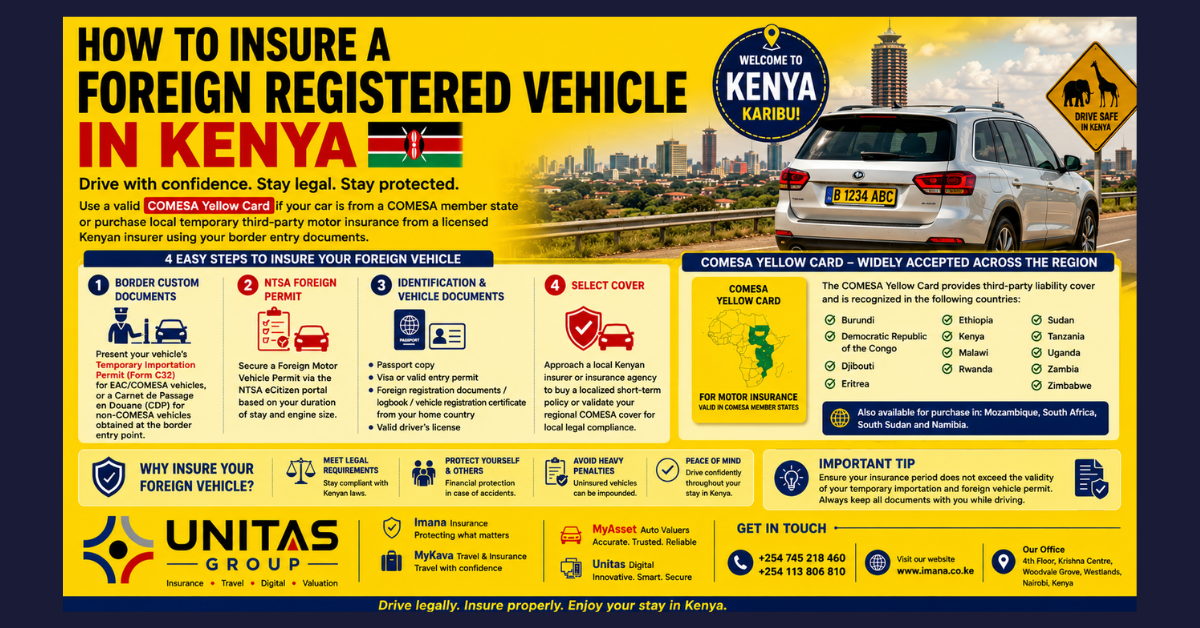
How to Insure a Foreign-Registered Vehicle in Kenya
Learn how to insure a foreign-registered vehicle in Kenya using a COMESA Yellow Card or local temporary motor insurance, including Form C32, Carnet de Passage, foreign vehicle permits, required documents and accepted COMESA Yellow Card countries.
Can You Insure a Foreign-Registered Vehicle in Kenya?
Yes.
A foreign-registered vehicle can be legally operated and insured in Kenya, provided the owner or driver has the correct customs, permit and insurance documentation.
In practice, there are two common insurance routes:
- Use a valid COMESA Yellow Card where applicable.
- Purchase or arrange local temporary motor insurance through a licensed Kenyan insurer or insurance intermediary, subject to underwriting.
Kenya Revenue Authority confirms that operators of foreign-registered vehicles must hold the appropriate temporary importation documentation and must also obtain a Foreign Motor Vehicle Permit. KRA further requires either a Certificate of COMESA Insurance or other valid insurance cover when applying for the foreign permit.
Insurance is only one part of the process. A foreign vehicle also needs lawful temporary importation and permission to operate in Kenya.
Step 1: Obtain the Correct Border Customs Documents
The first requirement is the correct temporary importation documentation.
Form C32
KRA states that Form C32 – Temporary Importation of Motor Vehicles applies to eligible vehicles from:
- East African Community countries
- COMESA countries
- SADC countries
- Countries with relevant bilateral arrangements with EAC Partner States.
For foreign vehicles entering Kenya under the applicable arrangements, Form C32 is normally processed through Customs at the point of entry.
KRA says an applicant may be required to provide:
- Foreign identification
- Foreign Motor Vehicle Registration Book
- Proof of residency or work permit where applicable
- Power of Attorney or authorisation where the person driving is not the registered owner.
What Is a Carnet de Passage en Douane?
For vehicles from countries outside the applicable EAC/COMESA arrangements, KRA may require a valid International Circulation Permit, commonly known as a Carnet de Passage en Douane (CDP), or other accepted customs documentation.
KRA specifically states that vehicles from outside EAC or COMESA may require a valid Carnet de Passage or Pass Sheet issued in the country of origin and valid for use in Kenya.
A Carnet functions as an international customs document allowing temporary importation of a vehicle without normal permanent-import duties being paid immediately.
Step 2: Apply for a Foreign Motor Vehicle Permit
Having a Form C32 or Carnet alone is not enough.
KRA states that an operator of a foreign vehicle must also apply for a Foreign Motor Vehicle Permit.
To apply, the operator may need:
- Valid Form C32 or endorsed Carnet de Passage
- Certificate of COMESA Insurance or other valid insurance cover
- An eCitizen account.
The initial foreign-vehicle permit is normally processed when the vehicle enters Kenya.
How Long Can a Foreign Vehicle Operate in Kenya?
KRA distinguishes between different temporary-entry arrangements.
For vehicles entering with Form C32, a free 14-day temporary permit may be issued at the entry point.
KRA also provides for a paid foreign permit for certain vehicles entering with a Carnet de Passage. Extensions may be considered subject to Customs approval and physical verification of the vehicle.
KRA currently states that extensions may be sought for periods not exceeding 90 days in the relevant circumstances.
Therefore, the insurance period should ordinarily align with the lawful period during which the vehicle is authorised to remain and operate in Kenya.
Step 3: Prepare Your Identification and Vehicle Documents
Before arranging insurance, prepare:
- Passport
- Visa or valid entry permit where applicable
- Foreign vehicle-registration certificate or logbook
- Valid driver's licence
- Form C32 or Carnet de Passage
- Foreign Motor Vehicle Permit
- Power of Attorney where the driver is not the vehicle owner
- Existing foreign insurance certificate
- COMESA Yellow Card where applicable
An insurer or intermediary may request additional information depending on:
- Vehicle type
- Vehicle value
- Country of registration
- Intended use
- Period required
- Driver profile
Step 4: Choose the Correct Insurance
A foreign-registered vehicle should have insurance that is valid for Kenya.
The appropriate option depends on where the vehicle comes from and how long it will remain in the country.
Option 1: COMESA Yellow Card
The COMESA Yellow Card is a regional third-party motor-insurance system recognised across participating countries.
It allows motorists travelling across participating countries to carry one regional third-party liability certificate rather than having to purchase a separate basic third-party policy at every border.
The COMESA Yellow Card is primarily designed for third-party liability.
It should not automatically be treated as Comprehensive Insurance covering damage to your own vehicle.
If you already have Comprehensive Insurance in your home country, confirm whether that insurer has extended the policy territorially to Kenya.
Which Countries Accept the COMESA Yellow Card?
The official COMESA Yellow Card scheme currently lists the following member countries:
- Burundi
- Democratic Republic of the Congo
- Djibouti
- Eritrea
- Ethiopia
- Kenya
- Malawi
- Rwanda
- Sudan
- Tanzania
- Uganda
- Zambia
- Zimbabwe. (COMESA Yellow Card)
The official Yellow Card scheme also states that the card can be purchased in some additional countries, including:
- Mozambique
- South Africa
- South Sudan
- Namibia.
These additional countries should not automatically be described as full Yellow Card Scheme members; the official COMESA page categorises them separately as countries where the Yellow Card can be bought.
Before travelling, always verify the latest participating-country position because regional arrangements can change.
How the COMESA Yellow Card Works
Imagine you drive from Kenya to:
Uganda → Rwanda → Burundi
Instead of purchasing a separate basic third-party insurance policy in every country, a valid Yellow Card can provide recognised third-party protection within participating jurisdictions, subject to the scheme rules.
Similarly, a foreign motorist entering Kenya from a participating country may use a valid COMESA Yellow Card as evidence of regional motor third-party insurance.
KRA expressly recognises a Certificate of COMESA Insurance when processing foreign-vehicle permits.
What Does COMESA Yellow Card Insurance Cover?
The Yellow Card primarily provides protection for liabilities involving third parties.
This can include eligible claims relating to:
- Third-party bodily injury
- Third-party death
- Third-party property damage
subject to the laws and limits of the country where the accident occurs.
It does not ordinarily replace your own Comprehensive vehicle policy.
Option 2: Local Temporary Motor Insurance in Kenya
Where a COMESA Yellow Card is unavailable, unsuitable or not applicable, a foreign motorist may be able to arrange local temporary motor insurance through a licensed Kenyan insurer.
This may be structured on Third Party terms depending on:
- Vehicle category
- Registration country
- Period required
- Insurer appetite
- Border documentation
The insurer will normally require the vehicle to have valid customs and operating documents before issuing cover.
Can I Buy One-Month Insurance for a Foreign Vehicle?
Potentially, yes.
Some insurers may offer short-term Motor Insurance for selected foreign vehicles.
The period might correspond to:
- One month
- Several weeks
- Another approved period
depending on the insurer and lawful vehicle-permit period.
However:
Insurance should not be issued for a period that assumes the vehicle can legally remain in Kenya longer than its customs or foreign permit allows.
The Customs position and insurance period should therefore be reviewed together.
Can a Foreign Vehicle Get Comprehensive Insurance in Kenya?
Possibly, but Comprehensive Insurance can be more complicated than Third Party cover for a foreign-registered vehicle.
An insurer may require:
- Vehicle valuation
- Inspection
- Photographs
- Proof of ownership
- Customs documents
- Confirmation of lawful temporary importation
- Details of the vehicle's current foreign insurance
- Confirmation of how long it will remain in Kenya
Some insurers may not offer Comprehensive terms for every foreign-registered vehicle.
The quotation therefore depends on underwriting.
Foreign Vehicle Comprehensive Insurance vs COMESA Yellow Card
These two should not be confused.
COMESA Yellow Card
Primarily provides regional third-party liability protection.
Comprehensive Motor Insurance
May protect:
- Your own vehicle
- Accidental damage
- Fire
- Theft
- Third-party liability
subject to the policy wording.
A motorist travelling regionally may therefore have:
Comprehensive home-country insurance + territorial extension + COMESA Yellow Card
rather than treating the Yellow Card as a replacement for Comprehensive Insurance.
Can I Use My Foreign Insurance Policy in Kenya?
Possibly, but you should not assume that a policy issued abroad is automatically valid in Kenya.
Check:
- Territorial scope
- Cross-border extensions
- Kenyan legal recognition
- Third-party liability compliance
- Claims procedures
KRA requires evidence of COMESA Insurance or valid insurance cover for the foreign-vehicle permit process.
A local Kenyan insurance intermediary can help determine whether additional local cover is required.
Can a Foreign-Registered Car Be Used for Uber or Bolt in Kenya?
Do not assume that temporary entry plus insurance automatically permits commercial passenger use.
A vehicle lawfully admitted for private temporary use may still face separate:
- Licensing
- PSV
- NTSA
- Tax
- Platform
- Insurance
requirements before being used commercially.
If the vehicle will be used to carry passengers for hire or reward, disclose this before arranging insurance.
A private-use policy should not be relied upon for undeclared commercial passenger activity.
Can a Foreign Vehicle Be Used for Business in Kenya?
This also depends on:
- Customs entry status
- Permit conditions
- Vehicle classification
- Insurance
- Kenyan regulatory requirements
Commercial use should be disclosed to:
- Customs
- NTSA
- Insurer
- Insurance intermediary
where relevant.
Foreign-Registered Motorcycles in Kenya
Foreign motorcycles may also require:
- Temporary importation documents
- Foreign permit
- Valid insurance
- Registration documentation
- Driver or rider licence
A COMESA Yellow Card may be relevant where the motorcycle originates from and travels through participating jurisdictions.
The same basic principle applies:
The vehicle must be both lawfully admitted and properly insured.
Foreign Tour and Safari Vehicles
Foreign tour operators entering Kenya with:
- Safari vehicles
- Tour vans
- Passenger vehicles
should pay particular attention to:
- Temporary importation permits
- Passenger use
- COMESA Yellow Card
- Local transport regulations
- Passenger liability
- Territorial insurance extensions
A tour vehicle carrying passengers presents a different risk from a privately driven foreign car.
Foreign Commercial Trucks and Prime Movers
Cross-border logistics operators frequently move vehicles between:
- Kenya
- Uganda
- Tanzania
- Rwanda
- Burundi
- DRC
- Zambia
- Other regional destinations
The COMESA Yellow Card can be particularly valuable for these operations.
However, trucking businesses should separately consider:
- Commercial Motor Insurance
- Goods in Transit
- Marine Cargo
- Carrier's Liability
- Driver Personal Accident
- Cross-border regulatory requirements
The Yellow Card does not replace these other insurance needs.
What Happens If a Foreign Vehicle Is Involved in an Accident in Kenya?
If an accident occurs:
1. Protect life and property
Check for injuries and obtain emergency assistance where necessary.
2. Report the accident
Follow Kenyan police-reporting requirements.
3. Document the scene
Take photographs of:
- Vehicle positions
- Registration plates
- Damage
- Road conditions
- Third-party property
4. Notify your insurer
If using a COMESA Yellow Card, contact the relevant insurer or national bureau according to the Yellow Card claims procedure.
5. Notify your insurance intermediary
Where the cover was arranged through a Kenyan intermediary, provide:
- Police details
- Accident photographs
- Driver information
- Foreign registration documents
- Insurance certificate
- Temporary permit documents
Do not repair major damage before obtaining the insurer's instructions unless emergency action is necessary to prevent further loss.
What If My COMESA Yellow Card Expires While I Am in Kenya?
Do not continue driving on an expired insurance certificate.
Before expiry:
- Contact your insurer
- Contact your intermediary
- Confirm your foreign-vehicle permit validity
- Arrange appropriate renewal or replacement cover
Your insurance validity should correspond with your lawful permission to operate the vehicle in Kenya.
What If My Form C32 Expires?
KRA says operators may seek extension of Form C32 and the Foreign Motor Vehicle Permit subject to Customs approval and the required physical vehicle verification. (Kenya Revenue Authority)
Do not assume an insurance renewal automatically extends the customs permit.
Insurance and customs authorisation are separate requirements.
Can I Permanently Keep the Foreign Vehicle in Kenya?
Temporary importation is not the same as permanent importation.
If you intend to permanently retain and register the vehicle in Kenya, you may need to comply with:
- Import rules
- Customs duties and taxes
- Vehicle standards
- Registration requirements
- NTSA procedures
Temporary permits should not be treated as a way to indefinitely avoid permanent import requirements.
Common Mistakes Foreign Motorists Make
1. Assuming foreign insurance automatically works in Kenya
Check territorial validity.
2. Arriving without correct customs documents
Form C32 or a valid Carnet may be required.
3. Forgetting the Foreign Motor Vehicle Permit
KRA requires a foreign permit in addition to the temporary import documentation. (Kenya Revenue Authority)
4. Confusing COMESA with Comprehensive Insurance
They are completely different.
5. Letting insurance expire before leaving Kenya
Maintain valid insurance throughout the period of operation.
6. Using the vehicle commercially without disclosure
Vehicle use must be accurately declared.
7. Assuming the insurance period automatically extends the customs stay
It does not.
Documents Checklist for Foreign Vehicle Insurance in Kenya
Prepare:
- Passport or foreign identification
- Visa or lawful immigration status where applicable
- Foreign vehicle-registration certificate
- Valid driver's licence
- Form C32 where applicable
- Carnet de Passage where applicable
- Foreign Motor Vehicle Permit
- COMESA Yellow Card or existing insurance
- Power of Attorney where applicable
- Vehicle photographs or valuation if requested
KRA specifically identifies Form C32/Carnet, COMESA insurance or valid cover, foreign vehicle-registration documents and owner authorisation among the relevant requirements.
Frequently Asked Questions
Can a foreign-registered car be insured in Kenya?
Yes, subject to valid temporary import documentation, foreign-vehicle permitting and insurer underwriting.
Do I need COMESA Yellow Card Insurance?
If the vehicle originates from or travels through participating COMESA Yellow Card jurisdictions, it can provide recognised regional third-party protection.
Is COMESA Yellow Card the same as Comprehensive Insurance?
No.
COMESA refers to a regional third-party insurance scheme.
Comprehensive Insurance is broader own-vehicle protection.
Which countries participate in the COMESA Yellow Card?
The official scheme currently lists Burundi, DRC, Djibouti, Eritrea, Ethiopia, Kenya, Malawi, Rwanda, Sudan, Tanzania, Uganda, Zambia and Zimbabwe as member countries.
Can I buy a COMESA Yellow Card in South Africa?
The official Yellow Card website currently lists South Africa among additional countries where the Yellow Card can be purchased, although it is not listed in the same category as the main member countries.
What is Form C32?
It is Kenya's Temporary Importation of Motor Vehicles form for qualifying foreign vehicles. KRA currently provides an online temporary-import service for foreign-registered vehicles.
What is a Carnet de Passage?
It is an international customs document used for temporary importation of vehicles and may be required for foreign vehicles originating outside applicable EAC/COMESA arrangements.
Do I need an NTSA foreign permit?
A foreign vehicle must have the applicable Foreign Motor Vehicle Permit. KRA states that the application is made through eCitizen after the required customs and insurance documentation is obtained.
How long is the initial temporary permit?
KRA states that vehicles entering with Form C32 may receive a free 14-day temporary permit, subject to the applicable rules and extension process.
Can I insure the vehicle for one month?
Potentially, depending on insurer underwriting and the period for which the vehicle is legally authorised to operate in Kenya.
Can a foreign car get Comprehensive Insurance in Kenya?
It may be possible, subject to vehicle valuation, inspection, documentation and insurer appetite.
How Imana Insurance Agency Kenya Ltd Can Help
If you are bringing a foreign-registered vehicle into Kenya, the insurance process can involve several moving parts:
- Temporary importation
- Foreign Motor Vehicle Permit
- COMESA Yellow Card
- Short-term insurance
- Comprehensive insurance
- Cross-border extensions
- Claims procedures
Imana Insurance Agency Kenya Ltd can help you review the available Motor Insurance options and determine which insurance documents may be appropriate for the vehicle's intended use and duration in Kenya.
Imana Insurance Agency Kenya Ltd
Website:
https://www.imana.co.ke/
Motor Insurance:
https://www.imana.co.ke/insurance/motor-insurance
COMESA Yellow Card:
https://www.imana.co.ke/comesa-insurance
Motor Insurance Quote:
https://www.imana.co.ke/motor-quote
Claims:
https://www.imana.co.ke/claims-request
The Bottom Line
To insure and operate a foreign-registered vehicle in Kenya, think about four separate requirements:
1. Customs entry
Obtain:
- Form C32, or
- Carnet de Passage where applicable.
2. Foreign Vehicle Permit
Apply for the applicable Foreign Motor Vehicle Permit through the required eCitizen process.
3. Insurance
Use:
- Valid COMESA Yellow Card, or
- Other valid insurance accepted for Kenya, including local temporary cover where available.
4. Correct vehicle use
Declare whether the vehicle is:
- Private
- Commercial
- Passenger carrying
- Tour
- Motorcycle
- Heavy commercial
A foreign registration plate does not prevent you from obtaining insurance in Kenya. The key is making sure the customs documents, vehicle permit and insurance all work together.
Author: Raymond Momanyi – Founder & CEO, Imana Insurance Agency Kenya Ltd
Website: https://www.imana.co.ke/
Foreign-vehicle permit rules, customs periods, insurance availability and COMESA Yellow Card participation can change. Verify current KRA, eCitizen and COMESA requirements before entering Kenya or arranging cover.