
Blog Details
Diskava. Beta. Kava
02Aug
Family-Shared vs Per-Person Medical Insurance Benefits in Kenya
Understand the difference between family-shared and per-person medical insurance benefits in Kenya. Compare limits, costs, risks and suitability before choosing family health cover.
Why Benefit Structure Matters in Family Medical Insurance
Two family medical insurance plans can advertise the same overall limit but provide very different levels of protection.
One policy may give every family member an individual limit. Another may place the whole family under one shared benefit pool.
For example, a medical quotation may show:
- KSh 500,000 inpatient benefit per person, or
- KSh 1 million inpatient benefit shared by the entire family
Both options may appear attractive, but they do not work in the same way.
The better structure depends on:
- Number of family members
- Ages of the members
- Existing medical conditions
- Frequency of hospital visits
- Expected maternity needs
- Available budget
- Individual and shared sublimits
- Risk of one member using a large portion of the benefit
The headline limit is only the starting point. You must also establish who can use it, how much each person can access and what happens when the benefit is exhausted.
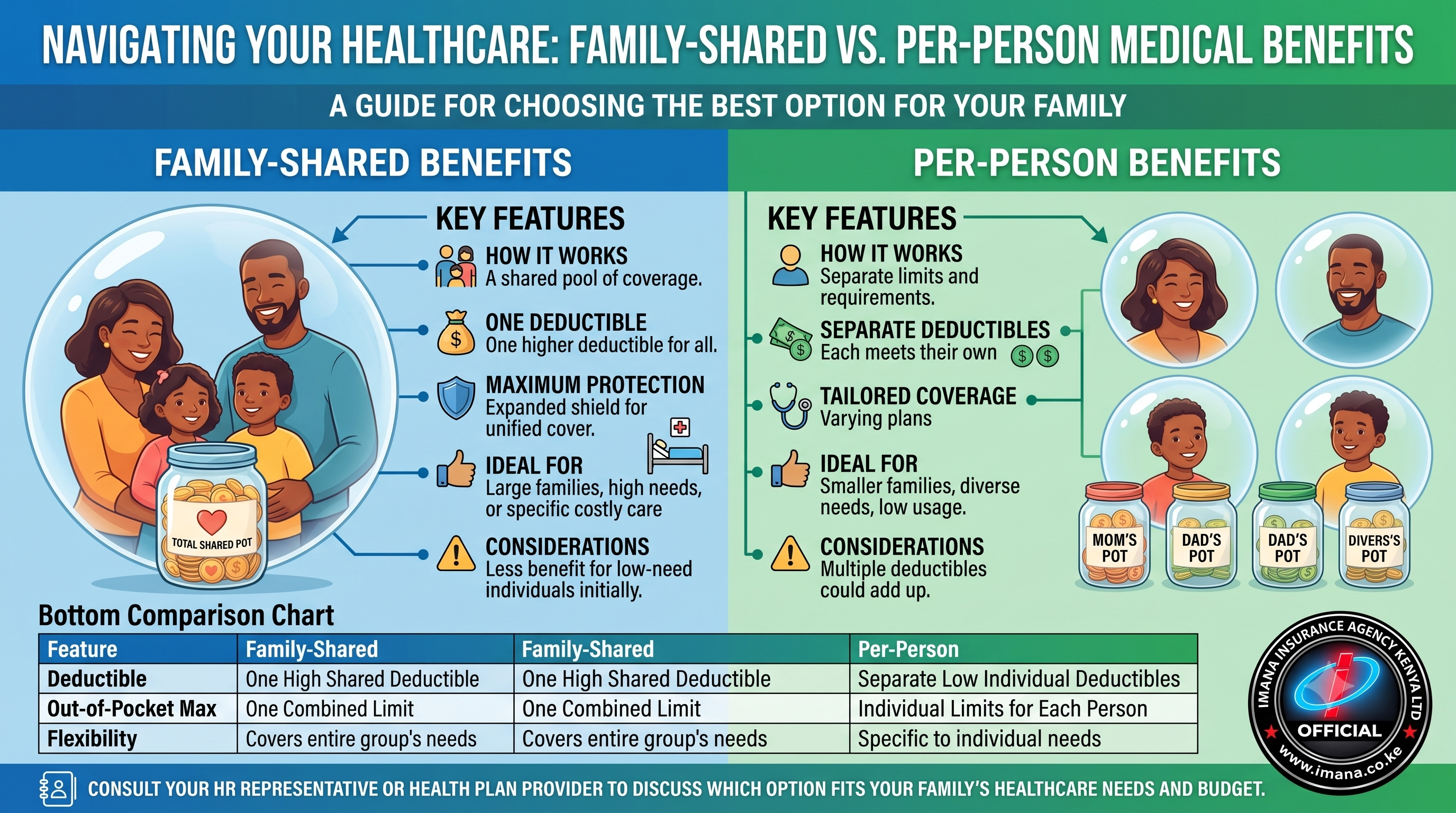
What Is a Family-Shared Medical Benefit?
A family-shared benefit is one medical insurance limit used collectively by all insured family members.
The policy may cover:
- Principal member
- Spouse
- Children
- Other eligible dependants
Every approved claim is deducted from the same family pool.
Example of a shared inpatient benefit
A family of four has a shared inpatient limit of KSh 1 million.
During the policy year:
- Parent A uses KSh 150,000
- Child A uses KSh 250,000
- Parent B uses KSh 100,000
The family has used KSh 500,000.
The remaining shared balance is:
KSh 500,000
That balance must protect all four members for the rest of the policy year.
Main advantage
A member who experiences a serious illness may access a large portion of the family pool instead of being restricted to a smaller individual limit.
Main risk
One major admission can significantly reduce or exhaust the protection available to everyone else.
What Is a Per-Person Medical Benefit?
A per-person benefit gives each insured family member their own individual limit.
Claims made by one member do not ordinarily reduce another member’s limit.
Example of a per-person inpatient benefit
A family of four receives KSh 500,000 per person.
During the policy year:
- Parent A uses KSh 400,000
- Child A uses KSh 100,000
- Parent B makes no claim
- Child B makes no claim
The remaining protection is:
- Parent A: KSh 100,000
- Child A: KSh 400,000
- Parent B: KSh 500,000
- Child B: KSh 500,000
Each member’s benefit remains separate.
Main advantage
One family member cannot ordinarily consume another person’s medical limit.
Main risk
A member who develops a costly condition may exhaust their individual limit even when the other family members have unused benefits.
Family-Shared vs Per-Person Benefits: The Main Difference
The distinction is about how the available money is allocated.
Family-shared structure
One combined limit is available to all insured family members.
Per-person structure
Every insured member receives an individual limit.
Simple comparison
Suppose a family has four members.
Shared option:
KSh 1 million for the whole family
Per-person option:
KSh 500,000 for each family member
The maximum theoretical protection under the per-person option is KSh 2 million across the family. However, no member can ordinarily use more than their KSh 500,000 individual allocation.
Under the shared option, one member might access most of the KSh 1 million, but that reduces what remains for everybody else.
How Family-Shared Benefits Work in Practice
A shared arrangement can be useful where:
- Most family members are healthy
- The likelihood of several major claims in one year is low
- The family wants a larger flexible pool
- The premium is more affordable
- The members understand the risk of benefit depletion
Example: one major admission
A family has a KSh 1 million shared inpatient limit.
One child requires treatment costing KSh 700,000.
The insurer pays the eligible amount, subject to the policy.
The remaining shared benefit is KSh 300,000.
That amount must protect the parents and other children until renewal.
Example: several smaller admissions
The same family has the following claims:
- Parent: KSh 180,000
- Child one: KSh 120,000
- Child two: KSh 90,000
- Parent: KSh 160,000
Total used: KSh 550,000
Remaining family limit: KSh 450,000
The shared arrangement can work efficiently where claims are spread across different members and remain within the total pool.
How Per-Person Benefits Work in Practice
A per-person arrangement creates a separate financial boundary around each insured member.
Example: one family member has repeated treatment
A family receives KSh 500,000 per person.
One parent incurs:
- First admission: KSh 200,000
- Second admission: KSh 180,000
- Third admission: KSh 150,000
Total eligible expenses: KSh 530,000
The individual benefit may be exhausted at KSh 500,000, leaving the member responsible for the remaining eligible amount.
The other family members’ limits remain untouched.
Example: two serious illnesses in one family
Two members each incur KSh 450,000 in medical expenses.
Under a KSh 500,000 per-person arrangement, each member remains within their individual limit.
Under a KSh 1 million family-shared arrangement, the two claims consume KSh 900,000, leaving only KSh 100,000 for the rest of the family.
Which Option Is More Affordable?
Family-shared plans can sometimes be priced more affordably because the insurer’s maximum exposure is one combined family limit.
Per-person policies may cost more because every insured member receives a separate full benefit.
However, the premium depends on more than the allocation method.
Pricing may also consider:
- Ages of family members
- Number of dependants
- Inpatient limit
- Outpatient limit
- Hospital network
- Maternity benefits
- Chronic and pre-existing conditions
- Dental and optical benefits
- Co-payments
- Waiting periods
- Territorial scope
- Claims history
- Selected insurer
Do not assume every shared plan is cheaper or every per-person plan is more expensive.
Compare written quotations using identical benefits.
Family-Shared Inpatient Benefits
The inpatient benefit covers eligible treatment requiring hospital admission, subject to the policy terms.
A family-shared inpatient limit may apply to:
- Hospital accommodation
- Theatre expenses
- Doctors’ fees
- Surgery
- Diagnostic tests
- Medication
- Intensive care
- Other covered inpatient services
The policy may still impose separate limits for:
- Maternity
- Chronic conditions
- Cancer
- Renal treatment
- Congenital conditions
- Mental-health treatment
- Emergency evacuation
A KSh 1 million shared inpatient limit does not necessarily mean the whole amount can be used for every type of treatment.
Family-Shared Outpatient Benefits
An outpatient benefit covers eligible treatment where the member is not formally admitted.
This may include:
- Doctor consultations
- Diagnostic tests
- Prescribed medication
- Minor procedures
- Specialist consultations
- Chronic-condition management
A family may have a shared outpatient limit such as KSh 150,000.
Every outpatient visit reduces the same balance.
This can be practical where:
- Some members rarely visit hospitals
- Children require more frequent treatment
- The family prefers flexible benefit use
However, one member with frequent treatment may consume a large share of the outpatient pool.
Per-Person Outpatient Benefits
A per-person outpatient arrangement gives each member a separate annual allocation.
For example:
- Parent: KSh 50,000
- Spouse: KSh 50,000
- Child one: KSh 50,000
- Child two: KSh 50,000
The total family allocation is KSh 200,000, but each member is ordinarily restricted to KSh 50,000.
This protects one member’s benefit from being consumed by another.
It may be less flexible where one child needs frequent treatment while the other members do not use their limits.
What Is a Hybrid Medical Benefit Structure?
Some family medical policies combine shared and individual benefits.
A hybrid structure may provide:
- Shared inpatient limit
- Per-person outpatient limit
- Shared dental and optical benefits
- Per-person maternity limit
- Separate chronic-condition sublimit
- Individual emergency evacuation limit
Example
A family plan may include:
- Inpatient: KSh 1 million shared
- Outpatient: KSh 50,000 per person
- Maternity: KSh 100,000 per eligible member
- Dental: KSh 20,000 shared
- Optical: KSh 15,000 per person
Hybrid arrangements can offer flexibility, but the customer must understand which benefits are shared and which are individual.
Shared Limits and Medical Sublimits
A shared medical policy can still contain smaller sublimits.
Suppose a family receives:
- Shared inpatient limit: KSh 1 million
- Shared chronic-condition limit: KSh 200,000
- Maternity limit: KSh 100,000
- Dental limit: KSh 30,000
- Optical limit: KSh 20,000
The family cannot ordinarily use the entire KSh 1 million for chronic treatment where the chronic-condition sublimit is KSh 200,000.
Similarly, maternity remains restricted to its stated limit.
Before buying, ask whether every sublimit is:
- Per family
- Per person
- Per year
- Per condition
- Part of the main limit
- Additional to the main limit
Family-Shared Benefits and Co-Payments
A co-payment is the amount or percentage the insured member contributes when receiving treatment.
A family-shared policy may still apply:
- KSh 500 per outpatient visit
- A percentage contribution at selected hospitals
- A maternity co-payment
- A contribution for treatment outside the preferred network
The insurer deducts eligible claims from the shared benefit after applying the relevant policy calculations.
A generous shared limit can therefore still produce significant out-of-pocket expenses where high co-payments apply.
Advantages of Family-Shared Medical Benefits
Greater flexibility
The family can use the benefit where it is most needed.
Larger accessible limit for one member
A seriously ill member may access more than they would receive under a modest per-person plan.
Potentially lower premium
Some shared structures offer more affordable family pricing.
Reduced unused individual benefits
Unused protection is not locked under family members who make no claims.
Suitable for young and generally healthy families
The arrangement may work well where the likelihood of multiple major claims is relatively low.
Disadvantages of Family-Shared Medical Benefits
One member can exhaust the family pool
A serious admission may leave little protection for everyone else.
Difficult to predict remaining protection
The available benefit changes every time a family member receives treatment.
Several claims can create a major gap
Two or more illnesses during the same year may exhaust the shared limit quickly.
Renewal can become expensive after heavy utilisation
Claims experience may influence future pricing and terms.
Some benefits may have restrictive shared sublimits
Dental, optical, maternity and chronic benefits may be lower than expected.
Advantages of Per-Person Medical Benefits
Every member has protected individual cover
One person’s treatment does not ordinarily reduce another person’s benefit.
Easier benefit tracking
Each member can see their remaining individual balance.
Better protection where several members may claim
The family is less exposed to one combined limit being exhausted.
Suitable for families with known medical needs
Separate benefits can protect each member’s expected treatment requirements.
Stronger total theoretical family protection
The combined value of individual benefits may exceed one family-shared limit.
Disadvantages of Per-Person Medical Benefits
An individual limit may be exhausted
Unused benefits belonging to other family members may not be transferred.
Potentially higher premium
Separate limits for every member may cost more.
Some allocations may remain unused
Healthy members may finish the year without using their benefits.
Less flexibility during one large claim
A member may require treatment exceeding their individual limit while substantial unused benefits remain elsewhere in the family.
Which Structure Is Better for a Young Family?
A family-shared plan may suit a young and generally healthy family where:
- There are no major chronic conditions
- Hospital utilisation is normally low
- The premium budget is limited
- The shared limit is reasonably high
- Maternity and child benefits are suitable
However, families with young children should consider that children may require more frequent outpatient treatment.
The family should review both:
- Inpatient allocation
- Outpatient allocation
A shared inpatient limit combined with individual outpatient benefits may offer a practical balance.
Which Structure Is Better for Families With Chronic Conditions?
A per-person plan may provide greater certainty where one or more members require:
- Regular specialist consultations
- Ongoing medication
- Repeated hospital admissions
- Chronic-condition monitoring
- Planned procedures
However, the benefit must include a suitable chronic-condition sublimit.
A KSh 1 million individual inpatient benefit may still provide limited value where chronic treatment is capped at KSh 100,000.
Always compare the condition-specific benefits.
Which Structure Is Better for Large Families?
The answer depends on the total shared limit.
For a family of six, a KSh 500,000 shared inpatient limit may provide relatively low protection per member.
A larger shared pool may still be suitable where the premium remains affordable.
When comparing cover, calculate:
Shared family limit ÷ number of insured members
This does not create an actual individual limit, but it helps show how thinly the protection may be spread.
For example:
- Shared limit: KSh 600,000
- Family members: Six
- Average exposure equivalent: KSh 100,000 per person
One member could use more than KSh 100,000, but the total limit may be inadequate if several claims occur.
Which Structure Is Better for Parents Above 60?
Older family members may face a higher likelihood of:
- Hospital admission
- Chronic-condition treatment
- Specialist consultations
- Ongoing medication
- Diagnostic tests
Adding an older parent to a shared family policy may increase the possibility of the family limit being heavily utilised.
Consider:
- A separate senior medical plan
- A per-person family structure
- A higher shared limit
- Separate chronic-condition benefits
- Co-payments
- Entry and renewal age
- Pre-existing-condition terms
The cheapest arrangement may not provide the strongest long-term protection.
Can One Family Member Be Removed From a Shared Policy?
A member may be removed according to the insurer’s policy-administration rules.
Common reasons include:
- Child exceeding the eligibility age
- Divorce or separation
- Death
- Change of employment cover
- Member obtaining separate insurance
- Relocation
Removal does not ordinarily restore benefits already used during the policy year.
Policy changes may also require:
- Written request
- Supporting documents
- Endorsement
- Premium adjustment
Can a Newborn Be Added to a Family Policy?
Many medical insurers allow newborns to be added within a specified period after birth.
Parents should confirm:
- Notification deadline
- Required birth documents
- Additional premium
- Effective date
- Congenital-condition cover
- Neonatal limits
- Whether maternity benefits must have been active
- Whether waiting periods apply
A newborn should not be assumed to be automatically insured because the mother has medical cover.
What Happens When the Family Limit Is Exhausted?
Once the shared limit is fully used, the insurer will ordinarily stop paying further expenses under that section until the benefit renews.
The family may then have to:
- Pay hospital bills directly
- Use SHA benefits where applicable
- Use another medical policy
- Seek employer medical protection
- Arrange payment with the hospital
- Use personal savings
Medical insurance should therefore be monitored during the year.
Ask the insurer or administrator for updated benefit utilisation where necessary.
Can Unused Benefits Be Carried Forward?
Normally, unused medical benefits expire at the end of the policy year.
They are not ordinarily:
- Refunded
- Carried forward
- Converted into cash
- Transferred to another family
- Added to the following year’s limit
Insurance protects against risk during a defined period. It is not a savings account.
Some specialised products may operate differently, but this should be expressly stated.
Can You Have More Than One Medical Insurance Policy?
A person may have:
- SHA
- Employer medical insurance
- Individual private medical insurance
- Family medical insurance
- International medical cover
However, medical expenses are generally indemnity-based. The insured person cannot ordinarily recover more than the actual eligible cost of treatment.
The policies may coordinate benefits.
Confirm:
- Which policy pays first
- Whether one policy covers the balance
- Whether co-payments remain
- Whether both insurers require pre-authorisation
- Which documents each insurer requires
Questions to Ask Before Choosing a Family Medical Plan
Before paying, ask:
- Is the inpatient benefit shared or per person?
- Is the outpatient benefit shared or per person?
- How many family members can be included?
- Can one person use the entire shared limit?
- Are maternity benefits shared or individual?
- Are chronic conditions separately limited?
- What are the cancer and renal sublimits?
- Are dental and optical benefits shared?
- Which hospitals require co-payments?
- Is the limit renewed annually?
- Can unused benefits be transferred?
- What happens when one member exhausts their limit?
- Can newborns be added immediately?
- What waiting periods apply?
- Are pre-existing conditions covered?
- Is the family limit within or additional to SHA benefits?
- Are emergency evacuation benefits shared?
- What is the maximum entry and renewal age?
Request the answers in writing.
How to Compare Family Medical Quotations
Every insurer should receive the same information, including:
- Ages of all family members
- Relationship to principal member
- Existing conditions
- Preferred hospitals
- Required inpatient limit
- Outpatient requirements
- Maternity needs
- Dental and optical needs
- Previous claims
- Desired territorial scope
Then compare:
- Premium
- Shared or individual structure
- Main inpatient limit
- Outpatient benefit
- Maternity
- Chronic conditions
- Cancer and renal treatment
- Dental and optical
- Co-payments
- Waiting periods
- Hospital network
- Bed limit
- Emergency evacuation
- Exclusions
- Renewal age
Do not compare premiums where the underlying benefits are different.
Common Mistakes Families Make
Looking only at the combined limit
A large shared figure may become inadequate when divided across several members.
Assuming everyone has the advertised amount
A KSh 1 million family-shared plan does not mean every member has KSh 1 million.
Ignoring member-specific sublimits
Maternity, chronic and cancer benefits may be separately restricted.
Failing to consider one major illness
One admission may consume most of the shared benefit.
Buying per-person cover with very low individual limits
Separate benefits are useful only when each limit is reasonably adequate.
Ignoring outpatient utilisation
Families with children may consume outpatient cover quickly.
Failing to monitor benefit balances
Shared benefits can be exhausted without every family member knowing.
Choosing solely by premium
A cheaper plan may offer lower limits, higher co-payments or a narrower hospital network.
How Imana Helps Families Compare Medical Insurance
Imana Insurance Agency Kenya Ltd helps individuals and families compare medical insurance options from suitable licensed insurers.
The comparison process may include:
- Reviewing the ages and number of family members.
- Identifying medical and maternity needs.
- Comparing family-shared and per-person structures.
- Reviewing inpatient and outpatient limits.
- Checking chronic, cancer and renal benefits.
- Comparing co-payments and hospital networks.
- Reviewing waiting periods and exclusions.
- Explaining family and individual sublimits.
- Coordinating policy issuance.
- Supporting membership amendments and renewal.
Available options may include:
- Individual medical insurance
- Family medical insurance
- Child-only medical cover
- Senior medical insurance
- Inpatient-only cover
- Inpatient and outpatient cover
- Group Medical Insurance
- SHA supplementary medical plans
Family Medical Insurance in Westlands and Across Kenya
Imana Insurance Agency Kenya Ltd
4th Floor, Krishna Centre
Woodvale Grove, Westlands
Nairobi, Kenya
Medical insurance information:
www.imana.co.ke/insurance/imana-health
Website: www.imana.co.ke
Call or WhatsApp: +254 796 209 402
Compare the structure. Check the sublimits. Understand who can use each benefit. Let Imana help you choose suitable family medical cover.
Frequently Asked Questions
What is a family-shared medical benefit?
It is one combined medical-insurance limit used by all insured members of the family.
What is a per-person medical benefit?
It gives every insured family member an individual benefit limit.
Can one person use the full shared limit?
Potentially, subject to the main limit, sublimits and policy conditions.
Can a member use another person’s unused individual limit?
Not ordinarily under a per-person arrangement.
Which option is cheaper?
Family-shared cover may sometimes be more affordable, but pricing depends on the insurer, ages, benefits and number of members.
Which option is better for a large family?
A large family should compare the adequacy of the shared limit against separate individual protection. A low shared limit can be exhausted quickly.
Are maternity benefits shared?
They may be shared or allocated per eligible member. Check the benefit schedule.
Are outpatient benefits always structured like inpatient benefits?
No. A plan may provide shared inpatient cover and per-person outpatient benefits, or the reverse.
Do sublimits apply under both structures?
Yes. Maternity, chronic, cancer, dental, optical and other sublimits may apply to either arrangement.
What happens when the shared limit is exhausted?
Further eligible expenses under that benefit ordinarily become the family’s responsibility until renewal.
Can newborn babies be added?
Usually, subject to the insurer’s notification period, documents, premium and policy conditions.
Can Imana compare family-shared and per-person quotations?
Yes. Imana can help compare benefit allocation, premiums, hospital networks, waiting periods, co-payments and exclusions.
The Bottom Line
Neither family-shared nor per-person medical insurance is automatically better for every household.
A family-shared plan offers flexibility and can allow one member to access a larger part of the benefit. However, one serious claim may reduce the protection available to everybody.
A per-person plan protects each member’s individual allocation. However, a member may exhaust their limit while other family benefits remain unused.
Before choosing:
- Count the family members.
- Review their ages and medical needs.
- Compare shared and individual limits.
- Check maternity and chronic-condition sublimits.
- Review co-payments.
- Confirm the hospital network.
- Consider the effect of one major admission.
- Compare total family protection—not only the premium.
The right family medical plan is not simply the one with the largest number. It is the one whose benefit structure fits how your family is most likely to use healthcare.
Imana Insurance Agency Kenya Ltd
Call or WhatsApp: +254 796 209 402
Website: www.imana.co.ke
Understand the pool. Protect each member. Choose family medical cover with clarity.
Medical insurance benefit structures, limits, sublimits, co-payments, waiting periods, hospital networks and eligibility rules vary between insurers. Obtain a current quotation, detailed benefit schedule and full policy wording before purchasing cover.