
Blog Details
Diskava. Beta. Kava
18Aug
Contractors Insurance & Performance Bonds Kenya | Complete Guide
Learn about Performance Bonds, Bid Bonds, Advance Payment Bonds, Contractors All Risks, WIBA, Public Liability, Plant & Machinery and other contractors insurance in Kenya. Understand what each cover does, when it may be required and how contractors can structure complete project protection.
Winning a construction contract is only the beginning.
Once a contractor is awarded a project, the business may need to protect:
- The contract
- Construction works
- Employees
- Heavy equipment
- Third parties
- Materials
- Vehicles
- Imported machinery
- Professional responsibilities
- Advance payments
- Contractual performance
That is why contractors in Kenya should not think about Performance Bonds in isolation.
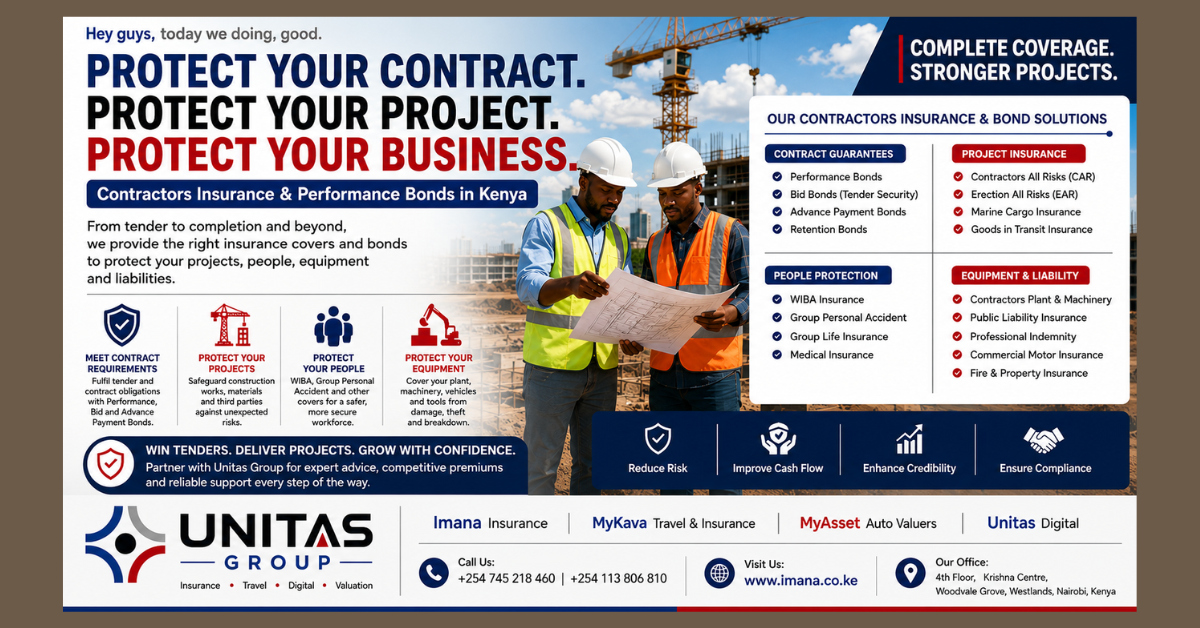
A stronger approach is to build a complete Contractors Insurance and Bonds programme around the project.
Depending on the contract, this may include:
- Performance Bond
- Bid Bond or Tender Security
- Advance Payment Bond
- Retention Bond
- Contractors All Risks Insurance
- Contractors Plant and Machinery Insurance
- WIBA Insurance
- Group Personal Accident
- Public Liability
- Professional Indemnity
- Marine Cargo
- Goods in Transit
- Commercial Motor Insurance
- Fire and Property Insurance
The contractor's objective should be to protect four things: contractual obligations, the project itself, people and equipment.
What Is a Performance Bond in Kenya?
A Performance Bond, sometimes referred to as a Performance Guarantee or Performance Security depending on the contract, provides security to the project owner or employer that the contractor will perform specified contractual obligations.
It is normally required after a successful contractor has been awarded a project and before or around execution of the contract.
In Kenya's public-procurement framework, the Public Procurement and Asset Disposal Act provides that, subject to the applicable regulations, a successful tenderer may be required to submit performance security before signing the contract. The Act provides for performance security of not more than 10% of the contract amount, subject to applicable exceptions and regulations. (Kenya Law)
The applicable tender document ultimately determines:
- Whether security is required
- The amount
- Required wording
- Acceptable issuer
- Validity period
- Conditions for release
Contractors should therefore never assume that every project requires a fixed 10% bond.
Why Do Employers Require Performance Bonds?
A project owner may pay significant sums or make major commitments after awarding a contract.
The employer therefore wants financial protection if the contractor:
- Fails to perform
- Abandons the project
- Does not fulfil specified contractual obligations
- Defaults according to the bond conditions
Performance security helps protect the employer against this contractual risk.
Major infrastructure and construction contracts commonly use Performance Bonds and Advance Payment Bonds as contractual security instruments.
How Does a Performance Bond Work?
There are usually several parties involved.
The Principal
This is normally the contractor who must provide the bond.
The Beneficiary
This is usually the employer, client or procuring entity that requires the bond.
The Guarantor
This may be an approved insurer, bank or other acceptable institution depending on the tender requirements.
The guarantor issues the Performance Bond according to the agreed wording and limit.
If the contractor defaults in circumstances covered by the bond, the beneficiary may make a demand subject to the bond terms.
Is a Performance Bond the Same as Insurance?
Not exactly.
Although insurers may issue bonds, a surety or bond arrangement is different from ordinary indemnity insurance.
With conventional insurance, the insurer generally assumes specified insured risks in exchange for a premium.
With a Performance Bond, the guarantee primarily protects the beneficiary against specified default by the contractor.
Importantly, where an insurer pays under a bond, the contractor may remain financially responsible under the indemnity arrangements signed when obtaining the bond.
Contractors should therefore not think of a bond as:
“Insurance that pays my debt if I fail.”
It is a contractual guarantee.
How Much Performance Bond Is Required in Kenya?
For public procurement, section 142 of the Public Procurement and Asset Disposal Act provides that applicable performance security may be up to 10% of the contract amount, while the regulations establish thresholds and special treatment for certain procurements and disadvantaged groups. (Kenya Law)
The Public Procurement and Asset Disposal Regulations also provide that performance security for goods, works and non-consultancy services is generally applicable above the prescribed contract threshold, subject to specific exceptions. (Kenya Law)
For an actual project, always follow the tender document.
The tender may state:
- 5%
- 10%
- Another permitted amount
- Specific exemptions or reduced security
Do not obtain a bond before checking the required wording and percentage.
What Is a Bid Bond or Tender Security?
A Bid Bond, commonly called Tender Security, is provided during the tender stage.
It helps protect the procuring entity against certain bidder actions, including circumstances such as:
- Withdrawing the tender during the validity period
- Refusing to enter into the contract
- Failing to provide required Performance Security
Under Kenya's Public Procurement and Asset Disposal Act, tender security may be required and is generally stated as an absolute value not exceeding 2% of the tender value, subject to procurement rules and exemptions. (Kenya Law)
Tender security and Performance Security therefore apply at different stages.
Bid Bond
Before contract award
Performance Bond
After award, when required
Bid Bond vs Performance Bond
These products are often confused.
Bid Bond
Protects the procuring entity during the tender process.
It demonstrates that the bidder is serious and will honour specified tender obligations.
Performance Bond
Protects the employer after contract award against qualifying failure by the contractor to perform the contract.
A contractor may therefore require both during the same procurement journey.
What Is an Advance Payment Bond?
Many construction projects provide an upfront payment to help the contractor mobilise.
This may fund:
- Materials
- Equipment
- Labour mobilisation
- Site establishment
- Initial project expenses
The employer may require an Advance Payment Bond before releasing the funds.
An Advance Payment Bond provides financial security relating to the advance payment according to the bond terms.
Construction and infrastructure contracts frequently use Advance Payment Bonds alongside Performance Bonds. (Solidum Global)
It may also be referred to as:
- Advance Payment Guarantee
- Mobilisation Guarantee
- APG
Always use the wording required by the contract.
What Is a Retention Bond?
Construction contracts frequently allow the employer to retain a percentage of payments as security for:
- Defects
- Incomplete work
- Post-completion obligations
Where acceptable under the contract, a Retention Bond may allow the contractor to receive funds that would otherwise remain withheld.
The bond provides the employer with financial security in place of retaining cash.
For contractors, this can improve:
- Cash flow
- Working capital
- Project liquidity
Availability and wording depend on the contract and guarantor.
Why Contractors Need More Than Bonds
Bonds protect contractual obligations.
They do not automatically insure:
- Construction works
- Injured employees
- Heavy machinery
- Third-party property
- Materials in transit
- Company vehicles
- Professional negligence
This is why a contractor should think beyond:
“I have a Performance Bond, therefore the project is insured.”
It is not.
A complete contractors programme combines Bonds + Insurance.
Contractors All Risks Insurance in Kenya
Contractors All Risks Insurance, commonly called CAR Insurance, is one of the most important construction insurance policies.
It is designed to protect insured construction works against specified accidental physical loss or damage during the project period.
Depending on the policy, it may cover:
- Contract works
- Construction materials
- Temporary works
- Existing property where specifically included
- Third-party liability
Typical projects may include:
- Residential buildings
- Commercial buildings
- Roads
- Warehouses
- Schools
- Hospitals
- Hotels
- Factories
- Civil engineering works
What Does Contractors All Risks Insurance Cover?
A CAR policy is generally divided into major sections.
Material Damage
This may cover insured physical damage to:
- Contract works
- Materials
- Temporary structures
- Other declared project property
Third-Party Liability
This may provide protection against eligible claims involving:
- Bodily injury to third parties
- Damage to third-party property
arising from construction activity.
The exact policy wording determines what is insured.
What Information Is Needed for a Contractors All Risks Quote?
Insurers may request:
- Contract value
- Project description
- Contract period
- Project location
- Bill of quantities
- Principal details
- Contractor details
- Construction method
- Previous experience
- Project drawings
- Claims history
- Third-party liability limit
Complex projects may require more detailed underwriting information.
Contractors Plant and Machinery Insurance
Construction businesses often own expensive equipment such as:
- Excavators
- Bulldozers
- Graders
- Loaders
- Cranes
- Concrete mixers
- Rollers
- Forklifts
- Compressors
- Generators
These assets may not automatically be protected simply because a CAR policy exists.
Contractors Plant and Machinery Insurance can protect specified equipment against insured accidental physical loss or damage.
This is especially important where machinery:
- Operates at several sites
- Is highly valuable
- Is financed
- Is critical to project completion
Does Contractors All Risks Cover Construction Machinery?
Not necessarily.
Some equipment may need to be:
- Specifically declared
- Added by endorsement
- Insured under a separate Contractors Plant and Machinery policy
Never assume that an excavator worth millions of shillings is automatically covered by the project CAR policy.
Check the schedule.
WIBA Insurance for Contractors
Construction is a labour-intensive industry with significant occupational risks.
Workers may be exposed to:
- Falls from height
- Machinery accidents
- Falling objects
- Electrical accidents
- Excavation accidents
- Vehicle incidents
- Occupational injuries
WIBA Insurance helps employers manage qualifying liabilities arising from work-related injuries and occupational diseases.
The Insurance Regulatory Authority recognises WIBA among the insurance products available in Kenya. (Insurance Regulatory Authority)
For contractors, employee protection should be considered separately from the physical project.
WIBA vs Group Personal Accident
Some contractors combine:
WIBA + Group Personal Accident
The policies are not identical.
WIBA
Addresses qualifying occupational injury obligations within Kenya's work-injury framework.
Group Personal Accident
May provide defined accident benefits, potentially on a broader basis such as 24-hour protection depending on the policy.
A contractor should not assume GPA automatically replaces WIBA.
Public Liability Insurance for Contractors
Construction activity can accidentally injure third parties or damage surrounding property.
Examples include:
- Falling materials damaging a neighbouring vehicle
- Excavation damaging underground infrastructure
- Construction debris injuring a pedestrian
- Equipment damaging neighbouring property
- Water damage spreading beyond the site
Public Liability Insurance may protect against eligible third-party bodily injury and property-damage claims.
CAR Insurance may contain a third-party liability section, but contractors should check whether:
- The limit is sufficient
- The required liability is included
- Separate Public Liability Insurance is contractually required
Professional Indemnity Insurance for Contractors
Professional Indemnity becomes particularly important where the contractor assumes responsibility for:
- Design
- Engineering
- Technical advice
- Specifications
- Project management
- Professional consultancy
This commonly applies to:
- Design-and-build contractors
- Architects
- Engineers
- Quantity surveyors
- Consultants
- Project managers
A construction defect caused by professional design error is a different exposure from accidental physical damage during construction.
Therefore:
CAR and Professional Indemnity solve different risks.
Marine Cargo Insurance for Contractors
Many major projects depend on imported materials or machinery.
Examples include:
- Lifts
- Generators
- Electrical equipment
- Industrial machinery
- Steel
- Specialist building systems
Marine Cargo Insurance may protect specified goods while being transported from the supplier to the destination, depending on the policy.
This can be particularly important for high-value imported project equipment.
Goods in Transit Insurance
Contractors also move materials within Kenya.
Examples include:
- Cement
- Steel
- Pipes
- Electrical equipment
- Construction materials
- Tools
Goods in Transit Insurance may protect insured goods while being transported by road or other specified means.
Marine Cargo and Goods in Transit should not automatically be treated as identical policies.
Commercial Motor Insurance for Contractors
Construction companies often operate:
- Pickups
- Trucks
- Prime movers
- Tippers
- Staff vehicles
- Site vehicles
These require correct Motor Insurance according to actual use.
Options may include:
- Comprehensive
- Third Party
- Commercial Motor
- Fleet Insurance
A contractor should periodically review:
- Vehicle values
- Drivers
- Usage
- Claims history
- Fleet size
Fire and Property Insurance for Contractors
Contractors may have assets outside the construction site.
These include:
- Offices
- Warehouses
- Workshops
- Stores
- Computers
- Tools
- Spare parts
- Stock
Fire and Property Insurance can protect these assets against insured risks such as:
- Fire
- Explosion
- Flood
- Storm
- Other specified perils
Site insurance should therefore not be confused with insurance for permanent business premises.
Business Interruption Insurance for Contractors
A major insured incident affecting:
- Head office
- Workshop
- Warehouse
- Machinery
can prevent the contractor from operating.
Business Interruption Insurance may protect eligible loss of income and continuing expenses following specified insured property damage.
Depending on the policy, this can include:
- Gross profit
- Salaries
- Rent
- Additional operating expenses
It should generally be considered together with Property Insurance.
Contractors Insurance Programme: The Four-Pillar Approach
A useful way to structure contractor protection is around four pillars.
Pillar 1: Contract Guarantees
Includes:
- Bid Bond
- Performance Bond
- Advance Payment Bond
- Retention Bond
These protect contractual obligations.
Pillar 2: Project Insurance
Includes:
- Contractors All Risks
- Erection All Risks
- Marine Cargo
- Goods in Transit
These primarily protect the project and project-related property.
Pillar 3: People Protection
Includes:
- WIBA
- Group Personal Accident
- Group Life
- Medical Insurance
These address employee-related risks.
Pillar 4: Equipment and Liability
Includes:
- Contractors Plant and Machinery
- Commercial Motor
- Public Liability
- Professional Indemnity
- Property Insurance
Together, these create a much more complete risk-management programme.
What Is Erection All Risks Insurance?
Erection All Risks Insurance, or EAR, is particularly relevant to projects involving installation and erection of machinery or industrial equipment.
Examples include:
- Manufacturing plants
- Power systems
- Industrial machinery
- Mechanical installations
- Electrical installations
The distinction between CAR and EAR depends on the dominant nature of the project.
Construction-heavy projects may lean toward CAR.
Machinery installation and erection projects may require EAR.
Which Insurance Does a Building Contractor Need?
A building contractor may require:
- Performance Bond
- Advance Payment Bond
- Contractors All Risks
- WIBA
- Public Liability
- Contractors Plant and Machinery
- Commercial Motor
- Professional Indemnity where design responsibility exists
Which Insurance Does a Road Contractor Need?
Road contractors may need:
- Performance Bonds
- Advance Payment Bonds
- CAR
- WIBA
- GPA
- Heavy plant insurance
- Commercial Motor
- Public Liability
- Goods in Transit
Plant exposure can be particularly significant because road contractors often operate:
- Graders
- Excavators
- Rollers
- Loaders
- Tippers
Which Insurance Does an Engineering Contractor Need?
Engineering contractors may consider:
- CAR or EAR
- Performance Bond
- Advance Payment Bond
- Professional Indemnity
- WIBA
- Public Liability
- Plant and Machinery
- Marine Cargo
The exact combination depends on the project.
What Documents Are Required for a Performance Bond?
Requirements vary between insurers and guarantors.
A contractor may be asked for:
- Bond application
- Tender award letter
- Signed contract
- Required bond wording
- Company registration documents
- Directors' identification
- KRA documents
- Financial statements
- Bank statements
- Previous project experience
- Existing contracts
- Board resolution
- Indemnity documentation
The underwriting process may also consider:
- Financial strength
- Contractor experience
- Contract size
- Project duration
- Existing obligations
- Past performance
- Available collateral or counter-security
Why Financial Statements Matter for Bonds
A Performance Bond creates a potential financial obligation.
The guarantor therefore needs to understand whether the contractor:
- Has sufficient working capital
- Can execute the contract
- Has relevant experience
- Is overcommitted
- Has a history of completing projects
- Can absorb unexpected costs
A newly formed contractor seeking a very large Performance Bond may therefore face more stringent underwriting than an established contractor with a strong track record.
Does a Contractor Need Collateral for a Performance Bond?
It depends.
Requirements vary according to:
- Insurer
- Contractor profile
- Bond amount
- Financial strength
- Contract
- Risk assessment
An insurer or guarantor may request:
- Indemnity
- Cash collateral
- Property security
- Counter-guarantees
- Other acceptable security
Some stronger contractors may qualify for more favourable structures.
There is no universal collateral requirement applicable to every contractor.
How Long Does a Performance Bond Last?
The validity should match the contract requirements.
It may extend through:
- Construction period
- Completion
- Defects-liability period
depending on the wording.
Never guess the expiry date.
The bond should reflect the employer's required:
- Commencement
- Expiry
- Claim period
- Extension terms
What Happens When the Project Is Extended?
A contract extension may require the contractor to extend:
- Performance Bond
- Advance Payment Bond
- CAR policy
- WIBA policy
- Plant cover
- Other project insurance
This is a commonly overlooked issue.
A project that was originally scheduled for 12 months may run for 18 months.
If the insurance and bonds expire after month 12, the contractor can face a serious contractual and insurance gap.
Performance Bond vs Advance Payment Bond
The distinction is straightforward.
Performance Bond
Protects against specified contractor non-performance.
Advance Payment Bond
Protects the advance payment made to the contractor.
A contract can require both.
Performance Bond vs Contractors All Risks Insurance
These should never be confused.
Performance Bond
Protects the beneficiary against specified contractual default.
Contractors All Risks
Protects insured project works against specified accidental physical loss or damage and may include third-party liability.
Having one does not eliminate the need for the other.
Performance Bond vs Professional Indemnity
Again, they solve very different problems.
Performance Bond
Contractual security.
Professional Indemnity
Protection against eligible professional-negligence claims.
A design-and-build contractor may need both.
Performance Bonds in Government Tenders
Contractors tendering for government projects should carefully review the tender document.
Under Kenya's procurement legislation, a successful tenderer may be required to provide Performance Security before signing the contract, subject to the Act and regulations. (Kenya Law)
PPRA also publishes standard tender documents and Performance Security forms for use by procuring entities and bidders. (Public Procurement Regulatory Authority)
Do not assume that a bond wording accepted on one tender will automatically be accepted on another.
Contractors and NCA Requirements
Construction contractors operating in Kenya must also consider National Construction Authority requirements.
The NCA states that a person carrying on business as a contractor must be registered and hold a valid practising licence in accordance with the National Construction Authority Act. (National Construction Authority)
Insurance does not replace:
- NCA registration
- Project approvals
- Occupational safety requirements
- Procurement compliance
- Other statutory obligations
Contractors need both regulatory compliance and appropriate insurance.
Common Mistakes Contractors Make When Buying Insurance
1. Waiting until the last day to arrange the bond
Performance Bond underwriting may require:
- Financial documents
- Contract review
- Approvals
- Security arrangements
Start early.
2. Using the wrong bond wording
The beneficiary may reject it.
Always submit the required wording before issuance.
3. Assuming CAR covers employees
Employees generally require separate WIBA protection.
4. Forgetting heavy equipment
Excavators and other machinery may need specific Plant and Machinery cover.
5. Ignoring Public Liability
A project can cause major third-party losses.
6. Forgetting Professional Indemnity
Design-and-build contractors may have significant professional exposure.
7. Letting insurance expire before project completion
Extend project insurance when the construction period changes.
8. Focusing only on premium
A cheaper policy with inadequate limits can become expensive during a serious claim.
How Contractors Should Compare Insurance Quotations
Compare:
- Premium
- Sum insured
- Contract value
- Excess
- Liability limit
- Project period
- Defects-liability period
- Extensions
- Exclusions
- Territorial scope
- Claims conditions
For bonds, also compare:
- Bond limit
- Wording
- Validity
- Collateral
- Indemnity requirements
- Extension conditions
A Performance Bond quotation cannot be properly compared using premium alone.
Frequently Asked Questions
What is a Performance Bond?
It is a contractual security instrument that protects a beneficiary against specified failure by a contractor to perform its contractual obligations.
Is Performance Security mandatory for every Kenyan tender?
No. Requirements depend on the applicable procurement law, regulations, tender value and tender document. Public-procurement rules specify thresholds and exceptions.
How much can Performance Security be?
Under Kenya's Public Procurement and Asset Disposal Act, performance security may be up to 10% of the contract amount, subject to applicable regulations and exceptions.
Is a Bid Bond the same as a Performance Bond?
No.
A Bid Bond applies during tendering.
A Performance Bond generally applies after award.
What is an Advance Payment Bond?
It protects an employer in relation to advance or mobilisation funds released to the contractor.
Does Performance Bond cover construction damage?
No. Contractors All Risks Insurance addresses insured physical project damage.
Does CAR Insurance cover employees?
Do not assume so. WIBA should be considered separately for employee occupational injuries.
Does every contractor need Professional Indemnity?
It is particularly important where the contractor provides design, engineering, consulting or other professional services.
Can I insure my excavator?
Yes. Contractors Plant and Machinery Insurance can cover specified construction equipment subject to underwriting.
Can one insurance policy cover everything?
Usually not.
Construction risks require several different policies and bonds working together.
The Bottom Line
A contractor should not simply ask:
“Where can I get a Performance Bond?”
A better question is:
“What contractual, project, employee, equipment and liability risks does this project create?”
The answer may include:
Contract security
- Bid Bond
- Performance Bond
- Advance Payment Bond
- Retention Bond
Project protection
- Contractors All Risks
- Erection All Risks
- Marine Cargo
- Goods in Transit
Employee protection
- WIBA
- Group Personal Accident
- Group Life
- Medical Insurance
Equipment and liability
- Contractors Plant and Machinery
- Commercial Motor
- Public Liability
- Professional Indemnity
- Property Insurance
Winning the contract is only the beginning. Protect the project, your workers, equipment, liabilities and contractual obligations.
Contractors Insurance and Bonds with Imana
Imana Insurance Agency Kenya Ltd can assist contractors, construction companies, suppliers and engineering firms to review insurance and bonding requirements for their projects.
This can include:
- Performance Bonds
- Bid Bonds
- Advance Payment Bonds
- Contractors All Risks Insurance
- WIBA
- Contractors Plant and Machinery
- Public Liability
- Professional Indemnity
- Marine Insurance
- Commercial Motor Insurance
- Other project-related insurance
Before requesting a quotation, have the:
- Tender document
- Award letter
- Contract
- Required bond wording
- Project value
- Project duration
- Company financial information available for review.
Website: https://imana.co.ke
Author: Raymond Momanyi - Founder Imana Insurance Agency Kenya Ltd (Unitas Group)
Protect the Contract. Protect the Project. Protect the People. Protect the Equipment.
Bond availability, premiums, collateral, indemnities, insurer appetite and underwriting requirements vary by provider and contractor. Contract insurance requirements also vary by project. Always review the specific tender or contract wording before arranging a bond or insurance policy.