
Blog Details
Diskava. Beta. Kava
07Sep
Compare Last Expense Insurance in Kenya | 2026 Guide
Compare last expense and funeral insurance in Kenya. Review benefit limits, nuclear and extended-family cover, premiums, waiting periods and claims.
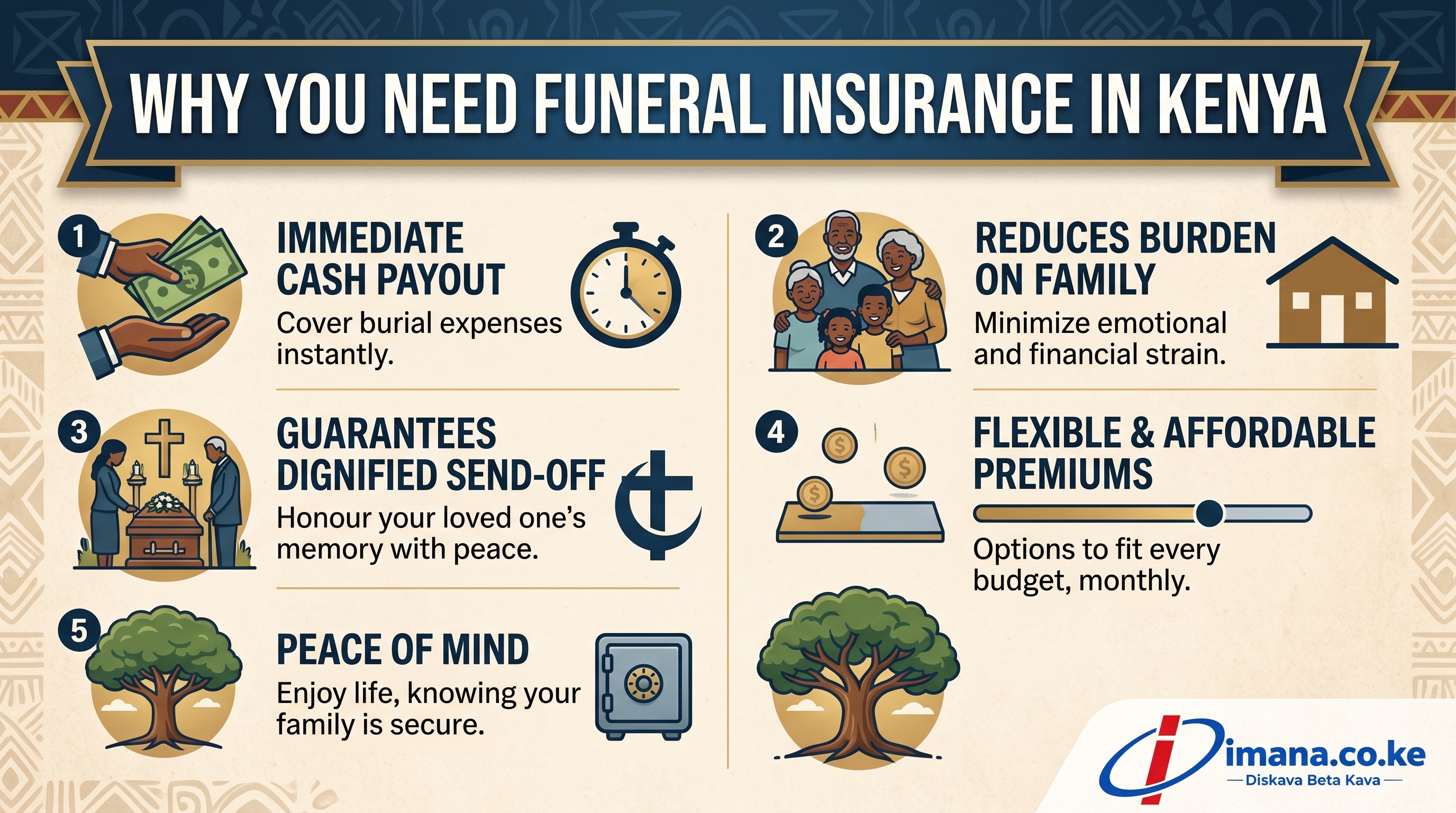
The death of a family member brings grief, difficult decisions and expenses that rarely wait for a family to become financially ready.
Mortuary charges, transport, burial arrangements, food, travel, funeral-home services and other immediate costs can quickly create financial pressure. Families may be forced to organise emergency harambees, borrow money, sell assets or withdraw business capital at the worst possible moment.
Last Expense Insurance, also known as Funeral Insurance, provides a predetermined cash benefit when an insured person dies.
The benefit helps the family meet immediate funeral-related expenses without depending entirely on last-minute contributions.
This authority guide explains how to compare funeral insurance in Kenya by examining:
- Benefit limits
- Nuclear-family cover
- Extended-family cover
- Annual premiums
- Entry and cover ages
- Waiting periods
- Claims requirements
- Exclusions
- Additional dependants
What Is Last Expense Insurance?
Last Expense Insurance is a policy that pays a lump-sum cash benefit following the death of an insured person, subject to the policy’s terms and submission of the required claim documents.
The benefit is normally paid to the nominated beneficiary or claimant. The family can then use the money to meet immediate expenses such as:
- Mortuary charges
- Coffin and funeral-home services
- Burial or cremation expenses
- Transport of the deceased
- Travel costs for family members
- Food and accommodation
- Religious or cultural arrangements
- Other immediate family expenses
The insurer does not necessarily ask the family to account for every shilling spent. It generally pays the agreed cash benefit after validating the claim.
Imana’s existing Last Expense information confirms that funeral cover is designed to transfer the immediate financial burden of funeral expenses and reduce dependence on emergency fundraising.
Is Last Expense Insurance the Same as Life Insurance?
No. Both may pay following death, but they serve different financial purposes.
Last Expense Insurance is designed primarily for immediate funeral and burial expenses. Benefit limits are usually smaller, premiums may be more affordable and claims are intended to be processed quickly once the required documents are submitted.
Life insurance is designed for broader, longer-term financial protection. Its benefit can help replace lost income, repay loans, support dependants, fund education or protect a family’s future.
A household may therefore need both:
- Last Expense Insurance for urgent funeral costs
- Life Insurance for longer-term financial security
Learn more about Life Insurance in Kenya.
What Does “Compare Funeral Insurance” Mean?
Comparing funeral insurance means looking beyond the cheapest advertised premium.
A useful comparison should consider:
- The cash benefit payable
- Who is covered
- Entry-age limits
- Maximum cover age
- Premium for older parents
- Child benefit limits
- Waiting periods
- Accidental-death conditions
- Territorial limits
- Claim-processing requirements
- Maximum number of claims
- Exclusions
- Additional dependant premiums
- Whether medical examinations are required
- How quickly complete claims are processed
A KSh 1,000 plan may be excellent for one family and completely inadequate for another. The right choice depends on family structure, ages, existing responsibilities and the expected cost of a funeral.
1. Compare Last Expense Benefit Limits
The benefit limit—also called the sum assured—is the amount payable after the death of an insured person.
Common benefit options may include:
- KSh 50,000
- KSh 100,000
- KSh 200,000
- KSh 250,000
- KSh 300,000
- KSh 500,000
Not every family member will necessarily receive the same benefit.
A plan may provide:
- KSh 300,000 for the principal member
- KSh 300,000 for the spouse
- KSh 100,000 for each eligible child
- Separate limits for parents and siblings
How should a family choose the benefit limit?
Consider:
- Expected funeral costs
- Distance to the family’s burial location
- Cost of transporting the deceased
- Number of relatives likely to travel
- Mortuary and funeral-home charges
- Cultural and religious requirements
- Existing savings
- Employer or SACCO funeral benefits
- Other life or funeral policies
- Dependants who would require immediate support
The lowest benefit may cover basic arrangements but leave the family exposed to additional costs.
The goal is not to create an extravagant funeral. It is to prevent grief from becoming an immediate financial emergency.
2. Nuclear-Family Funeral Cover
A nuclear-family funeral policy commonly covers:
- The principal member
- One spouse
- Eligible dependent children
The attached sample rate card provides family options for adults aged 18–69. It covers the principal member, spouse and up to four children, subject to its terms.
KSh 50,000 family benefit
The indicative annual premium is approximately KSh 1,000 per family.
Under this option:
- The principal member receives a KSh 50,000 benefit
- The spouse receives a KSh 50,000 benefit
- Each eligible child receives a KSh 50,000 benefit
- Up to four children may be included
KSh 100,000 family benefit
The indicative annual premium is approximately KSh 1,930 per family.
Under this option:
- The principal member receives KSh 100,000
- The spouse receives KSh 100,000
- Each eligible child receives up to KSh 100,000
KSh 200,000 family benefit
The indicative annual premium is approximately KSh 3,850 per family.
Under this option:
- The principal member receives KSh 200,000
- The spouse receives KSh 200,000
- The benefit for each child remains limited to KSh 100,000
KSh 250,000 family benefit
The indicative annual premium is approximately KSh 5,000 per family.
The principal member and spouse are covered for KSh 250,000 each, while the benefit per child remains KSh 100,000.
KSh 300,000 family benefit
The indicative annual premium is approximately KSh 5,770 per family.
The principal member and spouse receive KSh 300,000 each. The child benefit remains limited to KSh 100,000 per eligible child.
KSh 500,000 family benefit
The indicative annual premium is approximately KSh 9,600 per family.
The principal member and spouse receive KSh 500,000 each, while eligible children remain covered for a maximum of KSh 100,000 each.
These premiums are drawn from the supplied sample rate card and are intended as a market-planning index. The issuing insurer’s current quotation and policy schedule will determine the actual premium and benefits.
Additional Children and Spouses
Some households have more dependants than the standard family definition allows.
The sample pricing provides additional-child premiums of approximately:
- KSh 260 annually for a KSh 50,000 benefit
- KSh 510 annually for a KSh 100,000 benefit
- KSh 1,020 annually under the KSh 200,000 family option
- KSh 1,280 annually under the KSh 250,000 family option
- KSh 1,530 annually under the KSh 300,000 family option
- KSh 2,550 annually under the KSh 500,000 family option
However, the maximum benefit payable for a child under the sample plan is KSh 100,000.
An additional spouse may be included at indicative annual premiums starting from approximately:
- KSh 510 for KSh 50,000 cover
- KSh 1,020 for KSh 100,000 cover
- KSh 2,040 for KSh 200,000 cover
- KSh 2,550 for KSh 250,000 cover
- KSh 3,060 for KSh 300,000 cover
- KSh 5,090 for KSh 500,000 cover
The insurer must confirm whether its family definition permits an additional spouse and what supporting documents are required.
3. Extended-Family Funeral Cover
In Kenya, family responsibility often stretches far beyond the principal member, spouse and children.
Many people are also responsible for:
- Biological parents
- Parents-in-law
- Adult siblings
- Dependent siblings
- Other accepted extended-family members
A strong family funeral plan should therefore allow the principal member to add selected relatives individually.
Why extended-family cover matters
Leaving elderly parents outside the policy can create the exact financial emergency the family was trying to avoid.
Before purchasing a plan, ask:
- Can parents and parents-in-law be included?
- What is their maximum entry age?
- Until what age can their cover continue?
- Are siblings eligible?
- Is each relative charged separately?
- Does the premium increase with age?
- Can different relatives have different benefit limits?
- Is proof of relationship required?
- Is there a separate waiting period for added relatives?
Premiums for Parents and Siblings Aged 18–69
The supplied rate card provides the following indicative annual premiums per person:
- KSh 510 for a KSh 50,000 benefit
- KSh 1,020 for a KSh 100,000 benefit
- KSh 2,040 for a KSh 200,000 benefit
- KSh 2,550 for a KSh 250,000 benefit
- KSh 3,060 for a KSh 300,000 benefit
Premiums for Parents and Siblings Aged 70–75
The indicative annual premiums per person are:
- KSh 1,060 for a KSh 50,000 benefit
- KSh 2,110 for a KSh 100,000 benefit
- KSh 4,210 for a KSh 200,000 benefit
- KSh 5,260 for a KSh 250,000 benefit
- KSh 6,310 for a KSh 300,000 benefit
Premiums for Parents and Siblings Aged 76–85
The indicative annual premiums per person are:
- KSh 1,840 for a KSh 50,000 benefit
- KSh 3,680 for a KSh 100,000 benefit
- KSh 7,350 for a KSh 200,000 benefit
- KSh 9,190 for a KSh 250,000 benefit
- KSh 11,020 for a KSh 300,000 benefit
These rates show why the ages of parents and extended-family members are essential when requesting a quotation. Older entrants generally attract higher premiums because mortality risk increases with age.
4. Individual Last Expense Premiums
A person who does not require a full family package may purchase individual funeral cover.
According to the supplied sample rates, indicative annual premiums for an individual aged 18–69 are:
- KSh 510 for a KSh 50,000 benefit
- KSh 1,020 for a KSh 100,000 benefit
- KSh 2,040 for a KSh 200,000 benefit
- KSh 2,550 for a KSh 250,000 benefit
- KSh 3,060 for a KSh 300,000 benefit
- KSh 5,090 for a KSh 500,000 benefit
Individual cover may suit:
- Single adults
- Young professionals
- People whose dependants already have separate cover
- Individuals supplementing an employer’s funeral benefit
- People seeking a simple and affordable starting point
Before choosing individual cover, confirm whether dependants can be added later and whether doing so creates a new waiting period.
What Determines the Premium?
A funeral insurance premium may depend on:
- Benefit limit selected
- Age of each insured person
- Number of family members
- Nuclear or extended-family structure
- Maximum entry age
- Maximum continuation age
- Individual, family or group arrangement
- Waiting period
- Claims experience
- Additional benefits
- Insurer’s minimum premium
- Applicable taxes and levies
The attached sample rates exclude the stated 0.45% training levy and policyholder-related charges, together with KSh 40 stamp duty. A final quotation should show the total amount payable, including applicable statutory charges.
Entry Age and Maximum Cover Age
Age limits differ between insurers.
The sample plan accepts adults up to age 85 and allows cover to continue up to age 100, subject to continuous renewal and the policy terms.
Before purchasing cover, ask two separate questions:
- What is the maximum age for joining?
- Until what age can an existing member remain covered?
These are not the same.
A person may be allowed to continue renewing into old age but may not be accepted as a new entrant after the maximum entry age.
How Are Children Covered?
Under the sample plan:
- Children can be covered as dependants from birth, subject to the stated full-term birth requirement.
- Cover can continue up to age 25 where the child remains eligible under the policy.
- The standard family package covers up to four children.
- Additional children may be added at an extra premium.
- The maximum child benefit is KSh 100,000.
Parents should confirm:
- Whether newborns must be declared
- Age limits for children
- Whether students above 18 require proof of education
- Whether married or employed children remain eligible
- What happens when a child reaches the maximum dependant age
- Whether an additional-child premium applies
Waiting Periods
A waiting period is the time after cover begins during which certain claims are not payable.
The sample plan applies:
- A 90-day waiting period for death from natural causes
- No waiting period for accidental death, subject to the policy terms
Waiting periods help prevent people from joining only after a known loss becomes imminent.
A waiting period may begin again when:
- A new policy is purchased
- A dependant is added later
- Cover lapses and is reinstated
- The benefit limit is increased
- The policy is moved to another insurer
Always obtain written confirmation of the applicable waiting period.
Are Medical Examinations Required?
Many last expense plans are issued without a medical examination.
However, applicants must still answer all questions truthfully and disclose relevant information requested by the insurer.
“No medical examination” does not mean “no disclosure.”
Incorrect information, undeclared dependants or misrepresentation can create serious problems during a claim.
Territorial Scope
The supplied sample describes the policy as providing worldwide cover.
That does not automatically mean every funeral plan covers death anywhere in the world. Territorial limits and repatriation expenses should be checked carefully.
Worldwide last expense cover may provide the agreed cash benefit following an eligible death abroad, but it does not necessarily include the cost of transporting the deceased back to Kenya.
Repatriation or evacuation benefits may need to be purchased separately.
How Quickly Are Funeral Claims Paid?
Last expense policies are designed to provide rapid financial assistance.
The sample plan targets payment within approximately 48 hours after notification and submission of all required claim documents.
Imana’s existing Last Expense page similarly describes quick claims processing after reporting and receipt of the required documents.
The clock should not be assumed to begin at the moment of death. It generally begins once the insurer receives a complete and valid claim.
Documents Required When Applying
The sample plan requires documents such as:
- National ID or passport for adult applicants and dependants
- KRA PIN for the principal member
- Birth certificate or birth notification for child dependants
- Completed application form
- Additional documents requested by the insurer
Names, identification numbers and dates of birth should match the supporting documents.
Documents Required When Claiming
Claim requirements may include:
- Completed benefit claim form
- Burial permit
- Police abstract for accidental death
- Claimant’s National ID or passport
- Deceased insured person’s National ID or passport
- Proof of relationship
- Policy document or certificate
- Additional documents depending on the circumstances
Keep digital copies of important family documents before an emergency occurs. Hunting for identification documents in the middle of grief is a burden families can avoid.
Common Funeral Insurance Exclusions
Exclusions differ between insurers, but a policy may exclude or restrict claims arising from:
- War or warlike operations
- Civil unrest under specified circumstances
- Suicide
- Intentional self-injury
- Criminal or illegal activities
- Certain dangerous activities
- Fraud or deliberate misrepresentation
- An undisclosed insured person
- Death during an applicable waiting period
- Non-payment of premium
- Claims outside the policy’s territorial conditions
The policy document—not an advert, social media post or verbal promise—contains the final terms.
Maximum Number of Claims
Some family policies limit the number of payable claims during one insurance year.
The supplied sample allows a maximum of five claims per family per year.
This is important for extended families. A policy may cover many listed relatives while still limiting the number of claims that can be paid during the policy period.
Ask the insurer or intermediary whether:
- There is an annual claims limit
- The limit applies per family or per insured person
- Child claims count towards the same limit
- A paid claim removes only the deceased member or terminates the policy
- Remaining family members continue to be covered
Nuclear Family or Extended Family: Which Is Better?
Neither option is automatically better.
Choose nuclear-family cover if the main responsibility is for:
- The principal member
- Spouse
- Dependent children
Consider extended-family cover if financial responsibility also includes:
- Parents
- Parents-in-law
- Adult siblings
- Other eligible relatives
A practical approach is to secure an adequate nuclear-family benefit and then add the relatives whose funeral expenses would realistically fall on the household.
Do not add names simply because the policy permits it. Build the cover around genuine financial responsibility.
Individual, Family or Group Funeral Cover?
Individual cover
Suitable for one person seeking a straightforward cash benefit.
Family cover
Suitable for a principal member, spouse, children and selected extended-family members.
Group cover
Suitable for:
- Employers
- SACCOs
- Chamas
- Churches
- Welfare associations
- Alumni groups
- Table-banking groups
- Community organisations
Group funeral insurance can create predictable annual costs and reduce dependence on emergency member contributions.
Read more about Chama, Welfare Group and Self-Help Insurance in Kenya.
Common Mistakes When Buying Funeral Insurance
Avoid:
- Choosing cover using premium alone
- Selecting a benefit too low for expected costs
- Forgetting to include parents
- Assuming all children are automatically covered
- Ignoring entry-age limits
- Confusing maximum entry age with maximum cover age
- Failing to declare additional dependants
- Assuming worldwide cover includes repatriation
- Ignoring the natural-death waiting period
- Allowing the policy to lapse
- Giving incorrect identification details
- Failing to tell beneficiaries about the policy
- Keeping all policy documents in one inaccessible place
A funeral policy nobody knows about can fail the family precisely when it is needed.
How to Compare Funeral Insurance Quotations in Kenya
When comparing quotations, ask each insurer or intermediary:
- What benefit limits are available?
- What is the annual premium?
- Are taxes and levies included?
- Who qualifies as a spouse or child?
- How many children are included?
- Can parents and parents-in-law be added?
- What are the age-banded premiums?
- What is the maximum joining age?
- Until what age can cover continue?
- What waiting period applies?
- Is accidental death covered immediately?
- Are medical examinations required?
- What documents are needed at claim stage?
- How quickly are complete claims processed?
- What exclusions apply?
- Is there a maximum number of annual claims?
- Does worldwide cover include repatriation?
Compare the answers—not just the headline price.
Frequently Asked Questions
How much does funeral insurance cost in Kenya?
Premiums vary by age, benefit and number of insured people. The supplied sample rates start from approximately KSh 510 annually for individual KSh 50,000 cover and KSh 1,000 annually for a basic nuclear-family package.
What is the maximum funeral benefit?
The sample options range from KSh 50,000 to KSh 500,000 for an adult. Other insurers may offer lower or higher limits.
Can I cover my parents?
Yes, many plans allow parents and parents-in-law to be included. Their premiums are usually calculated according to age and selected benefit.
Can I cover a parent aged above 75?
Some plans accept older parents. The sample rate card provides entry options up to age 85, with higher premiums for applicants aged 76–85.
Can I cover my siblings?
Some extended-family plans allow siblings to be included individually. Eligibility, relationship requirements and age limits must be confirmed.
Are children covered for the same amount as adults?
Not always. Under the supplied sample, a child’s benefit is limited to KSh 100,000 even when the principal member and spouse select a higher amount.
Is there a waiting period?
The sample plan applies a 90-day waiting period for natural death and no waiting period for accidental death. Conditions vary between insurers.
How soon is a last expense claim paid?
Some insurers target payment within 48–72 hours after receiving a complete and valid claim. Missing documentation can delay settlement.
Can someone have more than one funeral policy?
A person may hold multiple policies, subject to disclosure requirements and each insurer’s terms. Every insurer independently validates its claim.
Is last expense insurance worth it?
It can be valuable where a death would force the family to borrow, sell assets or organise emergency fundraising. The chosen benefit should be meaningful enough to meet realistic funeral expenses.
Request a Last Expense Insurance Quotation
Imana Insurance Agency Kenya Ltd is a Westlands-based insurance intermediary helping individuals, families and businesses compare insurance quotations from licensed Kenyan insurers across Motor, Medical, WIBA, PSV, Travel, Motorcycle, Corporate and other insurance classes.
Imana can help compare:
- Individual funeral insurance
- Nuclear-family funeral cover
- Extended-family cover
- Funeral insurance for parents
- Group last expense cover
- Chama and welfare-group funeral insurance
- Employer-sponsored funeral benefits
- Last expense options attached to other policies
Explore these related Imana resources:
- Last Expense Insurance
- Life Insurance
- Last Expense Quotation
- Chama, Welfare Group and Self-Help Insurance
- Frequently Asked Insurance Questions in Kenya
- Compare Insurance Quotations in Kenya
Contact Imana Insurance Agency Kenya Ltd
Office: 4th Floor, Krishna Centre, Woodvale Grove, Westlands, Nairobi
Call/WhatsApp: +254 796 209 402
Email: insurance@imana.co.ke
Quotation website: www.imanainsurance.com
Insurance information: www.imana.co.ke
Online comparison platform: www.mykava.co.ke
Compare. Buy. Save.
About the Author
Raymond Momanyi is the Founder and CEO of Imana Insurance Agency Kenya Ltd. His areas of expertise include motor insurance, medical insurance, WIBA, PSV insurance comparison, funeral insurance, business risk and claims support.
Disclaimer: The benefits, conditions and premiums in this guide are based on the supplied sample rate card and are provided as an indicative price index. They are not guaranteed market rates or a binding insurance quotation. Premiums may exclude applicable levies, policyholder charges and stamp duty. Final benefits, eligibility, waiting periods, exclusions and premiums are determined by the selected insurer’s current policy wording and quotation.