
Blog Details
Diskava. Beta. Kava
17Aug
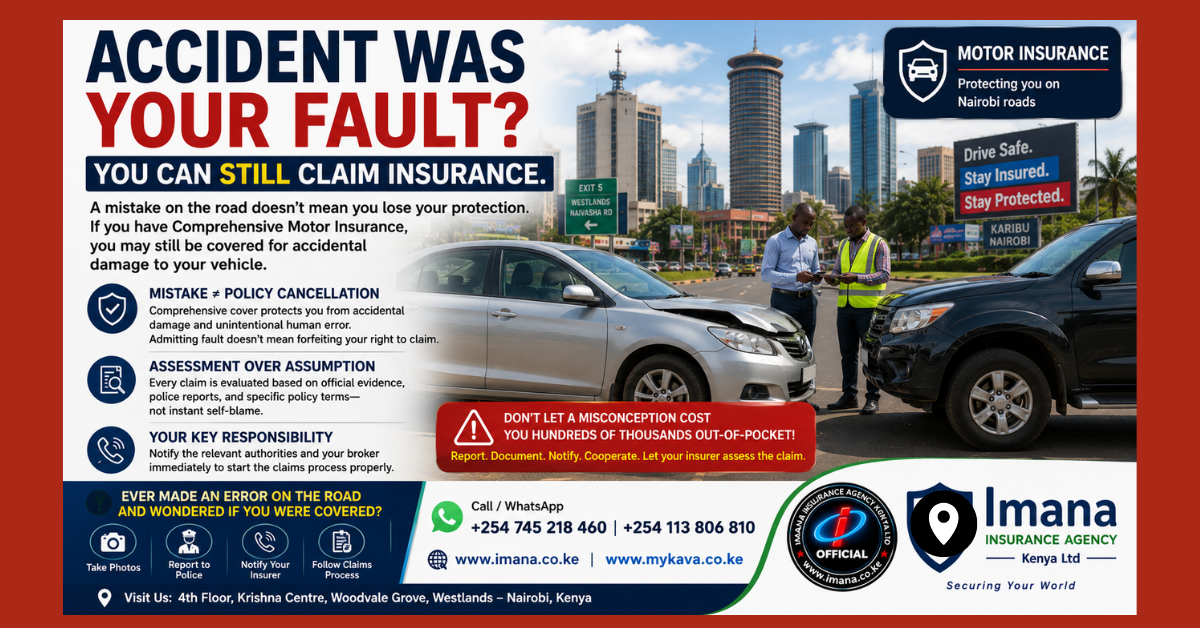
Can I Claim Insurance If an Accident Was My Fault in Kenya?
Caused a car accident and worried your insurer will reject the claim? Learn how fault affects Comprehensive Motor Insurance claims in Kenya, what insurers assess, exclusions, excesses and what to do after an accident.
“If the Accident Was My Fault, I Can’t Claim Insurance.”
This is one of the most common—and potentially expensive—motor-insurance misconceptions.
A driver makes a mistake.
Maybe they:
- Misjudge a corner
- Reverse into a wall
- Hit another vehicle
- Fail to brake in time
- Lose control on a wet road
- Miscalculate a parking space
Their immediate reaction is:
“I caused the accident, so insurance will not pay.”
That is not necessarily correct.
If you have a valid Comprehensive Motor Insurance policy, accidental damage resulting from ordinary, unintentional driving mistakes may still fall within the scope of cover, subject to the policy terms, exclusions, applicable excesses and circumstances of the accident.
Kenya’s standard private motor-policy framework distinguishes Comprehensive cover from Third Party Fire and Theft and provides for loss or damage to the insured vehicle under the applicable sections of the policy. (Insurance Regulatory Authority)
The important distinction is:
Making an ordinary driving mistake is not automatically the same thing as breaching your insurance policy.
What Does Comprehensive Motor Insurance Cover?
Comprehensive Motor Insurance is designed to provide broader protection than basic Third Party Insurance.
Depending on the policy, Comprehensive cover may protect against:
- Accidental damage
- Collision
- Overturning
- Fire
- Theft
- Flood damage
- Third-party liabilities
- Other specified insured risks
Imana’s Motor Insurance guidance similarly describes Comprehensive cover as protection against accidental damage, fire, theft and third-party liabilities, subject to policy terms. (imana.co.ke)
That means an accident does not necessarily have to be caused by somebody else before you can make an own-damage claim.
If I Cause the Accident, Can I Still Claim?
Potentially, yes.
Consider this example.
You are driving home during heavy rain.
You approach a corner too quickly, lose control and collide with a roadside barrier.
No other vehicle caused the accident.
You may consider yourself responsible.
But if you have valid Comprehensive Motor Insurance, the relevant question is not simply:
“Whose fault was it?”
The insurer will consider:
- Whether the policy was valid
- Whether the vehicle was insured for that use
- Whether the driver was authorised
- Whether the incident falls within an insured risk
- Whether any exclusion applies
- Whether policy conditions were complied with
- The evidence surrounding the accident
If the loss is admissible under the policy, an ordinary mistake behind the wheel does not automatically remove your right to claim.
Mistake Does Not Automatically Mean Policy Cancellation
Insurance exists partly because people make mistakes.
If Comprehensive Motor Insurance only covered accidents where the insured driver had done absolutely nothing wrong, its practical usefulness would be significantly reduced.
Common accidental situations can include:
- Reversing into an object
- Scraping a wall
- Misjudging another vehicle's distance
- Losing control on a slippery surface
- Accidentally hitting a gate
- Colliding with another vehicle
These circumstances still need to be assessed against the policy.
But:
An unintentional error is not, by itself, automatic proof that your insurance is invalid.
Fault and Insurance Coverage Are Two Different Questions
This distinction is important.
Question 1: Who caused the accident?
This concerns liability.
Question 2: Does the insurance policy respond to the loss?
This concerns coverage.
The two questions are related, but they are not identical.
You may have contributed to an accident and still have an admissible own-damage claim under Comprehensive Insurance.
Likewise, you may believe another person caused an accident, but your claim can still face difficulties if an important policy condition was breached.
Insurance decisions are based on:
- Facts
- Evidence
- Policy wording
- Applicable law
- Claim assessment
not simply on who feels guilty immediately after the crash.
Do Not Decide Your Own Claim at the Accident Scene
A common mistake is for drivers to immediately say:
“It was entirely my fault.”
The problem is that an accident can involve factors you have not yet considered.
These may include:
- Another driver's actions
- Road conditions
- Traffic signals
- Visibility
- Vehicle mechanical condition
- Road obstructions
- Witness evidence
You should provide accurate factual information.
However, avoid making unnecessary legal conclusions or promising another party that you will personally pay their loss before the insurer has assessed the matter.
What Happens After You Report the Claim?
Once a Motor Insurance claim is reported, the insurer may investigate the circumstances.
The process can involve:
- Claim notification
- Police documentation
- Driver's statement
- Vehicle inspection
- Photographs
- Repair estimates
- Motor assessment
- Third-party statements
- Witness evidence
The insurer then determines whether the claim is admissible under the contract.
The Insurance Regulatory Authority also recognises the role of insurance brokers and agents during the claims-settlement process. (Insurance Regulatory Authority)
What Should You Do Immediately After an Accident?
1. Check for injuries
People come first.
If anyone is injured, seek emergency assistance.
2. Secure the scene
Where safe:
- Switch on hazard lights
- Use reflective warning triangles
- Avoid creating additional traffic danger
3. Take photographs
Photograph:
- Your vehicle
- Other vehicles
- Registration numbers
- Damage
- Vehicle positions
- Road surface
- Traffic signs
- Surroundings
These photographs may become important evidence.
4. Exchange details
Record:
- Driver names
- Telephone numbers
- Vehicle registration numbers
- Insurance details
- Witness contacts
5. Report to the relevant authorities
Follow applicable police-reporting requirements.
6. Notify your insurer or insurance intermediary promptly
Do not wait until the vehicle has already been repaired.
7. Follow the claims procedure
Submit the required documentation and cooperate with the insurer's assessment.
Assessment Over Assumption
A motorist should not conclude:
“I made the mistake, so there is no point reporting the accident.”
Let the insurer assess the claim.
A proper assessment may consider:
- Police report
- Driver statements
- Photographs
- Assessor's report
- Witness statements
- Policy schedule
- Policy wording
Even where you believe the accident was entirely your mistake, reporting the incident allows the insurer to determine whether cover applies.
When Can an At-Fault Accident Claim Still Be Rejected?
Being at fault may not automatically invalidate the claim.
But that does not mean every accident will be payable.
A claim may still be declined or reduced where the facts trigger an exclusion or policy breach.
Examples can include circumstances involving:
- Unlicensed driving
- Unauthorised drivers
- Undeclared commercial use
- Driving outside the permitted territorial area
- Fraudulent claim information
- Material misrepresentation
- Excluded competition or racing use
- Failure to comply with specific security requirements
- Other policy exclusions or conditions
The exact wording varies between insurers.
What If the Driver Was Drunk?
This is very different from an ordinary driving error.
Many motor policies contain exclusions or conditions relating to driving under the influence of alcohol or drugs.
A driver should therefore never assume:
“Comprehensive means I am covered regardless of what I do.”
It does not.
Comprehensive Insurance is broad protection, but it remains a contract with conditions and exclusions.
What If I Was Speeding?
This depends on the circumstances and policy wording.
The insurer will assess the facts rather than applying a simplistic rule that every driver error automatically cancels insurance.
Where conduct amounts to a serious policy breach, illegality or excluded behaviour, the claim may be affected.
The safest principle is:
Report the accident truthfully and allow the insurer to determine coverage from the evidence and policy terms.
What If I Hit Another Car?
If you have Comprehensive Motor Insurance and accidentally cause a collision, two different aspects may arise.
Damage to your own vehicle
This may fall under your Comprehensive own-damage protection, subject to the policy.
Damage or injury caused to another person
The third-party liability section may respond where liability is established, subject to the policy and applicable law.
Kenya’s Insurance (Motor Vehicles Third Party Risks) Act requires motor vehicles used on public roads to have qualifying third-party insurance protection. (Kenya Law)
What If I Only Have Third Party Insurance?
This changes the situation considerably.
Third Party Insurance is primarily intended to protect against eligible liabilities involving other people.
It does not ordinarily cover accidental damage to your own vehicle.
Therefore, if you lose control and damage only your own Third-Party-insured vehicle, you may have to pay for your own repairs.
This is one of the fundamental differences between:
- Comprehensive Insurance
- Third Party Insurance
Kenya’s statutory motor framework focuses compulsory insurance on third-party risks. (Kenya Law)
Example: Comprehensive vs Third Party After an At-Fault Accident
Imagine you accidentally drive into the rear of another vehicle.
Your vehicle suffers:
KSh 250,000 damage
The other vehicle suffers:
KSh 150,000 damage
If you have Comprehensive Insurance
Subject to admissibility and the policy:
- Your own damage may be considered under the Comprehensive section.
- Eligible third-party liability may be considered under the liability section.
An excess or other claim deductions may apply.
If you have Third Party Only
Your policy may address the eligible third-party liability.
But:
Your own KSh 250,000 repair bill would ordinarily remain yours.
That difference explains why policy choice matters.
Will I Have to Pay an Excess?
Possibly.
An excess is the portion of an admissible claim that remains payable by the insured under the policy.
For example:
Approved repair cost:
KSh 200,000
Applicable excess:
KSh 20,000
The insured may bear KSh 20,000 while the insurer considers the remaining KSh 180,000, subject to other policy terms.
The existence of an excess does not mean the claim was rejected.
It is part of the agreed claims structure.
What Is Excess Protector?
Some Comprehensive Motor policies offer Excess Protector as an extension.
It may protect against specified excesses that would otherwise be borne by the motorist.
However, it may not necessarily cover:
- Young-driver excess
- Inexperienced-driver excess
- Theft excess
- Other special excesses
Check the actual policy.
Can My Premium Increase After an At-Fault Claim?
Claims experience can be one of the factors insurers consider when pricing Motor Insurance.
A claim can potentially affect:
- Renewal terms
- No-claims discounts
- Premium
- Excess requirements
depending on the insurer and claims history.
This is another reason motorists should focus not only on the current claim, but also on maintaining a good long-term risk profile.
Should I Report a Minor Accident?
Generally, you should notify your insurer or intermediary when an incident could reasonably lead to a claim or third-party liability.
A seemingly minor accident can later develop into:
- A larger repair claim
- A bodily injury allegation
- A third-party demand
- A legal dispute
Failing to notify the insurer promptly may create unnecessary complications.
Follow the notification conditions in your policy.
What If the Other Driver Says the Accident Was My Fault?
Do not panic.
Their opinion is not automatically the final determination.
Record:
- Their details
- Their vehicle information
- Photographs
- Witness details
Then report the matter.
Police evidence, witness statements, physical evidence and other facts may be considered when determining responsibility.
Can I Repair My Car Immediately?
Usually, you should first notify your insurer or intermediary.
The insurer may need to:
- Inspect the vehicle
- Appoint an assessor
- Approve repairs
- Direct you to an approved garage
Authorising substantial repairs yourself before the insurer has assessed the loss may complicate the claim.
Emergency steps necessary to prevent further damage may be treated differently depending on the circumstances and policy.
What Documents May Be Needed for a Motor Claim?
Depending on the insurer and type of accident, the claims process may require:
- Completed claim form
- Police abstract or other police documentation
- Driver's licence
- Vehicle logbook
- Insurance certificate
- Photographs
- Repair estimate
- Assessor's report
- Witness details
- Third-party information
Imana’s existing insurance guidance describes Motor Insurance as protection against unexpected financial losses caused by accidents, theft or damage. (imana.co.ke)
Why You Should Contact Your Insurance Intermediary Immediately
A dedicated intermediary can help you understand:
- What documents are needed
- How to notify the claim
- Whether assessment is required
- What the excess means
- What happens to the third-party claim
- What information the insurer still requires
The intermediary does not decide whether the insurer will pay the claim.
But good claims guidance can reduce delays caused by:
- Missing documents
- Incorrect procedures
- Poor communication
IRA explicitly highlights the role brokers and agents can play during insurance claims settlement. (Insurance Regulatory Authority)
Five Motor Insurance Myths Drivers Should Stop Believing
Myth 1: “If the accident was my fault, I cannot claim.”
Not automatically true.
A valid Comprehensive policy may respond to accidental own damage even where the insured driver made an ordinary mistake, subject to the policy.
Myth 2: “Comprehensive Insurance covers absolutely everything.”
False.
It still contains:
- Exclusions
- Excesses
- Conditions
- Limits
Myth 3: “If I have Third Party Insurance, my car is covered.”
Not for ordinary accidental own damage.
Third Party primarily protects against eligible liabilities to others.
Myth 4: “I should admit fault immediately to be honest.”
You should be truthful about facts.
But there is a difference between accurately describing events and making an immediate legal admission of liability.
Myth 5: “A small accident does not need to be reported.”
A small incident can later produce a third-party claim.
Follow the policy's notification requirements.
Frequently Asked Questions
Can I claim Comprehensive Insurance if I caused the accident?
Potentially, yes. Comprehensive Insurance is designed to cover specified accidental damage to the insured vehicle, subject to policy terms and exclusions. (Insurance Regulatory Authority)
Will the insurer reject my claim because I admitted fault?
Not automatically. Coverage depends on the facts, evidence and policy wording.
Does Comprehensive Insurance cover driver mistakes?
Ordinary accidental human error may fall within Comprehensive cover unless an exclusion or policy breach applies.
What if I only have Third Party Insurance?
Third Party Insurance will not ordinarily pay to repair your own vehicle after an at-fault accident.
What if I hit another vehicle?
Your own vehicle damage may be considered under Comprehensive cover, while eligible liability to the other vehicle may fall under the third-party section.
Will I pay an excess?
An applicable policy excess may still be payable even where the claim is admitted.
Should I call the police?
Follow applicable legal and policy reporting requirements, particularly where there are injuries, significant damage or third-party involvement.
Should I contact my insurer before repairing the car?
Yes. Notify the insurer or intermediary and obtain appropriate claims guidance before carrying out substantial repairs.
Can my claim be rejected for drunk driving?
Policies commonly contain restrictions or exclusions relating to alcohol or drugs. The applicable wording must be checked.
What if I disagree with the insurer's claim decision?
First request a written explanation referring to the policy wording. If the matter remains unresolved, Kenya’s Insurance Regulatory Authority provides a complaints mechanism for insurance consumers. (Insurance Regulatory Authority)
The Most Important Lesson
If you make an ordinary mistake on the road, do not automatically conclude:
“Insurance cannot help me because the accident was my fault.”
That misconception could lead you to pay a substantial repair bill yourself without even giving your insurer the opportunity to assess the claim.
Instead:
Report → Document → Notify → Cooperate → Let the insurer assess
Your responsibility is to provide truthful information and follow the claims process.
The insurer's responsibility is to assess the claim against the policy.
Don't Let Self-Blame Cost You Hundreds of Thousands
Motor Insurance exists because accidents happen.
Sometimes:
- Another driver causes the accident.
- Road conditions contribute.
- Mechanical problems arise.
- You simply make a human mistake.
If you have Comprehensive Motor Insurance, do not abandon a legitimate potential claim simply because you believe you were responsible.
Fault does not automatically equal no insurance.
What matters is whether the claim falls within the protection provided by your policy.
Need Help With a Motor Insurance Claim?
Imana Insurance Agency Kenya Ltd helps motorists understand Motor Insurance, compare quotations and navigate the claims process.
Motor Insurance:
https://imana.co.ke/insurance/motor-insurance
Compare Motor Insurance Quotes:
https://imana.co.ke/motor-quote
Report a Claim:
https://imana.co.ke/claims-request
Website:
https://imana.co.ke
Know your policy. Report the accident. Submit the evidence. Let the claim be assessed.
Author: Raymond Momanyi - Founder&CEO Imana Insurance Agency Kenya Ltd (Unitas Group)
Every Motor Insurance claim is assessed on its individual facts and the applicable policy terms. Comprehensive Insurance does not guarantee payment of every accident claim, and exclusions, excesses, driver conditions and other requirements may apply.