
Blog Details
Diskava. Beta. Kava
01Sep
How Much Does WIBA Insurance Cost in Kenya? | Quote Guide
How much does WIBA Insurance cost in Kenya? Learn how WIBA premiums are calculated from annual payroll, indicative risk rates, documents required and how to compare quotations through Imana.
Website: www.imana.co.ke
MyKava: www.mykava.co.ke
Compare WIBA quotations:
https://imana.co.ke/
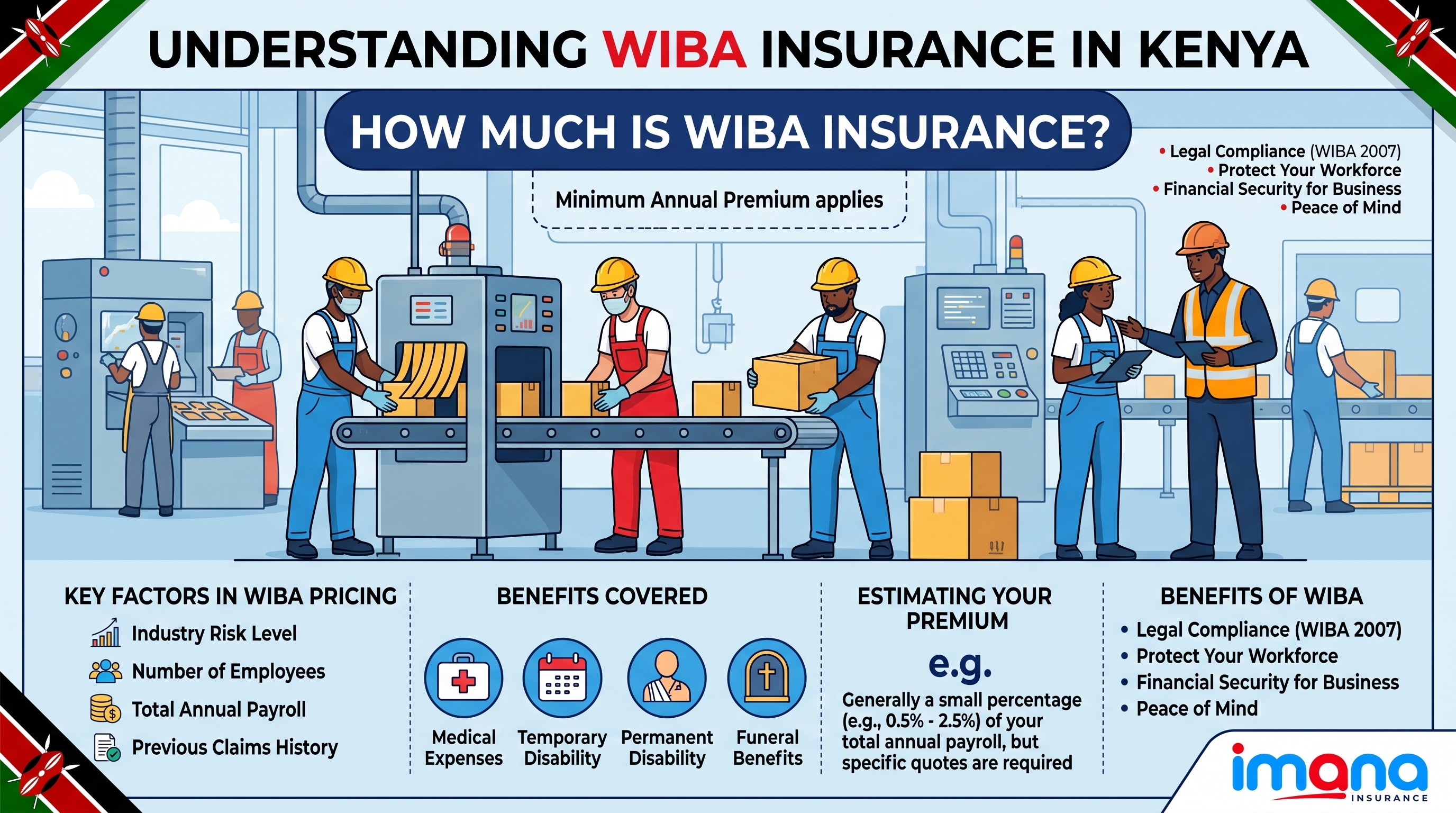
WIBA Insurance does not normally have one flat price per employee.
For most businesses, the premium is calculated using:
Estimated annual payroll × occupational risk rate
The insurer looks at:
- Total annual wages
- Nature of business
- Employee occupations
- Workplace risk
- Claims history
- Extensions selected
- Minimum premium
That means an accounting firm, a restaurant, a transport company and a construction contractor can have the same payroll but pay very different WIBA premiums.
The Work Injury Benefits Act requires employers to obtain and maintain insurance against liabilities they may incur under the Act in respect of employees.
Imana Insurance Agency Kenya Ltd is a Westlands-based insurance intermediary helping individuals, families and businesses compare insurance quotations from licensed Kenyan insurers across Motor, Medical, WIBA, PSV, Travel, Motorcycle, Corporate and other insurance classes.
For a current WIBA quotation:
www.imana.co.ke
What Is WIBA Insurance?
WIBA stands for the Work Injury Benefits Act.
It provides the legal framework for compensation where an employee suffers a qualifying:
- Work-related injury
- Occupational disease
- Disablement
- Death
arising in the course of employment.
The Ministry of Labour describes WIBA as the law providing compensation to employees for work-related injuries and occupational diseases.
Is WIBA Mandatory in Kenya?
Yes, employers should take this requirement seriously.
Section 7 of the Work Injury Benefits Act requires every employer to obtain and maintain an insurance policy covering liabilities the employer may incur under the Act.
In practical terms, if you employ workers, WIBA should be part of your insurance compliance review.
How Is WIBA Premium Calculated?
A simple budgeting formula is:
Annual payroll × insurer rate = indicative basic premium
For example:
If annual payroll is:
KSh 5,000,000
and the insurer applies an illustrative rate of:
0.5%
the indicative premium is:
KSh 25,000
At:
1%
the premium becomes:
KSh 50,000
At:
2%
the premium becomes:
KSh 100,000
The exact rate depends largely on occupational risk.
Indicative WIBA Rate Bands in Kenya
There is no single industry-wide tariff that every insurer must use.
However, for budgeting purposes, market quotations can sometimes fall within broad bands such as:
Lower-risk occupations
Examples:
- Offices
- Consulting
- Software
- Administration
- Professional services
Indicative planning range:
About 0.3%–0.8% of annual payroll
Medium-risk occupations
Examples:
- Retail
- Restaurants
- Hospitality
- Light agriculture
- Schools
Indicative planning range:
About 0.5%–1.5%
Medium-to-higher-risk occupations
Examples:
- Transport
- Security
- Cleaning
- Manufacturing
- Warehousing
Indicative planning range:
About 0.8%–2%
Higher-risk occupations
Examples:
- Construction
- Heavy engineering
- Factory operations
- Heavy manual work
- Machinery-intensive activities
Indicative planning range:
About 1%–3% or more
These are budgeting bands only, not statutory rates or guaranteed insurer quotations.
WIBA Cost Example for an Office
Suppose an office has:
8 employees
Annual payroll:
KSh 3,600,000
At an illustrative rate of:
0.5%
the estimated basic premium would be:
KSh 18,000
before applicable charges and insurer minimums.
WIBA Cost Example for a Restaurant
Suppose annual payroll is:
KSh 4,200,000
At an illustrative rate of:
0.8%
the indicative premium would be:
KSh 33,600
Again, the actual insurer rate depends on the employee mix.
Kitchen staff, cleaners, drivers and office staff may not all attract identical risk treatment.
WIBA Cost Example for a Transport Business
Suppose annual payroll is:
KSh 3,000,000
and the insurer applies:
1.5%
The indicative premium would be:
KSh 45,000
Drivers, loaders and mechanics usually present different occupational exposure from office staff.
WIBA Cost Example for a Construction Company
Suppose a contractor has annual wages of:
KSh 10,000,000
At an illustrative rate of:
1.2%
the estimated premium would be:
KSh 120,000
Higher-risk operations may attract different rates depending on:
- Working at height
- Machinery
- Welding
- Excavation
- Site conditions
- Claims history
Why Do WIBA Rates Differ?
The insurer is pricing the probability and severity of workplace injury.
An accountant working at a desk does not face the same exposure as:
- A mason
- A scaffolder
- A welder
- A truck driver
- A security guard
- A machine operator
This is why accurate employee classification matters.
A useful principle is:
Payroll measures the financial exposure. Occupation measures the risk.
What Is Annual Payroll for WIBA?
Annual payroll is the estimated annual earnings of employees being insured.
If your monthly payroll is:
KSh 500,000
then:
KSh 500,000 × 12
gives:
KSh 6,000,000 annual payroll
That figure becomes one of the main inputs to the WIBA quotation.
Should Allowances Be Included in Payroll?
The safest approach is to provide the insurer with the full remuneration structure and let the insurer determine the earnings figure used for rating.
That can include information on:
- Basic salary
- Regular allowances
- Overtime where relevant
- Other regular remuneration
Do not deliberately understate payroll simply to obtain a lower premium.
What Is Required to Generate a WIBA Quotation?
To obtain an accurate WIBA quote, provide five main categories of information.
1. Employer Details
Provide:
- Registered business name
- Trading name where applicable
- KRA PIN
- Registration or incorporation details
- Contact person
- Business location
2. Nature of Business
Be specific.
Instead of simply writing:
“Construction”
describe the operation more accurately, such as:
Residential building contractor with site masons, electricians and carpenters
For transport:
Courier company operating motorcycles and delivery vans
For hospitality:
Hotel with kitchen, housekeeping, maintenance and administrative employees
Better descriptions produce better quotations.
3. Number of Employees
State the total number of relevant employees.
Where possible, separate:
- Permanent
- Contract
- Casual
- Temporary
Employers should disclose the actual workforce rather than insuring only selected employee categories.
The Ministry of Labour states that WIBA applies broadly to employees.
4. Employee Categories and Job Titles
Break the workforce into logical occupational groups.
For example:
Office staff: 5 employees
Drivers: 4 employees
Loaders: 6 employees
Mechanics: 3 employees
This allows the insurer to understand the actual risk profile.
5. Annual Payroll by Category
Where possible, provide payroll split by job category.
For example:
Management: KSh 3 million annually
Administration: KSh 2 million
Drivers: KSh 4 million
Site workers: KSh 6 million
Total:
KSh 15 million annual payroll
That is significantly better than simply telling the insurer:
“We have 30 employees.”
Do I Need Employee Names to Get a WIBA Quote?
Not always at the initial quotation stage.
For many WIBA quotations, insurers can begin with:
- Number of employees
- Occupations
- Annual payroll
- Nature of business
A detailed employee schedule may be requested later.
What Documents Can Help Speed Up the Quotation?
Useful documents may include:
- Company registration documents
- KRA PIN
- Payroll summary
- Employee schedule
- Previous WIBA policy
- Previous claims information
- Completed proposal form
Higher-risk businesses may also be asked for more detailed risk information.
Does Claims History Affect the WIBA Premium?
Yes, it can.
Insurers may ask about previous workplace injury claims.
A poor claims history can affect:
- Rate
- Acceptance
- Conditions
- Risk-management requirements
Businesses with strong safety records can be more attractive to underwriters.
Does the Number of Work Locations Matter?
Yes.
If employees work at:
- Head office
- Construction sites
- Client premises
- Warehouses
- Factories
- Remote sites
disclose those operations.
The actual work environment can affect underwriting.
What Does WIBA Cover?
WIBA relates to qualifying work-related injury and occupational disease.
The statutory framework addresses benefits including:
- Temporary disablement
- Permanent disablement
- Death
- Medical aid
- Occupational disease
subject to the Act and applicable policy.
How Is Permanent Disablement Calculated?
The Work Injury Benefits Act provides that permanent-disablement compensation is calculated on the basis of:
96 months' earnings
subject to the statutory minimums, maximums and assessed degree of disability.
For example, a 50% permanent disability does not automatically receive the same amount as 100% permanent disability.
The assessed degree matters.
How Long Can Temporary Disablement Compensation Continue?
This is important because outdated summaries sometimes give incorrect periods.
Under Section 28 of WIBA, temporary total or partial disablement periodical payments may continue while disablement lasts, but:
not beyond 12 months.
That is the statutory reference employers should use rather than older or generic insurance summaries quoting longer periods.
What About WIBA Death Benefits?
Where an employee dies from a qualifying work injury, compensation is payable to the employee's dependants under the statutory process. The Ministry of Labour confirms that dependants are the beneficiaries where an employee dies as a result of a work-related accident.
The final calculation should follow the applicable statutory provisions and DOSHS assessment rather than a simplified blog formula.
What About Medical Expenses Under WIBA?
Medical aid forms part of the WIBA framework.
However, employers should not assume one universal KSh 100,000 medical limit applies to every WIBA policy.
Insurer products may structure medical-expense limits differently.
Always check the actual quotation.
Is WIBA the Same as Medical Insurance?
No.
WIBA
Deals with qualifying work-related injury and occupational disease.
Medical Insurance
Deals with healthcare expenses under a private Medical Insurance policy.
Employees may therefore have both.
Is WIBA the Same as Group Personal Accident?
No.
Group Personal Accident, or GPA, is an accident policy.
WIBA addresses the employer's statutory work-injury exposure.
Some insurers offer enhanced products combining WIBA with broader Personal Accident benefits.
What Is WIBA Plus?
WIBA Plus is generally an insurer-specific enhanced product.
It may combine:
- WIBA protection
- 24-hour Personal Accident
- Off-duty accident protection
- Additional death or disability benefits
Terms differ by insurer.
Do not assume every product called “WIBA Plus” has identical benefits.
What Is Employers' Liability Insurance?
Employers' Liability is another form of liability protection that may be relevant to some businesses.
It should not automatically be treated as a replacement for WIBA.
Businesses with more complex exposures can consider:
WIBA + Employers' Liability + Group Personal Accident
depending on their needs.
Should Casual Employees Be Included?
Employers should disclose the full workforce.
Leaving casual employees out simply to reduce payroll can create serious problems.
If you have:
- Permanent workers
- Contract workers
- Casual labour
- Temporary workers
provide that information when requesting the quotation.
What About Student Attachés?
Do not automatically assume every student attachment arrangement is identical to employment.
Depending on the arrangement, a student may require:
- Student Personal Accident Insurance
- WIBA consideration
- Other institutional cover
The actual relationship should be reviewed.
For Student Attachment Personal Accident Insurance, Imana also provides a dedicated cover option.
What Usually Increases the WIBA Premium?
Several factors can increase the quote:
- Higher payroll
- More employees
- Higher-risk occupations
- Poor claims history
- Construction or heavy manual work
- Drivers and riders
- Multiple sites
- Higher benefit extensions
- WIBA Plus
The insurer may also apply a minimum premium.
What Is a Minimum WIBA Premium?
Some insurers apply a minimum premium.
For example, a small office's payroll calculation may technically produce:
KSh 3,000
but an insurer could have a higher minimum premium.
Minimums vary.
That is why a very small business may pay a higher effective percentage than a larger organisation.
How Long Does a WIBA Quote Take?
A straightforward quote can often be produced quickly if you provide:
- Nature of business
- Number of employees
- Employee categories
- Annual payroll
The quotation may take longer if the risk includes:
- Construction
- Manufacturing
- Heavy machinery
- Multiple sites
- High claims history
- Complex employee categories
Complete information speeds up underwriting.
Can I Compare WIBA Quotes From Several Insurers?
Yes.
That is often worthwhile.
Different insurers can quote different:
- Rates
- Minimum premiums
- Medical benefits
- WIBA Plus extensions
- Claims procedures
The important rule is:
Give every insurer the same payroll and risk information.
Otherwise, the quotes are not comparable.
What Should I Compare Besides Price?
Compare:
- Payroll declared
- Job categories
- WIBA scope
- Extensions
- Medical-expense provisions
- WIBA Plus benefits
- Claims procedures
- Minimum premium
- Policy exclusions
The cheapest WIBA quotation is not automatically the best one.
Common WIBA Quotation Mistakes
One common mistake is declaring only permanent employees and ignoring casual or contract workers.
Another is understating annual payroll.
Another is putting all employees under one occupation even where some work in offices and others work on sites.
Another is failing to disclose drivers, welders, security personnel or other higher-risk categories.
And another is buying WIBA only after an accident or compliance issue occurs.
The better approach is to insure the actual workforce before the risk happens.
How to Get a WIBA Quotation Through Imana
Start at:
https://imana.co.ke/
Prepare:
- Company name
- Nature of business
- Employee headcount
- Job categories
- Annual payroll
- Work locations
- Previous claims where requested
Then compare available insurer terms.
Why Compare WIBA Through Imana Insurance Agency Kenya Ltd?
Different insurers have different appetites for:
- Office risks
- Hospitality
- Transport
- Construction
- Manufacturing
- Security
- Schools
- SMEs
Using an intermediary can make it easier to present one accurate risk schedule and compare insurer responses.
The objective is:
Not simply the lowest rate — but the right cover for the actual workforce.
Frequently Asked Questions
How much does WIBA Insurance cost in Kenya?
There is no fixed national premium.
A common calculation is:
Annual payroll × insurer risk rate
subject to minimum premiums and underwriting.
What are typical WIBA rates?
For broad budgeting, lower-risk office quotations may sometimes fall around 0.3%–0.8%, while higher-risk operations such as construction can exceed 1% and may move considerably higher.
These are indicative market ranges, not fixed tariffs.
What is needed for a WIBA quotation?
At minimum:
- Nature of business
- Number of employees
- Job categories
- Annual payroll
Is WIBA compulsory?
Section 7 of WIBA requires employers to obtain and maintain insurance against liabilities arising under the Act.
Do I need employee names?
Not always for the initial quotation.
Employee categories and payroll are usually more important at the first stage.
Can casual employees be covered?
Employers should disclose all relevant employees and workforce categories.
Is WIBA the same as Medical Insurance?
No.
WIBA deals with work-related injury and occupational disease.
How long can temporary disablement compensation run?
Under WIBA, periodical temporary-disablement payments cannot continue beyond 12 months.
How is permanent disability calculated?
The Act uses 96 months' earnings as the calculation basis, subject to degree of disability and statutory limits.
Can several insurers quote WIBA?
Yes.
Use the same employee and payroll schedule so the comparison is like-for-like.
How Much Does WIBA Insurance Cost in Kenya? Final Answer
WIBA pricing is mainly driven by:
Annual Payroll × Occupational Risk Rate
For budgeting purposes:
Low-risk office work: may begin around 0.3%–0.8%
Retail, hospitality and similar risks: can fall around 0.5%–1.5%
Transport, manufacturing, security and related risks: may fall around 0.8%–2%
Construction and heavier risks: can begin around 1% and move toward 3% or more
depending on insurer and exposure.
These figures are guides only.
To generate a useful quotation, send:
- Employer name
- Nature of business
- Number of employees
- Job categories
- Annual payroll
- Work locations
- Claims history where requested
- Whether you need standard WIBA or WIBA Plus
The quality of the quotation depends heavily on the quality of the payroll and occupation information supplied.
Declare the workforce accurately. Compare the rate. Compare the benefits. Then buy.
Compare WIBA Insurance Quotations
www.imana.co.ke
MyKava:
www.mykava.co.ke
Author:
Raymond Momanyi – Founder & CEO, Imana Insurance Agency Kenya Ltd
The WIBA rate ranges in this guide are indicative budgeting ranges rather than statutory tariffs or guaranteed insurer rates. Actual premiums, benefits, minimum premiums, extensions and underwriting requirements vary by insurer. Statutory compensation is governed by the Work Injury Benefits Act and applicable DOSHS assessment. This article is general information and not legal advice.