
Blog Details
Diskava. Beta. Kava
09Aug
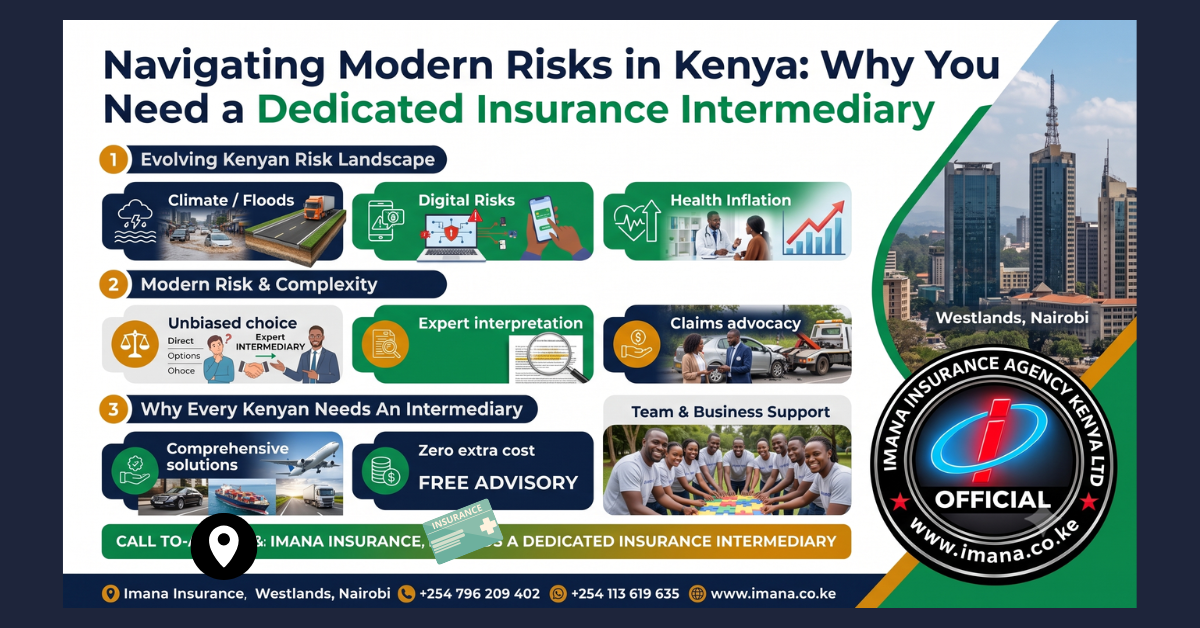
Why Every Kenyan Needs a Dedicated Insurance Intermediary
Emerging risks such as cyber threats, climate change, digital fraud and complex insurance products make professional insurance advice essential. Learn why every consumer and business in Kenya needs a dedicated insurance intermediary.
Insurance Is Becoming More Complex—and Consumers Should Not Navigate It Alone. For many years, insurance was relatively straightforward for the average consumer.
You insured your car. You bought medical cover. A business insured its premises. An employer arranged WIBA. A traveller purchased Travel Insurance.
That world is changing.
Individuals and businesses today face an expanding range of risks involving:
- Cybercrime
- Digital fraud
- Climate-related events
- Flooding
- Data breaches
- Artificial intelligence
- Electric vehicles
- International travel
- Cross-border trade
- Online businesses
- Remote working
- Digital payments
- Professional liability
- Supply-chain disruption
- Emerging health risks
- Increasing property replacement costs
At the same time, insurance itself is becoming more sophisticated. Consumers must understand limits, sublimits, excesses, co-payments, exclusions, waiting periods, territorial restrictions, cyber conditions, warranties and claims procedures.
Globally, supervisors are paying increased attention to risks including climate change, cybersecurity, operational resilience and artificial intelligence. The International Association of Insurance Supervisors has identified climate risk and cyber resilience as major supervisory themes, while its 2025 global market work also highlighted rising AI adoption as a significant insurance-sector issue. (IAIS)
In Kenya, the Insurance Regulatory Authority has similarly highlighted digital transformation and changing risk environments within the insurance industry. (Insurance Regulatory Authority)
This creates a powerful argument for a different way of buying insurance:
Every consumer, family and business should have a dedicated insurance expert—an insurance intermediary who understands their risks, compares available options and remains involved throughout the insurance journey.
Who Is an Insurance Intermediary?
An insurance intermediary sits between the customer and the insurance market.
Depending on the licence and business model, an intermediary may operate as an:
- Insurance agent
- Insurance broker
- Other authorised insurance distributor
The Insurance Regulatory Authority defines an insurance broker as an intermediary between the buyer and seller of an insurance contract who is not tied to either party. IRA also maintains registers of licensed insurance intermediaries in Kenya. (Insurance Regulatory Authority)
International insurance standards recognise intermediaries as important distribution channels. The IAIS notes that intermediaries have an important role in the relationship between consumers and insurers and that their competence and conduct help build confidence in insurance markets. (IAIS)
But the modern intermediary should do much more than simply deliver an insurance certificate.
A strong insurance intermediary should help the customer:
Learn → Assess Risk → Compare → Get a Quote → Buy → Claim → Review → Renew
That relationship becomes increasingly valuable as risks become more complicated.
Why the Traditional “Buy Insurance Once a Year” Model Is Becoming Outdated
Many consumers still interact with insurance only when:
- Their motor certificate is expiring
- Their employer requests WIBA
- An embassy requires Travel Insurance
- A bank requires Comprehensive Motor Insurance
- A landlord requires liability insurance
- A tender requires a bond
The customer buys the policy and may not speak to their insurance provider again until the next renewal.
That approach is becoming inadequate.
A household or business can change significantly within twelve months.
You may:
- Buy another vehicle
- Start driving for commercial purposes
- Employ more workers
- Move offices
- Add expensive equipment
- Begin selling online
- Collect customer data
- Start importing goods
- Travel internationally
- Add children to a medical plan
- Acquire rental property
- Start a construction project
Every one of those changes can create a new insurance exposure.
The role of the intermediary should therefore shift from annual policy seller to continuous risk adviser.
1. Cyber Risk Is No Longer Only a Large-Company Problem
More businesses now depend on:
- Cloud software
- Mobile money
- Online banking
- E-commerce
- Customer databases
- Websites
- Social media
- Digital accounting
- Remote-access systems
This creates exposures involving:
- Ransomware
- Phishing
- Payment diversion
- Data theft
- Business-email compromise
- System interruption
- Privacy claims
The IMF has warned that greater digitalisation is increasing cyber exposure and that severe cyber incidents can create significant financial losses. Its 2026 work also highlights how AI is increasing the speed and scale of some cybersecurity threats. (IMF)
The World Bank similarly notes that digital financial services expand access while creating consumer and cyber risks. (World Bank)
A business owner may therefore need more than conventional Fire, Burglary and WIBA policies.
The intermediary should ask:
- What customer information do you store?
- Are payments received digitally?
- Do employees have remote system access?
- Can the business operate without its IT systems?
- Are backups maintained?
- Would a data breach create legal or notification costs?
Those questions lead to a conversation about Cyber Insurance, rather than waiting for an incident before discovering that an ordinary property policy does not cover it.
2. Climate Risk Is Changing Traditional Insurance Thinking
Climate-related events increasingly influence insurance and financial-sector risk globally.
The IAIS published updated guidance on supervision of climate-related risks in 2025, covering areas including governance, risk management, valuation, disclosure and scenario analysis. (IAIS)
For Kenyan consumers, climate exposure may affect risks involving:
- Vehicles
- Homes
- Commercial buildings
- Farms
- Livestock
- Stock
- Warehouses
- Construction projects
- Transport operations
A motorist may need to understand flood protection.
A property owner may need to reconsider the building sum insured.
A farmer may need crop, livestock or index-based insurance.
A business operating from a flood-prone location may need to review both Property Insurance and Business Interruption.
This is where a dedicated intermediary becomes useful.
The question should not merely be:
“How much is Fire Insurance?”
It should be:
“What events could prevent this business from operating, and which of those risks can reasonably be insured?”
3. Artificial Intelligence Creates New Opportunities—and New Risks
Artificial intelligence is changing:
- Customer service
- Financial services
- Healthcare
- Professional advice
- Software development
- Marketing
- Fraud detection
- Claims processing
But AI can also create risks involving:
- Incorrect automated decisions
- Cyberattacks
- Data privacy
- Professional errors
- Intellectual property disputes
- Business interruption
The IAIS has identified rising AI adoption as an important issue for insurance supervisors, while the IMF has highlighted AI's potential to amplify cybersecurity risks. (IAIS)
For consumers and businesses, this means insurance advice increasingly needs to consider technology exposures alongside traditional risks.
A technology business may need:
- Professional Indemnity
- Cyber Insurance
- Public Liability
- WIBA
- Electronic Equipment Insurance
- Directors and Officers Liability
No single policy solves every exposure.
4. Digital Insurance Is Making Buying Easier—but Understanding Cover Is Still Essential
Insurance can increasingly be bought through:
- Websites
- Mobile applications
- Online marketplaces
- Banks
- Travel-booking systems
- Retail checkouts
- Embedded insurance platforms
This is excellent for accessibility.
But convenience creates another problem:
Customers can purchase insurance faster than they can understand it.
A checkbox saying:
“Add Travel Protection”
does not explain:
- Medical limits
- Trip cancellation
- Baggage sublimits
- Pre-existing conditions
- Excesses
- Territorial limits
Similarly, clicking “Comprehensive Motor Insurance” does not tell you whether the quotation includes:
- Excess Protector
- Political Violence and Terrorism
- Courtesy car
- Windscreen
- Road rescue
- Passenger liability
Digital distribution therefore does not eliminate the need for expert advice.
In many cases, it makes that advice more important.
5. Insurance Products That Look Similar Can Be Very Different
Consider two Comprehensive Motor Insurance quotations.
Both may say:
Comprehensive Motor Insurance – KSh 4 million vehicle
One may include:
- Excess Protector
- Political Violence and Terrorism
- Road rescue
- Windscreen cover
Another may exclude some of those benefits.
The premiums cannot therefore be compared fairly without reviewing the underlying terms.
The same problem exists with medical insurance.
Two policies offering:
KSh 1 million inpatient cover
may have completely different:
- Hospital networks
- Co-payments
- Maternity limits
- Chronic-condition benefits
- Cancer limits
- Waiting periods
- Family-sharing structures
This is exactly where an intermediary adds value.
The role is not simply:
“Which quotation is cheapest?”
It is:
“What are you actually receiving for the premium?”
International supervisory guidance says insurance advice should be fair and objective and should explain product benefits, costs, restrictions and alternatives. (IAIS)
6. Every Consumer Has a Different Risk Profile
Insurance should not be one-size-fits-all.
Consider two motorists.
Motorist A
- Drives a low-value older car
- Uses it occasionally
- Can comfortably finance repairs
Third-Party or Third-Party Fire and Theft may be appropriate.
Motorist B
- Drives a financed SUV
- Commutes every day
- Travels frequently
- Could not comfortably replace the vehicle
Comprehensive Insurance may be much more appropriate.
The same principle applies to families.
A young family may need:
- Medical Insurance
- Life Insurance
- Personal Accident
- Home Insurance
- Motor Insurance
- Travel Insurance
A retiree may prioritise:
- Senior Medical Insurance
- Life or Last Expense
- Home Insurance
- Travel Insurance
A business owner may need:
- WIBA
- Property Insurance
- Business Interruption
- Public Liability
- Cyber Insurance
- Professional Indemnity
The intermediary's job is to understand the client before recommending the insurance.
7. SMEs Need an Insurance Expert Even More
Small businesses often begin with one or two policies.
Perhaps:
- WIBA
- Motor Insurance
- Fire Insurance
Then the business grows.
It hires employees.
It moves into bigger premises.
It purchases machinery.
It imports goods.
It collects customer information.
It begins supplying large companies.
Suddenly the business may need:
- WIBA
- Group Personal Accident
- Property Insurance
- Business Interruption
- Goods in Transit
- Marine Cargo
- Public Liability
- Product Liability
- Professional Indemnity
- Cyber Insurance
- Fidelity Guarantee
- Commercial Motor
- Bid Bonds
- Performance Bonds
This transition can happen gradually, making insurance gaps difficult for the business owner to identify.
A dedicated intermediary should periodically conduct a risk review rather than simply renewing last year's policies.
8. The Intermediary Should Help Prevent Underinsurance
Underinsurance occurs when the insured value is inadequate compared with the actual value at risk.
It can affect:
- Vehicles
- Buildings
- Machinery
- Stock
- Household contents
Inflation, construction costs, currency movements and asset improvements can all change replacement values.
A building insured several years ago at the same sum may no longer be adequately protected.
The intermediary should therefore ask at renewal:
- Has the property been renovated?
- Has stock increased?
- Has machinery been added?
- Has the vehicle value changed?
- Has turnover grown?
- Has payroll increased?
Renewing the same schedule without reviewing it can leave a customer believing they have adequate insurance when they do not.
9. Claims Are Where the Value of an Intermediary Becomes Most Visible
Buying insurance can take minutes.
A complicated claim may take weeks or months.
Claims can require:
- Police reports
- Claim forms
- Medical reports
- Repair estimates
- Valuations
- Assessors
- Loss adjusters
- Investigation reports
- Witness statements
- Financial records
- Proof of ownership
This is where professional assistance matters.
IRA specifically recognises a role for brokers and agents during the claims-settlement process, while consumers and intermediaries can also seek IRA intervention in disputes involving policyholder rights or claim settlement. (Insurance Regulatory Authority)
A strong intermediary can assist with:
- Claim notification.
- Identifying required documents.
- Coordinating with assessors.
- Following up outstanding requirements.
- Explaining insurer requests.
- Monitoring progress.
- Helping the policyholder understand a settlement.
The insurer still determines whether a claim is payable under the policy.
But the customer should not have to navigate the entire process alone.
10. The Intermediary Should Become the Consumer's Insurance Record Keeper
Insurance becomes increasingly difficult to manage when a consumer has:
- Two vehicles
- Family Medical Insurance
- Home Insurance
- Travel Insurance
- Life Insurance
- Rental property
- Business insurance
Each policy has:
- Different renewal dates
- Different insurers
- Different claim contacts
- Different terms
A dedicated intermediary can help create a consolidated insurance portfolio containing:
- Policy
- Insurer
- Sum insured
- Premium
- Renewal date
- Main benefits
- Major exclusions
- Claim contact
- Required actions
This turns insurance from a collection of certificates into a managed risk programme.
11. Consumers Need Someone Who Understands What Is Changing
The insurance market does not remain static.
Products evolve.
Risks evolve.
Technology evolves.
Regulations evolve.
Consumer behaviour evolves.
Recent Kenyan insurance-sector discussions have focused on digital transformation, resilience and changing strategic risks, while the IRA continues public education initiatives that allow consumers to obtain guidance on policy coverage, claims and policyholder rights. (Insurance Regulatory Authority)
A consumer should not have to independently track every development.
A dedicated insurance expert should help translate market changes into a simple question:
Does this change create a risk that affects you?
12. Insurance Intermediaries Also Create Competition
Without comparison, the customer may simply renew with the same insurer every year.
That may be appropriate—but it should be a decision rather than an assumption.
An intermediary can help compare:
- Premium
- Benefits
- Excesses
- Sublimits
- Claims requirements
- Optional extensions
- Provider networks
- Insurer appetite
IRA states that consumers have the right to independently select an underwriter or broker from licensed providers. (Insurance Regulatory Authority)
Competition can improve both:
- Price
- Quality of protection
But price should never become the only criterion.
13. Your Insurance Intermediary Should Know When Not to Sell You a Policy
This is an important distinction.
Good insurance advice is not:
“Buy as much insurance as possible.”
Sometimes the appropriate advice may be:
- Increase your emergency savings.
- Improve security controls.
- Repair a dangerous electrical installation.
- Install backups.
- Change an unsafe business process.
- Increase an existing limit instead of buying another policy.
- Avoid duplicating cover you already have.
Insurance is one component of risk management—not the solution to every risk.
The objective should be to identify risks that are:
- Financially significant
- Insurable
- Difficult for the consumer to retain personally
What Should a Dedicated Insurance Intermediary Do for You?
A modern insurance intermediary should ideally provide six core services.
1. Risk assessment
Understand:
- What you own
- What you do
- Who depends on you
- What liabilities you face
- What could interrupt your income
2. Insurance education
Explain:
- Benefits
- Limits
- Sublimits
- Excesses
- Waiting periods
- Exclusions
- Claims procedures
3. Quotation comparison
Help you understand the difference between competing options.
4. Policy administration
Support:
- Issuance
- Amendments
- Addition of assets
- Addition of employees
- Certificates
- Renewals
5. Claims support
Guide you when an insured event occurs.
6. Regular insurance reviews
Your cover should evolve as your life or business evolves.
Questions to Ask Your Insurance Intermediary
Before establishing a long-term relationship, ask:
- Are you licensed by the Insurance Regulatory Authority?
- Which insurance products do you handle?
- Can you help compare alternatives?
- How do you explain exclusions and excesses?
- Do you provide claims support?
- How are renewals managed?
- Can you handle personal and business insurance together?
- Will you review my cover when circumstances change?
- Who do I contact during an emergency?
- Can I access my policy documents digitally?
Consumers can check licensed intermediaries through the Insurance Regulatory Authority's official resources. (Insurance Regulatory Authority)
From Insurance Seller to Insurance Relationship Manager
The future of insurance intermediation should be relationship-based.
The traditional model:
Quote → Pay → Certificate → See you next year
should evolve into:
Learn → Understand Risk → Compare → Get a Quote → Buy → Monitor → Claim → Review → Renew
That is particularly important as consumers simultaneously face:
- Traditional risks
- Digital risks
- Climate risks
- Liability risks
- Cross-border risks
- Changing health needs
- Increasing asset values
The intermediary should become the person a customer asks:
“Does this affect my insurance?”
How Imana Approaches Insurance Intermediation
Imana Insurance Agency Kenya Ltd operates as an insurance intermediary helping individuals, families and businesses compare and purchase multiple classes of insurance through its digital and physical channels. Its current insurance hub covers motor, medical, travel, WIBA, life, business and property insurance, with quotation and claims-support pathways. (imana.co.ke)
The approach can be summarised as:
Learn
Understand the risk and insurance solution.
Compare
Compare premiums, benefits and conditions.
Get a Quote
Request quotations from suitable insurers.
Buy
Select appropriate protection and complete issuance.
Claim
Receive guidance when a loss occurs.
Renew
Review the policy before continuing for another year.
Learn. Compare. Get a Quote. Buy. Claim. Renew—with Imana.
Insurance Solutions That May Require Professional Advice
Through a dedicated intermediary relationship, consumers and organisations can review areas such as:
- Motor Insurance
- Medical Insurance
- Life Insurance
- Last Expense
- Personal Accident
- Student Personal Accident
- WIBA
- Group Personal Accident
- Group Medical
- Travel Insurance
- COMESA Yellow Card
- Home Insurance
- Landlord Insurance
- Business Insurance
- Cyber Insurance
- Public Liability
- Product Liability
- Professional Indemnity
- Marine Cargo
- Goods in Transit
- Contractors All Risks
- Plant and Machinery
- Bid Bonds
- Performance Bonds
Imana's current online platform provides quotation and product pathways across personal and commercial insurance categories. (imana.co.ke)
Insurance Advice in Westlands, Nairobi and Across Kenya
Imana Insurance Agency Kenya Ltd
4th Floor, Krishna Centre
Woodvale Grove, Westlands
Nairobi, Kenya
Website: www.imana.co.ke
Call/WhatsApp: +254 745 218 460 | +254 796 209 402
Imana's official site identifies the agency as IRA-licensed and based in Westlands, Nairobi. (imana.co.ke)
Frequently Asked Questions
What is an insurance intermediary?
An insurance intermediary facilitates the relationship between customers and insurers. Depending on the licence, this may include agents and brokers. Kenya's IRA licenses and maintains information on insurance intermediaries. (Insurance Regulatory Authority)
Why should I use an insurance intermediary?
An intermediary can help you understand risks, obtain quotations, compare policy terms, arrange insurance, manage renewals and obtain guidance during claims.
Do I still choose the insurance company?
Yes. The consumer should understand and approve the insurer and policy selected. IRA specifically recognises consumers' ability to independently select insurers or brokers from licensed providers. (Insurance Regulatory Authority)
Is an intermediary useful if I can buy insurance online?
Yes. Digital purchasing improves convenience, but products can still contain limits, exclusions and conditions that require careful comparison.
Should businesses have a dedicated insurance intermediary?
It can be particularly useful because businesses may have interconnected risks involving employees, property, vehicles, liability, cyber exposures, cargo and business interruption.
Can an intermediary guarantee that my claim will be paid?
No. Claims are determined by the insurer according to policy terms and facts surrounding the loss. An intermediary can assist with notification, guidance, documentation and communication.
How do I know whether an intermediary is licensed?
Use the Insurance Regulatory Authority's official licensed-intermediary resources. (Insurance Regulatory Authority)
The Bottom Line: Every Consumer Needs an Insurance Expert
Insurance is moving beyond the days when consumers needed only a motor certificate, medical card or fire policy.
The risk environment is becoming broader.
Businesses are becoming digital.
Assets are changing.
Climate-related exposures are increasingly relevant.
Cyber threats are evolving.
AI is creating both opportunities and new risks.
Insurance products themselves are becoming more specialised. (IMF)
That means the modern insurance consumer needs more than an insurer.
They need someone who understands their complete risk picture.
Someone who can explain:
- What to insure
- What not to insure
- Which limits are appropriate
- What quotations actually mean
- Which exclusions matter
- What changed since last year
- What to do when a claim occurs
That person is the insurance intermediary.
Your accountant understands your finances. Your lawyer understands your legal exposure. Your doctor understands your health. In an increasingly complex risk environment, your insurance intermediary should understand your protection.
Imana Insurance Agency Kenya Ltd
Learn. Compare. Get a Quote. Buy. Claim. Renew—with Imana.
www.imana.co.ke
Call/WhatsApp: +254 745 218 460 | +254 796 209 402
Insurance needs differ between individuals and organisations. Policy availability, premiums, benefits, exclusions and underwriting requirements vary by insurer. Consumers should deal with licensed insurance providers and review policy documents before purchasing cover.
Author: Raymond Momanyi, Founder & CEO, Imana Insurance Agency Kenya Ltd