
Blog Details
Diskava. Beta. Kava
02Aug
Travel Insurance in Kenya: Schengen, Students, Seniors and Claims Guide
A complete travel insurance guide for Kenyans covering Schengen visa applications, students studying abroad, senior travellers, annual versus single-trip plans, flight cancellation, lost baggage and claim procedures.
What Should You Check Before Buying Travel Insurance?
Travel Insurance protects travellers against specified financial losses and emergencies arising before or during a journey.
Depending on the policy selected, it may provide cover for:
- Emergency medical treatment
- Hospital admission
- Medical evacuation
- Repatriation
- Trip cancellation
- Trip curtailment
- Delayed departure
- Lost or delayed baggage
- Passport loss
- Personal Accident
- Personal Liability
- Emergency assistance
However, not every travel policy includes every benefit.
A low-cost policy may satisfy basic visa requirements while providing limited protection for baggage, trip cancellation or pre-existing medical conditions. Another policy may offer broader benefits but carry higher excesses or stricter conditions.
The right Travel Insurance policy should match the destination, traveller’s age, trip duration, activities and visa requirements—not merely the cheapest available premium.
1. Travel Insurance for Schengen Visa Applications from Kenya
Kenyans applying for a short-stay Schengen visa are generally required to provide Travel Medical Insurance covering:
- Emergency medical care
- Emergency hospitalisation
- Medical repatriation
- Repatriation in the event of death
The European Commission lists medical insurance covering emergency care, hospitalisation and repatriation among the documents required for a Schengen visa application. (Migration and Home Affairs)
Minimum Schengen insurance requirement
The insurance should generally:
- Provide at least EUR 30,000 in medical coverage
- Be valid throughout the Schengen Area
- Cover the full intended stay
- Include emergency medical treatment
- Include hospitalisation
- Include medical repatriation
- Include repatriation following death
Official Schengen information confirms a minimum cover of EUR 30,000 and requires validity throughout the Schengen Area and the intended stay. (European External Action Service)
The certificate should show
Before submitting the visa application, confirm that the insurance certificate displays:
- Traveller’s full name as shown in the passport
- Passport number where required
- Destination or Schengen Area validity
- Policy start date
- Policy expiry date
- Medical benefit limit
- Repatriation benefits
- Insurer’s name
- Policy or certificate number
- Emergency-assistance contact
Incorrect names, dates or territorial wording may delay the application or require a replacement certificate.
Use an accepted insurance provider
Some Schengen missions maintain lists of insurance companies whose policies are accepted for applications made in Kenya.
For example, the German Embassy in Nairobi states that Kenyan-issued Travel Medical Insurance is accepted only where the insurance company appears on its approved list. (German Embassy Nairobi)
The relevant embassy or visa centre should therefore be checked before purchasing cover because acceptance arrangements may vary.
Multiple-entry Schengen visas
For a multiple-entry visa application, the applicant may initially be required to show insurance covering the first intended journey. However, the traveller remains responsible for maintaining appropriate insurance for later visits.
The European Commission’s Schengen guidance provides that applicants for multiple-entry visas present proof of insurance for their first intended stay. (Migration and Home Affairs)
Does Schengen Travel Insurance guarantee visa approval?
No.
Insurance satisfies only one part of the application.
The visa authority may also consider:
- Valid passport
- Purpose of travel
- Accommodation
- Flight reservation
- Financial capacity
- Travel history
- Intention to return to Kenya
- Supporting employment or business documents
The insurer and insurance intermediary do not determine whether a visa is approved.
2. Travel Insurance for Students Studying Abroad
Students travelling overseas for university, college, exchange programmes, internships or professional training may need more than ordinary short-term Travel Insurance.
A student may remain abroad for:
- One semester
- One academic year
- Several years
- A short exchange programme
- Internship or attachment
- Research placement
The policy should reflect the actual duration and purpose of travel.
What student Travel Insurance may cover
Depending on the plan, benefits may include:
- Emergency medical treatment
- Hospitalisation
- Medical evacuation
- Repatriation
- Personal Accident
- Personal Liability
- Lost baggage
- Passport loss
- Emergency dental treatment
- Study interruption
- Compassionate family visit
- Emergency return to Kenya
- Sponsor protection
- Tuition-fee protection
- Accidental damage to rented accommodation
Not every standard travel plan includes education-related benefits.
Travel Insurance vs international student health insurance
Short-term Travel Insurance may cover unexpected emergencies during the journey and initial stay.
Long-term international student health insurance may provide broader ongoing healthcare protection, including:
- Routine consultations
- Outpatient care
- Prescribed medicines
- Specialist treatment
- Chronic-condition management
- Mental-health services
- Maternity, where included
The student should establish whether the institution requires:
- Travel Medical Insurance
- Local national health insurance
- University-arranged medical cover
- Private international health insurance
- A combination of the above
Requirements vary by country, institution and visa category.
Important questions for students
Before purchasing cover, ask:
- Is the policy valid for the full academic period?
- Does it cover the country of study?
- Are trips to neighbouring countries included?
- Are academic holidays covered?
- Does protection continue during visits to Kenya?
- Are pre-existing conditions included?
- Are sports and extracurricular activities covered?
- Is mental-health treatment included?
- Is emergency evacuation included?
- What happens if studies are interrupted?
- Does the university accept the policy?
- Can the policy be renewed from abroad?
Documents students may need
A quotation or policy application may require:
- Passport copy
- Admission letter
- Student visa information
- Destination
- Travel dates
- Academic period
- Date of birth
- Medical declaration
- Sponsor details
- University insurance requirements
The student should carry both digital and printed policy documents while travelling.
3. Travel Insurance for Senior Citizens in Kenya
Senior travellers may face higher medical risks and more restrictive insurance terms than younger travellers.
Insurers may consider:
- Traveller’s age
- Destination
- Trip duration
- Medical history
- Existing conditions
- Planned activities
- Required benefit limit
Some policies have:
- Maximum entry ages
- Higher premiums for older travellers
- Reduced trip-duration limits
- Medical questionnaires
- Additional excesses
- Restricted pre-existing-condition benefits
- Different medical limits by age band
Important benefits for senior travellers
Senior citizens should pay particular attention to:
- Emergency medical expenses
- Hospitalisation
- Medical evacuation
- Repatriation
- Emergency dental treatment
- Trip cancellation
- Trip curtailment
- Companion travel expenses
- Personal Accident
- 24-hour emergency assistance
Pre-existing medical conditions
A pre-existing condition may include an illness, injury, symptom or medical concern that existed before the policy began.
Depending on the insurer, such a condition may be:
- Covered automatically
- Covered after medical assessment
- Covered subject to a separate limit
- Covered after additional premium
- Excluded completely
The traveller should disclose medical information accurately.
Failure to disclose a relevant condition may affect a claim.
Medication considerations
A senior traveller taking regular medication should:
- Carry enough medication for the journey
- Keep medicines in original packaging
- Carry a doctor’s prescription
- Confirm destination-country restrictions
- Place essential medicine in hand luggage
- Carry a brief medical summary
- Record emergency contacts
Routine medication is not normally reimbursed simply because it is required during travel.
The policy generally focuses on unexpected insured medical events.
Travelling with a companion
Where a senior traveller requires assistance, confirm whether the policy covers eligible costs involving:
- A travelling companion
- An accompanying family member
- An emergency family visit
- Additional accommodation
- Return travel following hospitalisation
These benefits vary significantly between insurers.
4. Annual Multi-Trip vs Single-Trip Travel Insurance
Travel Insurance can normally be arranged for one journey or several journeys within a year.
The most suitable option depends on how frequently the traveller leaves Kenya.
What is Single-Trip Travel Insurance?
Single-Trip Insurance covers one defined journey.
The certificate shows:
- Departure date
- Return date
- Destination
- Policy period
- Traveller details
It may suit:
- One annual holiday
- A single business trip
- One Schengen visa application
- A family visit
- A short academic trip
- A pilgrimage
- One international conference
Cover ordinarily ends when:
- The traveller returns
- The policy expires
- The maximum permitted trip period ends
- Another termination condition applies
Advantages of Single-Trip cover
- Suitable for infrequent travellers
- Premium reflects one journey
- Destination and dates are clearly defined
- May be easier to match with a specific visa application
- Can be customised for one trip
Limitations
- A new policy is required for every later journey
- Repeated purchases can become expensive
- A traveller may forget to arrange cover for a new trip
- Last-minute travel may be inconvenient
What is Annual Multi-Trip Travel Insurance?
Annual Multi-Trip Insurance covers multiple eligible journeys made within one policy year.
It may suit:
- Frequent business travellers
- Consultants
- Corporate executives
- Regional sales representatives
- Diplomats
- International-organisation employees
- Families travelling several times annually
- Travellers making regular holidays or visits
The policy remains active for 12 months, but each individual journey may be subject to a maximum duration such as:
- 30 days
- 45 days
- 60 days
- 90 days
The exact maximum varies by insurer.
Advantages of Annual Multi-Trip cover
- One policy covers several journeys
- Reduces repeated applications
- Convenient for urgent travel
- May be more economical for frequent travellers
- Provides consistent annual insurance details
Limitations
- Maximum duration applies to each trip
- Long stays may not qualify
- Some destinations may be excluded
- Age restrictions may apply
- Higher-risk activities may require extensions
- Not automatically suitable for full-time study or residence abroad
Which option is better?
Single-Trip may be better where:
- You travel once or twice annually.
- The trip is long.
- The destination requires a specific certificate.
- You want cover designed for one journey.
- Your future travel plans are uncertain.
Annual Multi-Trip may be better where:
- You travel several times each year.
- Most journeys are relatively short.
- You travel for business at short notice.
- You want one continuous annual arrangement.
- The total annual premium is more economical.
Questions to compare
Before choosing, confirm:
- Maximum duration per trip
- Number of permitted trips
- Geographical area
- Age limit
- Medical benefit
- Cancellation limit
- Baggage limit
- Winter or adventure-sports conditions
- Business-travel benefits
- Family eligibility
- Excess
- Renewal terms
Annual cover does not necessarily mean one uninterrupted 12-month journey. It usually covers several separate trips, each subject to a maximum duration.
5. Does Travel Insurance Cover Flight Cancellation?
Travel Insurance may cover flight or trip cancellation where the journey is cancelled before departure because of a reason specifically insured under the policy.
Possible insured reasons may include:
- Serious unexpected illness
- Accidental injury
- Death of the traveller
- Death or serious illness of an eligible close relative
- Serious damage to the traveller’s home
- Compulsory court attendance
- Another listed emergency
The policy may reimburse eligible non-refundable expenses such as:
- Airline tickets
- Accommodation deposits
- Tour bookings
- Other prepaid travel costs
Cancellation is not automatic
Travel Insurance does not ordinarily pay simply because:
- The traveller changed their mind.
- The visa was declined, unless specifically covered.
- The traveller forgot travel dates.
- The traveller found a cheaper ticket.
- Work commitments changed.
- The traveller failed to obtain required documents.
- The airline ticket was refundable.
- The reason is excluded by the policy.
When should cancellation cover begin?
Cancellation protection is most useful when purchased soon after booking or paying for the trip.
A policy bought after the event causing cancellation became known will not normally cover that event.
Documents for a cancellation claim
The insurer may request:
- Claim form
- Policy certificate
- Passport copy
- Flight itinerary
- Booking confirmation
- Proof of payment
- Cancellation invoice
- Airline refund statement
- Hotel refund statement
- Medical report
- Death certificate where applicable
- Evidence supporting the reason for cancellation
The claimant should first request all available refunds from airlines, hotels and service providers.
Insurance ordinarily considers the eligible non-refundable balance, subject to the policy.
6. Does Travel Insurance Cover Flight Delay?
Some policies provide a fixed benefit after a flight is delayed beyond a specified number of hours.
The policy may help with eligible:
- Meals
- Accommodation
- Local transport
- Essential expenses
- Fixed delay compensation
The delay must generally:
- Exceed the minimum waiting period
- Occur for an insured reason
- Be confirmed by the airline
- Take place during the insured journey
Required evidence may include
- Boarding pass
- Original itinerary
- Revised itinerary
- Airline delay confirmation
- Receipts for additional expenses
- Policy certificate
A minor delay may fall below the policy’s minimum qualifying period.
7. Does Travel Insurance Cover Lost Baggage?
Travel Insurance may cover baggage that is permanently lost, stolen or accidentally damaged during an insured journey.
Possible covered property includes:
- Clothing
- Suitcases
- Personal effects
- Travel documents
- Limited electronic equipment
- Other declared belongings
Baggage limits
The policy may apply:
- Overall baggage limit
- Limit per item
- Limit for valuables
- Excess payable by the traveller
- Depreciation
- Proof-of-ownership requirements
A KSh 300,000 baggage limit does not necessarily mean one phone or laptop is covered for KSh 300,000.
A smaller single-item limit may apply.
Common baggage exclusions
Policies may exclude or restrict:
- Unattended property
- Unlocked baggage
- Cash
- Jewellery
- Fragile items
- Business equipment
- Unreported theft
- Property left in a vehicle
- Wear and tear
- Confiscation by authorities
- Unexplained disappearance
Valuable items should normally be kept in hand luggage where airline rules allow.
8. Delayed Baggage
Delayed-baggage benefits are different from permanent baggage loss.
Where checked baggage does not arrive on time, the policy may reimburse essential emergency purchases after the delay exceeds a stated period.
Eligible items may include:
- Basic clothing
- Toiletries
- Essential personal items
The traveller should:
- Report the delay at the airport.
- Obtain a Property Irregularity Report.
- Keep the baggage-tag receipt.
- Keep receipts for essential purchases.
- Obtain delivery confirmation when the baggage arrives.
The benefit may not apply after the traveller returns to Kenya or their country of residence.
9. Travel Insurance Claims: Procedure
An emergency abroad can become more difficult where the traveller does not know whom to contact.
The following process applies generally, but the policy’s specific claims procedure takes priority.
Step 1: Protect life and obtain assistance
In a medical emergency, seek appropriate treatment.
Contact local emergency services where necessary.
Step 2: Contact the emergency-assistance provider
Use the number shown on the policy certificate.
For significant treatment or hospital admission, the assistance provider may:
- Confirm cover
- Direct the traveller to a suitable facility
- Issue a payment guarantee
- Coordinate evacuation
- Communicate with doctors
- Contact family members
Where possible, obtain authorisation before major non-emergency treatment.
Step 3: Notify the insurer promptly
Report the incident within the policy’s notification period.
Provide:
- Traveller’s name
- Policy number
- Location
- Contact details
- Nature of emergency
- Hospital or service-provider details
Step 4: Report incidents to relevant authorities
Depending on the claim, report to:
- Airline
- Airport baggage desk
- Police
- Hotel
- Tour operator
- Transport provider
- Embassy or consulate
Step 5: Preserve evidence
Keep:
- Reports
- Photographs
- Receipts
- Emails
- Booking confirmations
- Medical records
- Airline communications
- Witness information
Step 6: Complete the claim form
Answer all questions accurately and sign the declaration.
Step 7: Submit supporting documents
Send complete documents through the insurer’s approved channel.
Step 8: Respond to additional questions
The insurer may request clarification, translations, medical information or original documents.
Step 9: Track the claim
Retain the claim reference number and copies of everything submitted.
10. Common Travel Insurance Claim Documents
The documents required depend on the nature of the claim.
Documents required for most claims
- Completed claim form
- Policy certificate or schedule
- Passport bio-data page
- Entry and exit stamps
- Travel itinerary
- Boarding passes
- Proof of premium payment
- Bank or payment details
- Written description of the incident
Emergency medical claim
The insurer may require:
- Medical report
- Diagnosis
- Hospital discharge summary
- Treatment invoices
- Pharmacy receipts
- Laboratory reports
- Proof of payment
- Doctor’s prescription
- Emergency-assistance reference
- Previous medical records where relevant
Medical evacuation claim
Possible documents include:
- Treating doctor’s recommendation
- Assistance-provider authorisation
- Hospital reports
- Transport invoices
- Flight or ambulance records
Evacuation should ordinarily be coordinated by the insurer’s assistance provider unless immediate circumstances make prior contact impossible.
Trip-cancellation claim
Common documents include:
- Original itinerary
- Proof of booking
- Proof of payment
- Cancellation confirmation
- Refund statement
- Medical certificate
- Death certificate
- Proof of relationship
- Evidence supporting the cancellation reason
Trip-curtailment claim
The traveller may need:
- Original return ticket
- New return ticket
- Reason for early return
- Medical or death documents
- Refund information
- Additional travel receipts
Lost-baggage claim
The insurer may request:
- Property Irregularity Report
- Airline confirmation
- Baggage-tag receipt
- List of lost items
- Purchase receipts
- Proof of ownership
- Airline compensation statement
- Police report where theft is involved
Delayed-baggage claim
Common requirements include:
- Property Irregularity Report
- Delay confirmation
- Baggage tags
- Receipts for emergency purchases
- Date and time baggage was delivered
Passport-loss claim
Possible documents include:
- Police report
- Embassy report
- Emergency travel document
- Replacement-passport receipts
- Transport receipts
- Additional accommodation invoices
Personal Liability claim
The insurer may require:
- Third-party demand
- Police or incident report
- Witness statements
- Photographs
- Court documents
- Correspondence from the claimant
Do not admit liability or promise compensation without consulting the insurer.
11. Common Reasons Travel Insurance Claims Are Delayed or Declined
Claims may be affected by:
- Late notification
- Missing documents
- Treatment without required authorisation
- Undisclosed pre-existing conditions
- Policy expiry
- Travel to an excluded destination
- Participation in an excluded activity
- Alcohol- or substance-related incidents
- Unattended baggage
- Failure to report theft
- No proof of ownership
- Cancellation for a non-covered reason
- Costs already refunded elsewhere
- Incorrect traveller or trip information
A declined claim should be explained with reference to the policy terms.
The policyholder can request:
- Written decision
- Relevant exclusion
- Claim calculation
- Review by the insurer’s complaints department
12. Activities That May Need Additional Cover
Standard Travel Insurance may exclude or restrict:
- Mountain climbing
- Scuba diving
- Skiing
- Motor racing
- Professional sport
- High-altitude trekking
- Manual work
- Hazardous occupations
- Competitive events
- Motorcycle use above stated limits
Tell the insurer about planned activities before buying cover.
A policy suitable for ordinary sightseeing may not protect a traveller undertaking adventure sports or manual employment.
13. Travel Insurance and Pre-Existing Conditions
A policy may exclude a claim arising directly or indirectly from a condition that existed before purchase.
This may include:
- Diagnosed illnesses
- Ongoing symptoms
- Recent medical investigations
- Planned surgery
- Regular treatment
- Recently changed medication
Depending on the product, the insurer may:
- Exclude the condition
- Apply a separate limit
- Request medical information
- Charge additional premium
- Decline cover
- Accept the condition under stated terms
Accurate disclosure is especially important for students staying abroad long-term and senior travellers.
14. How to Compare Travel Insurance Quotations
Do not compare premium alone.
Review:
- Emergency medical limit
- Repatriation
- Medical evacuation
- Schengen compliance
- Cancellation benefit
- Curtailment benefit
- Baggage limit
- Single-item limit
- Travel-delay benefit
- Passport-loss benefit
- Personal Liability
- Personal Accident
- Pre-existing-condition terms
- Maximum age
- Trip-duration limit
- Territorial scope
- Policy excess
- Excluded activities
- Emergency-assistance service
Two policies described as “worldwide travel insurance” can provide very different protection.
15. Information Required for a Travel Insurance Quotation
Prepare:
- Traveller’s full name
- Date of birth
- Passport number
- Destination
- Transit countries
- Departure date
- Return date
- Purpose of travel
- Visa requirements
- Number of travellers
- Existing medical conditions
- Planned activities
- Required benefit limit
For Annual Multi-Trip cover, also provide:
- Expected number of journeys
- Maximum duration of each trip
- Main regions visited
- Business or leisure use
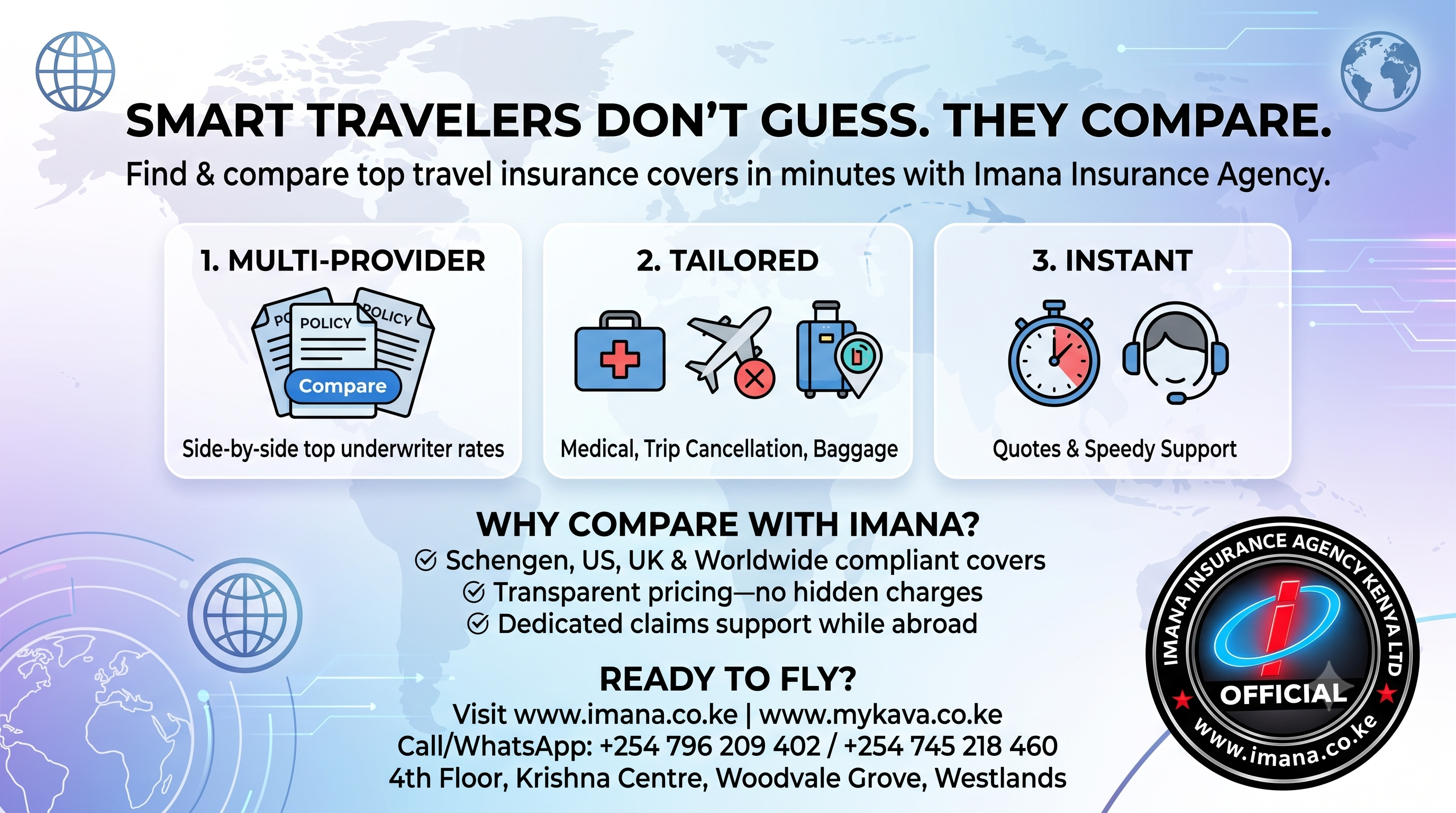
16. How Imana Helps Travellers Compare Travel Insurance
Imana Insurance Agency Kenya Ltd helps individuals, families, students, senior citizens and organisations compare Travel Insurance quotations from suitable licensed insurers.
Support may include:
- Reviewing the destination and travel dates.
- Identifying visa-insurance requirements.
- Comparing Single-Trip and Annual Multi-Trip options.
- Checking age eligibility.
- Reviewing medical and evacuation limits.
- Comparing baggage and cancellation benefits.
- Checking pre-existing-condition terms.
- Coordinating certificate issuance.
- Correcting certificate details where necessary.
- Supporting claim notification and documentation.
Travel Insurance may be arranged for:
- Schengen visa applications
- Business travel
- International students
- Family holidays
- Senior travellers
- Conferences
- Group travel
- Regional and worldwide trips
Travel Insurance in Westlands and Across Kenya
Imana Insurance Agency Kenya Ltd
4th Floor, Krishna Centre
Woodvale Grove, Westlands
Nairobi, Kenya
Travel Insurance information:
www.imana.co.ke/insurance/travel-insurance
Website: www.imana.co.ke
Call or WhatsApp: +254 796 209 402
Confirm the visa requirements. Compare the benefits. Keep the documents. Travel with appropriate protection.
Frequently Asked Questions
How much medical cover is required for a Schengen visa?
The standard minimum is EUR 30,000, covering emergency medical treatment, hospitalisation and repatriation throughout the Schengen Area. (European External Action Service)
Must Schengen insurance cover the entire trip?
Yes. It should be valid throughout the Schengen Area for the intended stay. (European External Action Service)
Does Travel Insurance guarantee visa approval?
No. It only satisfies one of several visa requirements.
Is Annual Multi-Trip Insurance suitable for students?
Usually not for continuous long-term residence unless the policy specifically allows it. Students may require long-term international student or medical insurance.
Does Travel Insurance cover a cancelled flight?
It may cover eligible non-refundable costs where cancellation results from a reason listed in the policy.
Does it cover visa rejection?
Not automatically. Visa-refusal cover must be expressly included.
Does Travel Insurance cover lost baggage?
It may cover eligible permanent loss, theft or accidental damage, subject to overall, single-item and valuables limits.
Can senior citizens obtain Travel Insurance?
Yes, subject to the insurer’s maximum entry age, health requirements, trip duration and available products.
Are pre-existing medical conditions covered?
They may be excluded, limited or accepted after underwriting. The traveller should disclose relevant conditions.
What should I do during a medical emergency abroad?
Obtain urgent assistance and contact the policy’s emergency-assistance provider as soon as possible.
Should I keep receipts?
Yes. Original or verifiable receipts are important for reimbursement claims.
Can Imana assist with a claim?
Yes. Imana can help with notification, document requirements and follow-up, although the insurer makes the final claim decision.
The Bottom Line
A suitable Travel Insurance policy should address the traveller’s real journey—not merely provide a certificate.
Before travelling:
- Confirm visa requirements.
- Check whether the insurer is accepted.
- Choose between Single-Trip and Annual Multi-Trip cover.
- Review medical and evacuation limits.
- Check baggage and cancellation benefits.
- Declare pre-existing conditions.
- Confirm age eligibility.
- Disclose planned activities.
- Save the emergency-assistance number.
- Carry printed and digital documents.
- Report incidents immediately.
- Keep all reports and receipts.
Travel Insurance is most valuable when the certificate is correct, the benefits match the journey and the traveller understands how to obtain help and file a claim.
Imana Insurance Agency Kenya Ltd
Call or WhatsApp: +254 796 209 402
Website: www.imana.co.ke
Plan the journey. Protect the traveller. Keep the evidence. Claim correctly.
Travel Insurance premiums, age limits, medical benefits, visa acceptance, trip-duration limits, exclusions and claims requirements vary between insurers and destinations. Embassy and visa requirements can change. Obtain current official guidance, a written quotation and complete policy wording before purchasing cover.