
Blog Details
Diskava. Beta. Kava
05Aug
Student Personal Accident vs Personal Accident Insurance in Kenya
Learn the difference between Student Personal Accident Cover and ordinary Personal Accident Insurance in Kenya, including benefits, eligibility, school activities, exclusions and claims.
Author: Raymond Momanyi, Founder and CEO, Imana Insurance Agency Kenya Ltd
Is Student Personal Accident Cover the Same as Personal Accident Insurance?
Not exactly.
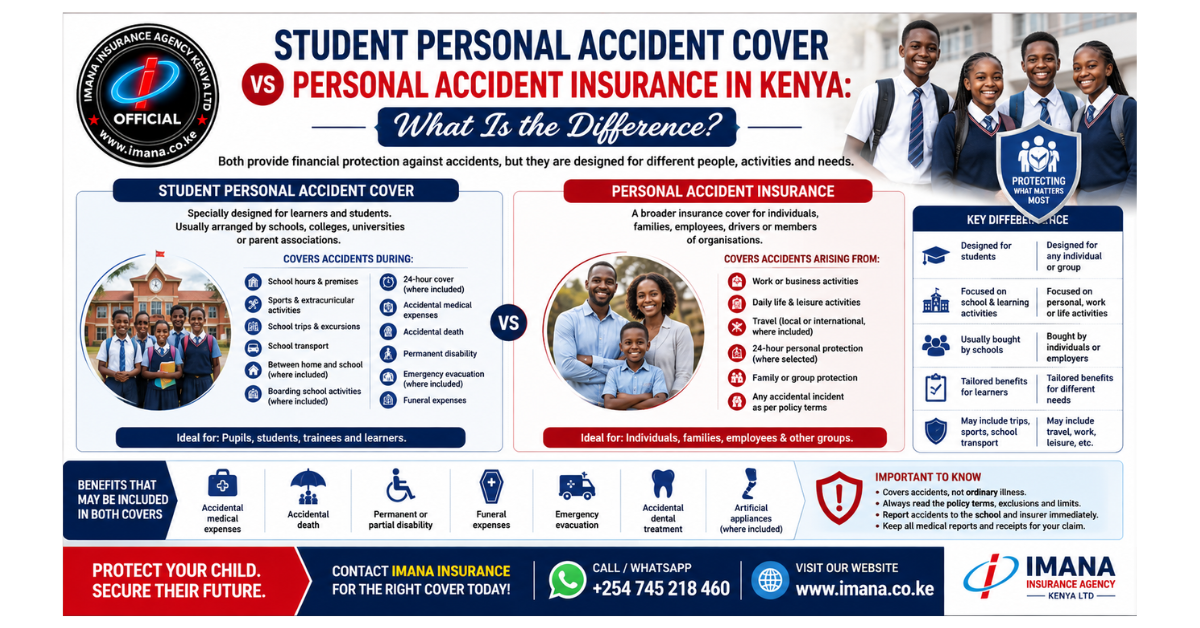
Student Personal Accident Cover is a specialised form of Personal Accident Insurance designed for learners and students. Ordinary Personal Accident Insurance is the broader insurance category and can cover individuals, families, employees, business owners, drivers and members of organised groups.
Both products may provide financial benefits following accidental injury, disability or death. However, they differ in:
- Who is insured
- Who purchases the policy
- Where the cover applies
- Which activities are included
- How benefits are structured
- How claims are reported
- Whether the cover is individual or group-based
Personal Accident Insurance is the broad category. Student Personal Accident Cover is a version structured specifically around learners, schools and educational activities.
What Is Student Personal Accident Cover?
Student Personal Accident Cover is insurance arranged to protect learners against specified accidental injuries during the policy period.
It may be purchased by:
- A school
- College
- University
- Training institution
- Parents’ association
- Educational organisation
- Parent or guardian, where an individual option is available
The institution commonly acts as the master policyholder, while the learners are the insured members.
Depending on the wording, cover may apply:
- While attending lessons
- Within the school compound
- During authorised sports
- During school trips
- During educational tours
- While travelling in an authorised school vehicle
- At boarding facilities
- While travelling between home and school
- On a 24-hour basis, where expressly included
Kenya’s Ministry of Education continues to emphasise compliance with school safety standards, emergency preparedness and learner protection, particularly in boarding institutions. Insurance supports financial recovery after an accident, but it does not replace the institution’s safety responsibilities.
What Is Ordinary Personal Accident Insurance?
Personal Accident Insurance provides stated financial benefits where the insured person suffers an accidental injury covered by the policy.
It may be arranged for:
- One individual
- A family
- Employees
- Company directors
- Drivers
- Members of a SACCO
- Members of an association
- Sports or social groups
- Other identifiable groups
The policy may apply:
- Only during working hours
- During stated activities
- While travelling
- On a 24-hour worldwide basis
- Within a specified geographical territory
The insurer assesses the insured person’s occupation, activities, age, benefit limits and risk exposure during underwriting. The Insurance Regulatory Authority describes underwriting as the process through which an insurer evaluates a risk and determines applicable terms and premiums.
The Main Difference at a Glance
Student Personal Accident Cover
Designed specifically for learners and educational institutions.
The cover may recognise risks connected to:
- Classroom activities
- School sports
- Boarding facilities
- School transport
- Educational trips
- Recreational activities
- Travel between school and home
Ordinary Personal Accident Insurance
Designed for a wider range of people and occupations.
The cover may be structured around:
- Personal daily activities
- Employment
- Business activities
- Driving
- Travel
- Professional duties
- Group membership
The difference is therefore not merely the name of the policy. It is the insured population and the activities around which the protection is designed.
Benefits That May Be Included Under Student Personal Accident Cover
Benefits differ among insurers, but a Student Personal Accident policy may include the following.
1. Accidental Medical Expenses
This may reimburse eligible treatment costs following an insured accident.
Examples may include:
- Doctor’s consultation
- Hospital treatment
- Diagnostic tests
- Prescribed medicine
- Minor surgery
- Physiotherapy
- Follow-up care
A medical-expense limit normally applies per student, accident or policy year.
2. Accidental Death
A fixed benefit may be payable if the insured student dies as a direct result of a covered accident.
The payment is made according to:
- The policy benefit schedule
- Beneficiary or guardian information
- Claim documentation
- Applicable policy conditions
3. Permanent Disability
A student who suffers permanent disability following an insured accident may receive a benefit based on the policy’s disability schedule.
The amount may depend on:
- Nature of the disability
- Medical assessment
- Maximum benefit
- Percentage assigned in the policy
- Whether the disability is total or partial
4. Funeral Expenses
The policy may provide a fixed funeral or burial-expense benefit following an eligible accidental death.
5. Emergency Evacuation
Some policies may cover or coordinate transport to an appropriate medical facility following a serious accident.
This may involve:
- Ground ambulance
- Transfer between hospitals
- Another approved emergency transport arrangement
6. Accidental Dental Treatment
Dental treatment may be covered where damage results directly from an accident.
Routine dental care, braces, cosmetic treatment and pre-existing dental problems may be excluded.
7. Artificial Appliances
A policy may provide limited benefits for medically required appliances following an insured accident, such as:
- Crutches
- Wheelchairs
- Prosthetic devices
- Other prescribed aids
8. Repatriation Expenses
For students travelling away from their normal residence or studying abroad, a policy may include repatriation benefits, subject to the territorial scope and wording.
What Does Student Personal Accident Insurance Usually Not Cover?
Student Personal Accident Insurance mainly responds to accidents, not every medical condition.
Common exclusions or limitations may include:
- Ordinary illness
- Malaria or infections
- Routine outpatient treatment
- Pre-existing medical conditions
- Deliberate injury
- Illegal activities
- Intoxication-related incidents
- Unauthorised hazardous activities
- War and certain civil disturbances
- Treatment unrelated to an accident
- Accidents occurring before the policy began
- Claims reported outside the required period
The exact exclusions vary between insurers.
A parent should not assume that a student with Personal Accident Cover has full medical insurance.
Accident insurance responds to accidental injury. Medical insurance responds to eligible healthcare expenses arising from illness and injury, subject to its own terms.
School-Hours Cover vs 24-Hour Cover
This is one of the most important distinctions when comparing Student Personal Accident policies.
School-hours cover
Protection may apply only:
- During lessons
- Within the school compound
- During authorised school activities
- During school-supervised transport
- On approved trips
An accident occurring at home during a weekend may fall outside this arrangement.
Twenty-four-hour cover
A 24-hour policy may protect the student throughout the day, including:
- At school
- At home
- During weekends
- During holidays
- While travelling
- During personal activities
This broader protection remains subject to:
- Policy territory
- Exclusions
- Sporting restrictions
- Maximum benefits
- Claims conditions
Schools and parents should confirm the coverage period in writing rather than relying on the general phrase “student insurance.”
Does Student Personal Accident Cover Include Sports?
It may, but sports protection should be confirmed.
The policy may distinguish between:
- Ordinary school sports
- Competitive sports
- Contact sports
- Swimming
- Athletics
- Adventure activities
- Professional or elite-level sport
Some activities may be:
- Automatically covered
- Covered only during school supervision
- Subject to lower benefit limits
- Subject to additional premium
- Excluded entirely
A school should disclose its sporting activities when requesting a quotation.
Are Students Covered During School Trips?
School trips may be covered where they are:
- Officially authorised
- Supervised by the institution
- Within the policy territory
- Conducted during the insurance period
- Not excluded by the policy
Trips may include:
- Educational visits
- Sports competitions
- Music festivals
- Academic events
- Excursions
- Exchange programmes
International school trips may require separate Travel Insurance because a local Student Personal Accident policy may not provide:
- Overseas emergency medical treatment
- Medical evacuation
- Repatriation
- Lost baggage
- Trip cancellation
- Passport-loss protection
Does Student Cover Apply During School Transport?
It may cover students while travelling in an authorised school vehicle, but this should be stated clearly.
The school bus itself requires correctly classified motor insurance, including applicable passenger liability. Student Personal Accident Cover and school-bus insurance are complementary products.
School-bus insurance
Primarily addresses:
- Motor-vehicle damage, where comprehensive
- Third-party liability
- Passenger liability
- Other motor-policy benefits
Student Personal Accident Insurance
Provides fixed or medical-expense benefits to the insured student following an eligible accident.
One should not be treated as a substitute for the other.
Student Personal Accident Cover vs Medical Insurance
These products serve different purposes.
Student Personal Accident Cover
Mainly protects against specified accidental events.
It may pay:
- Accident-related medical expenses
- Accidental death benefit
- Disability benefit
- Funeral expenses
Medical Insurance
May cover eligible treatment involving:
- Illness
- Infections
- Hospital admission
- Outpatient consultation
- Prescribed medicines
- Surgery
- Chronic conditions
- Dental or optical care, where included
A student may benefit from holding both policies.
Example
A learner develops pneumonia and is admitted to hospital.
Student Personal Accident Insurance would not ordinarily respond because pneumonia is an illness rather than an accident.
Medical Insurance may respond, subject to its limits, provider network and policy terms.
Another example
A learner falls during a sports activity and breaks an arm.
Student Personal Accident Cover may pay eligible accident-related treatment expenses.
Medical Insurance may also respond, depending on how benefits are coordinated.
Student Personal Accident Cover vs WIBA Insurance
Student Personal Accident Cover should not be confused with WIBA.
Kenya’s Work Injury Benefits Act applies to qualifying accidents and occupational diseases involving employees in the course of employment. The Act defines an accident in relation to an employee’s work and provides compensation benefits within the employer–employee framework. (Kenya Law)
Ordinary students are not employees merely because they attend a school.
WIBA protects school employees such as:
- Teachers
- Drivers
- Cooks
- Cleaners
- Administrators
- Laboratory technicians
- Security employees
- Maintenance staff
Student Personal Accident protects:
- Learners
- Pupils
- College students
- University students
- Trainees listed under the policy
A school may therefore require both:
- WIBA for employees
- Student Personal Accident Cover for learners
Student Personal Accident Cover vs Group Personal Accident
Student Personal Accident Cover is often technically arranged as a form of Group Personal Accident Insurance.
The distinction is mainly in the insured group.
Group Personal Accident
May cover:
- Employees
- Association members
- Club members
- Volunteers
- Directors
- Other organised groups
Student Personal Accident
Covers a defined group of learners and is tailored around educational activities.
A student policy may therefore contain school-specific features that an ordinary employee or association GPA policy does not include.
Who Is the Policyholder?
Under a school-arranged policy, the educational institution is commonly the master policyholder.
The policy schedule may state:
- Name of the school
- Number of students
- Age groups
- Policy period
- Benefit limits
- Territorial scope
- Activities covered
- Premium per learner or total premium
The school should maintain an accurate student register.
Claims may be affected where:
- A student was not declared.
- The student joined after the policy schedule was prepared.
- The school did not submit an updated enrolment list.
- The applicable premium was not paid.
- The learner falls outside the defined eligibility category.
Parents should request confirmation that their child is included.
Can a Parent Buy Student Personal Accident Cover Directly?
This depends on available insurer products.
Some insurers may offer:
- Individual child Personal Accident Insurance
- Family Personal Accident cover
- School-group cover
- Student plans arranged through institutions
Where the school already has group protection, a parent may still consider separate cover where:
- The school benefit is low.
- Protection applies only during school hours.
- Sports are restricted.
- Holiday protection is needed.
- The child frequently travels.
- Wider medical-expense limits are required.
The parent should check for overlapping benefits and determine whether more than one policy can respond.
How Much Does Student Personal Accident Insurance Cost?
There is no universal premium.
Pricing may depend on:
- Number of students
- Age range
- Benefit limits
- School-hours or 24-hour cover
- Day or boarding school
- Sports and extracurricular activities
- Travel requirements
- Claims history
- Territorial scope
- Medical-expense limit
- Disability and death benefits
Group policies may be priced:
- Per student
- Per term
- Per year
- As a total institutional premium
The lowest premium may provide very small medical or disability benefits. Schools should compare the full benefit schedule before selecting a quotation.
Information Required for a Student Personal Accident Quotation
A school or institution may need to provide:
- Registered institution name
- Physical address
- Number of students
- Age groups
- Day or boarding status
- Policy start date
- Required benefit limits
- Sports activities
- School-trip details
- Transport arrangements
- Previous claims
- Existing policy details
- Territorial requirements
Where individual names are required, the insurer may request:
- Student’s full name
- Admission number
- Date of birth
- Class or course
- Parent or guardian information
How Student Personal Accident Claims Work
Step 1: Attend to the student
Provide first aid and arrange appropriate medical treatment.
Step 2: Notify the parent or guardian
Communication should be prompt and factual.
Step 3: Record the incident
Document:
- Date and time
- Location
- Activity
- Nature of the accident
- Supervising staff member
- Witnesses
- Immediate action taken
Step 4: Notify the insurer or intermediary
The accident should be reported within the policy’s notification period.
Step 5: Complete the claim form
The school, parent and medical provider may each be required to complete part of the claim documentation.
Step 6: Submit supporting documents
Provide complete and accurate records.
Step 7: Retain copies
Keep a full claim file and submission confirmation.
Common Claim Documents
Depending on the benefit claimed, the insurer may request:
- Completed claim form
- Policy or certificate details
- Student register or proof of enrolment
- Student identification
- Parent or guardian identification
- School incident report
- Medical report
- Treatment invoices
- Receipts
- Prescription
- Diagnostic reports
- Police abstract where applicable
- Death certificate
- Burial permit
- Disability assessment
- Witness statements
- School-trip or activity authorisation
The insurer may request additional documents depending on the circumstances.
Common Reasons Claims May Be Delayed or Declined
A claim may face difficulties because of:
- Student not being listed or eligible
- Policy expiry
- Late notification
- Missing medical documents
- No proof of payment
- Ordinary illness presented as an accident
- Excluded sport or activity
- Accident outside the territorial scope
- Lack of evidence about how the incident occurred
- Treatment unrelated to the accident
- Benefit limit already exhausted
- Inconsistent information
Schools should avoid waiting until treatment is complete before notifying the insurer.
Questions Schools and Parents Should Ask
Before purchasing or accepting Student Personal Accident Cover, ask:
- Is the policy school-hours only or 24-hour?
- Are weekends and holidays covered?
- Are school trips included?
- Are sports covered?
- Is swimming included?
- Does cover apply between home and school?
- Are boarding students covered overnight?
- What is the accidental medical-expense limit?
- What is the permanent-disability benefit?
- What is the accidental-death benefit?
- Is accidental dental treatment included?
- Is emergency evacuation covered?
- What exclusions apply?
- Does every student need to be named?
- How are new students added?
- How quickly must an accident be reported?
- Which hospitals may be used?
- Who receives the claim payment?
Request a written benefit schedule and policy wording.
Common Mistakes Educational Institutions Make
Buying only WIBA
WIBA protects employees, not ordinary students.
Assuming school-bus insurance covers every student accident
Motor insurance mainly responds to motor-related risks. It does not replace general Student Personal Accident Cover.
Choosing the cheapest benefit
A very low medical-expense limit may be exhausted after one serious accident.
Failing to include sports and trips
The insurer should know the activities students participate in.
Failing to update student numbers
New students may not be covered automatically.
Treating accident insurance as medical insurance
Ordinary illnesses may not be covered.
Failing to educate parents
Parents should know:
- What the policy covers
- What it excludes
- How claims are reported
- Which documents are required
How to Compare Student Personal Accident Quotations
Give each insurer the same information, then compare:
- Premium per student
- Accident medical-expense limit
- Accidental-death benefit
- Permanent-disability benefit
- Funeral-expense benefit
- Emergency evacuation
- Accidental dental benefit
- School-hours or 24-hour protection
- Sports cover
- School-trip cover
- Territorial scope
- Policy excess
- Exclusions
- Claims procedure
Do not compare quotations by premium alone.
A suitable student policy should provide a useful medical benefit, recognise the school’s actual activities and clearly explain when protection begins and ends.
How Imana Helps Schools and Parents Arrange Accident Insurance
Imana Insurance Agency Kenya Ltd helps schools, colleges, universities, training institutions and parents compare Student Personal Accident and other insurance quotations from suitable licensed insurers.
Support may include:
- Reviewing student numbers and age groups.
- Confirming day or boarding-school status.
- Comparing school-hours and 24-hour options.
- Reviewing sports and trip requirements.
- Comparing medical, disability and death benefits.
- Explaining exclusions.
- Coordinating policy issuance.
- Adding new students where permitted.
- Supporting accident notification.
- Assisting with claim-document follow-up.
Schools should obtain insurance through licensed insurers and intermediaries. The Insurance Regulatory Authority regulates Kenya’s insurance sector and maintains resources for checking licensed entities.
Student and School Insurance in Westlands and Across Kenya
Imana Insurance Agency Kenya Ltd
4th Floor, Krishna Centre
Woodvale Grove, Westlands
Nairobi, Kenya
Website: www.imana.co.ke
Call or WhatsApp: +254 745 218 460 | +254 796 209 402
Other insurance solutions for educational institutions may include:
- WIBA Insurance
- Group Personal Accident
- Student Medical Insurance
- School Bus Insurance
- Property Insurance
- Public Liability
- Business Interruption
- Cyber Insurance
- Group Medical Insurance
- Travel Insurance for school trips
Frequently Asked Questions
Is Student Personal Accident Cover the same as Personal Accident Insurance?
Student Personal Accident Cover is a specialised type of Personal Accident Insurance designed for learners and educational activities.
Does Student Personal Accident Cover pay hospital bills?
It may pay eligible accident-related medical expenses up to the stated benefit limit.
Does it cover malaria or ordinary illness?
Not ordinarily. It primarily covers accidents. Medical Insurance is needed for broader illness-related treatment.
Does the cover apply outside school?
Only where the policy provides 24-hour protection or expressly includes the relevant activity.
Are sports injuries covered?
They may be, depending on the sport and policy wording.
Are students covered on school trips?
They may be covered where authorised trips are included.
Does WIBA cover students?
WIBA applies to employees and qualifying work-related injuries. Ordinary students generally require separate Student Personal Accident protection.
Does school-bus insurance replace student accident cover?
No. The two policies protect different risks.
Can parents purchase additional accident cover?
Yes, subject to available individual or family Personal Accident products.
Can one policy cover the whole school?
Yes. Schools commonly arrange group protection for their declared student population.
Can colleges and universities obtain this cover?
Yes. Student Personal Accident Insurance may be arranged for different educational institutions, subject to underwriting.
Can Imana compare quotations for a school?
Yes. Imana can compare student, employee, property, vehicle and liability insurance options from suitable licensed insurers.
The Bottom Line
Student Personal Accident Cover and ordinary Personal Accident Insurance belong to the same general insurance category, but they are structured differently.
Student Personal Accident Cover:
- Is designed for learners.
- Is commonly arranged by a school.
- May include school activities, sports, trips and transport.
- May provide accident-related medical, disability and death benefits.
- May operate during school hours or on a 24-hour basis.
Ordinary Personal Accident Insurance:
- Can protect individuals, families, employees or groups.
- Is not limited to educational settings.
- May be structured around occupations, personal activities or travel.
- Can provide broader individual or group accident protection.
Before purchasing student cover:
- Confirm the coverage period.
- Check sports and trip protection.
- Review the medical-expense limit.
- Understand the exclusions.
- Confirm that every student is included.
- Explain the claims procedure to parents.
- Keep the insurer’s emergency and claims contacts available.
The right student policy should protect the learner during the activities that genuinely form part of their school and daily life—not merely provide a certificate with a low premium.
Imana Insurance Agency Kenya Ltd
Call or WhatsApp: +254 745 218 460 | +254 796 209 402
Website: www.imana.co.ke
Protect the learner. Support the parent. Strengthen the school’s safety programme.
Benefits, premiums, age limits, activities covered, territorial scope, claim requirements and exclusions vary among insurers. Obtain a current quotation, detailed benefit schedule and full policy wording before purchasing cover.