
Blog Details
Diskava. Beta. Kava
22Aug
PSV Insurance Kenya | Matatu, Bus, Taxi, School Bus & More
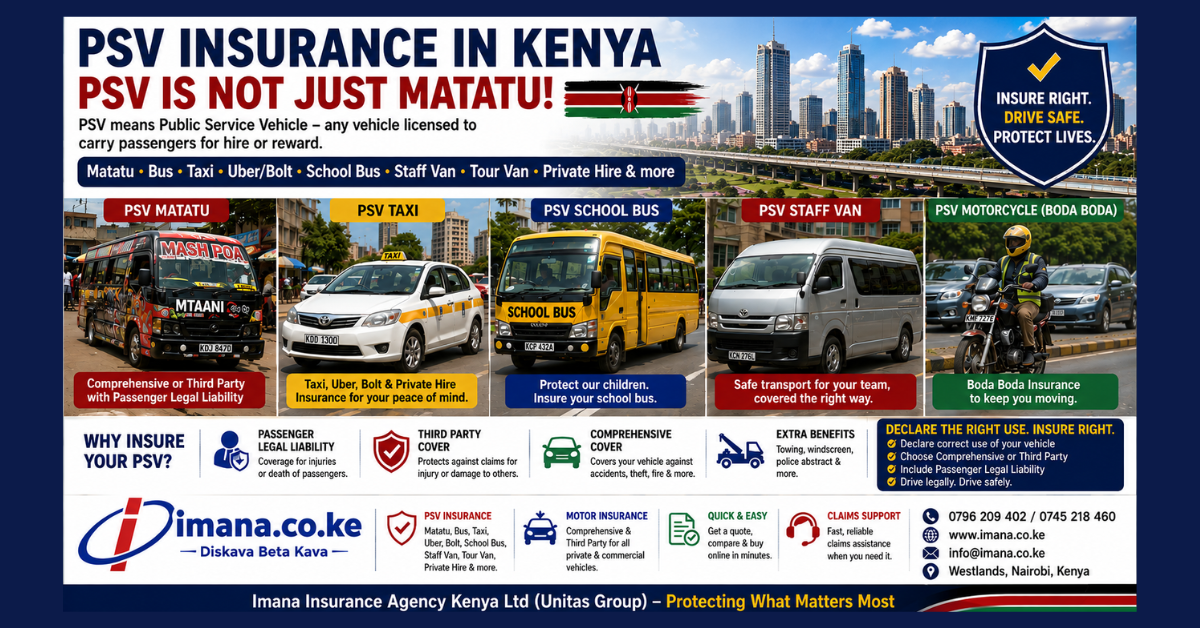
Does PSV mean matatu in Kenya? No. Learn what Public Service Vehicle insurance covers for matatus, buses, school buses, taxis, Uber, Bolt, tour vans, private hire and other PSV classes, including Comprehensive, Third Party and Passenger Legal Liability cover.
Does PSV Mean Matatu in Kenya?
No. PSV does not mean matatu.
This is one of the most persistent misunderstandings in Kenyan motor insurance.
PSV means Public Service Vehicle.
Under Kenya’s Traffic Act, a public service vehicle is broadly a motor vehicle that is licensed to carry passengers for hire or reward, plies for hire or reward, is let out for hire or reward, or is carrying passengers for hire or reward. The same law separately defines a matatu as a particular type of PSV with seating accommodation for not more than 25 passengers, excluding the driver.
That distinction matters.
A matatu is a PSV.
But not every PSV is a matatu.
A PSV can include:
- Matatu
- Bus
- School bus
- Staff or institutional bus
- Taxi
- Uber, Bolt and other ride-hailing vehicles
- Private hire vehicle
- Tour van or safari vehicle
- Shuttle
- Other vehicles legitimately carrying passengers for hire or reward
Imana Insurance Agency currently lists PSV Taxi, chauffeur-driven online taxi, yellow-line taxi, private hire vehicles, matatus, public minibuses, buses, school buses, staff buses, shuttles and tour vans among its PSV insurance categories.
The simplest way to end the myth is this: Matatu is one class of PSV. PSV is the wider category.
What Does PSV Mean in Kenya?
PSV stands for:
Public Service Vehicle
The important words are public service and passenger use.
The Traffic Act defines a PSV by how the vehicle is licensed and used: carrying passengers for hire or reward.
The NTSA Public Service Vehicle Regulations also operate within this broader definition and regulate both commuter and long-distance passenger services.
That means a vehicle does not become a matatu simply because it is classified as a PSV.
For insurance purposes, what matters is the declared use of the vehicle.
Why the PSV Classification Matters for Insurance
Insurance pricing and policy terms depend heavily on how a vehicle is used.
Compare these two vehicles:
Vehicle A
A seven-seater vehicle driven privately by a family.
Vehicle B
The same model used every day to carry paying passengers through Uber or Bolt.
The physical vehicle may be identical.
The insurance risk is not.
The PSV vehicle may:
- Travel more kilometres
- Carry multiple unrelated passengers
- Operate for longer hours
- Be driven in heavier traffic
- Have higher passenger-liability exposure
- Generate income from passenger transport
The insurer therefore needs the true use of the vehicle before issuing cover.
Insurance follows the risk, not simply the body shape of the vehicle.
Main Types of PSV Insurance in Kenya
PSV insurance is not one single uniform policy.
Different PSV categories present different risks.
1. PSV Matatu Insurance
A matatu is one of Kenya’s best-known PSV categories.
Under the Traffic Act, a matatu is specifically a public service vehicle with seating accommodation for not more than 25 passengers, excluding the driver, and which is not a motor car.
A matatu may be insured on:
- Comprehensive terms
- Third Party Only terms
subject to insurer underwriting and policy availability.
Comprehensive Matatu Insurance
Depending on the insurer, Comprehensive cover may include:
- Accidental damage
- Fire
- Theft
- Third-party property liability
- Third-party bodily injury liability
- Passenger Legal Liability
- Windscreen benefits
- Towing
- Other policy extensions
Imana’s current PSV insurance page lists accidental damage, theft, fire, third-party liabilities, Passenger Legal Liability and selected additional benefits under Comprehensive PSV insurance.
2. PSV Bus Insurance
A bus is also a PSV.
Kenyan law separately defines a motor omnibus as a public service vehicle with seating accommodation for more than 25 passengers, excluding the driver.
Bus insurance may apply to:
- Urban buses
- Long-distance buses
- Staff buses
- Institutional buses
- School buses
- Shuttle buses
The correct quotation should reflect the vehicle’s actual use.
A long-distance passenger bus does not necessarily present the same risk as a staff bus transporting employees on a fixed route.
3. School Bus Insurance
A school bus may also fall within the PSV insurance framework depending on its licensing and use.
Imana currently includes School Bus among the PSV bus categories it serves.
School Bus Insurance should consider:
- Seating capacity
- Passenger liability
- Vehicle value
- Driver requirements
- Route
- School use
- Comprehensive or Third Party cover
Schools should also remember that Motor Insurance is only one layer of school risk protection.
Other policies may include:
- Student Personal Accident
- WIBA
- Group Personal Accident
- Public Liability
- Property Insurance
4. Institutional and Staff Bus Insurance
A company, NGO, school, university, hospital or other organisation may own a vehicle for transporting employees, students or other authorised passengers.
These vehicles should be insured according to their actual institutional transport role.
They should not automatically be described as ordinary matatus simply because they are passenger vehicles.
The underwriting may consider:
- Who is transported
- Whether passengers pay fares
- Route
- Seating capacity
- Frequency of trips
- Vehicle value
- Driver profile
5. PSV Taxi Insurance
A taxi is a PSV.
Kenya’s Traffic Act defines a taxicab separately from a matatu and also recognises private hire vehicles as public service vehicles.
Taxi insurance can include:
- Traditional taxis
- Yellow-line taxis
- Chauffeur-driven taxis
- Private hire vehicles
Imana’s PSV offering currently includes both yellow-line taxis and private hire vehicles.
6. Uber, Bolt and Other Online Taxi Insurance
If a privately owned car is being used to carry passengers through a ride-hailing platform for payment, its insurance use changes.
The vehicle may need to be insured under the appropriate PSV Taxi / online taxi class.
Imana currently places Uber, Bolt, Little, Faras and similar chauffeur-driven platforms under PSV Taxi Insurance.
This is critical because a vehicle insured as Private Use but actually carrying paying passengers may create a serious disclosure or claims problem.
The insurer must know what the vehicle actually does.
7. Private Hire Vehicle Insurance
Kenya’s Traffic Act defines a private hire vehicle as a PSV constructed or adapted to carry not more than seven passengers, excluding the driver, and which is not a taxicab or matatu.
That legal definition demonstrates why:
PSV does not equal matatu.
Private hire vehicles can have different:
- Operating patterns
- Client profiles
- Routes
- Passenger exposure
from ordinary public commuter matatus.
They therefore need the correct insurance classification.
8. Tour Service and Safari Van Insurance
Tour vans and safari vehicles often carry paying tourists.
They may therefore fall within an appropriate passenger-service or PSV insurance category depending on licensing and operations.
Imana’s PSV insurance offering currently includes:
- Shuttles
- Tour vans.
These vehicles may require additional attention because they can:
- Travel long distances
- Operate in parks and remote areas
- Carry international tourists
- Cross national borders
- Carry expensive luggage
- Operate on difficult road surfaces
A tour operator should consider:
- Comprehensive Motor Insurance
- Passenger Legal Liability
- Road rescue
- COMESA Yellow Card where crossing borders
- Territorial extensions
- Travel-related liability exposures
What Is Comprehensive PSV Insurance?
Comprehensive PSV Insurance provides broader protection than basic Third Party Only insurance.
Depending on the insurer and vehicle class, it may cover:
- Accidental damage to the insured vehicle
- Fire
- Theft or attempted theft
- Third-party property damage
- Third-party bodily injury
- Passenger Legal Liability
- Flood damage
- Malicious damage
- Windscreen
- Towing
- Selected additional extensions
Imana’s published PSV cover currently lists accidental damage, theft, fire, third-party liabilities, passenger liability, windscreen-related benefits and towing among possible Comprehensive PSV protections.
However:
Comprehensive does not mean every possible loss is automatically covered.
The policy will still contain:
- Excesses
- Exclusions
- Limits
- Driver conditions
- Security requirements
- Claims procedures
What Is Third Party Only PSV Insurance?
Third Party Only PSV Insurance provides basic liability protection.
Imana’s current PSV guide identifies Third Party Only cover as including eligible:
- Third-party injury
- Third-party death
- Third-party property damage
- Passenger injury or death liability
while excluding the insured vehicle’s own accidental damage, theft, fire, windscreen and certain other losses.
That distinction is extremely important.
If your PSV has Third Party Only cover and the vehicle is damaged in an accident, the policy does not ordinarily pay to repair your own vehicle.
Comprehensive vs Third Party PSV Insurance
The choice should be based on more than premium.
Comprehensive may make sense where:
- Vehicle value is significant
- Vehicle is financed
- Repair costs would seriously affect the business
- Vehicle theft is a concern
- Vehicle downtime would create substantial income loss
Third Party may make sense where:
- Vehicle value is relatively low
- Owner can absorb repair costs
- Budget is limited
- Basic liability protection is the priority
The decision should reflect the actual business risk.
What Is Passenger Legal Liability?
Passenger Legal Liability is one of the most important concepts in PSV Insurance.
A PSV exists to carry passengers.
That means the owner and operator face liability if passengers are injured or killed in an accident and legal liability attaches.
Passenger Legal Liability addresses eligible liabilities relating to passengers, subject to the policy and applicable law.
Imana’s current PSV insurance page expressly lists Passenger Legal Liability under Comprehensive PSV and passenger injury/death liability under Third Party PSV.
This is why PSV insurance cannot simply be treated like ordinary private-car insurance.
Why Passenger Liability Makes PSV Different
Imagine two identical vehicles.
Car A
Private family vehicle carrying the owner’s family.
Car B
Taxi carrying paying passengers throughout Nairobi.
An accident involving Car B may create liability involving several passengers at once.
The financial exposure is therefore very different.
That passenger risk is one of the reasons proper PSV classification matters.
Can a PSV Be Insured Comprehensive?
Yes.
PSV does not mean Third Party Only.
Depending on:
- Insurer
- Vehicle category
- Vehicle age
- Value
- Claims history
- Underwriting rules
a PSV may be insured on Comprehensive terms.
Imana currently offers both Comprehensive and Third Party Only options across its PSV categories.
Can a Matatu Have Comprehensive Insurance?
Yes, subject to insurer underwriting.
Being a matatu does not restrict the vehicle to Third Party Only insurance.
A Comprehensive Matatu policy can potentially cover:
- Own accidental damage
- Fire
- Theft
- Third-party liabilities
- Passenger Legal Liability
- Other selected benefits
subject to the policy.
Can an Uber or Bolt Vehicle Have Comprehensive Insurance?
Yes, subject to insurer underwriting.
The critical issue is declaring the correct use.
If the vehicle is used for:
- Uber
- Bolt
- Little
- Faras
- Other ride-hailing work
it should be quoted under the appropriate PSV or online taxi classification.
Do not buy an ordinary private-use Comprehensive policy and assume it automatically extends to fare-paying passenger use.
Can a School Bus Have Comprehensive Insurance?
Yes, subject to the insurer’s underwriting terms.
A school may choose Comprehensive protection because:
- The bus may have significant value
- Repair costs can be high
- A damaged school bus can interrupt transport operations
The school should still separately consider other school risks.
Does PSV Insurance Cover the Driver?
Passenger Legal Liability and ordinary motor liability should not automatically be assumed to provide all benefits needed by the driver.
Depending on the business structure, owners may also consider:
- WIBA where the driver is an employee
- Group Personal Accident
- Personal Accident
- Medical Insurance
Motor Insurance and employee-benefit insurance address different exposures.
Does PSV Insurance Cover Theft?
Under Comprehensive cover, theft may be insured subject to policy terms.
Under Third Party Only, theft of the insured PSV is generally not covered.
Imana’s current PSV page explicitly distinguishes theft protection under Comprehensive from Third Party cover.
Does PSV Insurance Cover Fire?
Comprehensive PSV may cover fire subject to the policy.
Third Party Only generally does not provide own-vehicle fire protection.
Again, this is why the premium alone should not determine the choice.
Does PSV Insurance Cover Windscreen Damage?
Comprehensive PSV may include windscreen benefits subject to:
- Limit
- Excess
- Insurer terms
Imana lists windscreen-related benefits among its Comprehensive PSV offerings. (imana.co.ke)
Always confirm:
- Maximum windscreen limit
- Whether side glass is included
- Whether an excess applies
Does PSV Insurance Include Towing?
Some Comprehensive PSV policies may include towing after an accident.
Imana currently lists towing after an accident among possible Comprehensive PSV benefits. (imana.co.ke)
Check:
- Maximum towing amount
- Number of incidents
- Distance restrictions
- Whether breakdown towing is included or only accident towing
Why Declared Use Is the Most Important PSV Insurance Detail
A vehicle owner may think:
“It is still the same Toyota. Why should insurance care whether I use it privately or for passengers?”
Because the risk has changed.
Using a vehicle for passenger transport affects:
- Mileage
- Passenger exposure
- Driver hours
- Operating environment
- Liability
- Accident frequency
Imana’s existing PSV and boda-boda guidance also warns that using a vehicle under the wrong declared insurance class can create claims problems.
Never insure the vehicle based on the cheapest classification. Insure it based on the true use.
Private Car vs PSV Taxi
This distinction is particularly important for ride-hailing drivers.
Private Car Insurance
Designed for declared private use.
PSV Taxi Insurance
Designed for passenger transport for hire or reward.
If a vehicle changes from private use to Uber or Bolt operations, inform the insurer or intermediary.
Do not wait for an accident to discover that the policy classification was wrong.
Matatu vs Bus vs Taxi: Why They Are All Different
Kenyan law itself distinguishes between:
- Matatu
- Motor omnibus
- Taxicab
- Private hire vehicle
while treating them within the wider passenger-service framework. (Kenya Law)
That legal structure supports an important insurance principle:
The term PSV describes the wider category; the vehicle type and declared use determine the specific risk.
What Information Is Needed for a PSV Insurance Quote?
Typically prepare:
- Vehicle registration
- Logbook
- National ID or passport
- KRA PIN
- Vehicle make and model
- Year of manufacture
- Seating capacity
- Vehicle value for Comprehensive cover
- Exact use
- Operating route where relevant
- Claims history
- Preferred cover type
Imana’s PSV process currently identifies the logbook, KRA PIN and National ID/passport among the documents used to arrange PSV cover.
Additional underwriting information may be required.
How to Compare PSV Insurance Quotes
Do not compare only the total premium.
Compare:
Cover type
Comprehensive or Third Party?
Vehicle classification
Is the vehicle correctly described?
Passenger liability
What passenger protection applies?
Excess
How much could you pay during an own-damage claim?
Windscreen
What limit applies?
Towing
Is it included?
Theft
What excess and security conditions apply?
PVT
Is Political Violence and Terrorism included or optional?
Claims support
How will claims be reported and followed up?
Why the Cheapest PSV Insurance Can Become Expensive
Suppose two insurers quote the same vehicle.
Quote A
Cheaper, but:
- Higher excess
- Lower windscreen limit
- No towing
- No additional extensions
Quote B
Slightly more expensive, but:
- Better excess terms
- Broader benefits
- Better towing limits
- Appropriate passenger protection
The cheapest quotation may save money today but leave the owner carrying more risk when the claim occurs.
Compare the policy, not just the premium.
Common PSV Insurance Mistakes
Mistake 1: Thinking PSV means matatu
It does not.
Matatu is only one PSV category.
Mistake 2: Insuring Uber or Bolt as private use
Passenger-for-hire use should be properly declared.
Mistake 3: Assuming Third Party covers the PSV itself
It does not ordinarily cover own accidental damage.
Mistake 4: Ignoring Passenger Legal Liability
Passengers are central to PSV risk.
Mistake 5: Choosing the cheapest insurer without comparing terms
Premium alone does not show the full quality of protection.
Mistake 6: Failing to update changed vehicle use
If the use changes, tell the insurer.
PSV Insurance Claims in Kenya
After an accident, the PSV owner or driver should:
1. Protect passengers
Check for injuries and obtain emergency assistance.
2. Report the accident
Follow police-reporting requirements.
3. Document the scene
Take photographs of:
- Vehicle positions
- Registration numbers
- Damage
- Road conditions
- Passenger-related evidence where relevant
4. Notify the insurer or intermediary promptly
Do not delay.
5. Submit documents
Depending on the claim, these may include:
- Claim form
- Police abstract or report
- Driver’s licence
- Logbook
- Insurance certificate
- Photographs
- Repair estimate
- Passenger details
- Third-party information
6. Cooperate with assessment
For Comprehensive claims, the insurer may appoint a motor assessor before repairs are approved.
How Imana Helps PSV Owners
Imana Insurance Agency Kenya Ltd helps PSV owners compare insurance options across several classes.
Current PSV categories listed by Imana include:
- PSV Taxi – chauffeur-driven
- Uber, Bolt and other online taxis
- Yellow-line taxi
- Private hire vehicles
- Matatu
- Public minibuses
- Bus
- School bus
- Staff bus
- Shuttles
- Tour vans.
The process includes sharing vehicle and owner details, comparing quotations, selecting cover and obtaining claims support where needed. (imana.co.ke)
Frequently Asked Questions About PSV Insurance in Kenya
Does PSV mean matatu?
No.
PSV means Public Service Vehicle.
A matatu is only one type of PSV. Kenya’s Traffic Act separately defines matatu, motor omnibus, taxi and private hire vehicle within the broader passenger-vehicle framework. (Kenya Law)
What vehicles can be PSV?
Depending on licensing and actual use, PSV categories can include:
- Matatus
- Buses
- Taxis
- Online taxis
- Private hire vehicles
- School buses
- Staff buses
- Tour vans
- Shuttles
Is Uber a PSV in Kenya?
Where a vehicle is carrying passengers for hire or reward through a ride-hailing platform, it should be insured under the appropriate passenger-service classification. Imana categorises Uber, Bolt, Little and Faras under its chauffeur-driven PSV Taxi offering. https://imana.co.ke
Is Bolt PSV?
Yes, when used to transport fare-paying passengers, it falls within the appropriate PSV/online taxi insurance category.
Is a school bus a PSV?
School buses can fall within PSV insurance categories depending on their licensing and operation. Imana includes school buses among its PSV products.
Can a PSV be insured Comprehensive?
Yes, subject to insurer underwriting. Imana currently offers both Comprehensive and Third Party PSV options.
What does Third Party PSV Insurance cover?
It generally addresses eligible third-party and passenger liabilities but does not ordinarily cover accidental damage to the insured PSV itself.
What is Passenger Legal Liability?
It addresses eligible legal liability arising from injury or death of passengers, subject to policy terms.
Does Comprehensive PSV cover theft?
It may, subject to policy wording, excess and security conditions.
Can a private hire vehicle get PSV Insurance?
Yes. Private hire vehicles are recognised as PSVs under Kenyan traffic law and are also listed by Imana as a PSV insurance category.
What if my vehicle use changes?
Notify your insurer or intermediary immediately so the policy can be reviewed and correctly classified.
The Myth We Need to End
The statement:
“PSV means matatu.”
is incorrect.
The accurate statement is:
“A matatu is a PSV, but PSV is much broader than matatu.”
PSV simply means Public Service Vehicle, and the actual insurance category depends on the vehicle’s declared use.
That can include:
- PSV Matatu
- PSV Bus
- PSV School Bus
- PSV Institutional or Staff Bus
- PSV Tour Service Van
- PSV Uber/Bolt/Taxi
- PSV Private Hire
- Other qualifying passenger-service vehicles
Insurance can then be structured as:
- Comprehensive PSV
- Third Party PSV
with the appropriate consideration of Passenger Legal Liability.
The Bottom Line
When buying PSV Insurance in Kenya, do not start by asking:
“Is this a matatu?”
Start by asking:
“What exactly is this vehicle used for, who does it carry and is it carrying passengers for hire or reward?”
That answer determines the correct insurance class.
The safest approach is:
Declare the correct use → Choose Comprehensive or Third Party → Check Passenger Legal Liability → Compare benefits → Understand the claims process.
Because the same vehicle can present very different insurance risks depending on how it is operated.
Compare PSV Insurance with Imana Insurance Agency Kenya Ltd
Imana Insurance Agency Kenya Ltd helps owners and operators compare PSV insurance options for:
- Matatus
- Taxis
- Uber and Bolt
- Private hire
- Buses
- School buses
- Staff buses
- Shuttles
- Tour vans
PSV Insurance:
https://imana.co.ke/psv-insurance
Motor Insurance:
https://imana.co.ke/insurance/motor-insurance
Motor Quote:
https://imana.co.ke/motor-quote
Claims:
https://imana.co.ke/claims-request
Website:
https://imana.co.ke
Declare the right use. Choose the right PSV class. Protect the passengers. Protect the vehicle. Insure wisely.
Author:
Raymond Momanyi – Founder, Imana Insurance Agency Kenya Ltd (Unitas Group)
PSV classifications, premiums, excesses, Passenger Legal Liability limits, vehicle-age requirements, inspections and underwriting conditions vary by insurer and vehicle class. Confirm current NTSA requirements and review the applicable insurance schedule and policy wording before purchasing cover.