
Blog Details
Diskava. Beta. Kava
04Sep
Third Party Motor Private Insurance in Kenya | 2026 Price Guide
How much is Third Party Motor Private Insurance in Kenya? Compare KSh 5,063, KSh 7,574, KSh 12,094 and KSh 15,108 quotations, why prices differ, and what Cap. 405 actually requires.
Imana Insurance: www.imana.co.ke
MyKava: www.mykava.co.ke
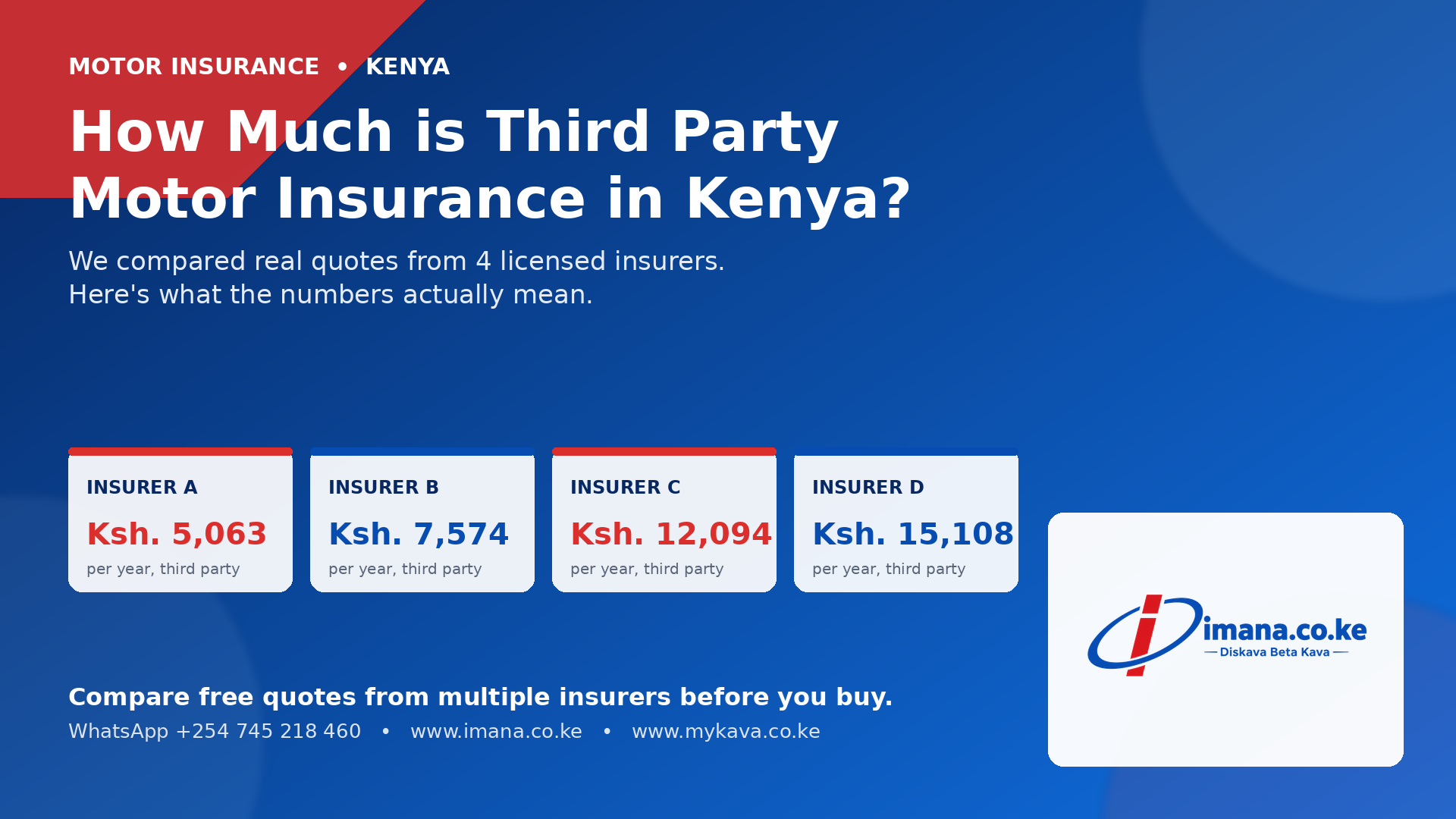
Ask four Kenyan insurers for Third Party Only insurance on the same private car and you may receive four very different prices:
Insurer A: KSh 5,063
Insurer B: KSh 7,574
Insurer C: KSh 12,094
Insurer D: KSh 15,108
The difference between the lowest and highest quotation is:
KSh 10,045
The highest quotation is almost three times the lowest.
That immediately raises two questions:
Why are the prices so different if all four are Third Party policies?
and:
Does paying KSh 5,063 mean I am getting less protection than someone paying KSh 15,108?
Not necessarily.
The legal foundation of Third Party Motor Insurance is common, but the insurer's pricing, policy wording, additional benefits, property-damage limits, underwriting appetite and service proposition may differ.
Imana Insurance Agency Kenya Ltd is a Westlands-based insurance intermediary helping individuals, families and businesses compare insurance quotations from licensed Kenyan insurers across Motor, Medical, WIBA, PSV, Travel, Motorcycle, Corporate and other insurance classes.
Compare Motor Insurance at: www.imana.co.ke
Quick Answer: How Much Is Private Third Party Motor Insurance?
Based on these four quotations:
Lowest example: KSh 5,063
Second example: KSh 7,574
Third example: KSh 12,094
Highest example: KSh 15,108
So, for this comparison, the practical observed range is:
KSh 5,063–15,108 annually
That does not mean every private car in Kenya will be quoted within exactly that range.
It also does not mean the KSh 15,108 insurer necessarily gives three times the cover of the KSh 5,063 insurer.
Is Third Party Motor Insurance Compulsory in Kenya?
Yes.
Section 4 of the Insurance (Motor Vehicles Third Party Risks) Act, Cap. 405 generally makes it unlawful to use, or permit the use of, a motor vehicle on a road unless there is an insurance policy or security in force that complies with the Act, subject to statutory exceptions.
This is the legal foundation of compulsory Third Party Motor Insurance in Kenya.
What Does IRA Do?
The Insurance Regulatory Authority (IRA) regulates and supervises Kenya's insurance industry.
IRA's current regulations classify:
- Private Motor
- Commercial Motor
as distinct Motor Insurance classes, and define Motor Insurance as including Third Party risks. Private Motor refers to vehicles that are not used for business or other commercial purposes.
So the distinction is:
IRA regulates the insurance market. Cap. 405 establishes the compulsory Third Party legal requirement.
What Does Cap. 405 Actually Require Third Party Insurance to Cover?
This is the most important legal point.
Section 5 requires a complying Motor policy to insure specified persons against liability for:
death or bodily injury to another person caused by or arising out of the use of the vehicle on a road.
The Act also provides that the compulsory policy is not required to cover liability above:
KSh 3,000,000 arising out of a claim by one person
for death or bodily injury.
That is the statutory core.
Does the Third Party Act Require Property Damage Cover?
Not in the same way.
The compulsory wording in Section 5 specifically refers to:
- Death
- Bodily injury
It does not itself make third-party property damage part of the same statutory minimum wording.
However, many Kenyan Third Party Motor policies contractually include liability for damage to:
- Another vehicle
- A wall
- A gate
- A shop
- Other third-party property
subject to the limit in the policy schedule.
This is one of the areas where Insurer A and Insurer D may genuinely differ.
Why Do Four Insurers Charge Four Different Prices?
Because Third Party Motor Insurance is compulsory, but the retail premium is not one universal national price.
Different insurers make different commercial and underwriting decisions.
1. Different Insurers Have Different Risk Appetite
One insurer may actively want more Private Motor Third Party business.
It may therefore quote aggressively at:
KSh 5,063
Another insurer may prefer Comprehensive Motor business and may price Third Party higher at:
KSh 12,094 or KSh 15,108
That does not automatically mean the higher-priced insurer offers materially better cover.
It may simply mean the insurer has a different appetite for that business.
2. Claims Experience Is Different
An insurer may have experienced:
- More bodily-injury claims
- Larger court awards
- More legal expenses
- Greater fraud exposure
- Poorer loss ratios
That can lead it to increase prices.
Another insurer with a more profitable Third Party portfolio may quote lower.
3. Third-Party Property Damage Limits May Differ
This is one of the first things you should compare.
For example, one policy may provide a lower contractual property-damage limit.
Another may provide a substantially higher one.
If the higher-priced insurer provides stronger contractual property-damage protection, then part of the extra premium may be buying a real additional benefit.
But you must read the policy schedule to know.
4. Extra Benefits May Be Included
One Third Party policy may be very basic.
Another may include additional contractual benefits such as:
- Driver Personal Accident
- Occupants' Personal Accident
- Legal assistance
- Road rescue
- Towing assistance
- Additional liability extensions
- Higher third-party property limits
These are not identical across insurers.
The supplied comparison correctly highlights that two legally compliant Third Party certificates can still carry different additional benefits.
5. The Vehicle May Be Rated Differently
Even under Private Motor, an insurer may take account of factors such as:
- Vehicle type
- Engine capacity
- Age
- Body type
- Claims profile
- Perceived severity of potential claims
A small private saloon and a large SUV may therefore not always attract identical commercial pricing.
6. Private vs Commercial Classification Matters
Private Motor Insurance is meant for private use.
If the vehicle is actually being used for:
- Uber
- Bolt
- Taxi work
- Hire or reward
- Commercial goods transport
it should not simply be insured as an ordinary private car.
Incorrect classification can create serious claims problems.
IRA's regulations specifically distinguish private vehicles from vehicles used for business or commercial purposes. (Ira)
7. Charges May Be Presented Differently
One quotation may show:
basic premium
while another may show:
final amount payable
including applicable charges.
Always compare the final invoice—not only the headline premium.
8. Claims Service Can Differ
You are not only buying an insurance certificate.
You are also choosing the insurer that may have to handle a liability claim long after the accident occurs.
Compare:
- Claims notification process
- Documentation requirements
- Responsiveness
- Legal defence
- Complaints handling
Service quality can matter significantly at claim time.
Does a More Expensive Third Party Policy Mean Better Cover?
No.
Not automatically.
Consider:
Insurer A: KSh 5,063
Insurer D: KSh 15,108
You cannot say:
“Insurer D gives three times the insurance.”
Likewise, you cannot say:
“Insurer A must be weak because it is cheap.”
If both policies satisfy the compulsory statutory requirement, the legal foundation remains.
The difference may instead be in:
Property limit + Add-ons + Policy wording + Claims service + Underwriting appetite + Price
Does Cheaper Third Party Insurance Mean Less Statutory Protection?
Not automatically.
If the KSh 5,063 policy is genuinely issued by an authorised insurer for the correct Private Motor class and complies with Cap. 405, the statutory requirement does not disappear simply because another insurer charges KSh 15,108.
The retail premium and the statutory requirement are different questions.
What Is the KSh 3 Million Third Party Limit?
Section 5 provides that a compulsory policy need not cover:
liability above KSh 3,000,000 arising out of a claim by one person
for death or bodily injury.
This is a crucial point.
Many motorists assume:
“If I have Third Party Insurance, the insurer will pay any amount a court awards.”
That is not necessarily correct.
Example: Court Awards KSh 2 Million
Suppose an eligible third party obtains an award of:
KSh 2,000,000
for bodily injury.
That amount is below the statutory KSh 3 million per-person ceiling.
The insurer would then deal with the claim subject to:
- Liability findings
- Policy terms
- The Act
- Claims procedures
- Applicable judgment or settlement
Example: Court Awards KSh 5 Million
Suppose one person obtains an eligible bodily-injury award of:
KSh 5,000,000
The compulsory statutory requirement does not require the insurer to cover more than:
KSh 3,000,000 for that person's claim
under Section 5.
A policy may contractually provide more, but that must be confirmed from the wording.
This is why motorists should understand the difference between:
Statutory minimum
and:
Additional contractual protection
Can the Balance Above KSh 3 Million Affect the Vehicle Owner?
Potentially, yes.
Where liability exceeds what the insurer is obliged or contractually bound to pay, the insured can face exposure to the balance.
That makes higher contractual limits worth asking about.
Does Third Party Insurance Cover Passengers in a Private Car?
This requires care.
Cap. 405 contains specific passenger exceptions.
The compulsory policy is not generally required to cover death or bodily injury to persons being carried in the vehicle, except in circumstances specified in the Act, including certain passenger-for-hire or employment situations. (Kenya Law)
For an ordinary private-car owner:
Do not simply assume every passenger in your car has the same protection as an outside third party.
Check:
- Passenger Legal Liability
- Occupants' Personal Accident
- Actual policy wording
Does Third Party Insurance Cover the Driver?
Not ordinarily for the driver's own bodily injury.
Motor Third Party Insurance primarily addresses legal liability to qualifying third parties.
If you want personal protection for:
- Accidental death
- Disability
- Accident medical expenses
consider Personal Accident Insurance separately.
Does Third Party Insurance Repair My Own Car?
No.
If your car is damaged in an accident, Third Party Only does not ordinarily pay for your repairs.
For example:
Your car needs:
KSh 400,000
in repairs.
Your Third Party insurer ordinarily does not pay that KSh 400,000 simply because you hold a valid TPO policy.
Does Third Party Insurance Cover Theft?
No, not ordinarily.
If your private car is stolen, Third Party Only is not designed to replace it.
Does Third Party Insurance Cover Fire?
Not damage to your own car under an ordinary Third Party Only policy.
Broader cover would be required.
Third Party vs Third Party Fire & Theft vs Comprehensive
Third Party Only
Primarily protects against qualifying liability to other people.
It does not ordinarily cover:
- Your own accidental damage
- Theft of your vehicle
- Fire damage to your vehicle
Third Party Fire & Theft
Where available, this generally adds:
- Theft of your vehicle
- Fire damage
to Third Party protection.
It still does not ordinarily provide full accidental-damage cover for your own car.
Comprehensive
Provides broader protection that may include:
- Accidental damage
- Theft
- Fire
- Third-party liability
subject to policy wording and excesses.
Who Should Consider Third Party Only?
Third Party can make sense where:
- The car is old
- Market value is low
- You can afford to repair your own vehicle
- You can replace the vehicle yourself if it is lost
- Your main objective is compulsory liability protection
When Might Comprehensive Make More Sense?
Consider Comprehensive where:
- The vehicle is valuable
- The vehicle is financed
- You cannot comfortably fund repairs
- Theft would create serious financial difficulty
- You want protection for your own vehicle
Is Insurer A at KSh 5,063 a Bad Deal?
Not necessarily.
A KSh 5,063 quotation could be perfectly reasonable if:
- The insurer is authorised
- The policy is correctly classified
- The certificate is genuine
- Statutory requirements are satisfied
- The policy wording is acceptable
The price alone does not make the quotation good or bad.
Is Insurer D at KSh 15,108 a Better Deal?
Again:
Not automatically.
Ask what the extra:
KSh 10,045
actually buys.
Does Insurer D offer:
- Higher property-damage limits?
- Additional Personal Accident?
- Better contractual liability extensions?
- Better rescue benefits?
- Something else?
If the schedules are almost identical, the difference may largely reflect the insurer's pricing and appetite.
The supplied versions make this same point: price is a clue; the policy schedule is the proof.
How Should You Compare the Four Quotations?
Before choosing, ask:
- Is the quotation Motor Private – Third Party Only?
- Who is the actual insurer?
- What bodily-injury liability applies?
- What is the third-party property-damage limit?
- What passenger protection exists?
- Is Driver Personal Accident included?
- Are legal costs included?
- What major exclusions apply?
- Does the quotation include all applicable charges?
- Does the policy provide anything beyond the statutory minimum?
The uploaded comparison similarly recommends looking at the class, insurer, property limit, passenger protection, driver benefits, territorial scope, charges and claims requirements—not just the headline price.
The Certificate Is Not the Whole Policy
Many drivers focus only on the certificate because that is what they need for compliance.
But:
The certificate proves that insurance exists.
The:
Policy schedule and wording explain what the insurer has actually agreed to cover.
That distinction matters enormously.
What Documents Do You Need for Private Third Party Insurance?
Typical requirements include:
- National ID or Passport
- KRA PIN
- Logbook or registration details
- Vehicle registration number
- Correct declaration of private use
Additional information may be requested depending on the insurer.
Can Third Party Motor Insurance Be Bought Online?
Yes.
Start at:
www.imana.co.ke
Provide your vehicle details and request a Private Motor Third Party comparison.
You may receive quotations such as:
Insurer A: KSh 5,063
Insurer B: KSh 7,574
Insurer C: KSh 12,094
Insurer D: KSh 15,108
The next step should not automatically be:
“Take the cheapest.”
Instead ask:
“What is different?”
Why Compare Through Imana Insurance Agency Kenya Ltd?
Imana Insurance Agency Kenya Ltd is a Westlands-based insurance intermediary helping individuals, families and businesses compare insurance quotations from licensed Kenyan insurers across Motor, Medical, WIBA, PSV, Travel, Motorcycle, Corporate and other insurance classes.
For Private Motor Third Party, a useful comparison should help explain:
- Why one insurer costs KSh 5,063
- Why another costs KSh 15,108
- Whether liability limits differ
- Whether additional benefits differ
- Whether the vehicle is correctly classified
- What exclusions apply
- Whether Comprehensive might be better value
Start at:
www.imana.co.ke
You can also explore selected insurance services through:
www.mykava.co.ke
Frequently Asked Questions
How much is Third Party Private Motor Insurance in Kenya?
There is no single universal retail price.
In this comparison, four insurers quote:
KSh 5,063, KSh 7,574, KSh 12,094 and KSh 15,108 annually.
Why is Insurer A only KSh 5,063?
It may reflect:
- Aggressive pricing
- Different risk appetite
- Lower additional benefits
- Different commercial strategy
You need the policy schedule to know.
Why is another insurer charging KSh 15,108?
Possible explanations include:
- Higher rating
- Different property limits
- Bundled benefits
- Claims experience
- Different underwriting appetite
Price alone does not reveal which explanation applies.
Does paying more automatically mean better cover?
No.
Compare the actual limits and wording.
Does the law require Third Party Motor Insurance?
Yes.
Cap. 405 establishes the compulsory Motor Third Party framework for vehicles used on roads, subject to statutory exceptions.
What does Cap. 405 require?
The statutory core concerns liability for:
death or bodily injury caused by or arising out of use of the vehicle on a road.
What is the statutory Third Party limit?
The Act provides that the compulsory policy need not cover:
more than KSh 3 million arising from one person's claim
for death or bodily injury.
Is third-party property damage part of the statutory minimum?
The compulsory wording in Section 5 focuses on death and bodily injury. Property damage is commonly included contractually in Motor Third Party policies, but the limit should be confirmed from the insurer's schedule.
Does Third Party Insurance cover my own car?
No, not ordinarily.
Does Third Party cover theft?
No, not ordinarily.
Does Third Party cover the driver?
Not ordinarily for the driver's own injury. Personal Accident cover should be considered separately.
Where can I compare Third Party Motor Insurance?
Visit:
www.imana.co.ke
How Much Is Third Party Motor Private Insurance in Kenya? Final Answer
Using the four actual comparison figures:
Insurer A: KSh 5,063
Insurer B: KSh 7,574
Insurer C: KSh 12,094
Insurer D: KSh 15,108
The price difference is real.
But:
Different price does not automatically mean different statutory protection.
Cap. 405 establishes the compulsory legal foundation around liability for death and bodily injury arising from use of a vehicle on a road and provides a statutory ceiling of KSh 3 million arising from a claim by one person, subject to the Act's provisions.
What may differ between insurers is:
Property-damage limit + Additional benefits + Policy wording + Exclusions + Claims service + Risk appetite + Price
So before choosing between:
KSh 5,063
and:
KSh 15,108
ask:
“What exactly does the extra KSh 10,045 buy?”
If the answer is:
- Higher limits
- Useful added benefits
- Stronger contractual protection
then the higher premium may make sense.
If the schedules are substantially the same, the price gap may primarily reflect insurer pricing strategy and underwriting appetite.
The correct comparison formula is:
Legal compliance → Correct Private Motor class → Bodily-injury liability → Property limit → Passenger protection → Additional benefits → Claims terms → Price
Don't buy the cheapest certificate. Don't buy the most expensive certificate. Buy the policy you understand.
Compare Private Motor Third Party Insurance
Imana Insurance Agency Kenya Ltd:
www.imana.co.ke
MyKava:
www.mykava.co.ke
Author:
Raymond Momanyi – Founder & CEO, Imana Insurance Agency Kenya Ltd
The premiums of KSh 5,063, KSh 7,574, KSh 12,094 and KSh 15,108 are comparison examples supplied for this article and are not fixed market tariffs. Policy benefits, property-damage limits, exclusions and insurer pricing can change. The legal discussion is general consumer information based on Cap. 405 and should not be treated as legal advice. Always review the current insurer quotation, schedule and full policy wording before purchasing cover.