
Blog Details
Diskava. Beta. Kava
02Aug
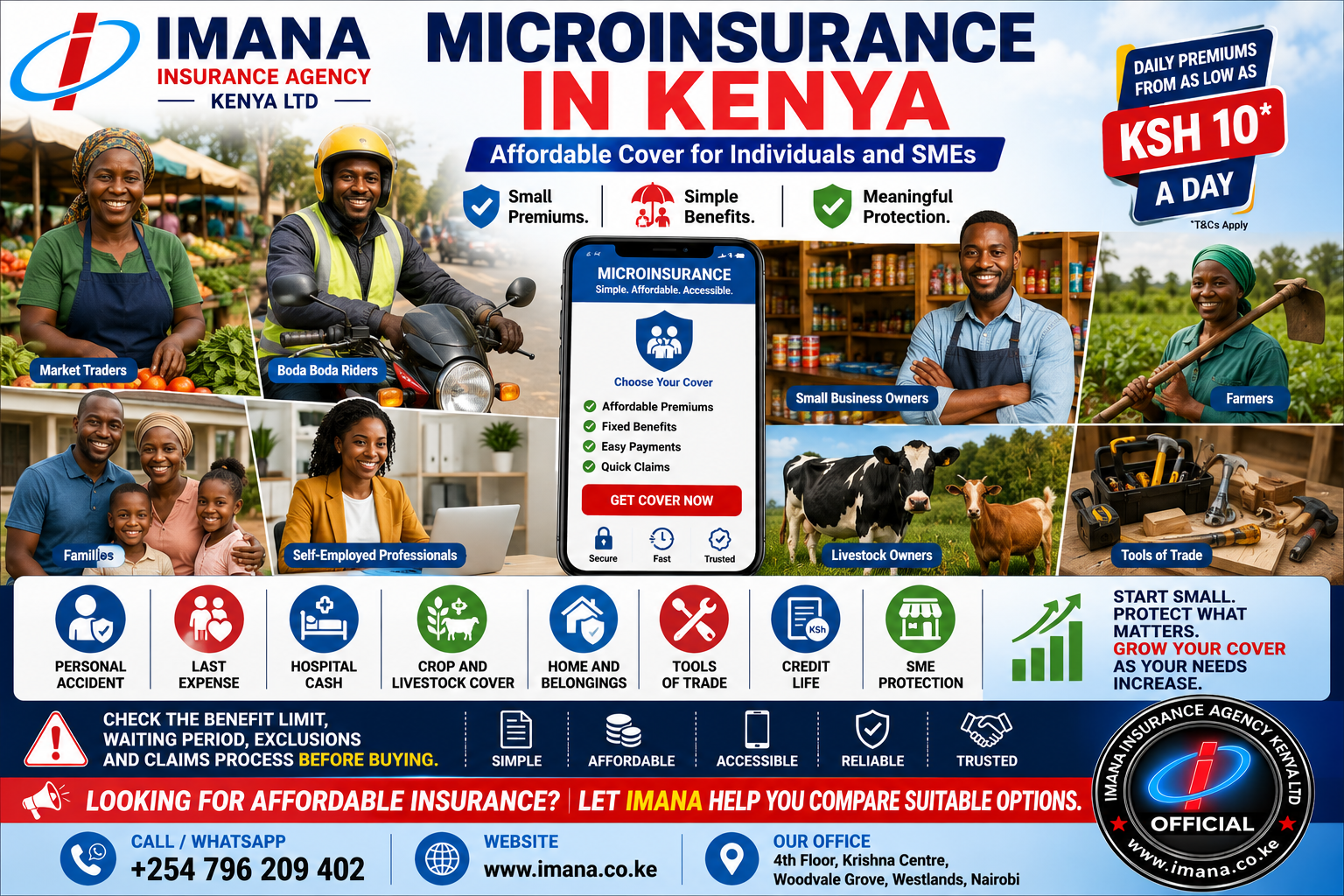
Microinsurance in Kenya: Affordable Cover for Individuals and SMEs
Learn how microinsurance in Kenya provides affordable, simplified protection for individuals, families, farmers and SMEs through low premiums, fixed benefits and accessible payment options.
Can Insurance Be Affordable for People With Small or Irregular Incomes?
Many Kenyans understand the importance of insurance but may consider conventional annual policies difficult to afford.
A household or small business may face risks involving:
- Accidental injury
- Death of a breadwinner
- Hospital expenses
- Fire
- Theft
- Damage to tools of trade
- Livestock loss
- Crop failure
- Damage to a small home
- Temporary interruption of income
The financial effect of these events can be severe, particularly where the affected person has limited savings or depends on daily business income.
Microinsurance is designed to make selected insurance benefits more accessible through:
- Relatively low premiums
- Simple policy terms
- Fixed benefit amounts
- Short policy periods
- Group arrangements
- Flexible payment options
- Digital distribution
- Simplified claims procedures
Kenya’s Insurance Regulatory Authority describes microinsurance as insurance characterised by low premiums and relatively low coverage limits, generally aimed at lower-income and underserved segments of the population.
Microinsurance does not attempt to cover every possible financial loss. It provides focused protection against specific risks at a premium that the intended customer can reasonably manage.
What Is Microinsurance?
Under Kenya’s Insurance (Microinsurance) Regulations, microinsurance refers to insurance that is accessible to low-income and underserved populations and is managed according to generally accepted insurance principles. (Kenya Law)
Microinsurance may protect:
- An individual
- A family
- Members of a group
- A small-business owner
- A farmer
- A trader
- A cooperative member
- A borrower
- A mobile-platform customer
- A community organisation
The cover may relate to:
- Life
- Health
- Personal Accident
- Dwellings
- Personal belongings
- Livestock
- Crops
- Tools of trade
Kenyan regulations recognise general, life and bundled microinsurance products. A bundled product may combine more than one class of insurance within one simplified arrangement.
What Makes a Policy a Microinsurance Product in Kenya?
Kenya’s current Microinsurance Regulations establish specific criteria for qualifying policies.
A microinsurance contract should generally:
- Protect an individual, group members or their property
- Exclude third-party liability risks
- Have a term not exceeding 12 months
- Be renewable after the policy period
- Have daily premiums or contributions not exceeding KSh 40
- Provide a sum insured not exceeding KSh 500,000
- Operate as a fixed-sum insurance contract
- Begin only after the premium or first instalment has been paid
The Regulations also prevent the policy’s features from being changed during the contract period.
These legal criteria distinguish regulated microinsurance from a conventional policy that is merely marketed as “cheap insurance.”
A low premium alone does not automatically make a product microinsurance. The policy must satisfy the applicable regulatory requirements.
What Is Fixed-Sum Insurance?
A fixed-sum policy pays a predetermined amount or benefit when the insured event occurs.
The payment is not necessarily calculated by matching every shilling of the customer’s actual financial loss.
Example
A Personal Accident microinsurance policy may provide:
- Accidental death benefit: KSh 200,000
- Permanent disability benefit: up to KSh 200,000
- Accident-related medical benefit: KSh 20,000
- Funeral benefit: KSh 30,000
Where a covered event occurs, the insurer considers the stated benefit rather than attempting to replace the customer’s entire lifetime income.
Fixed benefits can make a policy:
- Easier to understand
- Easier to price
- Faster to administer
- More suitable for digital distribution
- More predictable during claims
However, the customer should confirm whether the benefit would be adequate for the intended need.
Types of Microinsurance Available in Kenya
Actual products and benefit levels vary between insurers. The following are common categories that may be structured as microinsurance where they meet the regulatory criteria.
1. Personal Accident Microinsurance
Personal Accident cover may provide fixed benefits following an eligible accidental injury.
Possible benefits include:
- Accidental death
- Permanent disability
- Temporary disability
- Accident-related medical expenses
- Funeral expenses
- Emergency transport
This type of cover may be useful to:
- Boda boda riders
- Market traders
- Casual workers
- Delivery riders
- Artisans
- Small-scale farmers
- Domestic employees
- Informal-sector workers
It mainly covers accidents rather than ordinary illness.
2. Life Microinsurance
Life microinsurance may pay a fixed benefit following the insured person’s death.
The money can help the family manage:
- Funeral expenses
- Household bills
- Rent
- School expenses
- Outstanding debts
- Immediate living costs
The benefit is usually lower than under a conventional life-assurance policy, but the premium may also be more affordable.
Customers should check:
- Entry age
- Maximum renewal age
- Waiting period
- Natural-death terms
- Accidental-death benefits
- Exclusions
- Beneficiary details
3. Funeral or Last-Expense Microinsurance
Last-expense cover provides a fixed amount to help meet funeral-related costs after an eligible death.
It may be offered:
- Individually
- To families
- Through welfare groups
- Through cooperatives
- Through employers
- Through associations
- As part of a loan or membership package
The policy should explain:
- Who is covered
- Maximum family size
- Waiting periods
- Benefit per family member
- Claim documents
- Payment timelines
A last-expense benefit is not the same as long-term life insurance intended to replace years of family income.
4. Health Microinsurance
Health microinsurance may offer limited or fixed healthcare benefits such as:
- Hospital cash
- Specified inpatient benefits
- Accident-related treatment
- Maternity cash benefits
- Fixed surgical benefits
- Specified illness benefits
A hospital-cash product may pay a fixed daily amount for each qualifying day of hospital admission.
For example:
- Hospital cash: KSh 2,000 per day
- Maximum: 20 days per policy year
The money may help with:
- Transport
- Meals
- Lost business income
- Family support
- Expenses not paid by another health scheme
It should not automatically be assumed to settle the full hospital bill.
5. Crop Microinsurance
Farmers face risks such as:
- Drought
- Excess rainfall
- Flooding
- Crop disease
- Pest damage
- Hail
- Other weather-related losses
Crop microinsurance may use:
- Direct farm-loss assessment
- Weather measurements
- Area-yield information
- Satellite or index data
- Other agreed triggers
Index-based insurance may pay when a defined measurement reaches a stated level, even without assessing every farm individually.
Customers should understand:
- The insured crop
- Planting period
- Geographical area
- Trigger measurement
- Cover period
- Payout calculation
- Events not covered
The Microinsurance Regulations provide that the normal minimum grace period does not apply to index-based microinsurance products.
6. Livestock Microinsurance
Livestock cover may protect eligible animals against specified events such as:
- Accidental death
- Disease
- Drought-related loss
- Theft under stated conditions
- Emergency slaughter
- Other insured risks
The policy may require:
- Animal identification
- Veterinary records
- Vaccination
- Tagging
- Photographs
- Inspection
- Prompt reporting of illness or death
The cover does not ordinarily pay for every unexplained loss or poor animal husbandry.
7. Dwelling and Household Microinsurance
A simplified property policy may protect a modest home and selected belongings against risks such as:
- Fire
- Lightning
- Flood
- Storm
- Specified accidental damage
- Burglary under defined conditions
The customer should distinguish between:
- Building protection
- Contents protection
- Personal belongings
- Temporary accommodation
- Liability protection
Under Kenya’s regulatory definition, microinsurance excludes third-party liability risks. Customers requiring liability protection may need a separate conventional policy.
8. Tools-of-Trade Insurance
Small-business owners may depend on tools and equipment such as:
- Sewing machines
- Salon equipment
- Carpentry tools
- Welding equipment
- Mobile phones
- Laptops
- Photography equipment
- Food-processing tools
- Repair equipment
- Small commercial machines
A tools-of-trade microinsurance policy may provide fixed protection against specified risks such as:
- Fire
- Theft following forcible entry
- Accidental damage
- Other listed events
This can help the owner resume operations after an insured incident.
9. Credit Life Microinsurance
Credit life insurance may be attached to a small loan or digital-credit facility.
It may settle or reduce an eligible outstanding loan following events such as:
- Death
- Permanent disability
- Specified illness
- Another insured event
The customer should confirm:
- Premium charged
- Benefit amount
- Beneficiary
- Loan balance covered
- Policy period
- Early repayment terms
- Refund terms
- Exclusions
The lender is often the first beneficiary because the insurance is designed to protect the outstanding credit obligation.
10. Bundled Microinsurance
A bundled product may combine several forms of protection.
For example, one policy may include:
- Accidental death
- Hospital cash
- Funeral benefit
- Tools-of-trade protection
The advantage is convenience.
The customer must still understand the separate limit applying to each benefit.
A KSh 500,000 overall package does not necessarily mean KSh 500,000 is available for every insured event.
How Microinsurance Helps Individuals
Lower entry cost
Microinsurance is designed around relatively small contributions.
Payment may be:
- Daily
- Weekly
- Monthly
- Seasonal
- Deducted from membership contributions
- Included in another service payment
Simple benefits
Fixed benefits may be easier to understand than complex reimbursement policies.
Protection against financial shocks
Even a modest insurance payment can help after:
- An accident
- Death
- Hospitalisation
- Fire
- Crop loss
- Livestock loss
- Damage to business tools
Access through groups
Cover may be arranged through:
- SACCOs
- Chamas
- Cooperatives
- Employers
- Welfare groups
- Digital platforms
- Associations
Electronic policy delivery
The Microinsurance Regulations allow policy documents and premium receipts to be issued electronically.
How Microinsurance Can Help SMEs
Small and medium-sized businesses often operate with limited emergency funds.
A single loss may affect:
- Stock
- Equipment
- Owner’s income
- Loan repayments
- Employee welfare
- Business continuity
Microinsurance may provide entry-level protection for selected risks involving:
- Business tools
- Personal Accident
- Death
- Hospitalisation
- Small premises
- Agricultural activity
- Loan repayment
It can be relevant to:
- Kiosks
- Salons
- Barbershops
- Tailors
- Small workshops
- Online sellers
- Market traders
- Small farms
- Food vendors
- Repair businesses
- Freelancers
- Home-based enterprises
However, a growing SME may require broader conventional insurance once its:
- Stock value increases
- Equipment exceeds the microinsurance limit
- Premises become more valuable
- Workforce expands
- Liability exposure increases
- Vehicles or machinery are introduced
Microinsurance vs Conventional SME Insurance
Microinsurance
Usually offers:
- Lower premiums
- Smaller fixed benefits
- Simplified wording
- Short policy periods
- Limited insured events
- Easier digital or group distribution
Conventional SME insurance
May offer:
- Higher sums insured
- Property reinstatement
- Business Interruption
- Public Liability
- Product Liability
- WIBA
- Money Insurance
- Fidelity Guarantee
- Cyber Insurance
- Commercial Motor
- Goods in Transit
Because regulated microinsurance excludes third-party liability risks, a business requiring Public Liability, Product Liability or Professional Indemnity must consider separate conventional cover.
Microinsurance may be a useful starting point, but it should not be used to insure a business whose assets and liabilities have grown beyond the product’s limits.
Group Microinsurance
Microinsurance can be issued to an identifiable group that exists independently of the insurance contract.
Examples may include:
- Cooperative members
- Employees
- Farmers’ associations
- SACCO members
- Traders’ groups
- Welfare associations
Under the Regulations:
- The master policyholder buys cover on behalf of members.
- The group must exist independently of the insurance arrangement.
- The risks should relate to the members’ common activities or interests.
- The premium and benefits applicable to members must be disclosed.
- Price discrimination between individuals within a group is prohibited where group underwriting is used. (Kenya Law)
Group cover can reduce administration costs, but each member should still receive or access:
- Benefit information
- Eligibility requirements
- Policy period
- Claims procedure
- Complaints procedure
- Confirmation of inclusion
When Does Microinsurance Cover Begin?
The policy should clearly state that protection begins only after:
- The full premium has been paid, or
- The first instalment has been paid where instalments are permitted
This requirement is part of Kenya’s microinsurance criteria. (Kenya Law)
A customer should therefore keep evidence of payment, including:
- Receipt
- Mobile-money confirmation
- Bank confirmation
- Digital transaction reference
- Membership deduction statement
Registration or completion of a form alone may not activate the cover.
Grace Periods
Microinsurance contracts generally have a grace period of at least 45 days after the premium due date.
During this period, the overdue premium may be paid to continue the policy without interruption, subject to the contract terms.
The 45-day grace-period rule does not apply to index-based microinsurance products.
Customers should still avoid delaying payment because:
- Claims occurring during non-payment may create disputes.
- Cover conditions may differ.
- The policy may eventually lapse.
- Reinstatement may require additional steps.
Waiting Periods
Some benefits may not begin immediately after policy purchase.
Waiting periods may apply to:
- Natural death
- Maternity
- Specified illnesses
- Pre-existing conditions
- Hospital cash
- Funeral benefits
The policy summary must disclose applicable waiting periods.
Accidental benefits may sometimes begin earlier than illness-related benefits, but this depends on the specific product.
What Information Should Customers Receive?
Microinsurance policies are required to use clear, plain and understandable language.
The insurer must prepare a simple policy summary that:
- Identifies the product as microinsurance
- Is generally no more than one A4 page
- Explains the cover
- Lists exclusions and limitations
- States the premium
- Explains payment and renewal
- Shows the grace and waiting periods
- Provides claims procedures
- Explains how to complain
The summary should be given before the policy is sold.
The policy may be written in English, Kiswahili or another language, although an English or Kiswahili translation must be available where another language is used.
How Quickly Should Policy Documents Be Issued?
The Regulations require a microinsurer to provide the policy document and confirmation of premium receipt within three working days after the contract begins.
These documents may be delivered electronically.
Customers should retain:
- Policy summary
- Policy document
- Certificate or membership confirmation
- Receipt
- Claims contact
- Beneficiary information
How Microinsurance Claims Work
A simplified claim process may involve:
- Reporting the insured event.
- Providing the policy or membership number.
- Submitting identification.
- Providing evidence of the event.
- Completing a simplified claim form.
- Receiving the insurer’s decision.
Documents may include:
- National ID
- Death certificate
- Burial permit
- Medical report
- Hospital discharge summary
- Police abstract
- Photographs
- Veterinary report
- Proof of ownership
- Weather or index confirmation
- Payment receipt
The exact requirements depend on the insured event.
How Quickly Should a Microinsurance Claim Be Paid?
Kenya’s Microinsurance Regulations require the microinsurer to pay or reject a claim within 10 calendar days after receiving the claim notification.
Where the claim is rejected, the claimant should receive written reasons.
Where a reasonable cause prevents completion, the insurer may request an extension of no more than another 10 calendar days from the Insurance Regulatory Authority.
A claim submitted to an appointed microinsurance intermediary is treated as having been received by the microinsurer. (Kenya Law)
The claimant should obtain:
- Claim reference number
- Submission confirmation
- List of outstanding documents
- Written claim decision
Complaints About Microinsurance
Microinsurers must maintain procedures for handling enquiries, complaints and disputes.
The Regulations require the microinsurer to resolve a complaint and notify the complainant of its decision within seven calendar days of receiving it.
Where the issue remains unresolved, the customer may escalate it through the appropriate regulatory or dispute-resolution channels.
The Insurance Regulatory Authority regulates Kenya’s insurance sector, licenses insurance entities and protects policyholder interests.
Common Microinsurance Exclusions
The exclusions depend on the product, but may include:
- Events occurring before cover began
- Non-payment of premium
- Fraud or deliberate misrepresentation
- Undeclared pre-existing conditions
- Self-inflicted or deliberate loss
- Illegal activity
- War or civil unrest
- Wear and tear
- Poor maintenance
- Unexplained disappearance
- Loss outside the insured location
- Events outside the stated policy period
- Third-party liability
Customers should read the policy summary rather than relying only on marketing messages.
Advantages of Microinsurance
Affordability
Premiums are structured for customers who may not afford larger annual policies.
Accessibility
Products may be distributed through:
- Mobile phones
- Groups
- Cooperatives
- Retail outlets
- Digital platforms
- Approved intermediaries
Simplicity
Policy summaries and documents are required to use clear language.
Fast claims expectations
The Regulations prescribe short claims-processing timelines.
Flexible protection
Products can focus on risks relevant to a particular group or livelihood.
Financial resilience
A modest payment can help prevent a household or microenterprise from selling productive assets or taking expensive emergency loans.
Limitations of Microinsurance
Lower benefit amounts
The maximum regulated sum insured is limited.
Narrow protection
Only specified events are covered.
Fixed benefits may not match the full loss
The payout may be less than the actual financial damage.
Third-party liability is excluded
Businesses may require separate liability insurance.
Waiting periods may apply
Some benefits do not begin immediately.
Benefit exhaustion
Once the fixed benefit has been paid or exhausted, no further amount may be available.
Growing businesses can become underinsured
An SME with assets worth several million shillings should not depend only on a small fixed-benefit policy.
Questions to Ask Before Buying Microinsurance
Before paying, ask:
- Is this officially a microinsurance product?
- Who is the registered microinsurer?
- What event triggers payment?
- What is the exact benefit?
- Is the benefit fixed or reimbursement-based?
- What is the policy period?
- What waiting period applies?
- Is there a grace period?
- Are premiums daily, weekly or monthly?
- When does the policy begin?
- Who is the beneficiary?
- What exclusions apply?
- How is a claim reported?
- Which documents are required?
- Can the cover be renewed?
- What happens when a payment is missed?
- Is the product individual or group-based?
- Does the benefit adequately match the risk?
How SMEs Should Decide Whether Microinsurance Is Enough
A business owner should calculate:
- Value of stock
- Value of equipment
- Value of tools
- Daily income
- Outstanding loans
- Number of employees
- Liability to customers
- Cost of reopening after a loss
Microinsurance may be suitable where:
- Assets are modest
- The risk is simple
- The required benefit is within the product limit
- The owner wants entry-level protection
- Premium affordability is the main constraint
Conventional SME insurance may be more suitable where the business has:
- High stock values
- Several employees
- Expensive machinery
- Commercial vehicles
- Customer liability exposure
- Professional services
- Multiple branches
- Significant rental or operating expenses
Microinsurance and WIBA
Microinsurance should not be assumed to replace an employer’s obligations under the Work Injury Benefits Act.
An SME with employees should obtain suitable WIBA protection for qualifying work-related injury and occupational-disease liabilities.
Personal Accident microinsurance may provide additional fixed benefits, but it is not automatically a substitute for statutory employer protection.
Microinsurance and SHA
Private health or hospital-cash microinsurance should not be confused with Kenya’s statutory Social Health Insurance system.
A customer may hold:
- SHA protection
- Hospital-cash microinsurance
- Private medical insurance
- Personal Accident cover
Each product responds differently.
A hospital-cash benefit may provide a fixed amount following admission but may not settle the hospital’s full treatment bill.
How to Avoid Fake or Misleading Microinsurance
Before purchasing cover:
- Identify the insurer.
- Confirm that it is licensed or registered appropriately.
- Obtain the policy summary.
- Check the premium and benefit.
- Avoid paying into personal accounts.
- Keep the official receipt.
- Confirm the policy number.
- Verify the claims contact.
- Avoid promises of guaranteed payment outside the contract.
- Do not buy solely because the product is attached to a loan, phone line or membership.
The IRA maintains a current licensed-entities registry for verifying regulated insurance entities.
How Imana Helps Individuals and SMEs Compare Affordable Insurance
Imana Insurance Agency Kenya Ltd helps individuals, families, groups and SMEs review available insurance options from suitable licensed providers.
The process may include:
- Identifying the customer’s main risk.
- Establishing an affordable premium range.
- Comparing microinsurance and conventional insurance.
- Reviewing benefit limits.
- Explaining waiting and grace periods.
- Checking exclusions.
- Confirming policy activation.
- Coordinating documentation.
- Supporting claim notification.
- Reviewing cover as the business grows.
Related insurance solutions may include:
- Personal Accident
- Last Expense
- Medical Insurance
- WIBA
- Group Personal Accident
- Home Insurance
- SME Insurance
- Fire and Burglary
- Tools and Equipment Insurance
- Crop and Livestock Insurance
- Group Life
- Business Insurance
Affordable Insurance in Westlands and Across Kenya
Imana Insurance Agency Kenya Ltd
4th Floor, Krishna Centre
Woodvale Grove, Westlands
Nairobi, Kenya
Website: www.imana.co.ke
Call or WhatsApp: +254 796 209 402
Start with the risks you cannot comfortably pay for yourself. Choose an affordable benefit and increase your protection as your income or business grows.
Frequently Asked Questions
What is microinsurance?
Microinsurance is simplified insurance designed to be accessible to low-income and underserved customers through lower premiums and limited benefit amounts.
How much can a microinsurance policy cover?
Under Kenya’s current regulatory criteria, the sum insured should not exceed KSh 500,000.
How much can the daily premium be?
The Regulations state that daily premiums or contributions should not exceed KSh 40.
How long can a microinsurance policy run?
The contract period should not exceed 12 months, although it may be renewable.
Can microinsurance cover an SME?
Yes, where the business’s relevant assets or risks fit within the policy criteria and benefit limits.
Does microinsurance cover Public Liability?
Not under the regulatory microinsurance criteria, which exclude third-party liability risks. A separate conventional policy may be needed.
Can microinsurance be paid monthly?
It may allow instalments or periodic contributions, depending on the product.
When does cover begin?
Cover begins after the premium or required first instalment has been paid. (Kenya Law)
How long should a claim take?
The microinsurer should generally pay or reject the claim within 10 calendar days after receiving notification, subject to the permitted regulatory extension.
Can I receive the policy on my phone?
Yes. Policy documents and premium receipts may be delivered electronically.
Does microinsurance replace comprehensive medical or business insurance?
Not necessarily. Its lower limits and narrower protection may need to be supplemented by conventional insurance.
Can Imana help compare affordable covers?
Yes. Imana can help review benefit limits, premiums, exclusions and available alternatives from suitable licensed providers.
The Bottom Line
Microinsurance can make protection more accessible to:
- Individuals
- Families
- Farmers
- Traders
- Informal workers
- Cooperatives
- Groups
- Small businesses
Its strengths include:
- Affordable contributions
- Simple benefits
- Short documents
- Flexible distribution
- Faster claims expectations
- Digital policy delivery
Its limitations include:
- Lower sums insured
- Fixed rather than full-loss benefits
- Restricted risks
- Waiting periods
- No third-party liability protection
- Possible underinsurance as a business grows
Before buying:
- Identify the risk.
- Confirm the insurer.
- Read the one-page policy summary.
- Understand the fixed benefit.
- Check the waiting period.
- Keep proof of payment.
- Know how to claim.
- Review whether the benefit is enough.
Affordable insurance is valuable when it protects the right risk. A small premium should still provide a clear, useful and dependable benefit.
Imana Insurance Agency Kenya Ltd
Call or WhatsApp: +254 796 209 402
Website: www.imana.co.ke
Start small. Protect what matters. Build stronger financial resilience.
Microinsurance products, premiums, eligibility, waiting periods, benefits and exclusions vary between providers. Regulatory criteria may be amended. Obtain a current policy summary, written quotation and complete policy wording before purchasing cover.