
Blog Details
Diskava. Beta. Kava
15Jan
Medical Insurance in Kenya | Real-Life Cover Guide
Compare medical insurance in Kenya for individuals, families, children, seniors and businesses. Understand benefits, costs, exclusions and claims.
Medical insurance should work in real life—not only look impressive on a brochure. Learn how to compare inpatient and outpatient limits, hospital networks, waiting periods, exclusions, maternity, chronic conditions, senior cover, SHA coordination and claims before choosing a plan in Kenya.
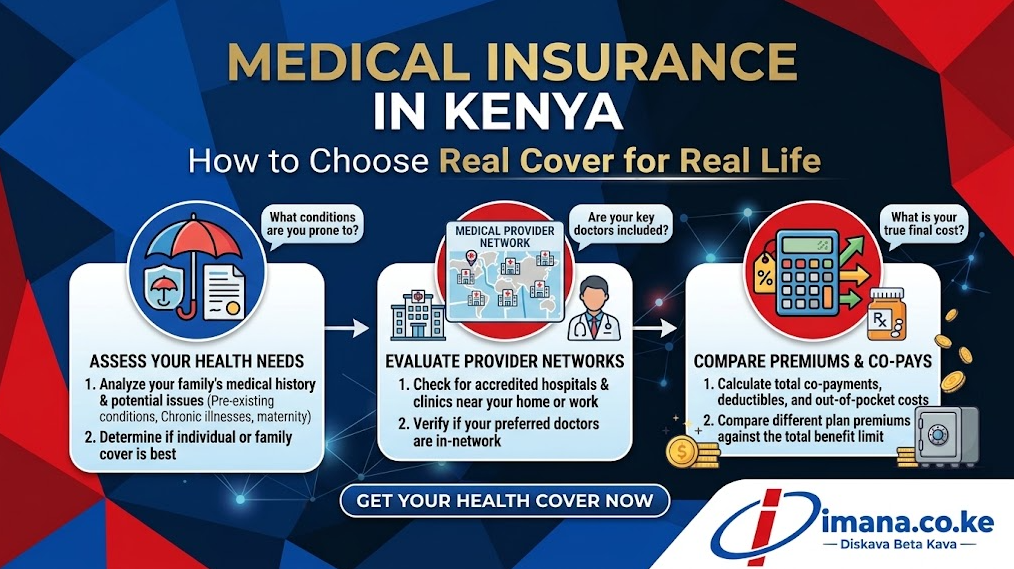
Medical Insurance in Kenya: How to Choose Real Cover for Real Life
By Raymond Momanyi, Founder & CEO, Imana Insurance Agency Kenya Ltd
Last reviewed: September 2026
A medical insurance policy can look generous on paper and still disappoint when real life arrives.
The inpatient limit may be high, but your preferred hospital could be outside the network. Maternity may appear in the benefits list, but a waiting period could apply. Outpatient cover may exist, yet co-payments and sublimits may reduce what is available. A parent may qualify for entry today but face different renewal conditions later.
That is why choosing medical insurance in Kenya requires more than asking, “How much is the premium?”
The better question is:
Will this plan work for the people being insured, the hospitals they use and the medical events they are most likely to face?
This guide explains how individuals, couples, families, children, senior citizens, employers and internationally connected clients can compare health insurance in Kenya with greater clarity.
For personalised medical insurance comparisons, visit ImanaInsurance.com, explore health insurance options through Imana, or review selected medical solutions through MyKava Travel & Insurance.
Quick answer: what should good medical insurance cover?
Good medical insurance should provide benefits that match the member's real healthcare needs and budget. Depending on the selected plan, it may include:
- inpatient hospital treatment;
- outpatient consultations and medicine;
- maternity care;
- dental and optical benefits;
- chronic and pre-existing-condition benefits;
- emergency evacuation;
- mental-health services;
- congenital-condition benefits;
- overseas treatment or referral benefits;
- last expense; and
- additional benefits defined by the insurer.
Not every plan includes every benefit. Limits, waiting periods, exclusions, hospital networks, co-payments and preauthorisation rules apply.
The best plan is not the one with the longest brochure. It is the one whose terms fit the insured people and remain affordable enough to renew.
Why medical insurance matters in real life
Illness rarely checks whether the timing is convenient. A child may develop a high fever at night. A parent may need surgery. An accident may require emergency admission. A routine consultation may reveal a condition that needs months of follow-up care.
Without suitable protection, a family may have to use savings, borrow, sell property or postpone treatment. Businesses can also lose productivity and staff confidence when employees cannot access timely care.
Medical insurance does not remove every healthcare expense. It creates a defined financial arrangement between the policyholder and insurer so eligible treatment can be funded within the policy's benefits and conditions.
The protection is only as strong as the details understood before purchase.
SHA and private medical insurance in Kenya
Kenya's Social Health Authority administers the Primary Healthcare Fund, Social Health Insurance Fund, and Emergency, Chronic and Critical Illness Fund under the country's public health-financing framework.
Private medical insurance should not automatically be treated as a replacement for SHA. For many people and employers, it can serve as an additional layer of protection by providing access to selected private facilities, broader benefit choices, higher limits or services beyond what may be available under the applicable public benefit package.
The exact coordination between SHA benefits and a private insurer depends on current law, tariffs, facility contracting and the selected private policy. These arrangements can change. Members should verify their SHA status and ask how the private plan coordinates benefits at the time of treatment.
Do not assume that the private insurer will automatically pay every balance that SHA does not meet. Policy limits, exclusions, sublimits, provider rules and preauthorisation requirements still apply.
Who can buy medical insurance in Kenya?
Medical insurance may be arranged for different groups, subject to insurer eligibility and underwriting.
Individuals
An individual plan may suit a self-employed person, consultant, student, professional, business owner or employee without adequate employer-sponsored cover.
The quotation will usually depend on age, chosen benefits, medical history, territorial scope and the insurer's product structure.
Couples and families
Family medical insurance can combine a principal member, spouse and children under one arrangement. Some plans price each person separately, while others use family bands or shared structures.
Compare whether benefits are individual or shared, how newborns are added, the maximum age for dependent children and what happens when a dependent exceeds that age.
Children
Some insurers require a child to join a parent or guardian's plan. Others may permit child-only medical insurance subject to minimum ages, documents, benefit structure and underwriting.
Parents should examine outpatient access, vaccinations where applicable, congenital and neonatal conditions, specialist consultations, emergency care and admission procedures.
Parents and senior citizens
Medical insurance for parents and senior citizens is available from selected providers, but entry ages, renewal ages, premiums, co-payments, medical screening and chronic-condition limits vary.
A plan that accepts a person at age 70 is not automatically the right plan. Ask:
- Can the member renew beyond the entry age?
- Are pre-existing conditions covered, excluded or subject to a waiting period?
- Is there a chronic-condition sublimit?
- Does a co-payment apply because of age?
- Which hospitals are accessible near the member's home?
- Is outpatient care included?
- Does the plan include emergency evacuation?
For suitable options, compare plans rather than assuming older applicants cannot obtain cover.
Employers, SMEs and larger organisations
Group medical insurance can be arranged for employees and, where selected, their dependants. Pricing may depend on membership size, ages, benefits, claims history, industry and insurer requirements.
Employers should balance staff expectations, budget sustainability and adequate protection. A plan that looks generous but becomes impossible to renew after one year is not a sound employee-benefit strategy.
Explore corporate insurance solutions or use the corporate quotation pathway.
Expatriates and internationally connected families
Expatriates, diaspora families, frequent travellers and people who divide their time between countries may need local, East African or international medical cover.
The correct plan depends on residence, nationality, desired territory, treatment preferences and whether the member requires routine care abroad or only emergency protection while travelling.
Review expatriate insurance and distinguish annual medical insurance from short-term travel insurance.
Understanding the main medical insurance benefits
Inpatient cover
Inpatient insurance responds when the member is formally admitted to hospital for eligible treatment. It may cover accommodation, theatre charges, doctors' fees, diagnostic tests, medication and other approved hospital costs within the limit.
Check:
- the annual inpatient limit;
- whether limits apply per person or family;
- room and bed limits;
- intensive-care and high-dependency-unit limits;
- surgical and specialist benefits;
- hospital network;
- preauthorisation requirements; and
- exclusions and sublimits.
A high inpatient limit can still be weakened by restrictive room limits or narrow sublimits.
Outpatient cover
Outpatient insurance applies where a member receives treatment without being admitted. Benefits may include consultations, laboratory tests, prescribed medicine, imaging, physiotherapy and specialist visits.
Review the annual limit, co-payment, facility network, referral requirements, medicine rules and whether chronic follow-up is handled under the same limit.
For families with young children or members managing recurring conditions, outpatient access may matter just as much as inpatient cover.
Maternity cover
Maternity insurance may cover eligible antenatal care, delivery and related treatment within the stated benefit. Caesarean-section limits, complications, newborn care and postnatal services vary.
Waiting periods commonly apply. Buying a policy after pregnancy begins may not create immediate maternity protection. Review maternity insurance in Kenya before choosing a plan.
Dental and optical benefits
Dental and optical cover usually carries separate sublimits. Dental benefits may include consultation, extraction, filling or other stated procedures. Optical benefits may include eye examination and prescribed lenses within the plan.
Cosmetic procedures and upgrades beyond the allowed benefit may be excluded or paid by the member.
Chronic and pre-existing conditions
A chronic condition requires ongoing management. A pre-existing condition existed, showed symptoms or received treatment before the cover began, according to the policy definition.
Insurers handle these conditions differently. A plan may exclude them, apply a waiting period, offer a sublimit or accept them subject to underwriting.
Full and honest disclosure is essential. Hiding medical information can result in declined claims or cancellation, depending on the circumstances and contract.
Emergency evacuation
Emergency evacuation may arrange medically necessary transportation where appropriate treatment is unavailable at the member's location. The service normally requires coordination or approval through the insurer's emergency provider.
It is not the same as choosing any ambulance and sending the bill later.
Last expense
Some medical plans include a limited funeral benefit after an insured death. This is separate from a dedicated last expense insurance policy, which may offer a different benefit structure.
Medical insurance terms that can change the value of a plan
Waiting period
A waiting period is the time that must pass before a stated benefit becomes available. Different periods may apply to maternity, chronic conditions, pre-existing conditions, surgery or other benefits.
Co-payment
A co-payment is the amount or percentage a member contributes when accessing specified services or facilities. A lower premium with frequent co-payments may not be cheaper for a household that uses outpatient care regularly.
Sublimit
A sublimit caps the amount payable for a particular service within the larger benefit. A KSh 1 million inpatient limit does not necessarily mean KSh 1 million is available for dental work, chronic treatment, maternity or every procedure.
Hospital network
The hospital network lists facilities where the cover can be used under agreed arrangements. Networks can differ by plan category, geographic location and benefit level.
Confirm specific hospitals directly before buying and again before non-emergency treatment because provider arrangements can change.
Preauthorisation
Preauthorisation is the insurer's approval before certain admissions, procedures, diagnostic tests, specialist visits or treatments. Failure to obtain required approval can delay or affect payment.
Exclusion
An exclusion identifies treatment, circumstances or costs the policy does not cover. Examples may include purely cosmetic treatment, experimental procedures, non-prescribed medicine, treatment outside the network without approval or undisclosed conditions, depending on the wording.
How much does medical insurance cost in Kenya?
There is no single medical insurance price for everyone.
Premiums depend on factors such as:
- age;
- number of people covered;
- inpatient and outpatient limits;
- maternity, dental and optical benefits;
- chronic and pre-existing-condition treatment;
- hospital network;
- Kenya, East Africa or international territory;
- co-payments and deductibles;
- group size and claims experience; and
- insurer underwriting rules.
Two families with the same number of people can receive different quotations because their ages, chosen benefits and medical circumstances differ.
An affordable plan is not simply the one with the lowest annual premium. It is one that offers useful benefits at a cost the policyholder can sustain at renewal.
For an accurate comparison, use the health insurance quotation form, the micro-health quotation pathway or ImanaInsurance.com.
Real-life medical insurance scenarios
A young professional buying first-time cover
A healthy professional may focus on affordability but should still consider emergency admission, outpatient care, chronic-condition rules and the hospital network near home and work.
Choosing an inpatient-only plan can control cost, but routine consultations and medicine may remain out of pocket.
A family with young children
Parents may use outpatient benefits frequently. The plan should be checked for paediatric facilities, diagnostics, specialist referrals, vaccinations where included, emergency admission and congenital-condition terms.
A couple planning a baby
The couple should compare maternity waiting periods, normal-delivery and Caesarean-section limits, complications, antenatal care and newborn-addition rules before conception or early enough to satisfy the applicable waiting period.
An adult arranging cover for ageing parents
The adult should look beyond the headline inpatient limit. Hospital proximity, chronic-condition benefits, co-payments, medical screening, outpatient access and renewal age may determine whether the policy works in practice.
An SME protecting employees
The employer must decide who qualifies, whether dependants are included, how benefits differ by job grade, what co-payment applies and how claims experience may influence renewal.
The programme should be documented clearly so employees understand how to access care.
A frequent regional traveller
A plan described as “East Africa” must still be checked for the exact countries, facilities and approval process. Routine treatment abroad and emergency treatment while travelling may be treated differently.
How to compare medical insurance quotations properly
Use the same membership information and desired benefits for each insurer. Then compare:
- Who is covered? Confirm names, ages, relationships and eligibility.
- What are the limits? Review inpatient, outpatient and every important sublimit.
- Which hospitals are available? Check facilities near home, work or school.
- Which waiting periods apply? Pay special attention to maternity, surgery and pre-existing conditions.
- Are chronic conditions covered? Confirm the wording and limit.
- What does the member pay? Review co-payments, deductibles and uncovered expenses.
- Where does the cover work? Confirm Kenya, East Africa or international territory.
- How are claims handled? Understand cashless access, reimbursement and preauthorisation.
- Can the cover be renewed at older ages? Entry age and renewal age are not the same.
- What is excluded? Read the schedule and policy wording before paying.
The quotation should not be reduced to a premium and one inpatient figure.
Documents commonly required
Requirements vary by insurer, but applicants may be asked for:
- national ID or passport;
- KRA PIN where applicable;
- dates of birth;
- relationship details for dependants;
- completed application or proposal form;
- medical declaration;
- previous insurance information;
- medical reports or tests where required;
- company registration details for group cover;
- employee census or membership schedule; and
- previous claims experience for some corporate schemes.
Provide complete and accurate information. The insurer may request additional documents before accepting the risk.
How medical insurance claims work
Medical claims are commonly handled in two ways.
Cashless or card-based treatment
The member visits an approved facility, presents the required identification or membership details and seeks approval where necessary. The provider bills the insurer or administrator for eligible expenses.
Cashless does not mean limitless. Benefits, exclusions, co-payments, sublimits and approval rules still apply.
Reimbursement
The member pays for eligible treatment and later submits the required claim documents. Reimbursement may require itemised invoices, receipts, prescriptions, medical reports, claim forms and proof of payment.
Treatment outside the network without prior approval may not automatically qualify for reimbursement.
For detailed guidance, read the Medical Insurance Claims and Preauthorisation Guide. If a claim is declined, request the reason in writing and review how to challenge a rejected insurance claim.
Clients may also use the Imana claims request page for notification and documentation support. The underwriting insurer remains responsible for assessing and determining the claim.
Common mistakes when buying medical insurance
Choosing only by price
A cheap policy may be suitable, but only if the network, limits and conditions meet the member's needs.
Ignoring the hospital network
Do not wait for an emergency to discover that the preferred hospital is unavailable under the selected plan.
Assuming every condition is covered immediately
Waiting periods and exclusions may apply even after the policy becomes active.
Failing to disclose medical history
Non-disclosure can undermine the policy when a claim is assessed.
Confusing the total limit with sublimits
The main inpatient figure does not cancel smaller limits for specific treatments.
Buying maternity cover too late
Maternity waiting periods should be considered before the benefit is needed.
Failing to review at renewal
Family size, age, health needs, provider networks, benefits and premiums can change. Renewal is a chance to reassess suitability.
Why compare medical insurance through Imana?
Imana Insurance Agency Kenya Ltd is a digital-first insurance intermediary based at 4th Floor, Krishna Centre, Woodvale Grove, Westlands, Nairobi.
Imana helps individuals, families, employers and organisations:
- identify suitable benefit structures;
- compare options from trusted insurers;
- understand limits, waiting periods and exclusions;
- complete application requirements;
- review issued policy documents;
- manage renewals and amendments; and
- obtain guidance with claims notification and documentation.
Imana is not the underwriting insurer. The selected insurer accepts or declines the risk, issues the policy and determines claims according to the policy terms.
For the broader insurance portfolio, read the complete Imana Insurance guide for Westlands, Nairobi, Kenya and East Africa.
How to request a medical insurance quotation
The process is straightforward:
- Share the number of people to be covered and their ages.
- State whether cover is for an individual, family, child, senior citizen or employee group.
- Select preferred inpatient and outpatient limits.
- Identify important benefits such as maternity, dental, optical or chronic-condition care.
- Mention preferred hospitals and required territory.
- Disclose relevant medical history accurately.
- Compare the available benefits, conditions and premiums.
- Select the suitable option and complete the insurer's requirements.
- Confirm official payment instructions before paying.
- Check the membership and policy documents after issuance.
Start through:
- ImanaInsurance.com quotation comparison
- Imana medical insurance authority page
- Imana Health
- Health insurance quotation form
- Micro-health quotation form
- MyKava travel and medical solutions
You can also contact Imana or Call/WhatsApp +254 796 209 402.
Frequently asked questions about medical insurance in Kenya
What is the difference between health insurance and medical insurance?
The terms are often used interchangeably in Kenya. Both generally refer to insurance that pays eligible healthcare expenses within stated benefits, limits and policy conditions.
Is private medical insurance compulsory in Kenya?
Private medical insurance is generally an optional additional arrangement. Kenya's public health-financing framework is administered by SHA. Individuals and employers may choose private cover for additional benefits, facility access or limits, subject to their needs and legal obligations.
Can I buy medical insurance for my parents?
Yes, selected insurers offer plans for older adults. Entry age, renewal age, premiums, co-payments, medical screening and chronic-condition terms vary, so quotations must be compared carefully.
Can a child obtain medical insurance without a parent?
Selected products may allow child-only cover, subject to age, guardian information, minimum membership rules and insurer underwriting. Other plans require a parent or guardian to join.
Does medical insurance cover pregnancy immediately?
Usually not. Maternity benefits commonly have a waiting period. The exact period and benefits differ by insurer and plan.
Are pre-existing conditions covered?
They may be excluded, covered after a waiting period, accepted under a sublimit or considered individually. Full disclosure is essential.
Can I use medical insurance at any hospital?
Not necessarily. Access normally depends on the plan's hospital network and approval rules. Confirm specific facilities before buying and before planned treatment.
Does a KSh 1 million inpatient limit pay KSh 1 million for every condition?
No. Sublimits, exclusions, room limits, co-payments, waiting periods and medical-necessity rules can reduce or restrict the amount available for a particular treatment.
Can private medical insurance work together with SHA?
Yes, private insurance may provide additional protection, but coordination depends on current rules, tariffs, provider arrangements and the private policy. Ask how benefits will be applied before treatment.
Does medical insurance cover treatment outside Kenya?
Only where the selected territory and policy terms allow it. Kenya-only, East Africa, Africa-wide and international plans have different conditions and premiums.
How much does family medical insurance cost in Kenya?
The price depends on family members' ages, number of dependants, benefits, limits, hospital network, territory, medical history and insurer. A personalised quotation is more reliable than a general headline price.
How quickly can medical cover begin?
Cover may begin after the insurer receives acceptable documents, completes underwriting, confirms acceptance and receives the required premium. Waiting periods for particular benefits can still apply after the policy starts.
Final word: real medical cover begins with honest comparison
Medical insurance should not be purchased for the card, the brochure or the comfort of saying, “We are covered.”
It should be chosen for the night a child develops a fever, the morning a parent needs tests, the day an employee is admitted or the moment a family encounters a diagnosis it never expected.
Real cover begins with accurate disclosure. It grows stronger through clear comparison. And it becomes valuable when the member understands how to access treatment before the emergency arrives.
Do not buy the biggest promise. Buy the clearest protection you can sustain.
- Compare medical insurance quotations
- Explore medical insurance through Imana
- Apply for selected medical options
- Explore MyKava
- Speak to the Imana team
- Call/WhatsApp: +254 796 209 402
About the author
Raymond Momanyi is the Founder & CEO of Imana Insurance Agency Kenya Ltd, a digital-first insurance intermediary based in Westlands, Nairobi. His work focuses on medical insurance comparison, motor insurance, WIBA, PSV insurance, business risk, digital insurance distribution and claims support for individuals, families and organisations in Kenya and East Africa.
Medical insurance disclaimer
This article provides general information and is not medical advice, a personalised quotation or a guarantee of insurance acceptance or claim payment. Premiums, eligibility, benefits, provider networks, exclusions, waiting periods, co-payments, sublimits, territorial scope and underwriting requirements vary by insurer and can change. Read the policy schedule and wording and confirm current SHA and insurer arrangements before making healthcare or insurance decisions. Claims are assessed by the underwriting insurer according to the issued policy and supporting evidence.