
Blog Details
Diskava. Beta. Kava
08Sep
Kilimani Garage Fire: Motor Insurance Claims in Kenya
If Your Car Burns at a Garage in Kenya, Who Pays?
Car destroyed in the Kilimani garage fire? Learn how comprehensive, TPFT and third-party motor insurance claims work in Kenya and what owners should do next.
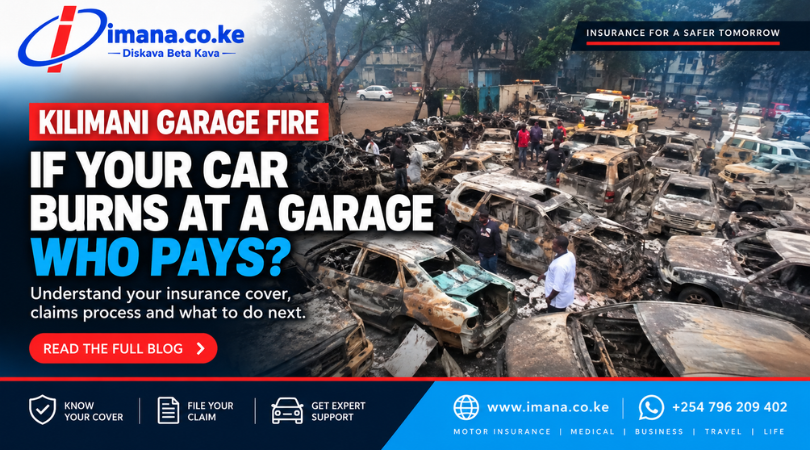
More Than 50 Vehicles Reportedly Destroyed in Kilimani Garage Fire
A major overnight fire at a garage off Ole Dume Road in Kilimani, Nairobi, has left vehicle owners and mechanics facing potentially millions of shillings in losses.
The fire broke out during the night of Monday, 7 September 2026, and emergency teams from Nairobi County reportedly battled the blaze for more than four hours.
Media reports indicated that more than 50 vehicles were destroyed, while several others were extensively damaged or reduced to burnt shells.
At the time of publication, the cause of the fire had not been officially established and investigations were continuing.
Beyond the heartbreaking images of burnt vehicles, the incident raises a question thousands of motorists across Nairobi and Kenya should understand:
If you leave your vehicle at a garage for repairs, servicing, painting or mechanical work and the garage burns down, who pays for your car?
The answer depends mainly on the type of motor insurance you have, the wording of your policy, the insurance arrangements held by the garage and whether another party is eventually found legally responsible for the fire.
Does Motor Insurance Cover a Car Burnt at a Garage?
Potentially, yes.
If the vehicle has comprehensive motor insurance, accidental fire damage is commonly one of the insured risks, subject to the conditions, exclusions, excesses and limits contained in the specific policy.
Some comprehensive motor insurance policies in Kenya also specifically address vehicles while they are temporarily in the custody of a garage or motor trader.
This is why motorists should always look beyond the word “comprehensive” and understand what their individual policy actually covers.
A vehicle insured under Third Party, Fire and Theft, commonly abbreviated as TPFT, may also be covered for fire damage because fire is one of the main additional protections under this class of insurance.
A vehicle insured under Third Party Only, however, is in a very different position.
Third Party Only insurance generally protects against specified liabilities arising from injury or property damage caused to other people. It does not normally compensate the policyholder for destruction of their own vehicle by fire.
Therefore, if your vehicle was destroyed in the Kilimani garage fire, the first question your insurer or insurance intermediary will ask is:
What type of motor insurance cover did the vehicle have?
If You Have Comprehensive Motor Insurance
If your vehicle had valid comprehensive motor insurance when the garage fire occurred, the first step should be to notify your own insurer immediately.
Do not wait for the garage owner to determine whether customers will be compensated.
Do not wait for another person's insurer to contact you.
Do not assume the garage will automatically settle the loss.
Open your own motor insurance claim.
Where the policy responds to fire damage, the insurer may appoint a motor assessor, loss adjuster or investigator to determine the extent of the damage and whether the vehicle can economically be repaired.
If the vehicle has been completely destroyed, the claim may eventually be handled as a total loss, subject to valuation, policy terms, applicable excesses and other conditions.
Affected motorists can notify claims through Imana Insurance Agency Kenya Ltd here:
Submit an Insurance Claim to Imana Insurance Agency
https://imana.co.ke/claims-request
If You Have Third Party, Fire and Theft Insurance
Third Party, Fire and Theft provides wider protection than Third Party Only because it ordinarily includes protection against risks such as fire and theft, in addition to third-party liability.
If your vehicle was covered under TPFT, report the claim to your insurer immediately and confirm whether the circumstances of the garage fire fall within the fire section of your policy.
The presence of fire cover does not mean every claim is automatically payable.
The insurer will still investigate the circumstances and apply the actual policy wording.
What Happens if the Vehicle Only Had Third Party Insurance?
Owners with Third Party Only insurance may face the greatest financial difficulty following a garage fire.
Third Party Only insurance generally does not provide own-damage compensation for the insured vehicle.
Therefore, if a car worth KSh 2 million was destroyed while insured under Third Party Only, the owner should not normally expect their own insurer to replace or compensate the vehicle merely because the loss arose from fire.
Instead, the owner may need to investigate whether the garage, another business, landlord, contractor or another party may be legally responsible for the loss.
Any recovery will depend on evidence, liability and the availability of applicable insurance.
Imana has an existing guide explaining how third-party claims work in Kenya:
Read Imana's Third-Party Motor Insurance Claims Guide
https://imana.co.ke/blog/How-to-File-a-Third-Party-Car-Insurance-Claim-in-Kenya
What Should Vehicle Owners Affected by the Kilimani Garage Fire Do Now?
Affected vehicle owners should act quickly while preserving evidence.
1. Notify Your Motor Insurer Immediately
Contact your insurance company or insurance intermediary and report the loss.
Provide the vehicle registration number, policy details, date of loss, location of the garage and a short description of what happened.
Request a formal claim reference number.
If your motor insurance was arranged through Imana Insurance Agency Kenya Ltd, notify the claim here:
https://imana.co.ke/claims-request
2. Do Not Dispose of the Burnt Vehicle
Even where the vehicle appears completely destroyed, do not dismantle it, sell the shell or remove parts before the insurer has had an opportunity to inspect it.
The remains of the vehicle are important evidence.
They may also become part of the insurer's salvage arrangements if the claim is ultimately settled as a total loss.
3. Prove That Your Vehicle Was at the Garage
This could become one of the most important parts of the claim.
Keep any evidence showing that the vehicle had legitimately been left at the garage.
This may include:
- Garage job card
- Service order
- Repair quotation
- Invoice
- Receipt
- M-Pesa payment records
- WhatsApp messages
- Emails
- Vehicle handover documents
- Photographs of the vehicle before the fire
- Communication with the mechanic or garage owner
- Evidence of the reason the vehicle was taken to the garage
If there is later a dispute over whether a particular car was in the garage when the fire occurred, these records may become extremely important.
4. Preserve Photographs and Videos
Take clear photographs and videos of the vehicle as soon as access to the premises is safely permitted.
Where possible, capture:
- Registration number
- Chassis details
- Overall damage
- Vehicle position
- Surrounding vehicles
- Garage location
- Fire damage around the vehicle
Avoid interfering with official investigations.
5. Obtain Available Police and Fire Reports
The insurer may request formal evidence of the incident.
Depending on the circumstances, this may include:
- Police OB number
- Police Abstract
- Fire Brigade report
- Fire incident report
- Official garage communication
- Statements relating to the incident
The exact documentation required will depend on the insurer and the circumstances of the loss.
6. Complete the Motor Insurance Claim Form Accurately
When completing the claim form, explain clearly why the vehicle was at the garage.
For example:
The vehicle may have been there for mechanical repairs, body repairs, painting, servicing, accident repairs or diagnosis.
The information provided to the insurer should be accurate and consistent with the supporting records.
7. Cooperate With the Motor Assessor or Investigator
The insurer may appoint an independent motor assessor or investigator.
The assessor may determine:
- Extent of fire damage
- Pre-loss vehicle value
- Whether repairs are economically viable
- Whether the vehicle should be treated as a total loss
- Salvage value
- Whether the damage is consistent with the reported incident
Do not commence repairs without insurer approval.
8. Keep Every Communication From the Garage
If the garage communicates with affected customers, keep copies of everything.
This includes:
- Letters
- Emails
- WhatsApp messages
- Notices
- Compensation proposals
- Insurance information
- Admission or denial of responsibility
Do not sign a discharge, waiver or settlement agreement without first understanding how it may affect your own insurance claim.
What Documents Could the Insurer Ask For?
The requirements vary from insurer to insurer, but affected vehicle owners should be prepared to provide documents such as:
- Motor insurance policy or certificate
- Vehicle logbook or proof of ownership
- National ID or passport
- KRA PIN where required
- Completed claim form
- Photographs of the damaged vehicle
- Police Abstract where applicable
- OB details
- Garage job card
- Service or repair documentation
- Vehicle keys
- Valuation report where available
- Communication with the garage
- Finance documents where the vehicle is bank-financed
Imana's motor claims resources explain the general process of notifying, documenting and following up a comprehensive motor claim.
Read Imana's Comprehensive Motor Insurance Claims Guide
https://imana.co.ke/blog/Comprehensive-Car-Insurance-Claim-Kenya
Should Comprehensive Vehicle Owners Claim From Their Own Insurer or the Garage?
Where a vehicle has valid comprehensive insurance, the practical starting point should normally be the vehicle owner's own insurer.
An insured owner should not spend weeks trying to establish whether the fire was caused by a mechanic, electrician, landlord, tenant, contractor, faulty wiring or another source before notifying the insurer.
The normal insurance process may work like this:
Vehicle owner → Own insurer → Assessment → Claim decision → Settlement → Recovery where appropriate
If the insurer settles an admissible claim and later establishes that another party was legally responsible for the loss, the insurer may pursue that party through subrogation.
Subrogation allows an insurer that has indemnified its policyholder to pursue recovery from a responsible third party, subject to the law and the circumstances of the claim.
In simple language:
Your insurer may pay you first and later pursue whoever caused the loss, where legally justified.
That is one of the major practical advantages of having proper comprehensive motor insurance.
Is the Garage Automatically Responsible Because the Cars Were Inside?
No.
This is an important distinction.
The fact that customers' vehicles were inside the garage when the fire occurred does not automatically prove that the garage was negligent.
Investigators may need to establish:
- Where the fire started
- What caused the fire
- Whether electrical faults were involved
- Whether fuel or other combustible materials contributed
- Whether reasonable safety precautions were in place
- Whether firefighting equipment was available
- Whether another tenant or business contributed
- Whether negligence occurred
- Whether contractual responsibilities existed between the vehicle owner and garage
Until those issues are established, affected vehicle owners should avoid assuming that liability has already been determined.
What About the Garage's Own Insurance?
This could become one of the most important issues arising from the Kilimani fire.
Motor garages, dealers, repairers, panel beaters and other businesses in the motor trade can obtain insurance designed to protect them against certain risks involving customers' vehicles.
Such policies may include forms of:
- Motor Traders insurance
- Garage liability insurance
- Customers' vehicles cover
- Fire insurance
- Public liability
- Property insurance
- Business interruption insurance
However, having a motor-trade policy does not automatically mean every customer's vehicle destroyed by fire will be compensated.
Some motor-trade policies may exclude fire unless the risk has specifically been added or extended.
There may also be:
- Limits per vehicle
- Limits per event
- Policy excesses
- Exclusions
- Conditions
- Maximum aggregate limits
This becomes especially important where dozens of vehicles are destroyed in a single incident.
If 50 vehicles with values ranging from KSh 500,000 to several million shillings are damaged at once, the combined loss could become extremely large.
Therefore, affected motorists should not rely solely on verbal statements such as:
"The garage insurer will pay everybody."
Notify your own insurer first.
Care, Custody and Control: Why It Matters
When a motorist leaves a vehicle at a garage, the garage temporarily has the vehicle in its care, custody or control.
This phrase is extremely important in liability insurance.
Some insurance policies specifically cover liability involving customers' property held in the insured business's custody.
Others may restrict or exclude such property unless the appropriate extension has been purchased.
This means the garage's policy wording will matter just as much as the vehicle owner's motor policy wording.
A major fire involving customers' vehicles can therefore trigger several overlapping insurance questions.
What if the Vehicle Is Declared a Total Loss?
A vehicle that has been severely burnt may be technically or economically beyond repair.
The motor assessor will determine whether restoration is practical.
Where the cost of repairing the vehicle becomes uneconomical compared with its pre-loss value, the insurer may consider the vehicle a total loss.
The settlement may then depend on:
- Pre-loss market value
- Insured value
- Policy wording
- Applicable excess
- Salvage value
- Outstanding premium
- Financier's interest
- Any applicable policy limits
This is another reason owners should not sell burnt shells to scrap dealers before the insurer has inspected and authorised disposal.
What Happens if the Burnt Vehicle Was Financed by a Bank?
Owners of financed vehicles should notify both the insurer and the financing institution.
Many bank-financed vehicles have the financier's interest noted on the motor insurance policy.
If the vehicle becomes a total loss, the insurer will usually consider the financier's interest when determining settlement.
A crucial point for motorists to understand is this:
The destruction of a financed vehicle does not automatically cancel the outstanding loan.
This is one of the strongest reasons financed vehicles are normally required to maintain comprehensive motor insurance.
Should an Owner Accept Money Directly From the Garage?
Be careful.
A garage may offer partial compensation, an interim payment or a final settlement.
Before accepting or signing anything, comprehensively insured owners should inform their insurer.
Signing a document that releases the garage from liability could interfere with the insurer's ability to recover money from a responsible third party after settling the claim.
Owners should also avoid receiving compensation twice for the same loss.
Insurance follows the principle of indemnity, meaning the intention is generally to restore the insured to approximately the same financial position they occupied before the loss, subject to policy terms.
Why the Kilimani Fire Should Change How Kenyans Think About Motor Insurance
Many motorists think motor insurance exists mainly for road accidents.
But vehicles face risks even when nobody is driving them.
A car can be damaged:
- At home
- In a parking lot
- At a shopping centre
- At a car wash
- At a garage
- At a dealership
- In storage
- During repairs
- During transportation
A motor vehicle does not stop being exposed to risk simply because the engine is switched off.
The Kilimani garage fire is therefore a powerful reminder that motorists should ask more than:
"How much is comprehensive insurance?"
They should also ask:
"What exactly does my comprehensive insurance cover?"
And:
"What happens if my car is damaged while being repaired at a garage?"
Compare Motor Insurance Quotations in Kenya
Before buying or renewing motor insurance, compare more than the premium.
Motorists should also compare:
- Fire protection
- Theft protection
- Policy excesses
- Excess Protector options
- Political Violence and Terrorism extensions
- Windscreen cover
- Towing limits
- Road rescue
- Courtesy car benefits
- Valuation requirements
- Authorised repair limits
- Loss-of-use benefits
- Territorial limits
- Claims support
- Garage and motor-trader provisions
- Other exclusions and conditions
Motorists can compare motor insurance quotations in Kenya through imanainsurance.com to review available options before choosing a policy.
Compare Motor Insurance Quotations in Kenya
https://imanainsurance.com
You can also request a motor insurance quotation directly through Imana Insurance Agency Kenya Ltd:
Get an Imana Motor Insurance Quote
https://imana.co.ke/motor-quote
Learn More About Motor Insurance in Kenya
https://imana.co.ke/insurance/motor-insurance
Frequently Asked Questions About Cars Burnt in a Garage in Kenya
Does comprehensive motor insurance cover a car destroyed by a garage fire?
Comprehensive motor insurance commonly covers accidental fire damage, subject to the individual policy wording, exclusions, limits and conditions.
Motorists should confirm whether their policy also addresses vehicles temporarily left in the custody of garages, repairers or motor traders.
Does Third Party Only insurance cover my car if it burns?
Ordinarily, Third Party Only insurance does not compensate the owner for fire damage to their own vehicle.
The owner may need to investigate whether another legally responsible party can be pursued.
Does Third Party, Fire and Theft cover a garage fire?
Potentially, yes.
Fire is normally one of the main protections under Third Party, Fire and Theft insurance.
However, the insurer will assess the exact circumstances against the policy wording.
Should I claim against the garage or my comprehensive insurer first?
Notify your own insurer immediately.
If the claim is admissible and another party is later found responsible, the insurer may pursue recovery through subrogation.
Can the garage's insurer compensate affected vehicle owners?
Possibly.
This depends on whether the garage had appropriate insurance, whether fire was covered, applicable liability terms, policy limits and the findings of the investigation.
Is the garage automatically liable for every vehicle destroyed by the fire?
No.
Legal liability depends on the cause of the fire, negligence, contractual obligations, evidence and other surrounding circumstances.
What happens if the garage's insurance is not enough to compensate all vehicle owners?
This may become a major issue where there is a large accumulation of vehicles in one location.
A garage policy may contain a maximum limit per occurrence or other restrictions.
This is why owners with comprehensive or TPFT insurance should notify their own insurers rather than relying entirely on the garage's insurance.
Should I move the burnt vehicle?
Do not move, dismantle, repair or dispose of the vehicle unless it is necessary for safety or authorised by the insurer, assessor or relevant authorities.
Where can I report a motor insurance claim to Imana Insurance Agency?
Affected policyholders can notify a claim through:
Imana Insurance Claim Notification
https://imana.co.ke/claims-request
Final Word
The Kilimani garage fire of 7–8 September 2026 is a painful reminder that motor insurance is not simply about obtaining a certificate so that a vehicle can legally operate on Kenyan roads.
Insurance becomes most important when the unexpected actually happens.
If your vehicle is affected by fire, theft, an accident or another insured event, report the loss immediately, preserve the evidence, avoid disposing of the vehicle prematurely and allow the insurer or insurance intermediary to guide the claims process.
For motorists buying or renewing cover, the lesson is equally important:
Do not compare premiums alone. Compare protection.
Ask what happens when the vehicle burns.
Ask what happens when it is stolen.
Ask what happens when it is at a garage.
Ask what excess applies.
Ask what is excluded.
Ask who will help when there is a claim.
Motorists looking for alternatives can compare motor insurance quotations in Kenya through imanainsurance.com before selecting a policy.
Imana Insurance Agency Kenya Ltd
4th Floor, Krishna Centre
Woodvale Grove, Westlands
Nairobi, Kenya
Call/WhatsApp: +254 796 209 402
Website: https://imana.co.ke
Compare Motor Insurance: https://imanainsurance.com
Claims Notification: https://imana.co.ke/claims-request
Author: Raymond Momanyi
Founder & CEO, Imana Insurance Agency Kenya Ltd
Disclaimer
This article is provided for general insurance education and should not be interpreted as a determination of liability in relation to the Kilimani garage fire.
Every insurance claim is assessed individually based on the circumstances of the loss, evidence provided, applicable law and the terms, conditions, exclusions and limits of the relevant insurance policy.
At the time of publication, the official cause of the Kilimani garage fire had not been conclusively established.