
Blog Details
Diskava. Beta. Kava
06Sep
Kenya Insurance Answers Guide 2026 | Compare Covers
Get clear answers to Kenya's important insurance questions. Compare motor, medical, WIBA, PSV, travel, marine and business covers with Imana.
Author: Raymond Momanyi, Founder & CEO, Imana Insurance Agency Kenya Ltd
Last reviewed: 6 September 2026
Insurance should not feel like a maze written in fine print. Yet many Kenyans still buy a policy because it is cheap, required by a bank, requested by an employer or needed urgently at a roadside checkpoint. The real test comes later: Will the policy respond when something goes wrong?
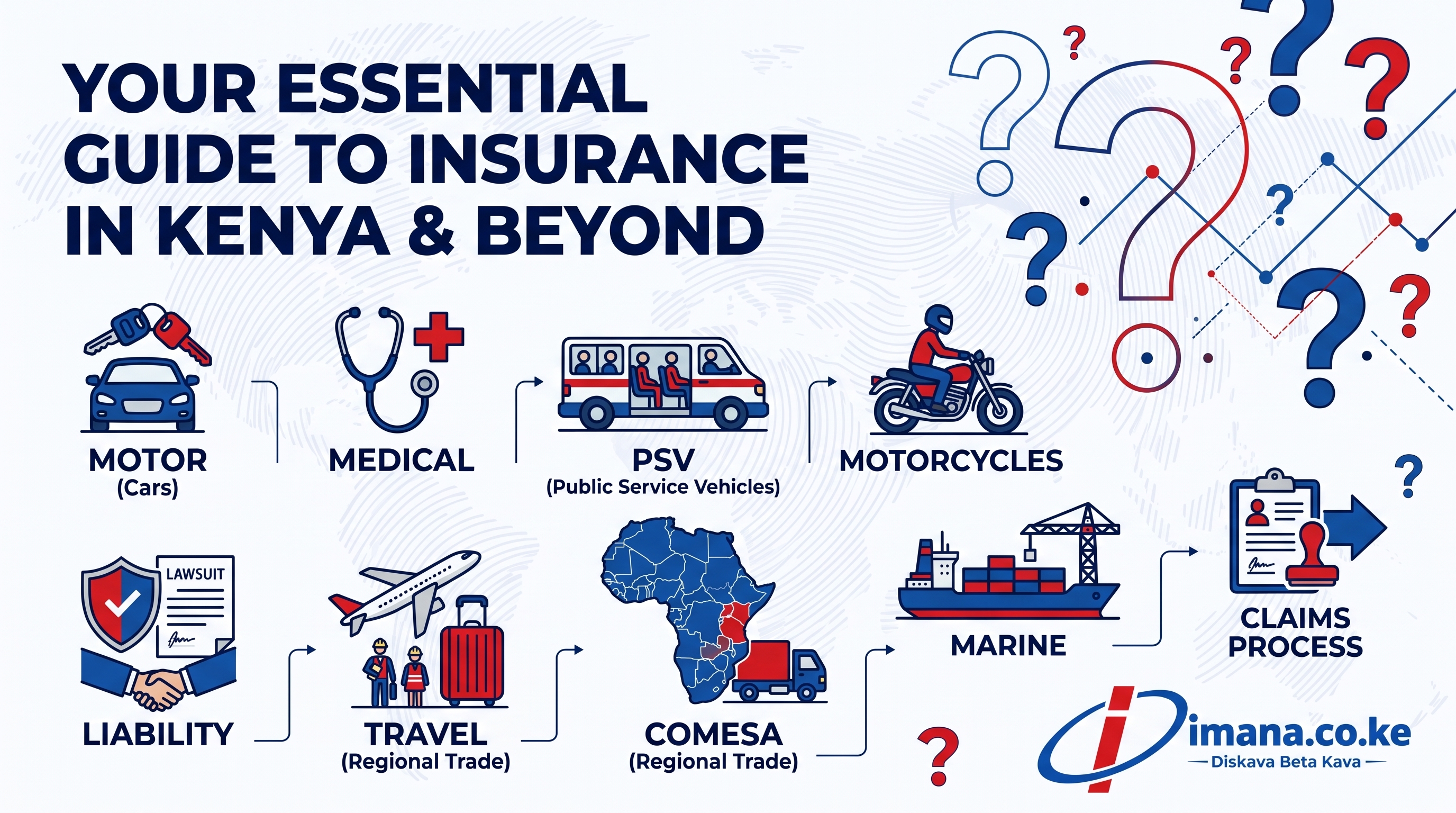
This guide brings the most important insurance questions into one current, practical resource. It covers personal, family and business insurance in Kenya, including motor, PSV, motorcycle, medical, WIBA, travel, marine, property, liability and claims.
Use it as a starting point, then follow the relevant links for detailed comparisons or request quotations from multiple insurers through Imana Insurance Agency Kenya Ltd and MyKava Online Insurance Consultants.
Quick answer: Do not choose insurance using price alone. Compare the insurer, scope of cover, exclusions, excesses, limits, waiting periods, provider network, claims process and optional benefits before paying.
Quick navigation
Insurance basics and quote comparison
Motor insurance
PSV, motorcycle and specialist vehicles
Medical and health insurance
WIBA and employee protection
Business, property and liability insurance
Travel, COMESA and marine insurance
Claims and policy servicing
Choosing an insurance intermediary
Getting a quotation
1. Insurance basics and quote comparison
1. What is insurance?
Insurance is a contract under which an insurer agrees to compensate an insured person or organisation for specified losses, subject to the policy's terms, exclusions, limits and payment of premium. It transfers defined financial risks; it does not remove every risk.
2. Why is insurance important in Kenya?
One accident, illness, fire, theft, liability claim or employee injury can destroy years of savings. Insurance converts certain unpredictable losses into a planned premium and gives households and businesses a financial recovery mechanism.
3. Which insurance covers are compulsory?
Third-party motor insurance is legally required for vehicles used on Kenyan roads. Employers also have statutory duties relating to workplace injuries under the Work Injury Benefits Act. Other insurance may be required by a lender, landlord, contract, professional regulator, tender or travel destination.
4. What is the difference between an insurer, agent and broker?
An insurer underwrites the risk and pays valid claims. An insurance agent represents one or more insurers within the authority granted to the agent. A broker advises clients and places business with insurers. Always verify that the insurer or intermediary is currently licensed by the Insurance Regulatory Authority.
5. Why should quotations from different insurers be compared?
Two policies with similar names may have different limits, exclusions, excesses, add-ons, hospital networks and claims conditions. A meaningful comparison shows the premium and what the buyer receives for it.
6. Does the cheapest policy provide the best value?
Not necessarily. A low premium can come with lower limits, a narrower provider network, higher excesses or missing extensions. The best-value cover is the one that fits the actual risk at a sustainable price.
7. What information is needed for an accurate quotation?
It depends on the product. Common details include identity or company documents, KRA PIN, asset value, occupation, payroll, vehicle use, previous claims, ages of medical-cover members, travel destination and dates, or cargo description and value. Incomplete information produces unreliable comparisons.
8. Must all material information be disclosed?
Yes. The proposer should disclose facts that may influence underwriting, pricing or acceptance. Misrepresentation or non-disclosure can lead to adjusted terms, cancellation or rejection of a claim, depending on the facts and policy.
9. What should be compared beyond premium?
Compare the sum insured, territorial limits, exclusions, excesses, sublimits, waiting periods, warranties, provider network, claim notification deadlines, add-ons, instalment terms and insurer's service capacity.
10. Can insurance be bought online in Kenya?
Yes. Quotations, proposal forms, payments and many policy documents can be handled digitally. Buyers should still verify the intermediary, insurer, payment instructions and policy details. Start with online insurance comparison in Kenya.
2. Motor insurance in Kenya
11. What are the main types of motor insurance?
The common options are Third-Party Only, Third-Party Fire and Theft, and Comprehensive insurance. The correct class must also match the vehicle's use: private, commercial, taxi, PSV, motorcycle, school transport, tour operation or another declared use.
12. What does Third-Party Only insurance cover?
It generally covers the insured's legal liability for third-party bodily injury or death and specified third-party property damage, subject to the law and policy. It does not ordinarily repair or replace the insured vehicle after accidental damage, theft or fire.
13. What does comprehensive motor insurance cover?
Comprehensive cover generally includes accidental damage to the insured vehicle, theft, fire and third-party liability, subject to exclusions, excesses and limits. Optional extensions may include excess protector, political violence and terrorism, road rescue, courtesy car, windscreen, entertainment equipment and COMESA cover.
14. Does comprehensive insurance cover everything?
No. “Comprehensive” is not unlimited. Common issues include undeclared use, unlicensed driving, intoxication, wear and tear, mechanical breakdown, excluded perils, policy excesses and breach of warranties. Read the schedule and wording together.
15. How much does motor insurance cost?
Third-party policies are usually priced using the vehicle class and period of insurance. Comprehensive premiums are commonly calculated as a percentage of the vehicle's accepted value, subject to a minimum premium, levies and selected extensions. Rates change by insurer and risk, so request a current comparison through the motor quotation page.
16. Why is a motor valuation required?
A valuation helps establish the vehicle's current market value and condition, reducing underinsurance, overinsurance and disputes after a claim. Some insurers require valuation within a stated period after cover begins.
17. What is underinsurance?
Underinsurance happens when an asset is insured below its proper value. Where the policy applies average, the insurer may reduce a partial claim in the same proportion that the asset was underinsured.
18. What is a motor insurance excess?
An excess is the portion of an admissible claim paid by the policyholder. Different excesses may apply to own damage, theft, young or inexperienced drivers, or particular vehicle uses.
19. What is excess protector?
It is an optional benefit that may reimburse or waive certain applicable excesses after an admissible claim, within its conditions. It does not erase every excess in every situation.
20. What is PVT cover?
Political Violence and Terrorism cover is an extension for specified loss or damage caused by insured political violence or terrorism events. It is not automatically included in every comprehensive motor policy.
21. Can a motor premium be paid in instalments?
Some insurers allow instalments for comprehensive cover, subject to approval and strict due dates. Third-party cover is commonly paid in full. Cover may be affected if an agreed instalment is not paid, so obtain the arrangement in writing.
22. Can a vehicle be insured for one month?
Short-period third-party policies may be available for certain vehicle classes. Availability, eligibility and price vary. Short-term cover should not be confused with an annual policy paid monthly.
23. Does private-car insurance cover taxi or ride-hailing work?
Usually not. Carrying passengers for hire or reward changes the risk and requires the correct PSV or taxi class. Undeclared commercial use can compromise a claim.
24. Can the buyer of a used vehicle continue using the seller's insurance?
Do not assume so. Insurance is issued using a particular insured person, vehicle and declared interest. Notify the insurer or intermediary immediately and arrange cancellation, transfer where permitted, or fresh cover for the buyer.
25. What documents are commonly needed for motor insurance?
Common requirements include a national ID or passport, KRA PIN, logbook or ownership evidence, completed proposal details and, for comprehensive cover, a valuation. Financed vehicles may require the lender's interest to be noted.
For deeper help, visit Motor Insurance Kenya or compare quotations at Imana Motor Quote.
3. PSV, motorcycle and specialist vehicles
26. Is every PSV a matatu?
No. A matatu is a type of Public Service Vehicle, but PSV is the wider category. It can include taxis, ride-hailing vehicles, buses, minibuses, school transport and tour vehicles, depending on licensing and use.
27. What affects PSV insurance pricing?
Pricing can depend on vehicle type, seating capacity, route or operation, period of cover, claims history, sum insured, driver controls and selected benefits. Compare like-for-like terms through the PSV insurance page.
28. Can matatu insurance be purchased monthly?
Short-period options may be available, but price and eligibility vary by insurer. Compare the total annual cost, renewal risk and operational convenience against annual cover.
29. What insurance does a school bus need?
School transport requires the correct motor class and adequate passenger liability. The school should also review driver controls, vehicle inspection, road-rescue arrangements and related institutional covers.
30. What is the difference between private and boda boda motorcycle insurance?
Private motorcycle use does not cover carrying passengers or goods for payment. A boda boda or commercial delivery motorcycle must be insured according to its actual use.
31. Does motorcycle insurance cover theft?
Third-Party Only normally does not. Theft may be covered under comprehensive or another applicable policy, subject to security requirements, documentation, excesses and exclusions.
32. Do delivery motorcycles need commercial insurance?
Yes, where the motorcycle is used for paid delivery or other commercial activity, the declared class should reflect that use. Fleet operators should also consider rider records, protective equipment, tracking and personal accident protection.
33. How are tuk-tuks, tractors and commercial pickups insured?
They require the motor class that matches their construction and actual use. Agricultural, goods-carrying and passenger-carrying risks should not be placed under private-car cover merely because it is cheaper.
Compare options through Motorcycle Insurance Kenya or PSV Insurance Kenya.
4. Medical and health insurance
34. Is SHA the same as private medical insurance?
No. The Social Health Authority administers Kenya's public health-financing funds and benefits. Private medical insurance is a separate contract with selected limits, providers, exclusions and benefits. Many households use private cover or a top-up to supplement public benefits.
35. What is inpatient medical cover?
Inpatient cover pays eligible hospital expenses when admission is medically necessary, up to the policy limit and applicable sublimits. Always check room limits, provider network, pre-authorisation and exclusions.
36. What is outpatient cover?
Outpatient cover pays eligible consultations, tests and prescribed treatment that do not require admission, within the selected limit and rules.
37. Are maternity, dental and optical benefits automatic?
Not always. They may be optional, subject to sublimits, waiting periods, provider rules and eligibility conditions. Confirm them before buying or planning treatment.
38. What is a medical-insurance waiting period?
It is the time after cover begins during which specified benefits or conditions are not payable. Waiting periods commonly affect maternity, chronic conditions, pre-existing conditions or particular procedures, but terms vary by plan.
39. Are pre-existing and chronic conditions covered?
Some plans cover them immediately, some after a waiting period, some with sublimits, and others exclude them. Full disclosure and written confirmation are essential.
40. Can a child be insured without a parent?
Some plans allow child-only medical cover, subject to entry age, guardianship details and product rules. Other family plans require an adult principal member.
41. Can people over 60 obtain medical insurance?
Yes. Several insurers offer senior medical plans, though entry ages, limits, co-payments, waiting periods and pre-existing-condition terms differ. Compare the total benefit structure rather than premium alone.
42. What is a medical top-up cover?
A top-up provides an additional layer above an underlying cover or stated deductible. It is useful when the base limit may be insufficient, but the triggering conditions must be understood.
43. What is a co-payment?
A co-payment is the amount or percentage the member pays for an eligible service. It may apply to particular facilities, treatments or benefit categories.
44. Why does the hospital network matter?
A low-priced medical plan is not useful if preferred hospitals are outside its network. Check facilities near home, work and school, and confirm referral or pre-authorisation requirements.
45. Does medical insurance cover treatment outside Kenya?
Some policies cover East Africa, Africa or worldwide treatment, sometimes excluding North America or requiring referral and pre-authorisation. Territorial scope must appear in the policy.
46. What details are needed for a medical quotation?
Usually the ages or dates of birth of all members, relationship, desired inpatient and outpatient limits, maternity needs, chronic conditions and preferred geographical scope. Accurate ages and medical disclosures matter.
Compare plans through Health Insurance Kenya, Imana Health or MyKava.
5. WIBA and employee protection
47. What is WIBA insurance?
WIBA insurance helps an employer meet statutory liability for employees who suffer injury, occupational disease or death arising out of and in the course of employment, subject to the Act and policy.
48. How is a WIBA premium calculated?
The premium is generally based on estimated annual earnings or payroll multiplied by the rate for each occupational category. Higher-risk work normally attracts a higher rate than office work.
49. What information is required for a WIBA quotation?
Provide the business activity, employee occupations, number of employees, estimated annual earnings by category, work locations and claims history. Separating office, retail, driving, factory and construction roles improves accuracy.
50. What is the difference between WIBA and Group Personal Accident?
WIBA responds to employment-related injury obligations. Group Personal Accident can provide broader accident benefits, potentially including non-work accidents, depending on the policy. WIBA Plus may combine statutory and additional benefits.
51. Does WIBA cover casual workers?
Employment status alone should not be used to dismiss exposure. Businesses should declare all workers who may fall within their legal responsibility, including eligible temporary or casual workers, and obtain insurer guidance.
52. What should an employer do after a workplace accident?
Arrange urgent care, record the incident, notify the relevant authorities and insurer within required timelines, preserve evidence and submit the prescribed documents. Late reporting can delay or prejudice a claim.
53. What other employee covers should a business consider?
Depending on the workforce, consider Group Personal Accident, Group Life, Group Medical, pension-related benefits, travel insurance and employer's liability extensions.
Request a comparison through WIBA Insurance Kenya or the Corporate Insurance Quote.
6. Business, property and liability insurance
54. Which insurance covers does a small business need?
Start with the risks that could stop operations or create a major legal bill: property damage, theft, fire, employee injury, public liability, professional negligence, cyber incidents, goods in transit and business interruption. The right mix depends on the business model.
55. What does fire and perils insurance cover?
It covers insured property against fire and any additional listed perils, subject to the schedule, exclusions and sum insured. Buildings, stock, machinery, furniture and equipment should be valued correctly.
56. What is business interruption insurance?
It covers insured loss of income or increased working costs following specified physical damage, usually when linked to an insured property policy. The indemnity period and declared gross profit require careful calculation.
57. What is public liability insurance?
It covers legal liability for third-party bodily injury or property damage arising from business activities, subject to policy terms. It is important for offices, shops, restaurants, contractors, events and premises receiving visitors.
58. What is professional indemnity insurance?
Professional indemnity protects professionals and service firms against covered claims alleging negligence, errors or omissions in professional services. Limits, retroactive dates, deductibles and notification terms matter.
59. What is product liability insurance?
It addresses covered liability arising from products manufactured, supplied or sold by the insured. Manufacturers, distributors, retailers and food businesses should assess it alongside product recall exposure.
60. What is Contractors All Risks insurance?
Contractors All Risks can cover contract works, construction materials and specified third-party liability during a project. Plant, workers, surrounding property, testing and maintenance periods may require separate or extended protection.
61. What is machinery breakdown insurance?
It covers sudden and unforeseen physical damage to insured machinery from specified internal causes, subject to exclusions. Ordinary wear, gradual deterioration and maintenance are not substitutes for insurance.
62. What is cyber insurance?
Cyber insurance may cover specified costs arising from data breaches, cyber extortion, business interruption, incident response and third-party liability. Controls such as backups, access management and staff training affect underwriting.
63. What insurance protects goods while being transported?
Goods in Transit insurance covers eligible goods against specified loss or damage during inland transportation. Confirm the mode of transport, territorial limits, security conditions, exclusions and whether loading or unloading is included.
64. What covers hotels and short-term rental properties?
Hotels and Airbnb operators may need property, business interruption, public liability, employer protection, money, burglary, fidelity guarantee, machinery breakdown and guest-related extensions. A domestic policy may not match commercial hospitality use.
65. What is a bid, performance or immigration bond?
A bond is a financial guarantee issued for an obligation. Bid bonds support tender participation; performance bonds support contractual performance; immigration or security bonds support specified immigration obligations. They are not ordinary indemnity policies.
Request tailored terms through the Corporate Insurance Quote.
7. Travel, COMESA and marine insurance
66. What does travel insurance cover?
Depending on the plan, travel insurance may cover emergency medical expenses, evacuation, repatriation, trip cancellation or curtailment, baggage problems, personal accident and travel delays. Limits and exclusions vary by destination and insurer.
67. Is travel insurance mandatory?
It depends on the destination, visa, organiser or travel contract. Even where it is optional, overseas medical treatment and evacuation can be expensive. Confirm destination-specific requirements before travel.
68. When should travel insurance be purchased?
Buy it once travel is confirmed and before departure. Cancellation benefits generally cannot protect events already known when the policy is purchased.
69. What information is needed for a travel quotation?
Provide travellers' ages, destination countries, departure and return dates, purpose of travel and any activities that may require special cover. Declare relevant medical conditions where requested.
70. What is the COMESA Yellow Card?
The COMESA Yellow Card is a regional third-party motor insurance scheme recognised in participating countries. It complements the underlying motor policy for cross-border travel; it is not a replacement for comprehensive own-damage cover.
71. What does marine cargo insurance cover?
Marine cargo insurance covers goods against insured loss or damage during transit, potentially from the supplier's warehouse to the buyer's warehouse, depending on the terms. Cover should match the cargo, route, packing, conveyance and Incoterms.
72. What is the difference between marine cargo and Goods in Transit?
Marine cargo commonly protects international or multimodal transit, while Goods in Transit commonly protects inland movement. The journey and contractual responsibility determine which policy is appropriate.
73. What documents support a marine cargo quotation or claim?
Typical documents include the commercial invoice, packing list, transport document, cargo description, value, origin, destination and shipping terms. Claims may also require survey reports, correspondence with carriers and proof of loss.
Explore Travel Insurance Kenya, COMESA Insurance and Marine Insurance Kenya.
8. Claims and policy servicing
74. What should be done immediately after a motor accident?
Protect life first, contact emergency services where necessary, report the incident as required, avoid admitting liability, document the scene, exchange relevant details and notify the insurer or intermediary promptly. Follow the insurer's towing, assessment and repair instructions.
75. Why are insurance claims rejected or reduced?
Common reasons include the loss falling outside cover, non-disclosure, excluded use, unpaid premium, breach of warranties, late notification, inadequate evidence, underinsurance, fraud or the application of an excess or sublimit.
76. Which documents are usually needed for a claim?
Requirements depend on the claim. They may include a claim form, policy details, police abstract, photographs, repair estimates, medical records, receipts, proof of ownership, statements, invoices, valuation or death and employment documents.
77. How quickly should a claim be reported?
Immediately or within the period specified by the policy. Do not wait for every document before giving initial notice. Early notification allows the insurer to investigate and control costs.
78. Can repairs begin before insurer approval?
Usually, the insurer should inspect or authorise repairs first, except for reasonable emergency steps taken to prevent further loss. Unauthorised repairs can create disputes over cause and cost.
79. What should a client do if a claim is delayed?
Ask for a written status, identify missing documents and keep a dated record of communication. Escalate through the intermediary and insurer's complaints process. Regulatory escalation may be available where the matter remains unresolved.
80. What is the intermediary's role during a claim?
A good intermediary explains requirements, helps organise documents, follows up with the insurer and keeps the client informed. The insurer still decides liability under the policy.
Start a claim through the Imana Claims Request and read the Insurance Claims Guide.
9. Choosing an insurance intermediary
81. How can a customer verify an insurance intermediary?
Check the current Insurance Regulatory Authority register, confirm the legal business name and physical contacts, and ensure payments follow verified instructions. A polished social-media page alone is not proof of authority.
82. What makes an insurance agency trustworthy?
Look for licensing, clear insurer disclosure, written comparisons, transparent payment instructions, accessible staff, policy-document support, renewal reminders and practical claims assistance.
83. Why use an intermediary instead of approaching one insurer?
An intermediary may help compare several options, explain technical differences and support servicing after purchase. The value comes from advice and follow-through—not simply forwarding the cheapest quotation.
84. Should a client receive policy documents and receipts?
Yes. Keep the proposal information, official payment evidence, policy schedule, certificate where applicable, wording, endorsements and intermediary communication. Check names, registration details, period of insurance and limits immediately.
85. Why does local accessibility still matter in a digital service?
Digital service brings speed, but clients may still need accountable people during complex claims, financing confirmations or business-risk reviews. Imana combines online support with a physical office at 4th Floor, Krishna Centre, Woodvale Grove, Westlands, Nairobi.
10. How to compare and buy the right cover
Step 1: Define the risk
Identify what could cause the largest financial loss: hospitalisation, vehicle damage, liability, employee injury, fire, theft, interrupted income, cargo loss or professional error.
Step 2: Gather accurate information
Prepare the documents and values relevant to the risk. Do not reduce payroll, asset values or vehicle use merely to obtain a cheaper quote.
Step 3: Compare equivalent benefits
Place quotations side by side using the same limits and extensions. Flag missing benefits, different excesses and restrictive conditions.
Step 4: Choose value, not just price
Consider financial protection, service, claims practicality and affordability together. Ask what happens in the exact loss scenario that worries you most.
Step 5: Verify before paying
Confirm the intermediary, insurer, account details, insured name, cover period and amount. Keep official evidence of payment.
Step 6: Review the documents immediately
Report errors as soon as the policy is issued. Store the documents where the family, driver, finance team or responsible employee can access them.
Step 7: Review cover every year
Vehicles depreciate, medical needs change, payroll grows, stock fluctuates and new contracts create new liabilities. Renewal should be a risk review—not an automatic repeat of last year's policy.
Frequently asked quick questions
Can one intermediary arrange several classes of insurance?
Yes, subject to its insurer appointments and authority. This can simplify renewals and claims coordination for families and businesses.
Are online insurance quotations free?
Imana provides quotation comparison without charging the client a quotation fee. Any premium, levy or policy charge should be clearly shown before purchase.
Can cover start immediately?
Some policies can begin after underwriting approval and confirmed premium. Complex medical, business, marine or high-value risks may require additional information before acceptance.
Can an insurer change terms at renewal?
Yes. Premiums, limits, networks, underwriting requirements and benefits can change. Compare the renewal terms against alternatives before accepting them.
What is the single most important insurance question to ask?
Ask: “In which realistic circumstances would this policy not pay?” The exclusions, warranties and conditions often reveal more than the headline benefit.
Get insurance quotations from multiple providers
Imana Insurance Agency Kenya Ltd helps individuals, families, professionals and businesses compare suitable insurance options from trusted insurance companies in Kenya.
Compare motor insurance: www.imana.co.ke/motor-quote
Compare medical insurance: www.imana.co.ke/insurance/health-insurance
Compare WIBA and business insurance: www.imana.co.ke/corporate-quote
Explore online insurance: www.mykava.co.ke
Call or WhatsApp: +254 745 218 460
Visit: 4th Floor, Krishna Centre, Woodvale Grove, Westlands, Nairobi
Compare. Understand. Buy with confidence.
Important notice
This guide provides general information and is not a policy contract, legal opinion or guarantee of claim payment. Benefits, premiums, limits, waiting periods, excesses, exclusions and underwriting decisions vary by insurer and can change. Always rely on the final quotation, policy schedule, wording and endorsements issued for the specific risk.
Author
Raymond Momanyi is the Founder and CEO of Imana Insurance Agency Kenya Ltd. His areas of practice include motor insurance, medical insurance, WIBA, PSV insurance comparison, claims support and business risk. Through Imana and MyKava, he promotes clear comparison, digital access and practical insurance education for clients in Kenya and East Africa.
Read more on the Raymond Momanyi author page.
Authoritative reference points
Insurance Regulatory Authority: current registers of licensed insurers and intermediaries - https://ira.go.ke/licensed-insurance-entities/
Kenya Law: Insurance Act, Cap. 487 - https://new.kenyalaw.org/akn/ke/act/1985/1/
Kenya Law: Insurance (Motor Vehicles Third Party Risks) Act, Cap. 405 - https://new.kenyalaw.org/akn/ke/act/1945/12/
Kenya Law: Work Injury Benefits Act, 2007 - https://new.kenyalaw.org/akn/ke/act/2007/13/
Social Health Authority: official information and benefit updates - https://sha.go.ke/
These references establish the regulatory framework. The applicable policy schedule, wording and endorsements determine the cover purchased from an insurer.