
Blog Details
Diskava. Beta. Kava
10Jul
Is WIBA Insurance Mandatory in Kenya? Everything Every Employer Must Know (2026 Guide)
If you've searched "Is WIBA mandatory in Kenya?", "What is WIBA Insurance?", "WIBA Insurance Kenya", "Work Injury Benefits Act Kenya", "WIBA cover requirements", or "How much is WIBA Insurance in Kenya?", you're asking one of the most important questions every employer should know.
The simple answer is:
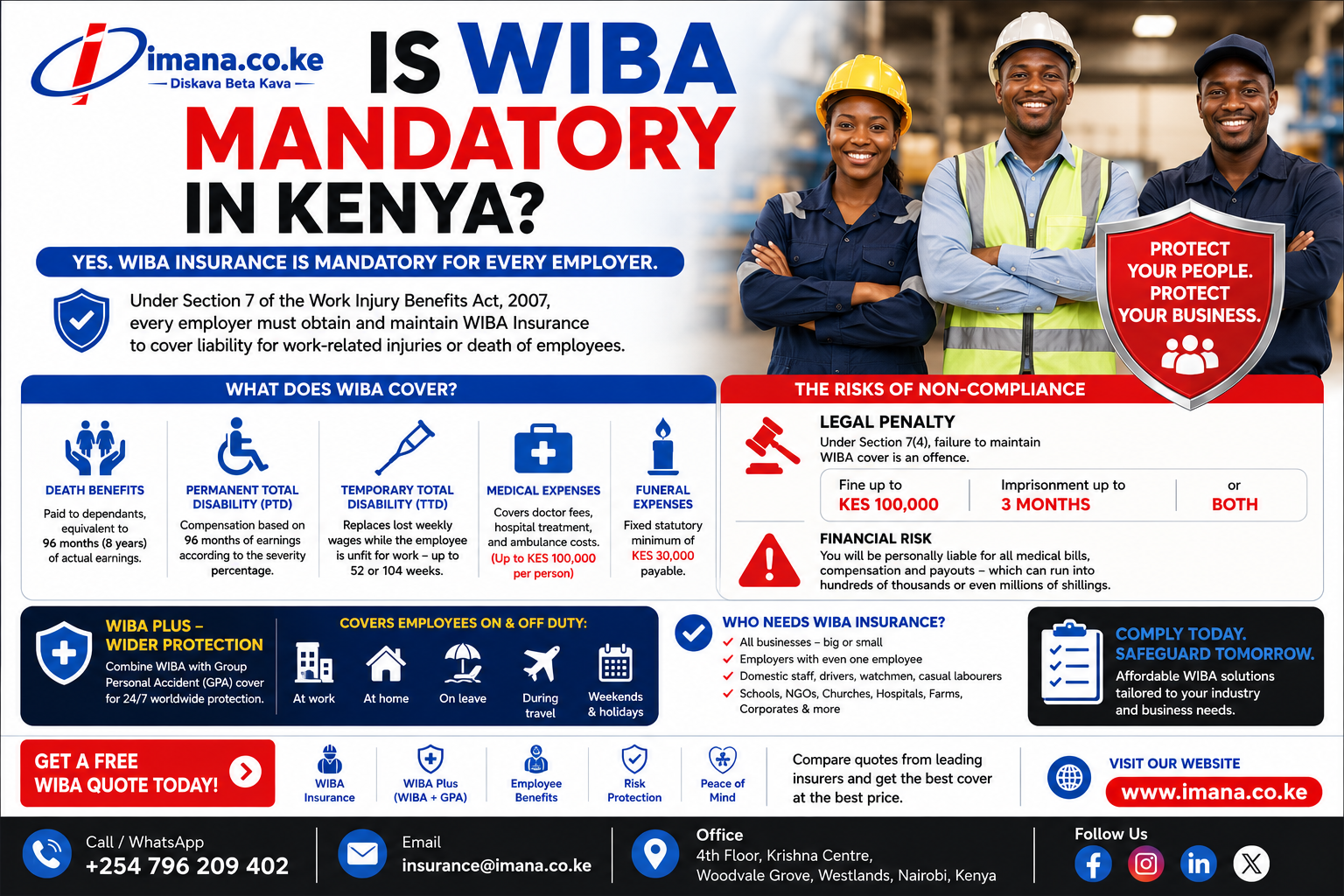
Yes. WIBA Insurance is mandatory for every employer in Kenya.
Whether you own a large company, a small business, employ casual workers, hire domestic staff, or operate a construction site, Kenyan law requires you to protect your employees under the Work Injury Benefits Act (WIBA), 2007.
Failure to comply can expose your business to heavy fines, imprisonment, and costly compensation claims.
This guide explains everything employers need to know about WIBA Insurance in Kenya, who needs it, what it covers, the penalties for non-compliance, and why many businesses are now upgrading to WIBA Plus.
What is WIBA Insurance?
WIBA (Work Injury Benefits Act) Insurance is an employer's liability insurance policy that compensates employees who suffer injuries, occupational diseases, disability, or death arising out of and in the course of their employment.
The policy protects both:
- Employees, by ensuring they receive statutory compensation.
- Employers, by protecting them from potentially devastating financial liabilities.
Is WIBA Insurance Mandatory in Kenya?
Yes. It is a legal requirement.
Under Section 7 of the Work Injury Benefits Act, 2007, every employer must obtain and maintain insurance that covers any legal liability arising from injuries sustained by employees while at work.
The law applies regardless of the size of your business.
If you employ even one person under a contract of service, you are legally required to have WIBA Insurance.
This includes:
- Limited companies
- Sole proprietorships
- Partnerships
- NGOs
- SACCOs
- Schools
- Churches
- Hotels
- Factories
- Construction companies
- Farms
- Hospitals
- Retail shops
- Security firms
- Professional offices
- Domestic employers
Who Needs WIBA Insurance?
Many employers mistakenly believe WIBA only applies to factories or construction sites.
In reality, it applies across almost every industry.
Examples include:
Corporate Offices
- Accountants
- Lawyers
- Insurance agencies
- ICT companies
- Marketing firms
Construction Companies
- Engineers
- Site supervisors
- Casual labourers
- Contractors
- Welders
- Electricians
Manufacturing
- Factory workers
- Machine operators
- Technicians
- Warehouse staff
Schools & Universities
- Teachers
- Drivers
- Cooks
- Cleaners
- Security personnel
- Groundskeepers
Healthcare
- Doctors
- Nurses
- Laboratory staff
- Pharmacists
- Ambulance crews
Retail Businesses
- Shop attendants
- Cashiers
- Supervisors
- Storekeepers
Hospitality Industry
- Hotel staff
- Waiters
- Chefs
- Housekeeping
- Receptionists
Agriculture
- Farm workers
- Tractor operators
- Dairy workers
- Packers
Domestic Employers
Even if you employ:
- House helps
- Gardeners
- Nannies
- Drivers
- Watchmen
You are still legally required to have WIBA Insurance.
What Does WIBA Insurance Cover?
The Work Injury Benefits Act provides compensation when employees suffer work-related injuries or occupational diseases.
1. Death Benefits
If an employee dies due to a work-related accident or occupational disease, their dependants receive compensation equivalent to:
96 months (8 years) of the employee's actual earnings, subject to the provisions of the Act.
2. Permanent Total Disability (PTD)
Where an employee becomes permanently disabled and cannot continue working, compensation is calculated based on:
- Actual earnings
- Percentage of disability
- Statutory formula under WIBA
Compensation can amount to hundreds of thousands—or even millions—of shillings depending on the circumstances.
3. Temporary Total Disability (TTD)
If an employee is temporarily unable to work following an accident:
The policy replaces lost income while the employee remains medically unfit for duty.
Benefits may continue for up to 52 or 104 weeks, depending on the medical assessment and statutory provisions.
4. Medical Expenses
WIBA covers reasonable medical costs arising from workplace injuries, including:
- Doctor consultations
- Hospital treatment
- Surgery
- Medication
- X-rays
- Ambulance services
- Rehabilitation
Many policies provide statutory medical expense limits of approximately KES 100,000 per employee, subject to the policy wording.
5. Funeral Expenses
Where a workplace accident results in death, WIBA provides a statutory funeral benefit.
The minimum statutory amount is generally KES 30,000, helping families manage immediate funeral costs.
What Doesn't Standard WIBA Cover?
Although WIBA provides excellent workplace protection, it has limitations.
Standard WIBA generally does not cover:
- Injuries occurring outside working hours
- Weekend accidents unrelated to work
- Personal travel
- Family activities
- Holidays
- Sports injuries outside employment
- Non-work-related illnesses
Coverage is limited to incidents arising out of and during employment.
Why Many Employers Choose WIBA Plus
Many businesses today choose WIBA Plus, which combines:
- Standard WIBA
- Group Personal Accident (GPA) Insurance
This significantly broadens protection.
WIBA Plus Benefits
In addition to workplace injuries, WIBA Plus may provide cover for accidents occurring:
- At home
- During weekends
- On annual leave
- During business travel
- After working hours
- Anywhere in the world (subject to policy terms)
This provides employees and employers with much wider protection than statutory WIBA alone.
What Happens If You Don't Have WIBA Insurance?
Operating without WIBA Insurance exposes your business to serious legal and financial consequences.
Legal Penalties
Under Section 7(4) of the Work Injury Benefits Act:
An employer who fails to maintain WIBA Insurance commits an offence and may face:
- A fine of up to KES 100,000
- Imprisonment for up to 3 months
- Or both
Financial Consequences
Without WIBA Insurance, the employer becomes personally responsible for paying:
- Medical bills
- Disability compensation
- Funeral expenses
- Death benefits
- Court awards
- Legal costs
A single serious workplace accident could cost hundreds of thousands—or even millions—of shillings, placing enormous financial strain on a business.
Why WIBA Insurance Makes Business Sense
Apart from complying with the law, WIBA Insurance helps businesses:
- Protect employees
- Demonstrate corporate responsibility
- Improve staff confidence
- Reduce financial uncertainty
- Meet contractual requirements
- Qualify for tenders
- Comply with labour laws
It is a relatively affordable investment compared to the potentially significant cost of workplace injury claims.
Why Choose Imana Insurance Agency Kenya Ltd?
At Imana Insurance Agency Kenya Ltd, we help businesses of all sizes compare WIBA Insurance from trusted insurers across Kenya.
We provide cover for:
- Small businesses
- SMEs
- Corporate organisations
- NGOs
- Schools
- Hospitals
- Manufacturers
- Construction companies
- Security firms
- Hotels
- Farms
- Churches
- Professional firms
- Domestic employers
Our team also assists employers in choosing between Standard WIBA and WIBA Plus, ensuring your business has protection that matches its operational risks.
Frequently Asked Questions
Is WIBA compulsory in Kenya?
Yes. Every employer is legally required to maintain WIBA Insurance under the Work Injury Benefits Act, 2007.
Does WIBA cover casual workers?
Yes. Casual employees working under a contract of service should also be covered.
Does WIBA cover house helps?
Yes. Domestic workers such as house helps, gardeners, drivers and watchmen should be protected under WIBA.
Does WIBA cover injuries outside work?
Standard WIBA generally covers only work-related injuries. If you need broader 24-hour protection, consider WIBA Plus combined with Group Personal Accident (GPA) cover.
Can small businesses buy WIBA Insurance?
Absolutely. WIBA is available for businesses of all sizes, including sole proprietors and SMEs.
Get a Free WIBA Insurance Quote Today
Not sure whether your business has the right WIBA cover?
Our experienced advisors can help you compare quotations from leading insurers and recommend the most suitable solution based on your industry, workforce, and risk profile.
Whether you need Standard WIBA, WIBA Plus, or a complete employee benefits package, we're here to help.
Contact Imana Insurance Agency Kenya Ltd
🌐 Main Website
👷 WIBA Insurance
https://imana.co.ke/insurance/wiba-insurance
📋 Get a Free Insurance Quote
https://imana.co.ke/corporate-quote
🏥 Health Insurance
https://imana.co.ke/insurance/health-insurance
🚗 Motor Insurance
https://imana.co.ke/insurance/motor-insurance
📞 Call / WhatsApp
+254 796 209 402
📍 Office
4th Floor, Krishna Centre, Woodvale Grove, Westlands, Nairobi, Kenya
Protect Your Employees. Protect Your Business. Stay Compliant.
Every employee deserves a safe working environment, and every employer deserves protection from unexpected financial liability. WIBA Insurance is more than a legal requirement—it's an investment in your people and the long-term stability of your business.
Compare. Buy. Save.
Imana Insurance Agency Kenya Ltd – Your Trusted Partner for WIBA Insurance, Employee Benefits, and Business Risk Protection in Kenya.