
Blog Details
Diskava. Beta. Kava
31Jul
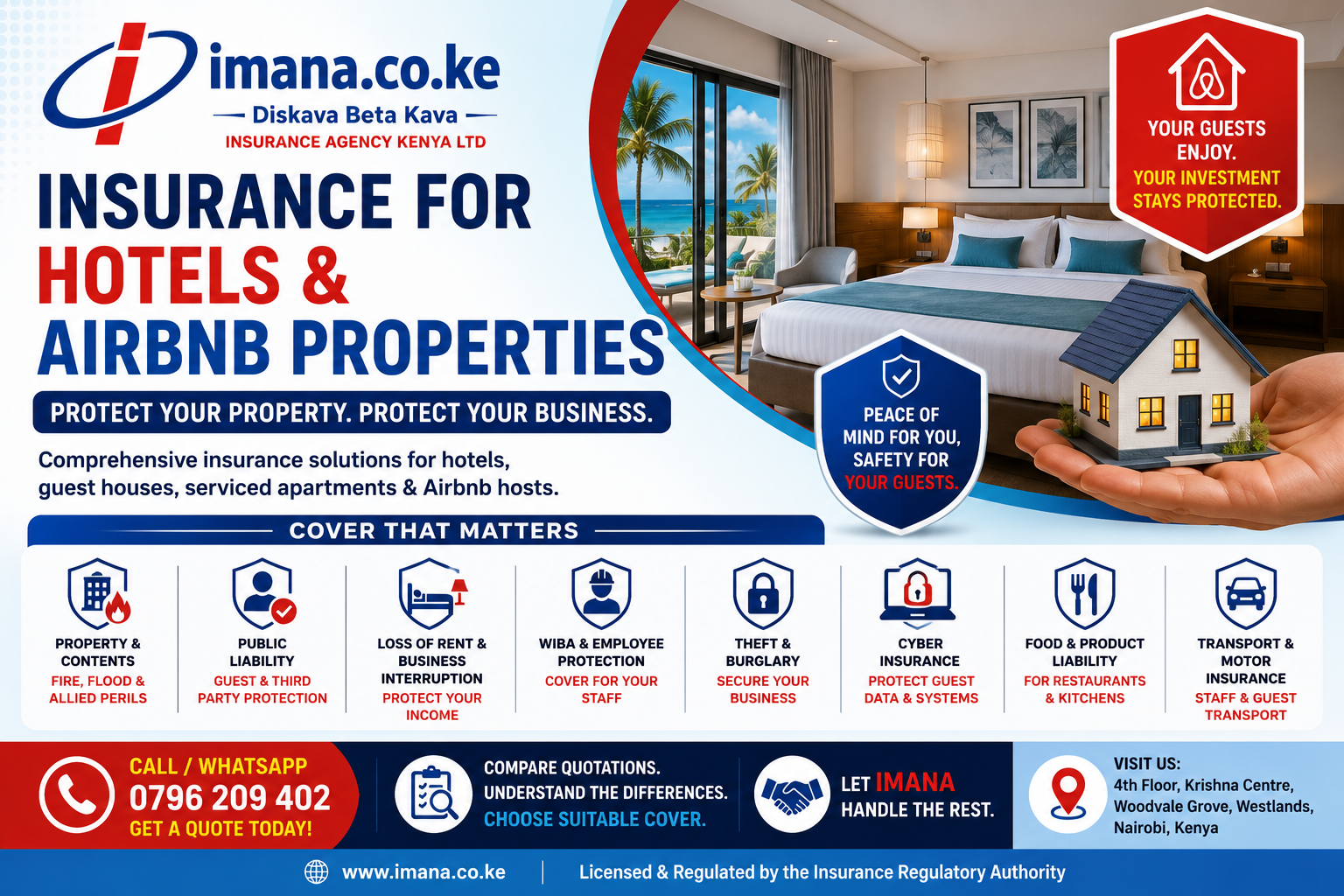
Insurance for Hotels and Airbnb Properties in Kenya
Learn which insurance covers hotels, serviced apartments, guest houses and Airbnb properties in Kenya need, including property, public liability, business interruption, WIBA, burglary and cyber insurance.
Why Hotels and Airbnb Properties Need Specialised Insurance
Hotels, guest houses, serviced apartments and Airbnb properties face risks that ordinary residential premises do not experience.
A private home may receive a few invited visitors. A hospitality property may accommodate different guests every day, employ workers, collect personal information, serve meals, operate recreational facilities and depend on continuous bookings for income.
Possible incidents include:
- A guest slipping on a wet floor
- Fire damaging rooms and furniture
- Theft of televisions or appliances
- A burst pipe flooding neighbouring apartments
- Guest property being damaged or stolen
- Food causing illness
- An employee being injured at work
- A cyberattack compromising booking records
- A major incident forcing booking cancellations
- Damage caused by a guest
- Electrical faults damaging appliances
- Swimming-pool accidents
- Loss of rental income during repairs
An ordinary domestic policy may exclude or restrict losses arising from commercial accommodation.
That is why the property’s actual use must be disclosed to the insurer.
A home used for paying guests is no longer exposed only as a home. It is also a hospitality business.
What Is Hotel and Airbnb Insurance?
Hotel or short-term-rental insurance is not necessarily one standalone policy.
It is usually an insurance programme combining several sections to protect:
- The building
- Furniture and appliances
- Guest-related liabilities
- Employees
- Rental income
- Electronic equipment
- Money
- Food and beverages
- Business records
- Vehicles
- Digital booking systems
The correct structure depends on whether the property is:
- A large hotel
- A boutique hotel
- A guest house
- A serviced apartment
- A furnished Airbnb unit
- A holiday villa
- A lodge
- A hostel
- A bed-and-breakfast establishment
- A homestay
- A property-management portfolio
A one-bedroom Airbnb apartment does not require the same limits as a 100-room hotel, but both need cover that recognises paying guests.
Are Airbnb and Short-Term Rental Properties Regulated in Kenya?
Kenya’s Tourism Regulatory Authority licenses regulated tourism enterprises and applies standards relating to areas such as safety, security, hygiene and service quality. New Tourism Regulatory Authority regulations published in December 2025 operate alongside standards developed by the Authority for hygiene, safety, security and quality. (Tourism Authority)
Property owners should therefore establish whether their accommodation business requires:
- Tourism licensing
- County business permits
- Public-health approvals
- Fire-safety compliance
- Building-management approval
- Landlord consent
- Planning or change-of-use approval
- Tax registration
- Data-protection compliance
Insurance does not replace regulatory compliance.
An insurer may ask for licences, inspection reports or fire-safety records when assessing the risk or investigating a claim.
Does Airbnb AirCover Replace Local Insurance?
No.
Airbnb currently provides eligible hosts with AirCover for Hosts, which includes Host Damage Protection and Host Liability Insurance. Airbnb describes Host Damage Protection as providing up to USD 3 million for certain guest-caused damage, while Host Liability Insurance can provide up to USD 1 million where an eligible host is legally responsible for a guest’s injury or damage to another person’s property.
However, Airbnb expressly states that these protections do not replace homeowners’, renters’ or other adequate insurance. Its Host Damage Protection terms also state that the damage programme is a contractual guarantee rather than an insurance contract.
AirCover may also be limited to eligible stays booked through Airbnb.
It may not address every exposure involving:
- Direct bookings
- Bookings through another platform
- Long-term tenants
- Ordinary wear and tear
- Undeclared commercial activities
- Building damage unrelated to a guest
- Employee injuries
- Business interruption from fire or flood
- Cyberattacks
- Motor vehicles
- Regulatory fines
- Events outside the programme’s terms
A host should therefore treat platform protection as an additional layer—not as a complete replacement for locally arranged property and liability insurance.
Essential Insurance Covers for Hotels and Airbnb Properties
1. Fire and Allied Perils Insurance
Fire and Allied Perils Insurance protects the property against fire and other insured events.
Depending on the selected policy, it may cover:
- The building
- Furniture
- Beds and mattresses
- Television sets
- Refrigerators
- Cookers
- Curtains and carpets
- Air-conditioning equipment
- Kitchen equipment
- Laundry equipment
- Office contents
- Guest-room fittings
- Stock and supplies
Allied perils may include:
- Explosion
- Lightning
- Storm
- Flood
- Earthquake
- Impact damage
- Malicious damage
- Burst pipes
- Water damage
The policy schedule should specify which perils are included.
Building owners
A hotel or apartment owner should insure the building using an appropriate rebuilding value.
This may need to include:
- Construction costs
- Professional fees
- Debris removal
- Statutory fees
- Reinstatement of fixtures
- Inflation during reconstruction
Tenants and Airbnb operators
A host who does not own the building may insure:
- Furniture
- Appliances
- Electronics
- Tenant improvements
- Curtains and fittings
- Stock
- Business equipment
The landlord’s building insurance does not automatically protect the host’s contents or rental income.
2. Burglary and Theft Insurance
Hotels and short-term rentals contain items that can be attractive to thieves, including:
- Television sets
- Laptops
- Appliances
- Linen
- Furniture
- Sound systems
- Kitchen equipment
- Guest property
- Cash
Burglary Insurance may respond where insured property is stolen following forcible or violent entry into or exit from the premises, subject to the wording.
The policy may require:
- Working locks
- Security guards
- CCTV
- Controlled keys
- Alarm systems
- Secure windows
- Prompt police reporting
- An inventory of insured items
Ordinary disappearance may not qualify.
For example, where a television is missing after checkout but there is no clear evidence of how it disappeared, settlement may depend on whether guest-caused theft, mysterious disappearance or employee dishonesty is included.
3. All Risks Insurance for Portable Equipment
Portable property can be damaged or lost away from the premises.
All Risks cover may be suitable for:
- Laptops
- Cameras
- Mobile point-of-sale devices
- Portable speakers
- Projectors
- Event equipment
- Business phones
The equipment should be listed with its description, serial number and value.
Ordinary Fire and Burglary Insurance may apply only at the named property.
4. Public Liability Insurance
Public Liability Insurance protects the business against eligible legal claims where a guest, visitor or member of the public suffers accidental bodily injury, death or property damage connected to the premises or operations.
Possible incidents include:
- A guest slipping in a bathroom
- A visitor falling on a staircase
- A balcony rail failing
- A loose ceiling fixture causing injury
- A swimming-pool accident
- Water leaking into a neighbouring apartment
- A signboard damaging a parked vehicle
- Hot food or drinks burning a guest
- A guest being injured by damaged furniture
Hotels and short-term-rental operators owe visitors a duty to take reasonable care for their safety. Kenya’s Occupational Safety and Health Act also requires fire precautions in workplaces, while recognised accommodation standards include fire-safety requirements for hotels. (Kenya Law)
Public Liability Insurance may cover:
- Eligible compensation
- Approved legal defence costs
- Claimant’s legal costs
- Investigation expenses
The liability limit should reflect the possible severity of an injury—not simply the cheapest premium.
5. Guest Property Liability
A guest may allege that personal belongings were:
- Stolen
- Damaged
- Lost while held for safekeeping
- Destroyed by fire
- Damaged by water
- Mishandled by employees
A hotel package may contain an Innkeeper’s Liability or guest-property section.
The policy may impose limits:
- Per guest
- Per room
- Per incident
- For valuables
- For items deposited in a safe
Cash, jewellery, passports and high-value electronics may have restricted protection.
Hosts should provide secure storage and clearly communicate procedures for valuables.
6. Business Interruption Insurance
Physical repairs are not the only cost following a serious incident.
A fire may damage an Airbnb unit and make it unavailable for three months. A hotel may lose bookings while repairs, inspections and approvals are completed.
Business Interruption Insurance may protect eligible:
- Lost gross profit
- Lost rental income
- Continuing salaries
- Rent
- Loan expenses
- Temporary operating costs
- Additional advertising
- Alternative-premises costs
Example
A burst pipe floods three serviced apartments.
Property Insurance may pay for eligible repairs to:
- Floors
- Furniture
- Appliances
- Walls
Business Interruption Insurance may address eligible booking income lost while the apartments are unavailable.
The cover normally requires the interruption to result from physical damage caused by an insured peril.
The owner should select a realistic indemnity period, considering:
- Repair time
- Building approvals
- Replacement furniture
- Imported equipment
- High-season bookings
- Reputation recovery
- Time required to restore occupancy
7. Loss of Rent Insurance
Landlords operating furnished rental properties may lose income after insured damage makes the premises uninhabitable.
Loss of Rent Insurance may protect eligible income for the selected indemnity period.
The declared value should reflect:
- Expected annual rent
- Occupancy
- Seasonal rates
- Service charges
- Multiple units
- Expected business growth
The policy may not cover ordinary low occupancy, cancellations unrelated to insured damage or poor reviews.
8. WIBA Insurance
Hotels, lodges and Airbnb businesses may employ:
- Cleaners
- Receptionists
- Cooks
- Security staff
- Caretakers
- Drivers
- Maintenance workers
- Laundry staff
- Gardeners
- Pool attendants
Every employer should maintain the required Work Injury Benefits Act insurance for qualifying workplace injuries and occupational diseases.
WIBA may respond to eligible claims involving:
- Medical expenses
- Temporary disability
- Permanent disability
- Occupational disease
- Funeral expenses
- Work-related death
Even a host who employs one cleaner or caretaker should review their employer obligations.
The quotation normally depends on:
- Number of employees
- Annual payroll
- Occupations
- Work locations
- Claims history
9. Employer’s Liability and Group Personal Accident
WIBA focuses on statutory work-related compensation.
Hotels may also consider:
Employer’s Liability
This can address eligible common-law claims alleging employer negligence, subject to the policy.
Group Personal Accident
This may provide defined accident benefits for employees on a 24-hour basis, depending on the arrangement.
These covers should not be treated as replacements for WIBA.
10. Fidelity Guarantee Insurance
Hospitality businesses often give employees access to:
- Cash
- Mobile-money collections
- Guest deposits
- Stock
- Linen
- Food and beverages
- Booking systems
- Payment terminals
Fidelity Guarantee Insurance may protect the business against specified direct financial loss caused by dishonest employees.
The business should also maintain controls such as:
- Separation of duties
- Daily reconciliations
- Stock counts
- Restricted system access
- Cash limits
- Employee screening
- CCTV
- Mandatory leave
11. Money Insurance
Money Insurance protects business funds under specified circumstances.
It may cover money:
- At reception
- In a locked safe
- In transit to the bank
- In the custody of authorised employees
- At a designated collection point
The policy may impose separate limits for:
- Business hours
- Overnight storage
- Money in transit
- Safes
- Cash drawers
Money Insurance does not usually cover unexplained shortages or ordinary bookkeeping mistakes.
12. Electronic Equipment Insurance
Hotels and short-term rentals increasingly depend on electronic systems.
These may include:
- Computers
- Servers
- CCTV
- Wi-Fi routers
- Booking terminals
- Access-control systems
- Smart locks
- Television systems
- Point-of-sale equipment
- Communication equipment
Electronic Equipment Insurance may protect against sudden and accidental physical damage.
Optional extensions may include:
- Data-restoration costs
- Increased cost of working
- Portable equipment
- External storage media
Cyber incidents usually require separate Cyber Insurance.
13. Machinery Breakdown Insurance
Hotels may rely on:
- Lifts
- Boilers
- Generators
- Laundry equipment
- Refrigeration systems
- Air-conditioning systems
- Water pumps
- Kitchen machinery
- Cold rooms
Machinery Breakdown Insurance may protect these systems against sudden and unforeseen internal mechanical or electrical damage.
Common exclusions may include:
- Wear and tear
- Corrosion
- Gradual deterioration
- Poor maintenance
- Consumable parts
Maintenance records can be important during a claim.
14. Deterioration of Stock Insurance
Hotels and restaurants may lose food, drinks or other temperature-sensitive stock when refrigeration equipment breaks down.
Deterioration of Stock Insurance may cover eligible spoilage following an insured machinery breakdown.
The policy may require:
- Working temperature monitoring
- Equipment maintenance
- Backup power
- Stock records
- Immediate reporting
Ordinary spoilage, expired stock or utility failure without the relevant extension may be excluded.
15. Product Liability Insurance
Hotels, lodges and Airbnb hosts that provide food or beverages may face claims alleging:
- Food poisoning
- Contamination
- Allergic reaction
- Foreign objects in food
- Unsafe products
Product Liability Insurance may protect the business against eligible third-party injury or property damage caused by supplied products.
Public Liability and Product Liability should be coordinated.
A customer slipping in a dining room is ordinarily a public-liability exposure. A customer alleging illness from a meal may create a product-liability exposure.
16. Cyber Insurance
Hotels and short-term rentals collect information such as:
- Guest names
- Identification details
- Telephone numbers
- Email addresses
- Payment information
- Travel dates
- Passport details
- Booking records
A cyber incident may cause:
- Data exposure
- Booking-system interruption
- Ransomware
- Fraudulent payment instructions
- Loss of reservations
- Customer claims
- Reputation damage
Cyber Insurance may cover eligible:
- Forensic investigation
- Data restoration
- Privacy liability
- Customer notification
- Legal defence
- Cyber Business Interruption
- Crisis communication
The business should also use:
- Multi-factor authentication
- Strong passwords
- Secure Wi-Fi
- Tested backups
- Restricted access
- Staff training
- Updated software
17. Domestic Package vs Commercial Hospitality Insurance
A standard Domestic Package policy is intended primarily for private residential use.
It may cover:
- A private home
- Household contents
- Domestic liability
- Domestic employees
- Personal belongings
However, short-term accommodation introduces commercial risks.
A domestic insurer may restrict or exclude:
- Paying guests
- Frequent occupancy changes
- Business equipment
- Commercial liability
- Rental income
- Guest property
- Employee dishonesty
- Online booking operations
The host must disclose that the property is used for Airbnb, serviced accommodation or other paying guests.
An insurer may:
- Endorse the domestic policy
- Offer a landlord’s policy
- Arrange a hospitality package
- Require a commercial policy
- Decline certain risks
Never describe a commercial short-term rental as an owner-occupied private home merely to obtain a lower premium.
18. Motor and Passenger Transport Insurance
Hotels and lodges may operate:
- Airport-transfer vehicles
- Guest shuttles
- Tour vans
- Staff vehicles
- Delivery vehicles
The correct motor class depends on how each vehicle is used.
A private motor policy may be unsuitable for a vehicle carrying paying guests.
The business may also require:
- Passenger liability
- Driver Personal Accident
- Road rescue
- COMESA Yellow Card
- Commercial motor cover
- Tour Service Vehicle insurance
Motor Insurance does not automatically cover guests’ luggage or goods carried in the vehicle.
19. Political Violence and Terrorism
Hotels can be exposed to riots, malicious damage, political violence or terrorism.
Ordinary property insurance may exclude these events unless an extension is added.
The operator should confirm whether the extension applies to:
- Buildings
- Contents
- Stock
- Machinery
- Business interruption
- Loss of rent
- Malicious damage
Protecting physical assets without covering the resulting income loss may leave a serious gap.
20. Terrorism and Security-Related Liability
Large hotels, conference facilities and properties serving international visitors may have additional security exposures.
The insurer may assess:
- Access controls
- CCTV
- Security guards
- Emergency procedures
- Property location
- Occupancy
- Event activities
- Previous incidents
High-risk or specialist events may need separate underwriting.
Insurance for Different Hospitality Businesses
Airbnb Apartments
A practical package may include:
- Contents Insurance
- Fire and Allied Perils
- Burglary
- Public Liability
- Loss of Rent
- Guest-caused damage protection
- WIBA for employees
- All Risks for electronics
- Cyber Insurance where guest data is held
Serviced Apartments
A serviced-apartment operator may also require:
- Building Insurance
- Business Interruption
- Fidelity Guarantee
- Money Insurance
- Electronic Equipment
- Machinery Breakdown
- Guest Property Liability
- Commercial Motor
Guest Houses and Bed-and-Breakfast Properties
Relevant covers may include:
- Buildings and Contents
- Public Liability
- Product Liability
- Business Interruption
- WIBA
- Money
- Burglary
- Guest property
- Machinery Breakdown
Hotels
Hotels may need a broad combined package covering:
- Buildings
- Contents
- Stock
- Business Interruption
- Public Liability
- Product Liability
- Guest property
- Money
- Fidelity
- WIBA
- Employer’s Liability
- Machinery Breakdown
- Deterioration of Stock
- Cyber
- Motor
- Group Medical
- Political Violence and Terrorism
Lodges and Holiday Villas
Additional risks may include:
- Remote locations
- Wildlife
- Bush fires
- Water supply
- Power interruptions
- Long emergency-response times
- Guest transfers
- Outdoor activities
These exposures should be disclosed during quotation.
How Much Does Hotel or Airbnb Insurance Cost in Kenya?
There is no universal premium.
The cost depends on:
- Property value
- Contents value
- Number of rooms
- Annual revenue
- Location
- Construction type
- Fire protection
- Security
- Swimming pools
- Restaurant operations
- Alcohol service
- Number of employees
- Claims history
- Guest capacity
- Liability limits
- Online booking exposure
- Business-interruption period
- Political-violence extension
- Policy excesses
A furnished studio apartment and a five-star hotel cannot be priced in the same way.
The insurer needs accurate information about the property and operations.
Information Required for a Quotation
Prepare the following:
Property information
- Physical address
- Ownership or tenancy
- Building value
- Contents value
- Construction type
- Number of rooms or units
- Occupancy capacity
- Neighbouring properties
- Swimming pool or recreational facilities
Business information
- Type of accommodation
- Annual turnover
- Average occupancy
- Booking channels
- Direct bookings
- Food and beverage services
- Events
- Airport transfers
- Claims history
Safety and security
- Fire extinguishers
- Smoke alarms
- Fire exits
- CCTV
- Security guards
- Alarm systems
- Emergency lighting
- First-aid arrangements
- Pool safety
- Balcony and staircase controls
Employee details
- Number of employees
- Occupations
- Annual payroll
- Casual workers
- Outsourced staff
Required benefits
- Property damage
- Business interruption
- Public liability
- Guest property
- WIBA
- Money
- Fidelity
- Cyber
- Machinery Breakdown
- Political Violence and Terrorism
How to Calculate the Right Property Value
Building value
Use the estimated cost of rebuilding the structure—not the market selling price or land value.
Contents value
Include the current replacement cost of:
- Furniture
- Appliances
- Linen
- Electronics
- Kitchen equipment
- Decorations
- Office equipment
- Guest-room contents
Stock value
Include the maximum expected value of:
- Food
- Beverages
- Cleaning materials
- Guest supplies
- Replacement linen
- Consumables
Rental income
Use realistic projected income for the selected indemnity period.
Review values annually because inflation, renovations and new equipment can create underinsurance.
Public Liability Limits for Hospitality Properties
The appropriate liability limit depends on:
- Maximum number of guests
- Number of units
- Swimming pools
- Balconies
- Food service
- Events
- Recreational activities
- Property location
- Contract requirements
- Guest profile
A serious injury can exceed the value of damaged furniture or appliances.
Do not select a small liability limit merely because the property itself is small.
Important Exclusions to Check
Policies may exclude or restrict:
- Wear and tear
- Gradual deterioration
- Poor maintenance
- Existing damage
- Deliberate acts
- Undeclared commercial use
- Unauthorised events
- Excessive guest numbers
- Unattended theft
- Guest theft without evidence
- Cash beyond stated limits
- Pollution
- War
- Terrorism
- Cyber incidents
- Alcohol-related liabilities
- Professional services
- Illegal activities
- Building defects
- Vermin
- Mould
- Loss of income without physical damage
Read the policy wording and schedule before paying.
Risk Management for Hotels and Airbnb Properties
Install and maintain fire equipment
Use appropriate:
- Smoke detectors
- Fire alarms
- Extinguishers
- Fire blankets
- Emergency lighting
- Exit signs
Inspect the property regularly
Check:
- Balconies
- Staircases
- Handrails
- Electrical wiring
- Gas systems
- Furniture
- Water heaters
- Lifts
- Pool areas
- Locks
Keep an inventory
Maintain:
- Photographs
- Serial numbers
- Purchase receipts
- Replacement values
- Room-by-room records
Control keys and access codes
Change smart-lock codes between guests where appropriate.
Remove access immediately after checkout.
Screen and train employees
Staff should understand:
- Guest safety
- Fire response
- Incident reporting
- Data protection
- Cash handling
- Food hygiene
Maintain guest records securely
Do not keep identification documents longer than necessary.
Restrict access to booking and payment systems.
Document incidents
Preserve:
- Photographs
- CCTV
- Guest communication
- Witness details
- Maintenance records
- Cleaning schedules
- Police reports
What to Do After Guest-Caused Damage
- Photograph the damage immediately.
- Preserve damaged property.
- Obtain repair or replacement quotations.
- Notify the guest through the booking platform where applicable.
- Notify the insurer or intermediary.
- Avoid beginning major repairs before inspection.
- Preserve booking details and communication.
- Make a police report where theft or malicious damage is suspected.
- Provide proof of ownership and value.
- Take reasonable steps to prevent further damage.
Where the booking was made through Airbnb, the host should also follow Airbnb’s reporting and reimbursement process within the applicable deadlines. Airbnb’s protection remains subject to its programme terms and eligibility requirements. (Airbnb)
What to Do After a Guest Injury
- Obtain medical or emergency assistance.
- Secure the dangerous area.
- Record the incident.
- Collect witness details.
- Preserve CCTV.
- Take photographs.
- Notify the insurer immediately.
- Do not admit legal liability.
- Forward demand letters or court documents promptly.
- Cooperate with the insurer’s investigation.
Being sympathetic and helpful does not require promising compensation before the facts are assessed.
Common Insurance Mistakes Hosts Make
Relying only on AirCover
Platform protection does not replace a complete local insurance programme. (Airbnb)
Using ordinary home insurance without disclosure
Commercial guest accommodation may be excluded.
Insuring the building but not the contents
Furniture, appliances and tenant improvements require separate values.
Ignoring public liability
Guest injury may cost more than physical property damage.
Forgetting business interruption
Repairs do not replace cancelled booking income.
Failing to insure employees
Cleaners, cooks, caretakers and security personnel create WIBA exposure.
Choosing inadequate limits
Low property, liability or rental-income limits can produce underinsurance.
Failing to disclose pools or events
Pools, parties, conferences and food service materially change the risk.
Keeping poor inventories
Guest-damage and theft claims require evidence of ownership and value.
Ignoring direct bookings
Platform protection may not apply to reservations made outside the platform.
How to Compare Hotel and Airbnb Insurance Quotations
Ensure every insurer receives the same:
- Property use
- Building value
- Contents value
- Rental income
- Number of rooms
- Number of guests
- Employee payroll
- Liability limit
- Claims history
- Security measures
- Food-service activities
- Booking channels
Then compare:
- Total premium
- Fire and allied perils
- Burglary terms
- Guest-caused damage
- Public Liability limit
- Guest-property limit
- Business Interruption
- Loss of Rent
- WIBA
- Fidelity
- Money
- Machinery Breakdown
- Cyber protection
- Political Violence and Terrorism
- Excesses
- Warranties
- Exclusions
- Claims procedure
A cheaper quotation may omit the most important risk.
How Imana Helps Hospitality Businesses Compare Insurance
Imana Insurance Agency Kenya Ltd helps hotels, lodges, guest houses, serviced-apartment operators, property managers and Airbnb hosts compare quotations from suitable licensed insurers.
The process may include:
- Reviewing the property’s use.
- Identifying buildings, contents and equipment.
- Estimating rental income and business-interruption exposure.
- Reviewing guest and public-liability risks.
- Assessing employee and WIBA requirements.
- Identifying cyber, machinery and fidelity exposures.
- Requesting comparable quotations.
- Explaining premiums, limits, excesses and exclusions.
- Coordinating inspections and policy issuance.
- Providing renewal and claims support.
Available solutions can include:
- Property Insurance
- Fire and Allied Perils
- Burglary
- Public Liability
- Product Liability
- Business Interruption
- Loss of Rent
- WIBA and WIBA Plus
- Money Insurance
- Fidelity Guarantee
- Electronic Equipment
- Machinery Breakdown
- Cyber Insurance
- Commercial Motor
- Group Medical
- Political Violence and Terrorism
Hospitality Insurance in Nairobi and Across Kenya
Imana Insurance Agency Kenya Ltd
4th Floor, Krishna Centre
Woodvale Grove, Westlands
Nairobi, Kenya
Imana supports hospitality properties in:
- Westlands
- Kilimani
- Kileleshwa
- Lavington
- Parklands
- Riverside
- Gigiri
- Runda
- Karen
- Nairobi CBD
- Naivasha
- Nakuru
- Mombasa
- Diani
- Kisumu
- Nanyuki
- Other locations across Kenya
Call or WhatsApp: +254 796 209 402
Website: Imana.co.ke
Compare quotations. Understand the hospitality risks. Choose suitable protection. Let Imana handle the rest.
Frequently Asked Questions
Does ordinary home insurance cover an Airbnb?
Not necessarily. A domestic policy may restrict commercial use or paying guests. The host must disclose the property’s actual use.
Does Airbnb provide insurance for hosts?
Airbnb provides AirCover for Hosts, including Host Damage Protection and Host Liability Insurance, subject to its terms. Airbnb states that this does not replace adequate personal or commercial insurance. (Airbnb)
What insurance does an Airbnb host need?
Common covers include Contents, Fire, Burglary, Public Liability, Loss of Rent, Business Interruption and WIBA where employees are involved.
Does insurance cover damage caused by guests?
It may, where guest-caused malicious or accidental damage is included. The policy wording and evidence requirements apply.
Does it cover stolen appliances?
Burglary or theft cover may respond under specified circumstances. Unexplained disappearance may be excluded.
Can insurance cover cancelled bookings?
Business Interruption or Loss of Rent may cover eligible income loss resulting from insured physical damage.
Does Public Liability cover guest injuries?
It may cover eligible legal liability where a guest suffers accidental injury connected to the insured premises or operations.
Does a hotel need WIBA Insurance?
Yes, employers should maintain the required statutory protection for qualifying workplace injuries and occupational diseases.
Can swimming pools be insured?
The property can be insured, but pools create additional liability exposure and must be disclosed.
Does hotel insurance cover food poisoning?
Product Liability may cover eligible claims arising from supplied food, subject to hygiene requirements and policy terms.
Does property insurance cover cyberattacks?
Not ordinarily. Cyber Insurance is normally required for data breaches, ransomware and digital business interruption.
Can one policy cover several Airbnb units?
Possibly. A portfolio policy may cover several declared locations, subject to individual values, occupancy and insurer approval.
Can Imana compare hotel and Airbnb insurance quotations?
Yes. Imana can compare property, liability, income-protection, employee and specialist covers from suitable insurers.
The Bottom Line
Hotels and short-term rentals face more than ordinary property risks.
The correct insurance programme should protect:
- Buildings
- Furniture and appliances
- Guests
- Employees
- Rental income
- Money
- Machinery
- Booking systems
- Business reputation
Do not rely only on a domestic policy or a booking platform’s protection.
Disclose how the property is used, compare the policy sections carefully and select limits that reflect the real cost of a serious incident.
You provide guests with a safe place to stay. Suitable insurance helps provide your hospitality business with a safer financial future.
Imana Insurance Agency Kenya Ltd
4th Floor, Krishna Centre, Woodvale Grove, Westlands, Nairobi
Call or WhatsApp: +254 796 209 402
Protect the property. Protect the guests. Protect the income. Let Imana handle the rest.
Insurance premiums, benefits, limits, excesses, warranties and exclusions vary between insurers. Airbnb’s platform protections and Kenyan tourism regulations may change. Obtain current licensing information, a written insurance quotation, policy schedule and full policy wording before operating or purchasing cover.