
Blog Details
Diskava. Beta. Kava
28Aug
How to File a Motor Insurance Claim in Kenya After an Accident
A motor accident can be confusing, especially when you are dealing with injuries, police reporting, vehicle damage and insurance documentation at the same time.
The safest approach is to follow a structured process from the scene of the accident through assessment and settlement.
This guide explains the key steps in filing a motor insurance claim in Kenya, including scene safety, OB numbers, police abstracts, insurer notification, required documents, assessment and common reasons claims are declined.
1. Make the Accident Scene Safe
Your first priority is people, not the vehicle.
Where possible:
- Check whether anyone is injured.
- Call emergency services where necessary.
- Switch on hazard lights.
- Place reflective warning triangles where safe.
- Avoid creating another traffic hazard.
- Do not move a seriously injured person unless there is immediate danger.
If the vehicles are obstructing traffic and it is safe and lawful to move them, first take clear photographs showing their original positions.
2. Document the Accident Before Leaving the Scene
Take photographs and videos of:
- All vehicles involved
- Registration numbers
- Vehicle positions
- Impact points and damage
- Road markings
- Traffic signs
- Junctions or intersections
- Road surface
- Weather and visibility
- Third-party property damage
Also record the names and contacts of:
- Other drivers
- Vehicle owners
- Witnesses
- Injured passengers where relevant
Do not rely on memory alone.
3. Report the Accident to the Police and Obtain an OB Number
Report the accident to the relevant police station as soon as reasonably possible.
The incident will ordinarily be recorded in the Occurrence Book, and you should note the OB number.
The National Police Service Standing Orders specifically regulate road-traffic accident entries and state that late accident entries after seven days require special handling by the officer in charge of the station.
Your OB number is important because it helps identify the official police record connected to the accident.
4. Obtain the Police Abstract
For many motor claims, the insurer will require a Police Accident Abstract.
The National Police Service publishes the official Accident Abstract form and confirms that an accident abstract provides the salient facts recorded by police concerning the occurrence.
Depending on the accident and investigation status, the abstract may contain information such as:
- Vehicles involved
- Drivers
- Injured parties
- Insurance details
- Witness information
- Police reference details
The NPS guidance states that the accident abstract form itself is issued free of charge.
For injury accidents, additional documents such as a P3 form and treatment records may also become relevant.
5. Notify Your Insurer or Insurance Intermediary Immediately
Do not wait until the car has already been repaired.
Notify your insurer or intermediary promptly after the accident.
The exact notification period depends on your policy wording. Some policies may require notification immediately, as soon as reasonably possible, or within a specified number of days.
For that reason, there is no single universal notification deadline that applies identically to every motor policy.
The practical rule is:
Report the accident as soon as possible and check your policy for the specific notification requirement.
Importantly, the Insurance Regulatory Authority's Claims Management Guidelines state that an insurer should not automatically decline a claim merely because it was reported late without first establishing and considering the reasons for the delay.
That does not mean late reporting is advisable. Delays can make investigation and verification harder.
6. Do Not Admit Liability or Negotiate a Private Settlement Prematurely
At the scene, stick to the facts.
Avoid saying:
- “It was completely my fault.”
- “My insurance will pay everything.”
- “I will personally pay your repairs.”
Fault and insurance liability are matters to be established from:
- Police evidence
- Witness statements
- Physical evidence
- Policy terms
- Insurer assessment
You can be truthful without making an unnecessary legal admission.
7. Do Not Repair the Vehicle Before the Insurer Approves
After notification, the insurer may need to:
- Inspect the vehicle
- Appoint a motor assessor
- Request repair estimates
- Approve a garage
- Authorise repairs
If you carry out major repairs before assessment, you may make it difficult for the insurer to verify the loss.
Emergency action to prevent further damage may be different, but keep receipts and obtain guidance where possible.
8. Complete the Motor Claim Form
The insurer will normally provide a claim form.
Typical information includes:
- Policy number
- Vehicle registration
- Date and time of accident
- Location
- Driver details
- Driver's licence details
- Description of what happened
- Third-party information
- Police station and OB number
- Damage details
Complete the form accurately.
Do not guess. If you do not know something, say so rather than inventing information.
9. Prepare the Required Claim Documents
Requirements differ according to the insurer and type of claim, but common motor claim documents include:
- Completed claim form
- Police abstract
- OB number
- Copy of driver's licence
- Vehicle logbook or ownership documents
- Insurance certificate or policy schedule
- National ID or passport
- Photographs of the accident
- Repair estimates
- Third-party details
- Witness contacts
- Medical documents for injury claims
- Vehicle inspection or assessment reports where required
For theft claims, additional documents may include:
- Police investigations
- Vehicle keys
- Tracking information
- Logbook
- Theft notification documents
For total-loss claims, additional ownership and valuation documentation may be requested.
10. Vehicle Assessment
For Comprehensive claims involving own-vehicle damage, the insurer commonly appoints or approves a motor assessor.
The assessor may examine:
- Accident damage
- Pre-existing damage
- Repair method
- Parts required
- Labour costs
- Vehicle value
- Whether repair is economical
The Insurance Regulatory Authority licenses motor assessors as insurance service providers and requires relevant engineering and insurance qualifications for their principal officers.
An assessor does not normally decide whether the policy covers the claim.
Their role is principally to assess the damage and provide technical findings to the insurer.
11. The Insurer Reviews Admissibility
After receiving the documents and assessment, the underwriter evaluates whether the claim is payable under the insurance contract.
The insurer may review:
- Was the policy valid?
- Was the vehicle correctly insured?
- Was the driver authorised?
- Was the declared vehicle use accurate?
- Does the accident fall within an insured peril?
- Does an exclusion apply?
- What excess applies?
- Is there underinsurance?
- Is betterment applicable?
- Was the claim properly documented?
IRA's Claims Management Guidelines require insurers to explain claim conditions such as excess, depreciation, average and pre-loss value in understandable language. They also state that an assessment report should be made available to the claimant on request where an assessment has been conducted.
12. Repair Authorisation or Settlement
If the claim is admitted, the next step may involve:
- Repair authorisation
- Approved garage instructions
- Cash settlement
- Total-loss settlement
depending on the circumstances and policy.
An excess may still be payable.
For example, if the approved claim is KSh 300,000 and the applicable excess is KSh 25,000, the policyholder may have to bear the KSh 25,000 subject to the policy terms.
An admitted claim does not necessarily mean there will be no deductions.
13. Common Reasons Motor Insurance Claims Are Rejected or Reduced
Some of the most common issues include:
- Policy was not valid at the time of loss.
- Vehicle was being used for an undeclared purpose.
- Private vehicle was actually being used as a taxi or PSV.
- Driver was not permitted under the policy.
- Material information was fraudulently or negligently misrepresented.
- The loss falls under a policy exclusion.
- Required security conditions were not met.
- Claim documentation is inconsistent or fraudulent.
- Vehicle was materially underinsured.
- Damage existed before the accident.
- Certain replacement items involve betterment.
- Claim exceeds a policy limit or sublimit.
However, IRA guidance also places important limits on claim rejection. For example, insurers should not decline a claim solely because of a breach unrelated to the loss, or automatically because of late reporting without considering the reason for the delay.
14. If the Claim Is Declined, Ask for the Reason in Writing
Do not accept a verbal statement such as:
“The claim cannot be paid.”
Ask for:
- Written repudiation or decline letter
- Relevant policy clause
- Assessment findings
- Calculation of any deductions
IRA's Claims Management Guidelines require insurers to maintain reasonable procedures for declining claims.
If you disagree, first raise the matter formally with the insurer.
IRA advises consumers to first take complaints or disputes up in writing with the insurer or registered intermediary before escalating the matter to the Authority.
How a Broker or Insurance Intermediary Can Help
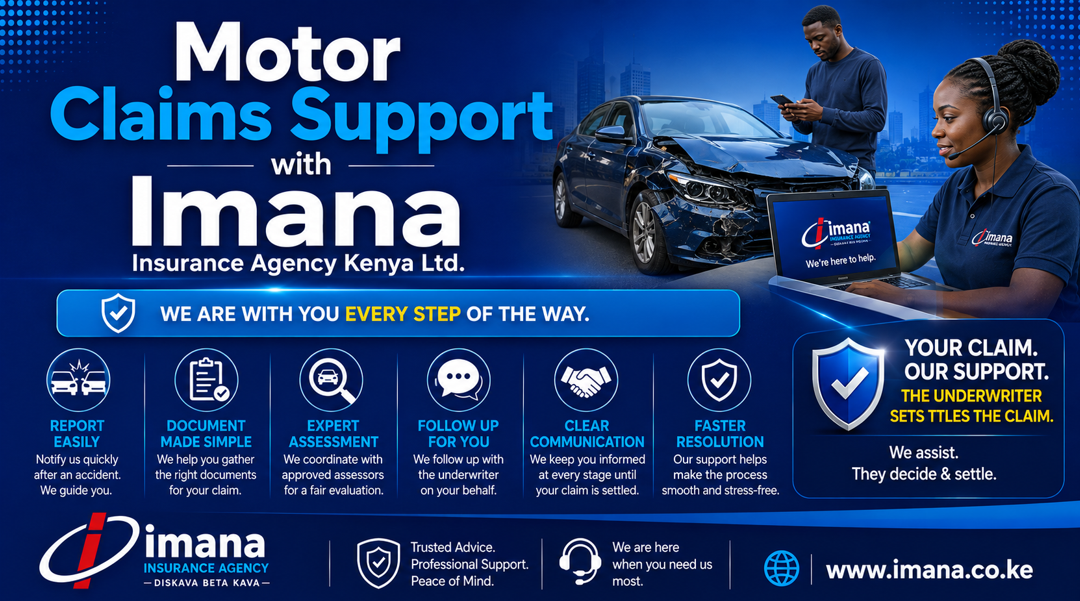
Working with an intermediary such as Imana Insurance Agency Kenya Ltd can make the claims process easier to navigate.
An intermediary can help you:
- Understand your policy terms.
- Clarify your excess and extensions.
- Explain which claim documents are needed.
- Help check that forms are completed correctly.
- Follow up with the underwriter on outstanding documents or progress.
- Help coordinate communication with assessors or garages.
- Explain requests made by the insurer.
- Help you understand a settlement or decline decision.
IRA's Claims Management Guidelines expressly recognise that claim-status information may be provided to either the claimant or the intermediary.
But there is an important distinction:
The insurance intermediary does not settle the claim.
The underwriter — the insurance company that issued the policy — assesses coverage and makes the decision to admit, settle, reduce or decline the claim.
The broker or agent can guide, communicate and follow up, but cannot guarantee settlement.
Quick Motor Claim Checklist
After an accident:
- Protect people and secure the scene.
- Take photographs and gather evidence.
- Exchange driver and vehicle details.
- Report to the police and obtain the OB number.
- Obtain the Police Abstract where required.
- Notify your insurer or intermediary immediately.
- Complete the claim form accurately.
- Submit all requested documents.
- Do not start unauthorised repairs.
- Allow assessment and cooperate with the insurer.
- Review any excess or settlement deductions.
- Ask for written reasons if the claim is declined.
Frequently Asked Questions
Do I need a police abstract for every motor claim?
It is commonly required for road-traffic accident claims, especially where third parties, injuries or significant damage are involved. Follow your insurer's requirements.
Is the OB number the same as the police abstract?
No. The OB number identifies the accident entry in the police Occurrence Book. The Police Abstract is a separate document summarising key accident information.
How quickly should I notify my insurer?
As quickly as reasonably possible. The exact deadline depends on your policy wording.
Can my claim be rejected just because I reported late?
Not automatically. IRA guidance says insurers should consider the reasons for late notification rather than decline solely on that ground.
Can I repair my vehicle before assessment?
Avoid major repairs until the insurer has inspected or authorised them, unless emergency action is required to prevent further damage.
Can I claim if the accident was my fault?
Potentially yes under Comprehensive Motor Insurance. Fault alone does not automatically invalidate an own-damage claim; the insurer assesses the circumstances and policy terms.
Who pays the claim if I bought insurance through Imana?
The insurance company underwriting the policy settles an admissible claim. Imana, as the intermediary, can assist with documentation, communication and follow-up.
Motor Claims Support with Imana Insurance Agency Kenya Ltd
For customers who arranged Motor Insurance through Imana, the team can assist with the practical claims journey — from understanding what documents are needed to following up with the underwriter.
Imana Insurance Agency Kenya Ltd
Website: www.imana.co.ke
Motor Insurance Quote:
www.imana.co.ke/motor-quote
Claims:
www.imana.co.ke/claims-request
MyKava Travel & Insurance:
www.mykava.co.ke
Report early. Document properly. Follow the policy. Let the underwriter assess the claim.
Motor insurance claims are subject to the individual policy wording, facts of the accident, exclusions, excesses and underwriting conditions. Requirements can differ between insurers, so always follow the specific instructions issued under your policy.