
Blog Details
Diskava. Beta. Kava
24Jul
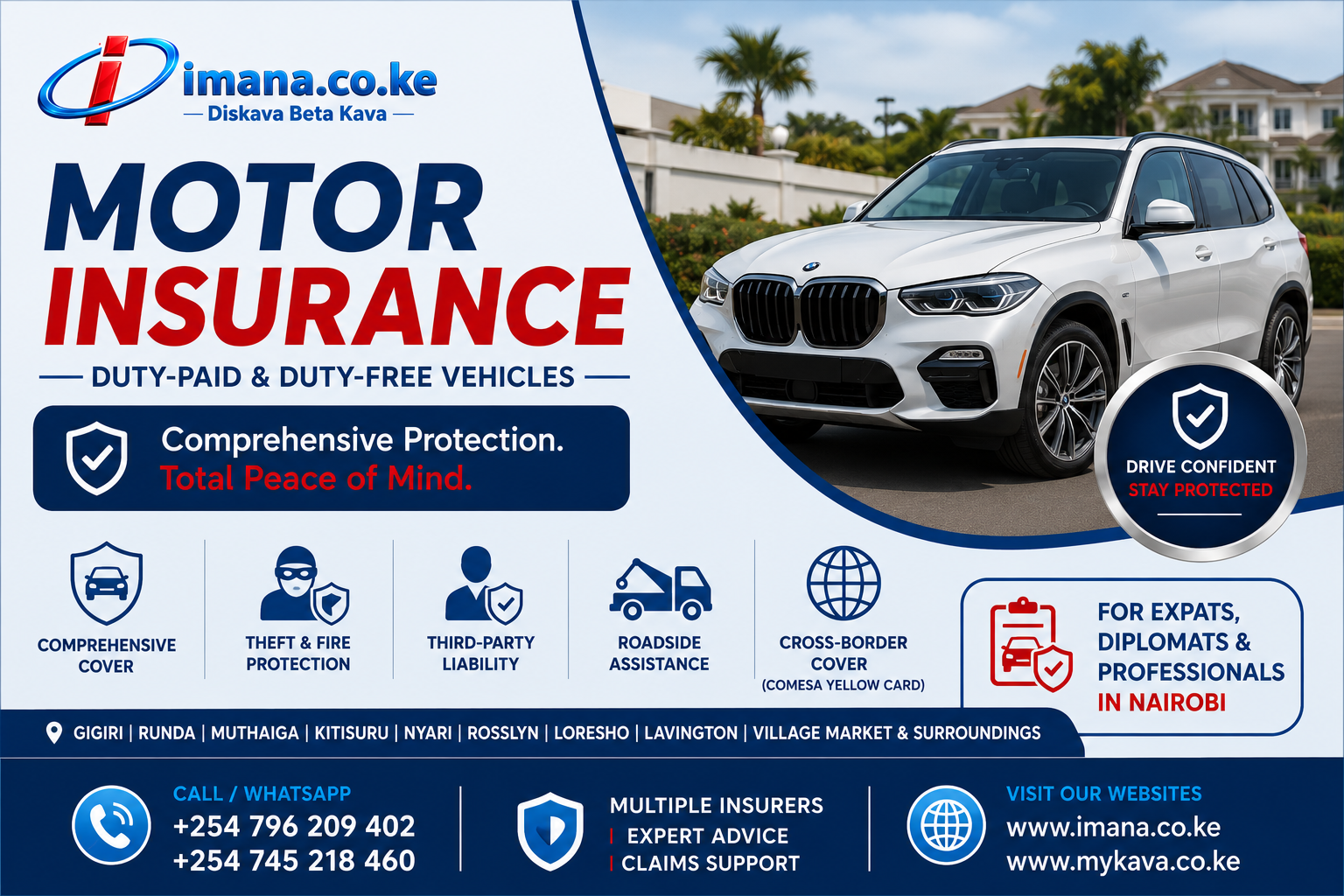
Duty-Free and Duty-Paid Motor Insurance in Gigiri, Runda, Muthaiga and Nairobi
Reliable Motor Insurance for Expatriates, Diplomats and Local Vehicle Owners in Nairobi
Many expatriates, diplomats, international organisation employees, professionals and families living around Gigiri, Runda, Muthaiga, Kitisuru, Nyari, Rosslyn, Loresho, Lavington and Village Market own imported vehicles.
Some of these vehicles are fully duty-paid, while others were imported or purchased under approved duty-free or tax-exempt privileges.
Whether your vehicle is duty-paid or duty-free, it still needs appropriate motor insurance before it is used on Kenyan roads. Kenya’s motor insurance law generally requires vehicles used on public roads to carry insurance against third-party risks.
Imana Insurance Agency Kenya Ltd helps expatriates and local residents compare motor insurance quotations for:
- Duty-paid vehicles
- Duty-free vehicles
- Diplomatic vehicles
- Vehicles owned by international organisation employees
- Locally purchased vehicles
- Imported vehicles
- High-value vehicles
- Private cars and family SUVs
- Corporate and institutional vehicles
Our role is to help you understand the cover, valuation requirements, policy limits, excesses and documentation before selecting a suitable insurer.
What Is a Duty-Paid Vehicle?
A duty-paid vehicle is one for which the required import taxes, duties, levies and clearance obligations have been settled before registration and use in Kenya.
The vehicle is ordinarily supported by documents such as:
- Kenyan logbook
- Importation documents, where applicable
- Customs clearance documents
- Evidence of payment of the required taxes
- Vehicle valuation report
- Owner’s identification and KRA PIN
KRA states that imported vehicles are generally subject to customs-related taxes and charges based on the vehicle’s customs value and the applicable tax regime.
Once properly registered, a duty-paid vehicle can normally be transferred or sold through the standard ownership-transfer process, subject to the relevant legal and administrative requirements.
What Is a Duty-Free Vehicle?
A duty-free vehicle is a vehicle imported or purchased under an approved customs or tax exemption.
Depending on the circumstances, duty-free privileges may apply to qualifying:
- Diplomats
- Diplomatic missions
- Certain international organisation employees
- Technical assistance personnel
- Returning residents who meet the prescribed conditions
- Persons or institutions covered by specific exemptions or agreements
A duty-free vehicle is not an uninsured vehicle and is not automatically exempt from road-use, registration or insurance requirements.
The term “duty-free” refers primarily to its customs and tax treatment—not to its motor insurance obligations.
KRA explains that qualifying exemptions are governed by specific conditions, and restrictions may apply to the possession, use, replacement or disposal of an exempt vehicle.
Can a Duty-Free Vehicle Be Insured in Kenya?
Yes. A duty-free vehicle can generally be insured in Kenya under comprehensive, third-party fire and theft, or third-party-only cover, subject to the insurer’s underwriting requirements.
The insurer will normally need to establish:
- The identity of the registered owner
- The vehicle’s legal registration status
- The vehicle’s current value
- Its duty-free or exemption status
- The authorised use of the vehicle
- Whether there are restrictions on transfer or disposal
- The intended drivers
- Previous claims history
- The vehicle’s make, model, year and condition
The duty-free status should always be disclosed when requesting a quotation.
Failing to disclose important information about ownership, registration, customs restrictions or vehicle use could create complications during a claim.
Does Duty-Free Status Affect the Insurance Premium?
Duty-free status does not automatically mean that the vehicle should be insured at a lower value.
For comprehensive insurance, insurers generally look at the vehicle’s current insurable or market value, not merely the amount the owner paid after receiving a tax exemption.
For example, a vehicle may have been imported without payment of certain duties, but replacing it after theft or total loss could still be expensive.
Factors considered when calculating the premium may include:
- Current vehicle value
- Make and model
- Year of manufacture
- Engine capacity
- Availability and cost of spare parts
- Repair costs
- Vehicle use
- Claims history
- Driver profile
- Security features
- Selected extensions
- Applicable minimum premium
The insurer may request a professional valuation before issuing comprehensive cover.
Why Correct Valuation Matters for Duty-Free Vehicles
One of the biggest mistakes a duty-free vehicle owner can make is insuring the vehicle based only on its duty-free purchase price.
That figure may not represent the vehicle’s actual replacement or market value.
Underinsurance
Underinsurance occurs when a vehicle is insured for substantially less than its correct value.
This can lead to:
- A reduced claim settlement
- Application of the average condition
- Insufficient funds to repair or replace the vehicle
- Disagreements over the vehicle’s pre-accident value
Overinsurance
Overinsurance occurs when a vehicle is insured for more than its reasonable value.
It does not necessarily mean the insurer will pay the exaggerated amount after a total loss. Motor insurance is generally intended to compensate the policyholder for the insured loss, not to create a profit.
A recent valuation helps the insurer determine a reasonable sum insured and gives the owner a clearer basis for understanding the cover.
Comprehensive Insurance for Duty-Free and Duty-Paid Vehicles
Comprehensive motor insurance provides the broadest standard form of motor protection.
The Insurance Regulatory Authority’s standard private motor policy wording distinguishes comprehensive cover from third-party fire and theft and third-party-only protection.
Subject to the policy terms, comprehensive insurance may cover:
- Accidental damage to the insured vehicle
- Theft
- Fire
- Malicious damage
- Third-party bodily injury
- Third-party property damage
- Towing and recovery expenses
- Authorised repair costs
Optional extensions may include:
- Excess protector
- Political violence and terrorism cover
- Windscreen cover
- Entertainment system cover
- Courtesy car
- Loss of use
- Road rescue
- Personal accident benefits
- Cross-border extensions
- COMESA Yellow Card
Comprehensive insurance is often suitable for:
- High-value duty-free vehicles
- Luxury vehicles
- Family SUVs
- Diplomatic vehicles
- Recently imported vehicles
- Vehicles financed by banks or other institutions
- Cars whose owners would struggle to fund major repairs personally
Third-Party-Only Insurance for Duty-Free Vehicles
A duty-free vehicle may also be insured under third-party-only cover, subject to acceptance by the insurer.
Third-party-only insurance primarily protects the policyholder against legal liability arising from injury, death or property damage caused to another party.
It generally does not cover:
- Accidental damage to your own vehicle
- Theft of your vehicle
- Fire damage to your vehicle
- Windscreen damage
- Your own repair costs
Third-party-only cover may satisfy the basic statutory insurance requirement, but it can leave the owner of a high-value vehicle exposed to a major financial loss.
Kenyan law requires motor vehicles used on public roads to be insured against specified third-party risks. (Kenya Law)
For an expensive duty-free vehicle, the lowest-priced policy may therefore not provide the most practical protection.
Third-Party Fire and Theft Insurance
Third-party fire and theft insurance sits between comprehensive and third-party-only cover.
It may provide:
- Third-party liability protection
- Cover for theft of the insured vehicle
- Cover for fire damage
It does not ordinarily cover accidental damage to the insured vehicle arising from a collision.
Availability depends on the insurer, vehicle type, age, value and underwriting guidelines.
Documents Required to Insure a Duty-Paid Vehicle
The insurer or insurance intermediary may request:
- Copy of the Kenyan logbook
- National ID or passport
- KRA PIN
- Vehicle valuation report
- Importation documents, where relevant
- Previous insurance details
- Previous claims information
- Photographs or vehicle inspection report
- Company registration documents for corporate vehicles
- Financier’s details where the vehicle is financed
KRA lists documents such as the original foreign logbook, commercial invoice, bill of lading, inspection certificate and PIN documentation as part of the motor vehicle importation process. (Kenya Revenue Authority)
Not all these importation documents will be required for every insurance application, but they may help resolve questions about ownership, model specifications or customs status.
Additional Documents for a Duty-Free Vehicle
For a duty-free or exemption-status vehicle, the insurer may also request:
- Duty-free approval or exemption letter
- Customs entry documents
- Diplomatic or international organisation identification
- Proof of the owner’s exemption status
- Registration documents
- Authorisation to use the vehicle, where the driver is not the registered owner
- Valid work permit or residency documentation, where relevant
- Disposal or transfer authority, if ownership has changed
- Evidence that applicable duties were paid following disposal, where required
KRA notes that duties may become payable when a duty-free vehicle is disposed of, and that authority and supporting documentation may be needed during the transfer process.
The precise documents depend on how the vehicle entered Kenya and the category of exemption involved.
Insuring a Foreign-Registered Vehicle Temporarily in Kenya
A foreign-registered vehicle temporarily brought into Kenya is different from a Kenyan-registered duty-free vehicle.
KRA requires qualifying users of foreign-registered vehicles to possess relevant documentation, which may include:
- Foreign identification
- Work permit or proof of residency
- Foreign vehicle registration book
- Power of attorney or authority from the owner
- Temporary importation documentation
- Foreign motor vehicle permit
Vehicles operated without the necessary documentation may face enforcement action. (Kenya Revenue Authority)
The owner should confirm:
- Whether the existing foreign insurance is recognised in Kenya
- Whether a local third-party policy is required
- Whether COMESA Yellow Card insurance applies
- The permitted duration of temporary importation
- The countries in which the vehicle will be driven
Do not assume that an overseas policy automatically provides valid or adequate protection in Kenya.
COMESA Yellow Card for Cross-Border Travel
Expatriates and residents frequently travel by road from Kenya to neighbouring countries such as Uganda, Tanzania, Rwanda, Burundi and other participating states.
A standard Kenyan motor policy may not automatically provide the required third-party protection in every destination.
The COMESA Yellow Card system provides cross-border third-party motor insurance within participating territories, subject to its rules and territorial scope. Kenyan rules require motorists travelling to participating states to obtain appropriate cross-border third-party insurance.
Before travelling, confirm:
- The territorial limits of your comprehensive policy
- Whether a cross-border extension is needed
- Whether a COMESA Yellow Card is required
- Whether theft and own-damage cover continue outside Kenya
- Whether the duty-free permit allows the planned cross-border travel
- Whether the vehicle must return to Kenya within a specified period
What Happens When a Duty-Free Vehicle Is Sold?
Duty-free vehicles may be subject to restrictions on disposal or transfer.
Before selling or transferring the vehicle, the owner may need to:
- Obtain the relevant customs authority.
- Establish whether taxes or duties have become payable.
- Settle the assessed amount where required.
- Complete the official ownership-transfer process.
- Inform the insurer.
- Cancel, transfer or replace the motor policy as appropriate.
KRA states that duties may become payable upon disposal of a motor vehicle acquired under duty-free status.
The insurance policy does not automatically transfer to the buyer merely because the vehicle has changed hands.
The insurer should be notified immediately to avoid uncertainty over ownership and cover.
Claims Process for Duty-Paid and Duty-Free Vehicles
The basic motor claims process is similar for both vehicle categories.
After an Accident
Take reasonable steps to:
- Ensure the occupants are safe
- Report the accident to the police where required
- Avoid admitting liability at the scene
- Record details of the other driver and vehicle
- Take photographs
- Notify the insurer or intermediary promptly
- Protect the vehicle from further damage
- Use an authorised towing provider where possible
The insurer may request:
- Claim form
- Police abstract
- Driver’s licence
- National ID or passport
- Vehicle logbook
- Insurance certificate
- Valuation report
- Repair estimate
- Accident photographs
- Assessor’s report
After Theft
You should:
- Report the theft to the police immediately
- Notify the insurer
- Provide the vehicle keys
- Submit the logbook and ownership documents
- Provide customs or exemption documents where requested
- Cooperate with investigations
- Disclose any tracking or recovery information
For a duty-free vehicle, the insurer may consult the owner, customs authorities, the relevant institution and other parties before completing a total-loss settlement.
Total-Loss Claims and Outstanding Duty
A total-loss claim involving a duty-free vehicle can be more complex than a standard claim.
Questions may arise regarding:
- The vehicle’s correct pre-loss value
- Whether customs duty remains outstanding
- Who has legal title to the salvage
- Whether the exemption affects the settlement
- Whether the vehicle can be transferred to the insurer
- Whether customs approval is required before disposal
- Whether the institution or mission has an interest in the vehicle
These issues should be clarified during policy placement—not after the vehicle has been stolen or written off.
The owner should provide complete exemption and customs documentation so the insurer can confirm how a total-loss claim would be handled.
Common Motor Insurance Mistakes Made by Expatriates
Insuring the Vehicle at Its Duty-Free Purchase Price
The purchase price may not represent the correct insurable value.
Failing to Declare Duty-Free Status
The insurer should know the customs and ownership status of the vehicle.
Choosing Third-Party Cover for a High-Value Vehicle
Third-party insurance does not repair or replace your own vehicle after an accident.
Assuming an International Policy Automatically Covers Kenya
Territorial limits and local legal requirements must be checked.
Allowing Unauthorised Drivers to Use the Vehicle
Some policies limit driving to specified or authorised drivers.
Forgetting Cross-Border Extensions
Comprehensive cover may not automatically continue across every border.
Ignoring Policy Excesses
A lower premium may come with higher claim excesses.
Delaying Notification of Ownership or Duty-Status Changes
Changes in ownership, use, registration or customs status should be reported promptly.
Motor Insurance for Residents of Gigiri, Runda and Nairobi’s Diplomatic Areas
Gigiri, Runda, Muthaiga, Rosslyn, Nyari and surrounding neighbourhoods host:
- Diplomatic missions
- United Nations personnel
- International organisations
- NGOs
- Multinational companies
- Consultants
- Expatriate families
- Senior professionals
- Property owners
- Business executives
Vehicle owners in these areas may require more than a basic insurance certificate.
They may need:
- High-value vehicle insurance
- Duty-free vehicle insurance
- Expatriate-friendly documentation support
- International or cross-border extensions
- Road rescue
- Courtesy car benefits
- Political violence and terrorism cover
- Windscreen protection
- Personal accident cover
- Claims assistance
- Flexible digital communication
Imana Insurance Agency Kenya Ltd helps clients compare available options before purchasing or renewing cover.
Why Choose Imana Insurance Agency Kenya Ltd?
We assist expatriates, diplomats, local residents, companies and organisations with:
- Comprehensive motor insurance
- Third-party-only insurance
- Third-party fire and theft
- Duty-free vehicle insurance
- Duty-paid vehicle insurance
- High-value motor insurance
- Corporate fleet insurance
- Short-term insurance
- COMESA Yellow Card insurance
- Policy renewals
- Vehicle valuation arrangements
- Claims support
We compare quotations based on more than the headline premium.
We help clients evaluate:
- Sum insured
- Policy excess
- Theft excess
- Young or inexperienced driver excess
- Political violence and terrorism cover
- Windscreen limits
- Road rescue
- Courtesy car
- Geographical limits
- Exclusions
- Claims procedures
The cheapest motor policy can become expensive when the cover does not match the vehicle or the owner’s circumstances.
Request Motor Insurance for a Duty-Paid or Duty-Free Vehicle
Whether you own a duty-paid family car, an exempt diplomatic vehicle, an imported SUV or a corporate vehicle, Imana can help you compare suitable insurance options.
Contact Imana Insurance Agency Kenya Ltd
Office:
4th Floor, Krishna Centre
Woodvale Grove, Westlands
Nairobi, Kenya
Call or WhatsApp:
+254 796 209 402
+254 745 218 460
+254 113 806 810
+254 103 806 588
Email:
insurance@imana.co.ke
Websites:
www.imana.co.ke
www.mykava.co.ke
Request a motor quotation:
Motor Insurance in Kenya
Get a free online quote:
Motor Insurance Quote
Imana Insurance Agency Kenya Ltd — Compare. Buy. Save.
Get comprehensive or third-party insurance for duty-free and duty-paid vehicles in Gigiri, Runda, Muthaiga, Kitisuru, Nyari, Rosslyn, Loresho, Lavington and Village Market. Compare motor insurance with Imana Insurance Agency Kenya Ltd.
Duty-free motor insurance in Kenya
- Duty-free car insurance in Kenya
- Motor insurance for expatriates in Kenya
- Diplomatic vehicle insurance in Nairobi
- Duty-paid vehicle insurance in Kenya
- Motor insurance in Gigiri
- Car insurance in Runda
- Motor insurance in Muthaiga
- Car insurance in Kitisuru
- Expat motor insurance in Rosslyn
- Comprehensive insurance for imported cars
- Duty-free vehicle insurance in Nairobi
- Motor insurance near Village Market
- Car insurance in Lavington
- High-value motor insurance in Kenya
Motor Insurance for Duty-Paid and Duty-Free Vehicles in Gigiri, Runda, Muthaiga, Kitisuru, Nyari, Rosslyn, Loresho, Lavington and Village Market