
Blog Details
Diskava. Beta. Kava
09Sep
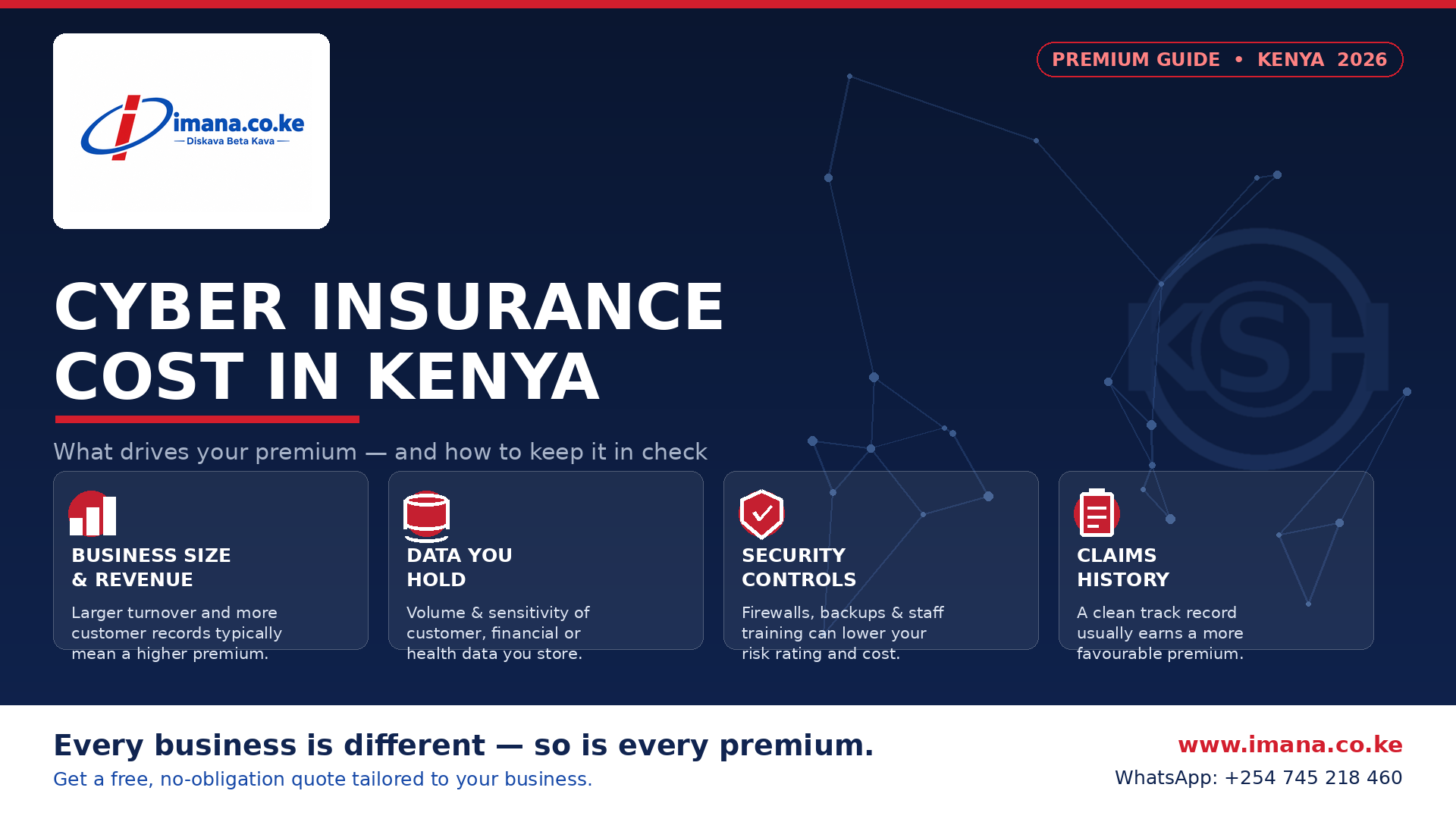
Cyber Insurance Cost in Kenya: 2026 Pricing Guide
Discover how much cyber insurance costs in Kenya, what determines premiums and how SMEs, SACCOs, hospitals and professional firms can compare cover.
Cyber Insurance Cost Guide Kenya: Premiums, Limits and Pricing Factors
How much does cyber insurance cost in Kenya?
There is no single flat premium.
Unlike Third-Party Motor Insurance, cyber insurance is individually priced according to the organisation’s systems, annual revenue, data exposure, security controls and potential financial loss following an attack.
A small consulting firm using email and cloud storage presents a different risk from a hospital holding patient records, a SACCO processing member transactions or an online business collecting thousands of customer payments.
Quick answer: As a broad planning estimate, a small Kenyan business with relatively modest digital exposure may encounter annual cyber insurance premiums starting from approximately KSh 80,000 to KSh 250,000. The final price can fall outside this range depending on the limit, business size, industry, security controls and extensions required. Medium-sized and high-exposure organisations usually require individual underwriting.
These figures are a budgeting guide—not an insurer tariff or guaranteed quotation.
To obtain terms based on your organisation’s actual exposure, submit a Corporate Insurance Quotation or request guided comparison through ImanaInsurance.com.
For a detailed explanation of the cover itself, read Cyber Insurance in Kenya: Data Breaches, Ransomware and Business Interruption.
Why does cyber insurance not have a standard price?
Cyber exposure is different in every organisation.
Two businesses with the same annual turnover may receive different quotations because one stores sensitive personal information and processes online payments while the other holds little customer data and has stronger security controls.
The insurer wants to estimate:
- How likely a cyber incident is
- How expensive the response could be
- How long the business might remain offline
- How many customers or employees could be affected
- Whether money could be stolen through digital fraud
- Whether the organisation could face privacy claims
- Whether systems and data can be restored quickly
- Whether existing security controls reduce the exposure
The price is therefore built around the organisation’s cyber-risk profile.
Indicative cyber insurance prices in Kenya
Publicly available Kenyan market estimates indicate that a small business with annual revenue below approximately KSh 50 million may encounter annual premiums in the region of KSh 80,000 to KSh 250,000 for limits potentially ranging from approximately KSh 5 million to KSh 20 million.
This is not a quotation from Imana or a promise that every insurer will offer the same range.
The premium may be lower or higher depending on:
- Industry
- Annual turnover
- Number of records
- Claims history
- Limit selected
- Policy excess
- Security maturity
- Social-engineering protection
- Business-interruption exposure
- Geographic operations
- Regulatory exposure
Medium-sized organisations, large corporates and businesses handling sensitive or high-volume information are usually priced individually.
Hospitals, financial institutions, SACCOs, payment businesses, technology companies and organisations operating internationally may require substantially higher limits and more detailed underwriting.
What determines the cost of cyber insurance?
1. Annual turnover
Turnover helps the insurer estimate the scale of the organisation, possible business-interruption losses and potential third-party exposure.
Higher turnover does not automatically mean poor risk, but it can increase the financial value exposed during an incident.
Provide accurate annual revenue figures. Under-declaring turnover to obtain a lower premium can create difficulties during a claim.
2. Industry and business activities
Some sectors hold more sensitive information, process more transactions or depend more heavily on uninterrupted technology.
Higher-exposure sectors can include:
- SACCOs and financial institutions
- Hospitals and healthcare providers
- Fintech businesses
- Law firms
- Accounting firms
- Schools and universities
- E-commerce businesses
- Technology companies
- Telecommunications providers
- Hotels and travel businesses
- Logistics companies
- Professional service firms
- Organisations processing children’s data
An offline business using email and basic accounting software may present a different exposure from an online platform serving thousands of customers.
3. Number and type of records
Insurers may ask how many personal or confidential records the organisation stores.
These can include:
- National identification details
- Contact information
- Bank and payment details
- Medical records
- Student information
- Employee records
- Payroll information
- Passwords and login credentials
- Client legal documents
- Credit information
- Biometric information
Sensitive information can increase notification, investigation and third-party liability costs following a breach.
4. Limit of indemnity
The limit of indemnity is the maximum amount available under the policy, subject to its terms.
Common quotation discussions may consider limits such as:
- KSh 5 million
- KSh 10 million
- KSh 20 million
- KSh 50 million
- KSh 100 million
- Higher customised limits
A higher limit generally attracts a higher premium, but the price does not necessarily increase in direct proportion.
A KSh 20 million limit may not cost exactly twice as much as a KSh 10 million limit because insurers consider the probability and severity of different loss layers.
Choose a limit by estimating the plausible cost of:
- Incident response
- Data restoration
- Business interruption
- Customer notification
- Legal representation
- Regulatory investigations
- Third-party claims
- Cyber extortion
- Digital theft
- Reputation management
5. Policy excess or deductible
The excess is the portion of an eligible loss the organisation must bear.
A higher excess can reduce the premium because the organisation retains more risk.
However, an excess should remain affordable.
A business should not choose a KSh 1 million excess merely to reduce the annual premium if it would struggle to raise that amount immediately after an attack.
Cyber policies may apply different excesses to:
- Incident response
- Business interruption
- Cybercrime
- Social engineering
- Privacy liability
- Data restoration
6. Business-interruption exposure
Insurers consider how much revenue could be lost if systems were unavailable.
They may ask:
- Which systems are critical?
- How much revenue depends on them?
- How long can the organisation operate manually?
- How quickly can backups be restored?
- Does the organisation depend on cloud providers?
- Can customers use alternative channels?
- What is the expected daily loss during downtime?
A business that can continue operating manually presents a different interruption exposure from one whose operations stop completely when its platform goes offline.
Business-interruption cover may include a waiting period. Loss occurring during that period may remain with the insured.
7. Security controls
Strong security controls can improve insurability and may influence the price or terms offered.
Underwriters may examine:
- Multi-factor authentication
- Endpoint protection
- Firewalls
- Email-security controls
- Software updates
- Network monitoring
- Data encryption
- Offline or immutable backups
- Backup testing
- Employee training
- Phishing awareness
- Password management
- Restricted administrator access
- Payment-verification procedures
- Incident-response planning
- Vendor-risk management
Weak or missing controls can result in:
- A higher premium
- A higher excess
- Lower limits
- Restrictive endorsements
- Mandatory improvements
- Postponed cover
- Declined terms
Never state that a control exists merely to secure a quotation. The insurer may rely on that declaration when assessing a claim.
8. Previous cyber incidents
The insurer may ask about:
- Ransomware
- Data breaches
- Phishing losses
- Fraudulent transfers
- System interruptions
- Lost devices
- Regulatory complaints
- Privacy investigations
- Previous cyber claims
A previous incident does not always make insurance unavailable. The underwriter will want to know:
- What happened
- What it cost
- How it was resolved
- Which weaknesses were identified
- What controls were improved
- Whether the threat remains active
Failing to disclose a known incident can create a serious coverage dispute.
9. Social-engineering and cybercrime limits
A cyber policy may respond to forensic, restoration and liability costs without paying the money transferred to a fraudster.
Cover for phishing, impersonation and fraudulent payment instructions may require a separate extension.
The cost can be influenced by:
- The cybercrime limit
- Number and value of transactions
- Online banking controls
- Payment-authorisation levels
- Supplier-verification processes
- Call-back procedures
- Staff access to payment systems
- Previous fraud incidents
Social-engineering protection often carries its own sublimit and excess.
10. Outsourced technology providers
Many organisations depend on:
- Cloud hosting
- Data centres
- Software-as-a-Service providers
- Payment gateways
- Managed IT providers
- Online booking platforms
- Payroll systems
- Medical-administration platforms
- Core banking or SACCO systems
If one of these providers fails, the insured organisation may suffer interruption even when its own network was not attacked.
Dependent business-interruption cover may increase the scope and cost of the policy.
Ask whether the policy covers failure of named and unnamed technology providers.
11. Geographic and legal exposure
An organisation serving customers outside Kenya may face additional legal and regulatory exposure.
Insurers may consider:
- Countries of operation
- Location of customers
- Location of servers
- Overseas subsidiaries
- Foreign legal jurisdictions
- Contractual requirements
- International privacy obligations
Worldwide cover can cost more than protection limited to Kenya, particularly where claims may be brought in expensive foreign jurisdictions.
How much cyber cover does a Kenyan business need?
There is no perfect limit for every organisation.
Begin by asking: What could one serious cyber incident cost us?
Consider:
Incident-response costs
These can include forensic investigators, privacy lawyers, cybersecurity specialists and crisis-communication advisers.
Data-restoration costs
Estimate the cost of rebuilding servers, restoring backups, reinstalling applications and reconstructing records.
Business interruption
Calculate the income that could be lost during several days or weeks of downtime.
Customer notification
A data breach involving thousands of people may require investigation, communication and support.
Third-party liability
Customers, members, employees or business partners may allege that the organisation failed to protect information or systems.
Regulatory investigations
A breach may require engagement with the Office of the Data Protection Commissioner or another sector regulator.
Cybercrime
Estimate the size of fraudulent transfers an employee could authorise before the fraud is detected.
The selected limit should reflect the organisation’s credible loss scenario rather than simply the cheapest available option.
Sample cyber insurance budgeting scenarios
Small professional firm
A small law, accounting, consulting or architectural firm may have:
- Fewer employees
- Moderate annual turnover
- Cloud-based email and file storage
- Confidential client information
- Limited online transactions
- Basic business-interruption exposure
A planning budget within the broad KSh 80,000 to KSh 250,000 annual range may provide a starting point, subject to the limit and security controls.
Growing e-commerce or technology business
An online business may have:
- Thousands of customer records
- Online payments
- Dependence on cloud services
- High daily transaction volume
- Significant interruption exposure
- Potential cybercrime risk
Such a business will normally need a customised quotation. The premium may be materially higher than that of a small offline professional firm.
SACCO or financial-services business
A SACCO may hold identity, transaction, loan and payroll information while providing mobile or online services.
Pricing will consider:
- Member numbers
- Transaction values
- Core-system dependence
- Fraud controls
- Regulatory exposure
- Cybercrime limits
- Previous incidents
- Vendor controls
A SACCO should not rely on the small-business estimate without completing detailed underwriting.
Hospital or healthcare provider
A hospital can face both privacy exposure and disruption of critical systems.
Pricing may consider:
- Patient-record volume
- Medical and billing systems
- Health-data sensitivity
- Connected medical equipment
- Ransomware exposure
- Downtime consequences
- Backup arrangements
- Sector-specific legal obligations
Healthcare providers usually require individual assessment.
School or educational institution
A school may hold children’s, parents’, employees’ and payment information.
Pricing will be influenced by:
- Number of students and staff
- Online learning systems
- Fee-payment platforms
- Data-access controls
- Third-party education applications
- Backup arrangements
- Whether boarding or medical information is held
What does the premium normally buy?
Depending on the policy, the premium may provide access to:
- A cyber incident-response hotline
- Digital-forensics specialists
- Legal and privacy advice
- Data restoration
- System recovery
- Cyber business interruption
- Ransomware response
- Cyber-extortion services
- Privacy liability
- Network-security liability
- Regulatory investigation defence
- Customer notification
- Public-relations support
- Cybercrime cover
- Social-engineering protection
- Dependent business interruption
Not every policy includes every item.
A quotation showing a low premium may exclude cybercrime, apply a low social-engineering sublimit or provide only limited business-interruption cover.
Premium versus total cost of risk
The annual premium is only one cost.
A proper comparison should also consider:
- Policy excess
- Uninsured waiting period
- Sublimits
- Security upgrades required
- Excluded events
- Uninsured stolen funds
- Losses above the limit
- Downtime beyond the indemnity period
- Reputation damage
- Future security improvements
A cheap cyber policy with a KSh 500,000 social-engineering sublimit will offer little comfort after a KSh 10 million fraudulent transfer.
The most useful quotation is the one that protects the organisation’s largest credible exposures at a sustainable price.
How can a business reduce its cyber insurance cost?
An organisation may improve its underwriting position by:
- Implementing multi-factor authentication
- Installing appropriate endpoint protection
- Maintaining secure backups
- Testing restoration procedures
- Updating software promptly
- Restricting administrator privileges
- Training employees
- Testing staff against phishing
- Verifying payment changes independently
- Creating an incident-response plan
- Reviewing third-party providers
- Encrypting sensitive information
- Conducting vulnerability assessments
- Documenting security improvements
These controls may not guarantee a lower premium, but they can improve risk quality and expand the range of terms available.
Cyber insurance cost mistakes to avoid
Selecting the smallest limit automatically
The cheapest limit may not cover a realistic incident.
Comparing premium only
Compare the policy wording, sublimits, exclusions, excesses and response services.
Assuming social engineering is included
Direct financial loss frequently requires specific protection.
Ignoring the interruption waiting period
The business may have to absorb losses during the first hours of downtime.
Under-declaring turnover or records
Incorrect declarations can create problems during claim assessment.
Hiding previous incidents
A known incident should be disclosed honestly, together with the corrective action taken.
Treating insurance as a cybersecurity substitute
A policy cannot repair weak governance or guarantee that an attack will not occur.
Information required for a cyber insurance quotation
To obtain meaningful terms, prepare:
- Registered company name
- Industry
- Business description
- Website
- Annual turnover
- Number of employees
- Countries of operation
- Number and type of personal records
- Online payment information
- Requested limit
- Preferred excess
- Critical computer systems
- Technology providers
- Backup arrangements
- Cybersecurity controls
- Previous incidents or claims
- Existing insurance
- Completed proposal form
Some simplified products may initially request only the company name, website, industry, annual revenue and required limit. More detailed information may still be required before binding cover or processing a claim.
How to compare cyber insurance quotations in Kenya
When quotations arrive, ask:
- What is the overall limit?
- What excess applies?
- Is ransomware covered?
- Are ransom payments covered where lawful?
- Is data restoration included?
- Is business interruption included?
- What waiting period applies?
- How long is the indemnity period?
- Is social-engineering fraud covered?
- What cybercrime sublimit applies?
- Are outsourced technology providers covered?
- Are regulatory investigations included?
- Are forensic expenses within the main limit?
- Which incident-response providers must be used?
- What security conditions must be maintained?
- What events are excluded?
- Does a retroactive date apply?
- Is the policy written on a claims-made basis?
Do not accept a quotation comparison containing premium figures alone.
Frequently asked questions about cyber insurance costs
What is the cheapest cyber insurance in Kenya?
There is no universally cheapest policy. Premium depends on the organisation’s risk profile, selected limit and coverage. The cheapest quotation may also provide narrower protection.
Can a small business afford cyber insurance?
Yes. SME cyber policies are available, but the business may need to meet minimum cybersecurity requirements.
Can cyber insurance start from KSh 80,000 annually?
Some public Kenyan estimates place small-business pricing from approximately KSh 80,000 annually. This is only a planning indicator; individual quotations may be lower or higher.
Does a higher limit increase the premium?
Generally, yes. The increase may not be directly proportional because insurers price different layers of risk separately.
Will multi-factor authentication reduce the premium?
It can improve insurability and risk quality. The actual pricing effect depends on the insurer and the organisation’s wider controls.
Does cyber insurance include stolen money?
Not automatically. Cybercrime, funds-transfer fraud and social engineering may require an extension and separate sublimit.
Is ransomware cover expensive?
Its cost depends on the organisation’s controls, backup arrangements, industry, past incidents and limit. Weak ransomware controls may lead to restrictive terms.
Can a new business obtain cyber insurance?
Yes. The insurer may rely on projected turnover, business activities, security controls and expected data exposure.
Does cyber insurance cover regulatory fines?
Only where the fine is legally insurable and the policy expressly provides cover. Regulatory defence costs may be treated separately.
How quickly can a cyber quotation be issued?
Simple SME risks may be quoted after basic information is provided. Complex organisations may require a detailed proposal form, security assessment and further underwriting.
Get a cyber insurance quotation in Kenya
Imana Insurance Agency Kenya Ltd helps organisations assess cyber exposures and compare quotations from licensed Kenyan insurers.
Cyber insurance can be considered by:
- SMEs
- SACCOs
- Hospitals
- Clinics
- Law firms
- Schools
- Universities
- Hotels
- Travel businesses
- Accountants
- Consultants
- NGOs
- E-commerce businesses
- Logistics companies
- Financial-service firms
- Technology companies
Start with a Corporate Insurance Quotation or request comparison through ImanaInsurance.com.
Visit Imana.co.ke for insurance authority resources and MyKava.co.ke for travel, medical and digital insurance comparison.
Contact Imana Insurance Agency Kenya Ltd
Imana Insurance Agency Kenya Ltd
4th Floor, Krishna Centre
Woodvale Grove, Westlands, Nairobi
Call/WhatsApp: +254 796 209 402
Websites:
- www.imanainsurance.com — quotation comparison and enquiries
- www.imana.co.ke — Kenyan insurance authority and product information
- www.mykava.co.ke — travel, medical and insurance comparison
Imana Insurance Agency Kenya Ltd is a Westlands-based insurance intermediary helping individuals, families and businesses compare insurance quotations from licensed Kenyan insurers across Motor, Medical, WIBA, PSV, Travel, Motorcycle, Cyber, SME/Corporate and other insurance classes.
Author: Raymond Momanyi
Founder & CEO, Imana Insurance Agency Kenya Ltd
Pricing disclaimer: The figures in this article are broad planning estimates and do not constitute an offer, insurer tariff or guaranteed premium. Cyber insurance is individually underwritten. Final premiums, limits, excesses and terms depend on the completed proposal form, security controls and insurer approval.