
Blog Details
Diskava. Beta. Kava
31Jul
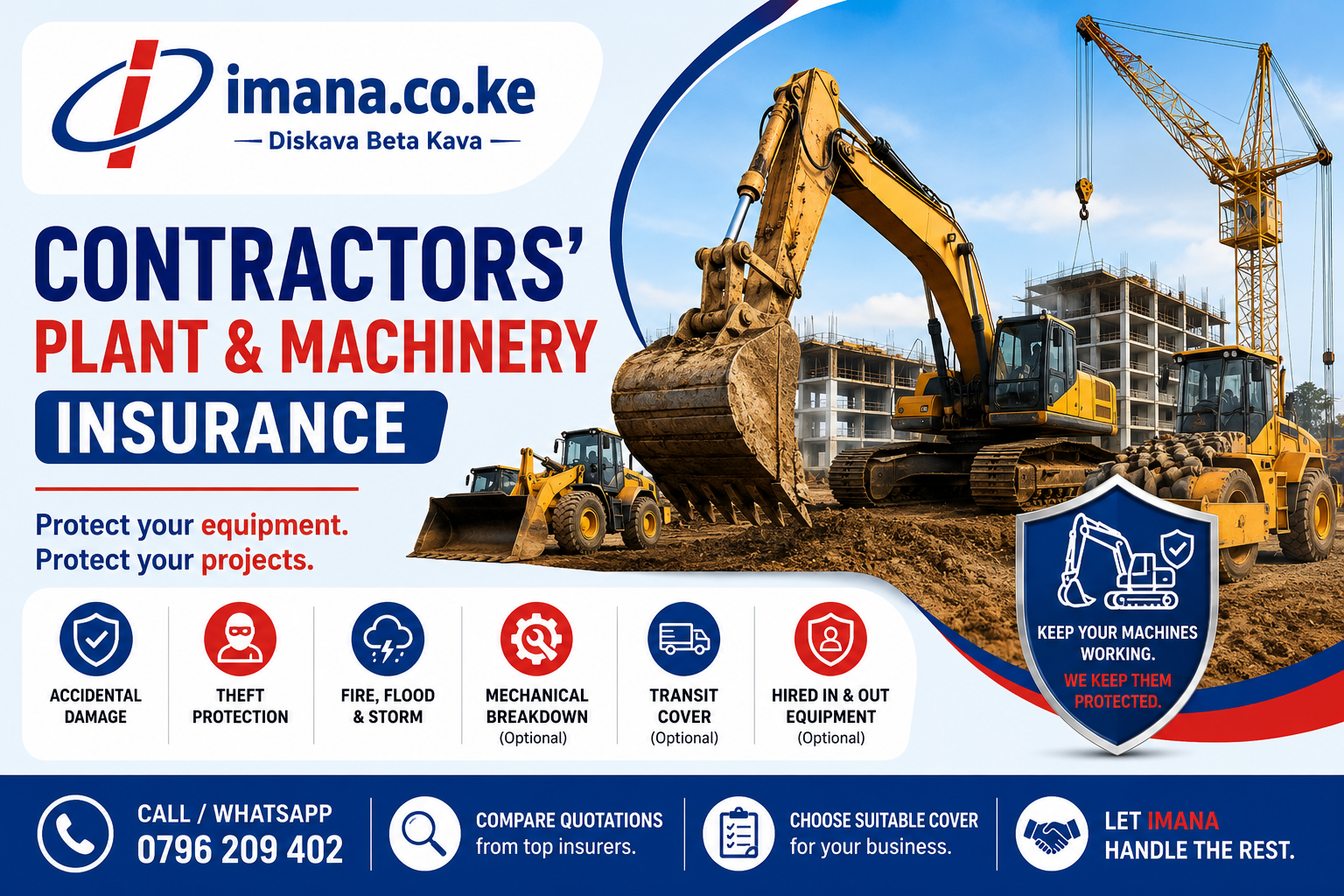
Contractors’ Plant and Machinery Insurance in Kenya | Equipment Cover
Learn how Contractors’ Plant and Machinery Insurance protects excavators, cranes, graders, bulldozers, concrete mixers and other construction equipment in Kenya. Compare cover, exclusions and quotations.
Why Construction Equipment Needs Specialised Insurance
Construction plant and machinery represent a major financial investment for contractors, property developers, equipment-hire businesses and infrastructure companies.
An excavator, crane, grader, bulldozer or concrete pump can cost millions of shillings. Yet the equipment may operate under difficult conditions involving:
- Rough or unstable ground
- Dust and debris
- Excavations
- Heavy loads
- Flooding and surface water
- Falling construction materials
- Accidental overturning
- Theft and malicious damage
- Movement between project sites
- Operator error
- Fire and collision
When a critical machine is damaged, the contractor may face more than a repair bill. The project may slow down, contractual deadlines may be missed and replacement equipment may have to be hired at short notice.
Contractors’ Plant and Machinery Insurance, commonly abbreviated as CPM Insurance, is designed to protect eligible construction plant and equipment against sudden and unforeseen physical loss or damage while operating, resting or being dismantled for maintenance, subject to the selected insurer’s policy terms.
Kenyan insurers generally place Contractors’ Plant and Machinery within the engineering-insurance category. Britam, for example, lists Contractors’ Plant and Machinery among its engineering covers, while CIC’s Contractors All Risks product separately recognises construction plant, equipment and machinery as project exposures.
Your equipment earns income only when it is working. CPM Insurance helps protect the machinery on which your contracts, employees and project timelines depend.
What Is Contractors’ Plant and Machinery Insurance?
Contractors’ Plant and Machinery Insurance is an engineering policy covering specified mobile or stationary construction equipment against accidental physical loss or damage from insured causes.
Depending on the policy, protection may apply while the machinery is:
- Operating at a construction site
- Stationary at the site
- Being cleaned
- Undergoing routine maintenance
- Being dismantled or reassembled for maintenance
- Moving within the project site
- Stored at an approved location
- Temporarily located at another declared project
The policy is generally arranged on an all-risks basis, meaning it covers sudden and accidental physical loss or damage unless the cause is specifically excluded.
“All risks” does not mean every possible event is insured. Wear and tear, mechanical breakdown, poor maintenance and other exclusions may still apply.
What Is Considered Plant or Machinery?
Kenya’s Occupational Safety and Health Act defines plant broadly to include equipment, gear, machinery, apparatus or appliances and their components. It defines machinery as articles assembled or connected to convert, transmit, control or use energy to perform work.
For insurance purposes, Contractors’ Plant and Machinery may include equipment such as:
- Excavators
- Bulldozers
- Wheel loaders
- Backhoe loaders
- Motor graders
- Mobile cranes
- Tower cranes
- Forklifts
- Concrete mixers
- Concrete pumps
- Road rollers
- Compactors
- Pavers
- Trenchers
- Drilling machines
- Piling equipment
- Crushers
- Screening plants
- Asphalt plants
- Compressors
- Generators
- Hoists
- Scaffolding systems where accepted
- Water pumps
- Site dumpers
- Earth-moving equipment
The insurer must receive a complete schedule showing each item’s:
- Make and model
- Serial or chassis number
- Year of manufacture
- Current replacement value
- Intended use
- Operating locations
- Ownership or financing status
Equipment omitted from the schedule may not be covered.
Who Needs Contractors’ Plant and Machinery Insurance?
CPM Insurance may be suitable for:
- Building contractors
- Civil-engineering contractors
- Road contractors
- Property developers
- Mining and quarrying businesses
- Equipment-hire companies
- Water and sewerage contractors
- Electrical and energy contractors
- Telecommunications infrastructure companies
- County and national infrastructure contractors
- Agricultural contractors
- Logistics and materials-handling businesses
- Owners of specialised mobile machinery
The National Construction Authority Act describes contracting broadly to include construction, installation, erection, alteration and related work involving the supply or control of materials and labour. Contractors working in these areas may own, lease or hire costly machinery that requires dedicated protection.
What Does CPM Insurance Cover?
Coverage differs between insurers, but a Contractors’ Plant and Machinery policy may protect against the following risks.
Accidental collision
The machinery may collide with:
- Another machine
- A building
- A wall
- Stored materials
- A project structure
- An obstruction at the site
Damage to the insured equipment may be covered, while damage to other people’s property may require an appropriate third-party liability section.
Overturning
Excavators, cranes, loaders and graders can overturn because of:
- Uneven ground
- Poor stabilisation
- Excessive loads
- Operator error
- Collapsed edges
- Slopes
- Soft ground
Overturning can cause extensive structural and hydraulic damage.
Fire and explosion
The policy may cover sudden physical damage caused by fire or explosion, subject to the policy wording.
Possible sources include:
- Fuel leaks
- Electrical faults
- Hot works
- Nearby site fires
- Battery faults
- Engine-compartment fires
Flood and storm
Construction equipment may be exposed to:
- Flash floods
- Surface-water accumulation
- Storm damage
- Collapsed excavations
- Water entering engines or electrical systems
- Machinery becoming submerged
Flood protection may be subject to additional excesses or risk conditions, particularly where machinery operates near rivers, low-lying areas or excavations.
Theft and burglary
Theft protection may apply where machinery or insured components are stolen under circumstances covered by the policy.
Insurers may require:
- Secure overnight storage
- Guards
- Tracking devices
- Immobilisers
- Fenced compounds
- Key-control procedures
- Prompt police reporting
Theft of easily removable parts may be restricted unless specifically included.
Malicious damage
The policy may cover deliberate physical damage caused by third parties, subject to exclusions and any political-violence requirements.
Falling objects
Plant may be damaged by:
- Construction materials
- Rocks
- Debris
- Crane loads
- Collapsing walls
- Trees
- Other machinery components
Accidental external damage
Other sudden and unforeseen events may be covered where they are not specifically excluded.
The policy is primarily concerned with physical damage to the insured plant, not every financial consequence arising after the machine stops working.
Does CPM Insurance Cover Mechanical Breakdown?
Not automatically.
Contractors’ Plant and Machinery Insurance generally focuses on accidental external physical damage. Internal mechanical or electrical breakdown may be excluded or require a separate Machinery Breakdown Insurance policy.
Examples of mechanical or electrical breakdown include:
- Internal engine failure
- Gearbox seizure
- Hydraulic-system failure caused by internal defects
- Electrical winding failure
- Bearing failure
- Lubrication failure
- Boiler or pressure-vessel breakdown
- Machinery failure arising from an internal fault
Britam distinguishes Contractors’ Plant and Machinery from other engineering policies, illustrating why CPM and Machinery Breakdown should not be treated as identical products.
A contractor should ask:
- Is internal mechanical breakdown covered?
- Is it excluded completely?
- Can Machinery Breakdown be added?
- Does cover apply only after an external accident?
- Are consequential losses covered?
- Are repair investigation costs included?
CPM Insurance vs Contractors All Risks Insurance
These policies are related but protect different exposures.
Contractors All Risks Insurance
Contractors All Risks, or CAR Insurance, primarily protects:
- Contract works
- Construction materials
- Temporary works
- Principal-supplied materials
- Third-party liabilities
- Plant and machinery where specifically included
CIC states that its Contractors All Risks cover can include contract works, construction plant, equipment and machinery.
Contractors’ Plant and Machinery Insurance
CPM focuses specifically on the contractor’s machinery and equipment.
It may be arranged:
- As an annual policy covering equipment across declared sites
- For specific machinery
- Alongside a CAR policy
- By equipment owners or hire companies
- For machinery used on several projects
Why contractors may need both
Consider a contractor building a bridge.
The contractor may require:
- CAR Insurance for the bridge works and construction materials
- CPM Insurance for excavators, cranes and graders
- WIBA Insurance for employees
- Public Liability Insurance for third-party injury or property damage
- Motor Insurance for road-registered vehicles
- Performance Bonds required by the project owner
One policy should not be assumed to replace all the others.
CPM Insurance vs Commercial Motor Insurance
Some construction machinery can travel on public roads, but CPM Insurance does not automatically satisfy compulsory motor-insurance requirements.
Commercial Motor Insurance may be required where equipment is:
- Registered for road use
- Driven on public roads
- Capable of causing road-related third-party liability
- Transported or operated in circumstances falling under motor-insurance law
Examples may include:
- Mobile cranes
- Tractor units
- Road rollers
- Site trucks
- Certain forklifts
- Self-propelled plant
The contractor should confirm whether the machine requires:
- Motor Third-Party Insurance
- Comprehensive Motor Insurance
- CPM Insurance
- Both Motor and CPM protection
CPM Insurance vs Equipment-in-Transit Cover
A standard CPM policy may not automatically protect machinery while being transported between sites.
A separate Inland Transit, Goods in Transit, Marine Cargo or plant-transit extension may be needed when equipment is:
- Carried on a low-loader
- Transported by truck
- Shipped by sea
- Imported into Kenya
- Moved between distant projects
- Loaded or unloaded
The contractor should confirm when cover begins and ends.
Important questions include:
- Does the policy cover loading and unloading?
- Is the machine covered while on a transporter?
- Is overturning of the transporter covered?
- Does cover apply outside Kenya?
- Is cross-border transit included?
- Is the transporter’s liability sufficient?
Do not assume the transporter will compensate the full equipment value.
Hired-In Plant and Machinery
Construction businesses often use equipment hired from third parties.
The hire agreement may make the contractor responsible for:
- Physical damage
- Theft
- Loss of use
- Continuing hire charges
- Transportation
- Recovery costs
- Repairs
A CPM policy can sometimes be extended to include hired-in plant, subject to:
- A declared maximum value
- Hire-contract terms
- Individual equipment details
- Insurer approval
- Security conditions
- Territorial limits
The contractor should review the hire agreement before accepting the equipment.
Particular attention should be paid to clauses requiring payment of continuing hire charges while the machine is under repair. These charges may not be covered by ordinary CPM Insurance unless specifically insured.
Hired-Out Plant and Machinery
Equipment owners may hire machinery to contractors.
An equipment-hire business should consider:
- Who operates the machine
- Who is responsible for maintenance
- Where the machine will be used
- Whether sub-hiring is allowed
- Who bears the excess
- Whether theft is covered
- Whether damage by the hirer is covered
- Whether loss of hire income is insured
- Whether the operator is supplied by the owner
The policy should permit the declared hire activity.
A policy arranged for the owner’s own use may not automatically cover commercial hiring to third parties.
What Is Not Normally Covered?
Common exclusions may include:
- Wear and tear
- Gradual deterioration
- Rust or corrosion
- Cavitation
- Erosion
- Ordinary vibration
- Mechanical or electrical breakdown
- Defective parts
- Lack of maintenance
- Damage from continued use after a fault develops
- Tyres and tracks unless damaged in the same insured accident
- Cutting edges and other consumable parts
- Fuel and lubricants
- Inventory shortages
- Unexplained disappearance
- Wilful acts
- Fraud
- War and nuclear risks
- Political violence unless extended
- Overloading beyond manufacturer limits
- Use by unqualified operators
- Operation outside declared sites
- Road risks requiring Motor Insurance
- Transit unless specifically included
- Loss of income unless separately insured
- Contractual penalties
- Existing damage
Exact exclusions differ between insurers.
Wear and Tear vs Accidental Damage
This distinction is important during claims.
Wear and tear
Wear and tear develops gradually through normal use.
Examples include:
- Worn bearings
- Reduced hydraulic efficiency
- Worn tracks
- Corroded parts
- Ageing seals
- Gradual engine deterioration
These costs are generally the owner’s maintenance responsibility.
Accidental damage
Accidental damage results from a sudden and unforeseen event.
Examples include:
- An excavator overturning
- A loader colliding with a structure
- A crane being struck by falling material
- A machine being damaged by a sudden flood
Where worn parts contribute to an accident, the insurer may exclude the defective component while considering resulting accidental damage to other insured parts, depending on the policy.
How Is Plant and Machinery Valued?
Equipment should generally be insured at its current replacement value, including relevant costs such as:
- Purchase price
- Freight
- Customs charges
- Taxes
- Installation
- Assembly
- Testing
- Professional costs
Using only the machine’s depreciated accounting value may create underinsurance.
For example, a contractor may have purchased an excavator several years ago for KSh 10 million. Replacing it today may cost KSh 17 million due to:
- Inflation
- Exchange-rate changes
- Shipping costs
- Taxes
- Manufacturer price increases
If the contractor insures it for only KSh 10 million, an average or underinsurance condition may reduce a partial claim.
What Is the Sum Insured?
The sum insured is the value declared for each item of plant or machinery.
The equipment schedule should contain accurate:
- Descriptions
- Identification numbers
- Values
- Models
- Years
- Capacities
- Locations
A blanket sum without a reliable equipment schedule may create uncertainty during a claim.
The schedule should be updated when machinery is:
- Purchased
- Sold
- Replaced
- Imported
- Moved to another project
- Substantially upgraded
- Hired in
- Hired out
What Is an Insurance Excess?
An excess is the portion of an approved claim that the insured must meet.
CPM excesses may be:
- Fixed monetary amounts
- A percentage of the loss
- Subject to a minimum amount
- Higher for theft
- Higher for flood or overturning
- Different according to equipment type
For example:
- Approved damage: KSh 2 million
- Applicable excess: KSh 250,000
- Contractor’s contribution: KSh 250,000
- Eligible insurer contribution: KSh 1.75 million
This simplified example remains subject to policy terms and any other deductions.
A low premium combined with a very high excess may create cash-flow difficulty during a claim.
Does CPM Insurance Cover Third-Party Liability?
Not always.
A standard CPM policy primarily protects the insured equipment.
If an excavator damages a neighbouring building or a crane injures a third party, the contractor may require:
- Public Liability Insurance
- A third-party liability section under CAR Insurance
- Motor Third-Party Insurance where road use is involved
- Employer’s Liability or WIBA where an employee is injured
The contractor should review potential limits for:
- Bodily injury
- Accidental death
- Property damage
- Legal defence costs
- Cross liability
- Vibration or weakening of support
- Underground services
- Work away from the premises
Does CPM Insurance Cover Operators?
No—not automatically.
CPM Insurance covers physical damage to the insured machinery. Injury to the operator should be addressed through appropriate people-protection policies, such as:
- WIBA Insurance
- WIBA Plus
- Group Personal Accident
- Employer’s Liability
- Medical Insurance
- Motor Personal Accident benefits where applicable
Kenya’s Occupational Safety and Health Act requires occupiers to provide and maintain plant, work systems and procedures that are safe and without risks to health, along with adequate information, training and supervision. Insurance does not replace these obligations. (Kenya Law)
Is Contractors’ Plant and Machinery Insurance Compulsory?
CPM Insurance is not automatically compulsory for every machine or every contractor.
However, it may be required by:
- Project contracts
- Tender documents
- Banks
- Asset financiers
- Equipment-hire agreements
- Joint-venture partners
- Principal contractors
- Project owners
- Development financiers
Where equipment is financed, the financier may require its interest to be noted in the policy.
Where equipment operates on public roads, separate statutory Motor Insurance requirements may also apply.
Contractors should review each contract and financing agreement carefully.
How Much Does CPM Insurance Cost in Kenya?
There is no universal premium.
The cost depends on:
- Type of machinery
- Replacement value
- Year of manufacture
- Equipment condition
- Operating environment
- Nature of projects
- Claims history
- Location
- Theft exposure
- Flood exposure
- Operator experience
- Security arrangements
- Maintenance programme
- Required extensions
- Policy excess
- Whether equipment is hired out
- Whether transit is included
- Territorial scope
A crane operating at a high-rise site may present a different risk from a generator operating inside a secured compound.
Similarly, an excavator working in a quarry or near a river may attract different terms from one used on a controlled building site.
Information Required for a CPM Quotation
Prepare the following information:
Contractor details
- Registered business name
- KRA PIN
- Nature of operations
- Construction experience
- Claims history
- Previous insurance details
Equipment details
- Equipment type
- Make and model
- Serial or chassis number
- Year of manufacture
- Capacity
- Replacement value
- Country of origin
- Current condition
- Ownership or financing status
Operating information
- Project locations
- Nature of work
- Ground conditions
- Working hours
- Operator qualifications
- Security controls
- Maintenance programme
- Transit requirements
- Hire arrangements
- Cross-border use
Additional requirements
- Third-party liability limit
- Political violence and terrorism
- Hired-in plant
- Hired-out plant
- Loss of hire
- Transit
- Flood
- Debris-removal costs
- Express freight
- Airfreight
- Overtime repair costs
Accurate information allows insurers to quote the real exposure.
Useful CPM Insurance Extensions
Depending on availability, a contractor may consider the following extensions.
Political violence and terrorism
This may protect machinery against specified damage arising from political violence, riots, strikes or terrorism.
Express freight and overtime
After a serious accident, the contractor may need parts urgently.
This extension may cover additional eligible costs associated with:
- Express delivery
- Overtime labour
- Night work
- Weekend repairs
Airfreight
Where parts must be imported quickly, an airfreight extension may cover the additional cost, subject to a sublimit.
Debris removal
Heavy damaged machinery may require cranes, recovery vehicles or specialist contractors to remove debris.
Escalation
An escalation provision can help account for changes in replacement costs during the policy period.
Hired-in plant
Protects declared equipment hired from other owners.
Loss of hire or continuing hire charges
This may help with eligible financial loss when hired-out equipment cannot earn income—or when the contractor remains responsible for hire charges—following insured damage.
This is not normally part of standard physical-damage cover and must be specifically arranged.
Transit
Protects machinery while moving between declared locations, subject to the agreed mode of transport.
Surrounding property
May cover property belonging to or under the control of the insured that is damaged during an insured event, subject to policy terms.
What Happens When Machinery Is Financed?
Where plant is financed by a bank, SACCO, leasing company or asset-finance provider, the financier may require:
- Comprehensive CPM cover
- Its interest to be noted
- The policy to remain active throughout the loan
- Claims payments to be directed appropriately
- The insurer to notify it of cancellation
- A current valuation
The contractor should not cancel or materially change the policy without considering the financing agreement.
After a major loss, the financier may have priority over settlement proceeds, depending on the policy endorsement and loan terms.
What Happens After an Accident?
The contractor should:
- Stop operating the damaged machine.
- Protect it from further damage.
- Assist injured persons and notify emergency services where necessary.
- Report the event to the insurer or intermediary immediately.
- Take photographs and videos.
- Record the operator’s account.
- Obtain witness details.
- Preserve damaged components.
- Make a police report where theft, malicious damage or a road accident is involved.
- Wait for inspection or approval before major repairs.
Continuing to operate damaged machinery can worsen the loss and affect the claim.
Documents Required for a CPM Claim
The insurer may request:
- Claim form
- Policy schedule
- Equipment ownership documents
- Purchase invoice
- Valuation
- Maintenance records
- Operator records
- Incident report
- Police abstract
- Photographs and videos
- Repair quotations
- Technical assessment
- Parts quotations
- Hire agreement
- Project documents
- Recovery invoices
- Financing documents
- Serial-number confirmation
The insurer may appoint:
- A loss adjuster
- An engineer
- A machinery assessor
- A surveyor
- A forensic investigator
- A recovery specialist
Theft Claims
After theft, the insured should:
- Notify the police immediately
- Inform the insurer
- Provide identifying numbers
- Activate tracking
- Preserve CCTV
- Provide key-control records
- Submit guard reports
- Provide proof of ownership
- Cooperate with investigation
The insurer may examine whether the declared security warranties were followed.
Repairable Damage
Where the equipment can be repaired, the insurer may pay eligible costs such as:
- Replacement parts
- Labour
- Dismantling
- Reassembly
- Reasonable transport
- Approved repair charges
Deductions may apply for:
- Excess
- Underinsurance
- Betterment
- Wear-related components
- Uninsured modifications
- Recoverable salvage
Total Loss
A machine may be treated as a total loss where:
- It is destroyed beyond economical repair
- The repair cost is disproportionate to its insured value
- It is stolen and not recovered
- Safe restoration is not practical
Settlement may consider:
- Replacement value
- Market value
- Policy basis
- Sum insured
- Underinsurance
- Excess
- Salvage
- Outstanding premium
- Financier’s interest
The sum printed on the schedule is not automatically the amount payable in every total-loss claim.
Common Mistakes Contractors Make
Insuring equipment at depreciated book value
Accounting values may be far lower than current replacement costs.
Assuming CAR covers every machine
Plant may need to be separately listed or covered under a dedicated CPM policy.
Ignoring movement between sites
Transit may require an extension.
Failing to disclose hiring activities
Hired-out equipment creates a different risk from machinery used only by the owner.
Poor maintenance records
The insurer may need evidence that damage resulted from an accident rather than neglect.
Using unqualified operators
This increases accident exposure and may breach policy conditions.
Continuing to use damaged equipment
This can turn a manageable repair into a major loss.
Ignoring flood risk
Machines should not be left overnight in riverbeds, excavations or flood-prone areas without appropriate controls.
Omitting accessories
Buckets, attachments, drilling heads, booms and other accessories should be declared where their values are significant.
Relying on the transporter’s insurance
The transporter’s liability may be limited or excluded.
Selecting the cheapest quotation
The lowest premium may have:
- Higher excesses
- Limited transit cover
- No theft protection
- Restricted operating territories
- No hired-in plant extension
- More exclusions
Risk-Management Measures Insurers May Consider
Planned maintenance
Maintain servicing based on manufacturer recommendations.
Daily inspection
Operators should inspect:
- Fluid levels
- Tyres or tracks
- Hydraulic systems
- Brakes
- Warning systems
- Lights
- Safety devices
- Structural components
Qualified operators
Operators should receive suitable training and authorisation.
Site assessment
Assess:
- Ground stability
- Excavation edges
- Slopes
- Overhead lines
- Underground services
- Flood risk
- Access routes
Secure storage
Use:
- Fenced compounds
- Guards
- Lighting
- CCTV
- Immobilisers
- Tracking systems
- Key-control procedures
Lifting plans
Cranes and lifting equipment should operate under appropriate load assessments and safety controls.
Incident reporting
Near misses can reveal problems before a major accident occurs.
The Occupational Safety and Health framework places duties on occupiers and users regarding safe plant, maintenance, supervision and risk controls. (Kenya Law)
How to Compare CPM Insurance Quotations
Ensure each insurer receives the same equipment schedule and operating information.
Compare:
- Total premium
- Equipment values
- Covered locations
- Accidental-damage scope
- Theft conditions
- Flood protection
- Transit cover
- Mechanical-breakdown terms
- Standard excess
- Theft excess
- Flood excess
- Hired-in plant
- Hired-out plant
- Loss-of-hire protection
- Political-violence cover
- Express freight
- Airfreight
- Debris removal
- Third-party liability
- Territorial limits
- Security warranties
- Claims requirements
- Exclusions
A professional comparison should explain what each quotation does not cover—not merely the quoted price.
How Imana Helps Contractors Arrange CPM Insurance
Imana Insurance Agency Kenya Ltd helps contractors, developers, equipment owners and plant-hire companies compare Contractors’ Plant and Machinery Insurance quotations from suitable licensed insurers.
The process can include:
- Reviewing the machinery schedule.
- Confirming replacement values.
- Understanding site operations.
- Identifying transit and hire exposures.
- Reviewing financing and contract requirements.
- Selecting relevant extensions.
- Requesting comparable quotations.
- Comparing premiums, excesses and exclusions.
- Coordinating inspection and policy issuance.
- Providing renewal and claims support.
Imana can also assist with related construction insurance, including:
- Contractors All Risks
- Erection All Risks
- Machinery Breakdown
- WIBA and WIBA Plus
- Public Liability
- Professional Indemnity
- Commercial Motor
- Goods in Transit
- Marine Cargo
- Performance Bonds
- Advance-Payment Bonds
The Insurance Regulatory Authority regulates and supervises Kenya’s insurance industry and provides a registry through which customers can verify licensed entities. (ira.go.ke)
Contractors’ Plant and Machinery Insurance in Westlands and Across Kenya
Imana Insurance Agency Kenya Ltd
4th Floor, Krishna Centre
Woodvale Grove, Westlands
Nairobi, Kenya
Imana serves contractors and equipment owners in:
- Nairobi
- Kiambu
- Machakos
- Kajiado
- Nakuru
- Mombasa
- Kisumu
- Eldoret
- Other counties across Kenya
Website: www.imana.co.ke
Call or WhatsApp: +254 796 209 402
Compare quotations. Understand the equipment risks. Choose suitable cover. Let Imana handle the rest.
Frequently Asked Questions
What is Contractors’ Plant and Machinery Insurance?
It is engineering insurance covering specified construction equipment against sudden and unforeseen physical loss or damage from insured causes.
What equipment can be insured?
Excavators, cranes, bulldozers, graders, loaders, rollers, concrete equipment, generators and other construction machinery may be insured, subject to the insurer’s acceptance.
Is CPM Insurance compulsory?
It is not automatically compulsory for every contractor, but project contracts, financiers, hire agreements and tender conditions may require it.
Does CPM cover mechanical breakdown?
Not necessarily. Internal mechanical or electrical breakdown may require a separate Machinery Breakdown policy or extension.
Does CPM cover theft?
Theft may be covered subject to security conditions, evidence and the policy wording.
Does CPM cover equipment during transit?
Only where transit is included or separately extended. Standard site cover should not be assumed to apply while the machine is being transported.
Does CPM cover third-party injuries?
Not automatically. A Public Liability, CAR liability, Motor or Employer’s Liability policy may be required.
Does CPM cover the operator?
No. Operator injuries should be addressed through WIBA, Group Personal Accident, medical or other suitable protection.
Can hired equipment be insured?
Yes, hired-in plant can sometimes be included subject to the insurer’s approval and the hire agreement.
Can equipment owners cover loss of hire income?
Loss-of-hire protection may be available as a specific extension or separate policy. It is not automatically included in ordinary CPM physical-damage cover.
How should machinery be valued?
It should generally be declared at current replacement value, including applicable freight, taxes and installation costs.
Can one annual policy cover equipment at several sites?
Possibly. Every location, activity and machine must be declared and accepted within the policy’s territorial limits.
Can Imana compare CPM quotations?
Yes. Imana can help compare premiums, equipment values, excesses, transit terms, theft conditions, extensions and exclusions.
The Bottom Line
Construction machinery is expensive, mobile and exposed to difficult operating conditions.
A single overturning, collision, flood, theft or fire can affect:
- The equipment owner’s capital
- Project deadlines
- Contract performance
- Employee productivity
- Cash flow
- Customer relationships
Contractors’ Plant and Machinery Insurance helps protect eligible physical damage to the machinery, but the policy must be structured correctly.
Before purchasing cover:
- Prepare a complete equipment schedule.
- Use realistic replacement values.
- Declare all project locations.
- Confirm transit protection.
- Review hired-in and hired-out exposures.
- Understand mechanical-breakdown exclusions.
- Compare excesses and security requirements.
- Coordinate CPM with CAR, Motor, WIBA and Public Liability Insurance.
Your machinery does the heavy work. Give it protection designed for the risks it faces.
Imana Insurance Agency Kenya Ltd
Website: www.imana.co.ke
Call or WhatsApp: +254 796 209 402
Contractors’ Plant and Machinery premiums, covered events, excesses, extensions, territorial limits and exclusions differ between insurers. This article provides general information and does not replace a current quotation, policy schedule or complete policy wording.