
Blog Details
Diskava. Beta. Kava
16Aug
Comprehensive Car Insurance Cost in Kenya | Compare Quotes
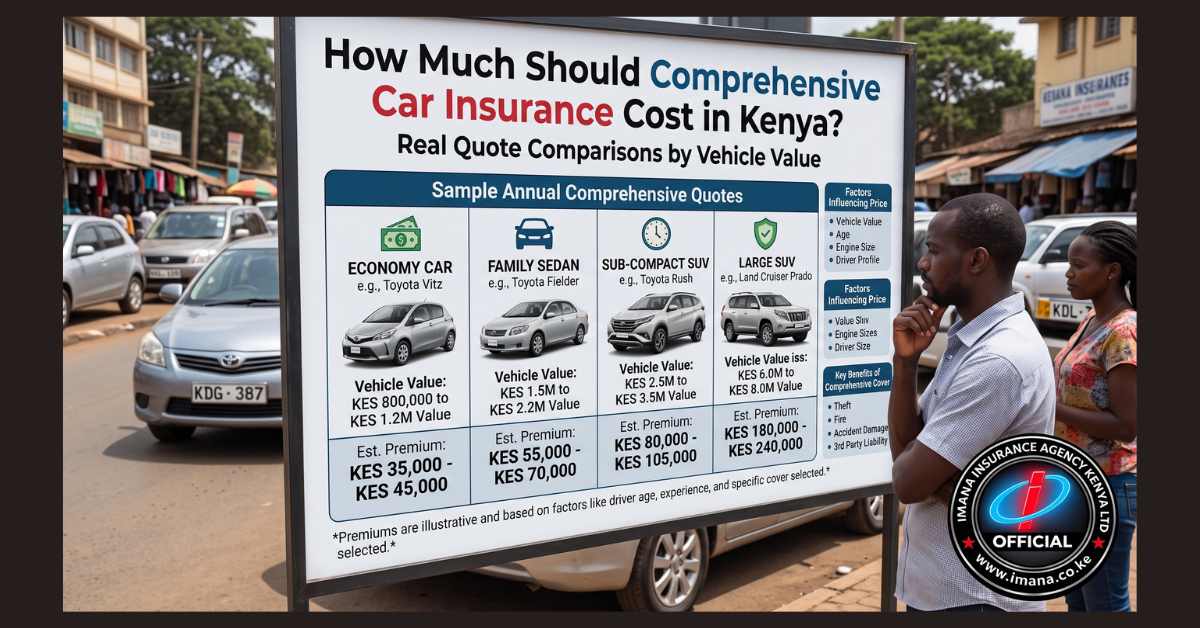
How much does comprehensive car insurance cost in Kenya? See practical quote comparisons by vehicle value and learn why premiums, excesses and benefits differ between insurers.
You have a vehicle worth KSh 1 million.
Your friend has a vehicle worth KSh 3 million.
Another person drives a KSh 7 million SUV.
Should all three pay the same motor insurance premium?
Of course not.
But even two people with vehicles of exactly the same value may receive very different comprehensive motor insurance quotations.
One insurer may quote KSh 75,000.
Another may quote KSh 92,000.
Another could quote KSh 110,000.
For the same vehicle value.
So what exactly determines the cost of comprehensive motor insurance in Kenya?
And more importantly:
How do you know whether the quotation you have received represents good value?
The answer is simple:
Compare before you buy.
At Imana Insurance Agency Kenya Ltd, we help motorists compare quotations from different insurers, understand what each quotation includes and choose based on overall value — not premium alone.
What Is Comprehensive Motor Insurance?
Comprehensive motor insurance generally provides broader protection than Third-Party Only insurance.
Depending on the policy wording and extensions purchased, comprehensive insurance may protect against risks such as:
- Accidental damage
- Theft
- Fire
- Third-party property damage
- Third-party bodily injury
- Malicious damage
- Windscreen damage
- Other insured risks and extensions
However, comprehensive insurance does not mean that every possible risk is automatically covered.
Different insurers have different:
- Terms
- Conditions
- Excesses
- Limits
- Exclusions
- Optional extensions
- Additional benefits
This is why comparing only the premium can be misleading.
How Is Comprehensive Car Insurance Priced in Kenya?
One of the major factors is the insured value of the vehicle.
But it is not the only factor.
An insurer may also consider:
- Vehicle make
- Vehicle model
- Year of manufacture
- Vehicle value
- Intended use
- Driver profile
- Claims history
- Security features
- Availability and cost of spare parts
- Repair costs
- Type of vehicle
- Previous insurance history
- Required extensions
This is why two insurers can look at the same vehicle and arrive at different premiums.
They may be pricing the risk differently.
Example: Comprehensive Insurance for a KSh 1 Million Vehicle
Let us take a hypothetical private vehicle valued at:
KSh 1,000,000
Three insurers might return quotations such as:
Insurer A: KSh 38,000
Insurer B: KSh 43,000
Insurer C: KSh 49,000
At first glance, Insurer A looks like the obvious winner.
But suppose:
Insurer A has a higher basic excess.
Insurer B includes stronger windscreen benefits.
Insurer C includes excess protector and additional roadside assistance.
Now the question becomes more interesting.
Is the KSh 38,000 policy still the best deal?
Maybe.
Maybe not.
That is exactly why the quotation needs interpretation.
Example: Comprehensive Insurance for a KSh 2 Million Vehicle
Now assume the vehicle is worth:
KSh 2,000,000
Illustrative quotations could look like:
Insurer A: KSh 65,000
Insurer B: KSh 72,000
Insurer C: KSh 84,000
The difference between the cheapest and highest quotation is:
KSh 19,000.
That is meaningful money.
But before choosing the KSh 65,000 quotation, ask:
- What excess applies?
- Is excess protector included?
- Is PVT included?
- What is the windscreen limit?
- Is road rescue available?
- What are the theft conditions?
- What exclusions apply?
- What additional benefits are included?
The premium tells you what you pay today.
The policy wording tells you what happens when something goes wrong tomorrow.
Example: Comprehensive Insurance for a KSh 3 Million Vehicle
Assume the insured vehicle value is:
KSh 3,000,000
Possible illustrative quotations:
Insurer A: KSh 93,000
Insurer B: KSh 105,000
Insurer C: KSh 123,000
A difference of KSh 30,000 between insurers deserves investigation.
Why is one insurer cheaper?
Why is another more expensive?
The answer might lie in:
- Different underwriting appetite
- Different excess structure
- Different benefits
- Different minimum premiums
- Vehicle model considerations
- Claims experience for that class of vehicle
- Optional extensions included in the quotation
This is where an independent comparison becomes valuable.
Example: Comprehensive Insurance for a KSh 5 Million Vehicle
Now let us move to a higher-value vehicle.
Vehicle Value: KSh 5,000,000
Illustrative quotations could be:
Insurer A: KSh 145,000
Insurer B: KSh 167,000
Insurer C: KSh 195,000
The gap is now:
KSh 50,000.
Naturally, most people will look at the cheapest figure first.
But with higher-value vehicles, there may be additional considerations:
- Expensive spare parts
- Advanced windscreens
- Cameras and sensors
- High repair costs
- Vehicle theft exposure
- Tracking requirements
- Specialist repair requirements
- Higher limits for accessories
A KSh 5 million vehicle deserves more than a five-second premium comparison.
Example: Comprehensive Insurance for a KSh 10 Million Vehicle
Consider a vehicle valued at:
KSh 10,000,000
Possible illustrative premiums may look like:
Insurer A: KSh 270,000
Insurer B: KSh 315,000
Insurer C: KSh 365,000
That is almost a KSh 100,000 difference between the lowest and highest quotations.
Would you simply choose the lowest?
Probably not without asking questions.
With a high-value vehicle, you should understand:
- Basic excess
- Theft excess
- Tracking conditions
- Authorized repair arrangements
- Windscreen limits
- Accessories limits
- Territorial limits
- Valuation requirements
- Replacement-parts considerations
- Claims procedures
The more valuable the asset, the more important the policy details become.
Important: These Examples Are Illustrative
The examples above are designed to demonstrate how quotations can differ.
They are not fixed market prices and should not be treated as a guarantee of what any insurer will quote.
Actual motor insurance premiums depend on the specific vehicle, insurer, underwriting terms, client profile, benefits selected and other risk factors.
For an accurate quotation, the best approach is to submit the actual vehicle details and compare real insurer responses.
Why Can Two Insurers Quote Very Different Premiums?
This surprises many motorists.
You might assume all insurance companies calculate risk in exactly the same way.
They do not.
Each insurer has its own:
- Underwriting philosophy
- Claims experience
- Risk appetite
- Pricing structure
- Minimum premium requirements
- Vehicle acceptance criteria
- Excess structure
- Policy benefits
One insurer might be particularly competitive for Japanese saloon cars.
Another might have stronger pricing for SUVs.
Another might prefer commercial vehicles.
Another may apply stricter terms to particular makes or age categories.
This is one of the biggest reasons insurance comparison matters.
Your Vehicle Value Matters — But So Does Your Vehicle Type
Two cars may each be worth KSh 3 million.
But one may cost more to insure.
Why?
Consider:
Vehicle A
Widely available locally.
Parts are readily available.
Repairers understand it well.
Replacement components are relatively affordable.
Vehicle B
Rare model.
Expensive parts.
Specialized electronic systems.
Imported components.
Few specialized repairers.
Both vehicles may have the same market value, but they may not represent the same insurance risk.
Why Vehicle Age Can Affect Your Quote
Older vehicles can sometimes raise different underwriting considerations.
The insurer may consider:
- Availability of parts
- Vehicle condition
- Market value
- Previous repairs
- Valuation
- Age restrictions under underwriting guidelines
A vehicle may therefore require an updated valuation before comprehensive insurance is offered or renewed.
Your Claims History Can Matter
Insurance pricing is about risk.
If a motorist has had several claims, an insurer may look at the risk differently from a client with a clean claims history.
Claims history can influence:
- Premium
- Excess
- Acceptance
- Special conditions
- Renewal terms
This is another reason one person's quotation should not automatically be used as a benchmark for another person's vehicle.
Don't Forget the Excess
This deserves its own section because it can completely change the meaning of a quotation.
Suppose:
Policy A
Premium: KSh 75,000
Policy B
Premium: KSh 84,000
Policy A is cheaper by KSh 9,000.
But Policy A could also expose you to a larger compulsory contribution during certain claims.
Suddenly that KSh 9,000 saving may not look as attractive.
Whenever you compare comprehensive insurance, ask:
What is the basic excess?
What is the minimum excess?
Are there additional excesses?
Is there excess protector?
What Is Excess Protector?
Excess Protector is an additional benefit that may protect the insured against certain applicable excesses, subject to the insurer's conditions and policy wording.
It may be:
- Included in the quotation
- Offered as an optional extension
- Subject to an additional premium
- Restricted by policy terms
This is exactly why you cannot compare insurance using premium alone.
What About Political Violence and Terrorism Cover?
PVT — Political Violence and Terrorism cover — is another important consideration.
Do not assume it is automatically included simply because you bought comprehensive insurance.
Always establish:
- Whether it is included
- Whether it is optional
- Whether an additional premium applies
- What the extension actually covers
When comparing quotations, compare the same scope of cover.
Otherwise, you may be comparing apples with oranges.
Compare Windscreen Benefits Carefully
A modern vehicle windscreen can cost much more than people expect.
Many modern cars use windscreen-mounted technology such as:
- Cameras
- Rain sensors
- Lane-assist equipment
- Driver-assistance systems
- Heating elements
- Special tinting
If your vehicle has a sophisticated windscreen, review the insurer's windscreen limit carefully.
Saving a small amount on premium while accepting an inadequate windscreen limit may be poor economics.
Road Rescue Can Make a Difference
Imagine your car breaks down hundreds of kilometres from Nairobi.
Who helps?
What does towing cost?
Does your insurer provide roadside assistance?
Depending on the policy, insurer and benefits purchased, road-rescue services may differ considerably.
Ask about:
- Towing
- Accident recovery
- Mechanical breakdown assistance
- Battery assistance
- Tyre support
- Geographical limitations
Again:
Compare benefits, not only premiums.
What About Courtesy Car Benefits?
Your vehicle is involved in an accident.
It goes to the garage.
Repairs take several weeks.
How do you get to work?
How do you move your family?
How do you attend meetings?
Some motor insurance packages may provide a courtesy-car or related benefit subject to particular conditions.
If mobility is critical to you, this benefit could be more valuable than a small reduction in premium.
Why the Cheapest Comprehensive Insurance May Cost More in the End
Imagine two quotations.
Quotation A
KSh 90,000
Quotation B
KSh 102,000
You save:
KSh 12,000
by choosing Quotation A.
Great.
Then you have a claim.
You discover that Quotation B would have given you:
- Lower excess
- Better windscreen protection
- Road rescue
- A useful extension
- More favourable benefits
The KSh 12,000 you saved may suddenly feel insignificant.
This does not mean you should always choose the most expensive policy.
Absolutely not.
It means you should understand why prices differ.
Cheap Insurance Is Not Bad Insurance
There is an important distinction here.
A lower-priced policy is not automatically inferior.
Sometimes one insurer is simply more competitive for your particular risk.
That is precisely why comparison works.
You may discover:
better cover at a lower premium.
But you only know that after comparing the details.
What Should You Compare Besides Price?
Before purchasing comprehensive motor insurance, compare:
1. Premium
How much are you paying?
2. Excess
What will you contribute if a claim occurs?
3. Sum Insured
Is the vehicle insured at a realistic current value?
4. Excess Protector
Is it included or optional?
5. PVT
Is Political Violence and Terrorism cover included?
6. Windscreen
What limit applies?
7. Entertainment Equipment
What limits and conditions apply?
8. Road Rescue
What assistance is available?
9. Courtesy Car
Is there a mobility benefit after an accident?
10. Geographical Coverage
Where does the policy apply?
11. Exclusions
What is specifically not covered?
12. Claims Support
Who assists you when you need to claim?
This is what proper comparison looks like.
Why Comparing Insurance Companies Yourself Can Be Difficult
You could contact five insurers individually.
Fill in five forms.
Send the same documents five times.
Receive five PDFs.
Then try to understand:
- Different wording
- Different excesses
- Different extensions
- Different limits
- Different terminology
Possible?
Yes.
Convenient?
Not always.
That is where an insurance intermediary becomes useful.
How Imana Helps You Compare Comprehensive Car Insurance
Imana Insurance Agency Kenya Ltd helps motorists look beyond a single quotation.
The process can be simple.
Step 1: Send Your Vehicle Details
Provide information such as:
- Registration number
- Vehicle make and model
- Year of manufacture
- Current estimated value
- Usage
- Current insurer, if applicable
- Claims history where required
Step 2: Compare Available Quotations
Imana can obtain and present suitable quotations from participating insurers depending on the risk.
Step 3: Understand the Differences
Our role is not simply to send you numbers.
We help explain:
- Premium
- Excess
- Benefits
- Extensions
- Limits
- Important differences
Step 4: Choose
You decide which quotation best fits your needs and budget.
Step 5: Buy Digitally
Much of the insurance purchasing process can be completed remotely, making renewal or new cover faster and more convenient.
Comparison + Advice + Digital Purchasing + Human Support
This is how modern insurance should work.
Technology makes comparison faster.
Digital processes make purchasing easier.
But insurance still needs human judgement.
A computer can show you:
KSh 78,000.
An adviser should help you understand:
What exactly am I getting for that KSh 78,000?
That distinction matters.
Especially when there is a claim.
Already Have a Comprehensive Insurance Quote?
Don't throw it away.
Send it to Imana.
If you already have:
- A renewal notice
- An insurer quotation
- Current policy schedule
it gives us a useful starting point.
We can help you evaluate what you have and explore alternative options where appropriate.
The goal is not to change insurers for the sake of changing.
The goal is to make sure your current policy still represents good value.
Buying a Car? Compare Insurance Before Collection
You do not need to wait until you have already purchased a vehicle to start thinking about insurance.
If you know:
- Make
- Model
- Year
- Vehicle value
- Registration details where available
you can start requesting insurance quotations.
This allows you to budget properly before taking possession.
Your car price is only one part of ownership.
Insurance is part of the real cost too.
Frequently Asked Questions
How much is comprehensive car insurance in Kenya?
There is no single universal price. Premiums vary depending on vehicle value, make, model, age, usage, underwriting terms, benefits selected and the insurer.
The best way to determine the actual cost is to request quotations using your specific vehicle details.
Is comprehensive insurance calculated according to vehicle value?
Vehicle value is an important pricing factor, but it is not the only factor. Insurers may also consider the vehicle type, age, usage, claims history, driver profile and other underwriting considerations.
Why are motor insurance quotes different between companies?
Different insurers have different pricing models, risk appetites, claims experiences, excess structures and policy benefits.
This can produce different quotations for the same vehicle.
Should I choose the cheapest comprehensive insurance quote?
Not automatically.
First compare:
- Excesses
- Limits
- Extensions
- Benefits
- Exclusions
- Claims arrangements
If the cheapest quotation also provides suitable protection, it may be excellent value.
But price should not be considered in isolation.
Can Imana compare motor insurance quotes for me?
Yes.
Imana helps clients compare available motor insurance quotations from different insurers and understand the differences before making a purchasing decision.
Can I buy comprehensive insurance online?
Much of the quotation, comparison, documentation and purchasing process can be handled remotely through digital channels, subject to the insurer's requirements.
Before You Pay, Compare
Your vehicle could be worth:
KSh 1 million.
KSh 3 million.
KSh 5 million.
Or KSh 10 million.
Whatever its value, there is no good reason to automatically assume the first comprehensive insurance quotation you receive is the best option available.
Compare:
Price.
Excess.
Benefits.
Extensions.
Policy terms.
Then decide.
Compare Comprehensive Motor Insurance Quotes with Imana
At Imana Insurance Agency Kenya Ltd, our role goes beyond sending quotations.
We help motorists:
Compare available insurance options
Understand policy differences
Choose suitable protection
Purchase conveniently through digital channels
Access human support when insurance becomes complicated
Get a Motor Insurance Quote
Motor Insurance:
https://imana.co.ke/insurance/motor-insurance
Request a Quote:
https://imana.co.ke/micro-quote
Website:
https://www.imana.co.ke
Call/WhatsApp:
+254 796 209 402
Imana Insurance Agency Kenya Ltd
4th Floor, Krishna Centre
Woodvale Grove, Westlands
Nairobi, Kenya
Your vehicle has a value. Your insurance should too.
Compare. Understand. Buy with confidence.
Author: Raymond Momanyi - Imana Insurance Agency Kenya Ltd (Unitas Digital Solutions)