
Blog Details
Diskava. Beta. Kava
05Sep
Compare Travel Insurance Quotes in Kenya | Schengen, Student & Family Cover
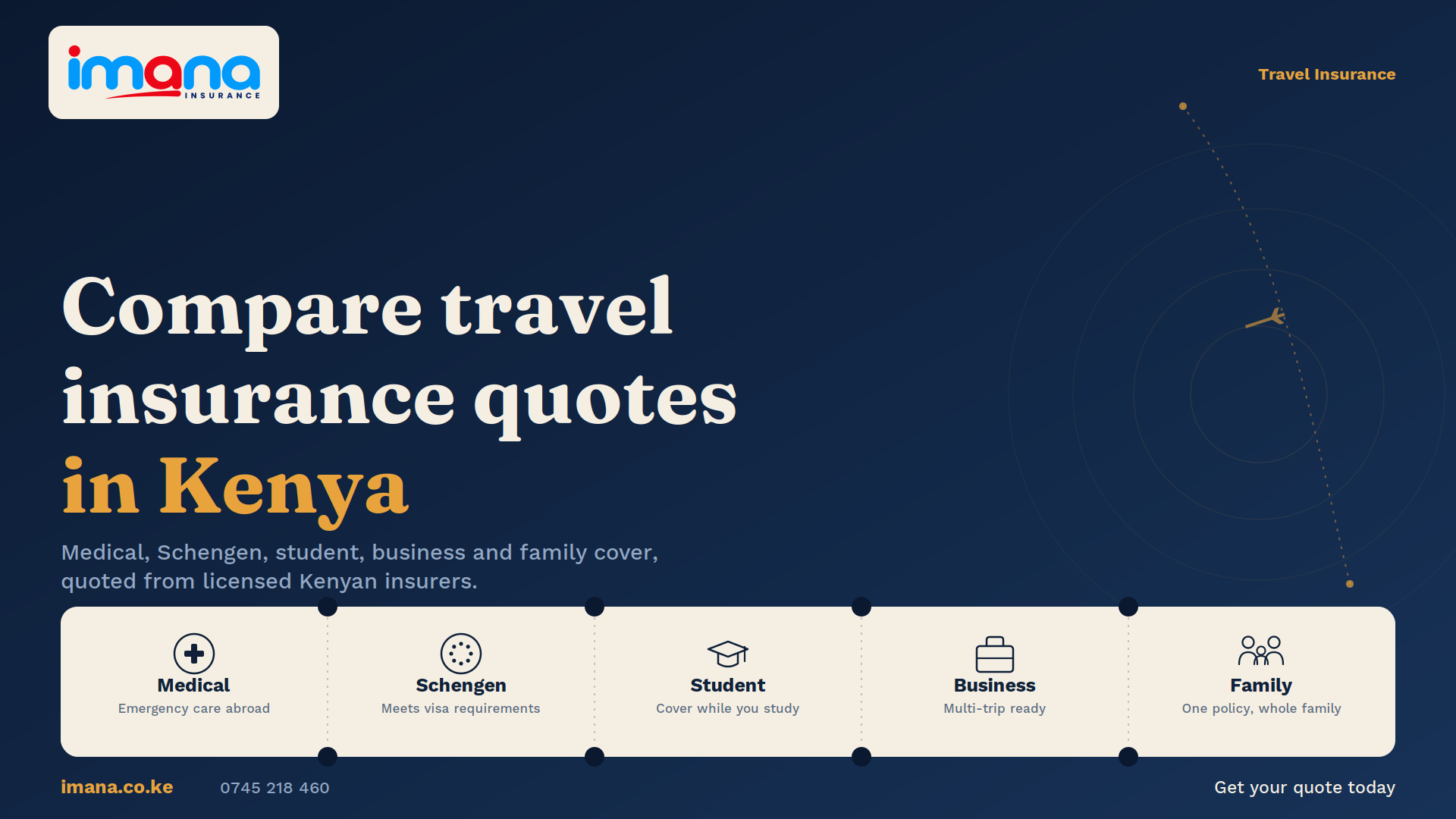
Compare Travel Insurance quotes in Kenya for Schengen visas, students, business trips, families and holidays. Compare medical limits, evacuation, baggage, exclusions and trip duration with Imana.
Travel Insurance is not one standard product.
A Kenyan travelling to Europe for a Schengen holiday may need different protection from a student spending a year abroad, a family going on holiday, a frequent business traveller or a senior visiting relatives overseas.
That is why Travel Insurance should not be chosen purely on premium.
A more useful comparison considers:
destination + trip duration + traveller age + medical limits + evacuation + repatriation + baggage + cancellation + exclusions
Imana Insurance Agency Kenya Ltd is a Westlands-based insurance intermediary helping individuals, families and businesses compare insurance quotations from licensed Kenyan insurers across Motor, Medical, WIBA, PSV, Travel, Motorcycle, Corporate and other insurance classes.
Travel Insurance information and quotation requests are available through:
Travel Insurance:
www.imana.co.ke/insurance/travel-insurance
Where Can I Compare Travel Insurance Quotes in Kenya?
Travellers looking to compare Travel Insurance quotations in Kenya can use an insurance intermediary such as Imana Insurance Agency Kenya Ltd.
Depending on the travel profile and insurer availability, quotations may differ in:
- Premium
- Emergency medical limit
- Medical evacuation
- Repatriation
- Baggage benefits
- Trip cancellation
- Travel delay
- Personal liability
- Policy excess
- Territorial limits
- Age eligibility
- Exclusions
The better question is not:
“Which Travel Insurance policy is cheapest?”
It is:
“Which policy best matches my destination, duration and travel risks?”
What Is Travel Insurance?
Travel Insurance is designed to provide financial protection against specified risks before or during a journey.
Depending on the insurer and selected plan, benefits may include:
- Emergency medical treatment
- Emergency hospitalisation
- Medical evacuation
- Repatriation
- Baggage loss or delay
- Loss of travel documents
- Trip cancellation
- Trip curtailment
- Travel delay
- Personal liability
- Personal accident
Not every policy contains every benefit.
The actual protection depends on the policy wording, limits, exclusions and selected cover.
Why Compare Travel Insurance Before Buying?
Two Travel Insurance quotations may have similar premiums but materially different protection.
For example, they can differ in:
- Medical limits
- Evacuation benefits
- Baggage sublimits
- Excesses
- Cancellation terms
- Age restrictions
- Territorial scope
- Sports or activity exclusions
That means a slightly cheaper quotation is not necessarily better value.
The actual benefits and exclusions matter.
The Imana 7-Point Travel Insurance Comparison
A practical comparison should review seven areas.
1. Premium
What is the final payable cost?
2. Benefits
Which travel risks are covered?
3. Limits
How much protection is available for medical expenses, evacuation, baggage and other benefits?
4. Excesses
What amount may the traveller need to contribute toward certain claims?
5. Exclusions
Which destinations, activities, medical conditions or circumstances fall outside the policy?
6. Eligibility
Does the traveller qualify based on age, destination and duration?
7. Claims and Service Requirements
What notifications, documents or approvals are required if something happens abroad?
This gives travellers a stronger basis for comparison than price alone.
Medical Travel Insurance
Emergency medical protection is one of the most important parts of a Travel Insurance policy.
Unexpected illness or injury overseas can involve:
- Doctor consultations
- Hospital admission
- Surgery
- Medication
- Specialist treatment
- Emergency transportation
Before buying, check:
- Emergency medical limit
- Hospitalisation benefit
- Medical evacuation
- Repatriation
- Excess
- Pre-existing-condition terms
- Territorial scope
The medical limit should be appropriate for the destination and trip.
Medical Evacuation and Repatriation
Medical evacuation may become necessary where suitable treatment is unavailable locally.
Depending on the policy, this may involve:
- Transfer to another medical facility
- Emergency transport
- Medical escort
- Repatriation to the traveller's home country
Some policies may also provide for repatriation of mortal remains, subject to applicable terms.
These benefits are worth reviewing carefully, particularly for long-distance travel or destinations where specialised medical facilities may be limited.
Schengen Travel Insurance for Kenyans
Travel medical insurance is an important requirement for many Schengen visa applications.
Under the EU Visa Code, qualifying insurance generally needs to:
- Be valid throughout the Schengen territory
- Cover the intended duration of stay or transit
- Provide at least EUR 30,000 in medical and repatriation cover
Applicants should confirm the current requirements of the relevant embassy, consulate or visa centre before applying.
Travel Insurance does not guarantee visa approval.
What Should You Compare in Schengen Travel Insurance?
Check:
- Territorial validity
- Medical limit
- Repatriation benefit
- Trip dates
- Traveller name
- Policy certificate wording
- Full period required for the application
- Destination requirements
- Any relevant exclusions
Do not assume every general Travel Insurance policy automatically satisfies the requirements for a specific visa application.
Student Travel Insurance
Students travelling abroad often require longer cover than ordinary holiday travellers.
A student may be away for:
- A semester
- An academic year
- An internship
- A postgraduate programme
Student Travel Insurance should therefore be matched to:
- Study destination
- Length of stay
- Visa requirements
- Emergency medical treatment
- Evacuation
- Repatriation
- Baggage
- Personal liability
- Study interruption where available
A short tourist policy may not be appropriate for a long academic stay.
What Should Students and Parents Compare?
Important questions include:
Does the policy cover the full study period?
Is the medical limit suitable for the destination?
Does it include evacuation and repatriation?
What baggage cover applies?
Are sports, internships or work placements excluded?
Does the policy satisfy any university or visa requirement?
These questions are often more important than the cheapest short-term premium.
Business Travel Insurance
Business travellers can have very different needs depending on frequency and destination.
Relevant options may include:
- Single-trip business cover
- Annual multi-trip cover
Important comparison factors include:
- Emergency medical limits
- Evacuation
- Cancellation
- Travel delay
- Baggage
- Personal liability
- Multiple-destination cover
- Maximum duration per trip
A traveller making one annual conference trip may need a different policy from an executive travelling several times each month.
Single-Trip vs Annual Multi-Trip Cover
Single-Trip Travel Insurance
This is designed for one specified journey.
It may suit:
- Holidays
- Family trips
- One-off business travel
- Visa-related travel
Annual Multi-Trip Travel Insurance
This may suit frequent travellers who take several international trips during the year.
Check:
- Maximum trip duration
- Territory
- Age limits
- Excluded activities
- Number or type of trips allowed
The total annual cost should be compared with repeated single-trip purchases.
Family Travel Insurance
Families should compare more than simply the total premium.
Important issues may include:
- Number of adults
- Number and ages of children
- Medical limits
- Baggage limits
- Cancellation cover
- Age limits for older family members
- Whether benefits are per person or shared
- Whether all family members must travel together
Product structures differ, so families should not assume that every insurer defines “family cover” in the same way.
Travel Insurance for Senior Travellers
Age can affect:
- Eligibility
- Premium
- Medical limits
- Trip duration
- Pre-existing-condition terms
- Evacuation
- Exclusions
A policy suitable for a younger traveller may have different terms for someone aged 65, 70 or above.
Senior travellers should therefore disclose requested health information and compare policy terms carefully.
Does Travel Insurance Cover Pre-Existing Conditions?
Not automatically.
Depending on the policy, a pre-existing condition may be:
- Excluded
- Subject to underwriting
- Covered only under specified circumstances
- Restricted by age or benefit limits
Travellers with known medical conditions should provide accurate information where requested.
Does Travel Insurance Cover Trip Cancellation?
Some plans include cancellation or curtailment benefits.
However, these normally apply only to specified insured events.
A traveller should check:
- Covered reasons
- Benefit limit
- Excess
- Documentation
- Exclusions
A voluntary change of mind should not automatically be assumed to be covered.
Does Travel Insurance Cover Lost or Delayed Baggage?
Many plans include baggage-related benefits, but limits vary.
Check:
- Total baggage limit
- Per-item limit
- Valuable-item restrictions
- Delay period
- Airline documentation requirements
- Proof of ownership
- Excess
High-value electronics and other valuables may have separate restrictions.
What About Lost Passports and Travel Documents?
Some policies may cover specified expenses arising from the loss of a passport or other travel documents.
Supporting documents may include:
- Police report
- Embassy or consular documentation
- Receipts
- Other proof requested by the insurer
The exact benefit depends on the policy.
Does Travel Insurance Cover Adventure Sports?
Not automatically.
Activities such as:
- Skiing
- Scuba diving
- Mountaineering
- Competitive sports
- Higher-risk adventure activities
may be excluded or require additional cover.
Declare planned higher-risk activities before buying.
Travel Insurance for the USA, UK, UAE, Europe and Other Destinations
Destination can materially affect both premium and appropriate benefit levels.
Someone travelling to:
- United States
- United Kingdom
- UAE
- Europe
- Asia
- Africa
may face different healthcare costs, visa conditions and assistance requirements.
Always disclose the full itinerary, including relevant stopovers where required.
How Much Does Travel Insurance Cost in Kenya?
There is no universal price.
Travel Insurance premiums may depend on:
- Destination
- Traveller age
- Trip duration
- Medical limit
- Single-trip or annual structure
- Number of travellers
- Selected benefits
- Insurer underwriting terms
A short trip by one young adult will usually be rated differently from:
- A three-month student trip
- A family holiday
- A senior traveller
- An annual business-travel policy
The best pricing reference is a current written quotation.
Imana should support this page over time with a separate Travel Insurance Price Guide using dated, real quotation scenarios.
Travel Insurance vs COMESA Yellow Card
These are different products.
Travel Insurance protects the traveller against specified personal travel risks such as medical emergencies, evacuation, baggage and cancellation.
COMESA Yellow Card is a regional motor third-party liability arrangement for qualifying cross-border vehicle travel.
A motorist travelling by road may need to consider both.
One does not replace the other.
Kenya Inbound Travel Health Insurance Is a Separate Issue
Requirements affecting visitors entering Kenya should be distinguished from Travel Insurance purchased by Kenyan residents travelling abroad.
Inbound travel health requirements apply to specified visitors entering Kenya.
Outbound Travel Insurance is purchased for the traveller's risks during an overseas journey.
Customers should confirm current requirements applicable to their specific travel direction and immigration status.
Can Travel Insurance Be Bought Online in Kenya?
Yes.
Depending on the insurer, much of the process can often be handled digitally.
A typical process may involve:
- Provide traveller details.
- Confirm destination.
- Confirm departure and return dates.
- Provide traveller ages.
- Explain the purpose of travel.
- Receive available quotations.
- Compare benefits, limits and exclusions.
- Select cover.
- Make payment through an approved channel.
- Receive policy documentation once the insurer's requirements are satisfied.
Additional underwriting may be required in some cases.
What Information Is Needed for a Travel Insurance Quote?
Common information includes:
- Traveller's full name
- Age or date of birth
- Destination
- Departure date
- Return date
- Purpose of travel
- Number of travellers
- Visa requirements where relevant
- Medical information where requested
- Planned higher-risk activities where relevant
Accurate dates and destination details matter because they affect policy validity.
What Happens if Your Travel Dates Change?
Do not assume the policy automatically changes with your itinerary.
If travel dates are amended, contact the insurer or intermediary before travelling.
The policy may need:
- Amendment
- Extension
- Reissue
- Additional premium
depending on the circumstances.
How Do Travel Insurance Claims Work?
A Travel Insurance claim may involve:
1. Notify the insurer or assistance provider
Early notification can be especially important for medical emergencies.
2. Preserve evidence
This may include:
- Medical reports
- Receipts
- Airline reports
- Police reports
- Baggage reports
- Booking documents
- Passport or travel records
3. Follow emergency-assistance instructions
Certain treatments or services may require coordination with the insurer's assistance provider.
4. Submit the claim
Provide all required supporting documents.
5. Claim assessment
The insurer determines whether the claim is admissible under the policy.
An insurance intermediary may assist with communication and documentation, but the insurer remains responsible for the claims decision and settlement.
Common Travel Insurance Mistakes
Avoid:
- Buying only on price
- Giving incorrect travel dates
- Omitting destinations
- Assuming every medical condition is covered
- Assuming cancellation means any change of mind
- Ignoring baggage sublimits
- Ignoring sports exclusions
- Buying cover for fewer days than the trip
- Assuming Travel Insurance guarantees visa approval
Most avoidable problems begin before the traveller leaves Kenya.
How to Compare Travel Insurance Quotes Properly
Before buying, ask:
Where am I travelling?
How long will I be away?
What is the medical limit?
Does the policy include evacuation and repatriation?
What baggage limits apply?
What cancellation cover is included?
Are my planned activities covered?
Does age affect eligibility?
Does the policy satisfy applicable visa requirements?
What must I do if I need to make a claim abroad?
If these questions are clear, comparison becomes much more meaningful.
Why Compare Travel Insurance Through Imana?
Imana Insurance Agency Kenya Ltd can assist travellers with comparing available Travel Insurance options based on:
- Destination
- Duration
- Age
- Purpose of travel
- Medical requirements
- Visa requirements
- Family structure
- Student needs
- Business-travel frequency
Travel profiles can include:
- Schengen travellers
- Students
- Business travellers
- Families
- Holiday travellers
- Senior travellers
- Frequent travellers
The objective is not simply to identify the lowest premium.
It is to help the traveller select cover that better reflects the actual journey.
Frequently Asked Questions About Travel Insurance in Kenya
Where can I compare Travel Insurance quotes in Kenya?
Imana Insurance Agency Kenya Ltd can assist travellers with reviewing available Travel Insurance options from insurers it works with, depending on destination, age, duration and required benefits.
Do Kenyans need Travel Insurance for a Schengen visa?
Applicants subject to Schengen travel-medical requirements generally need cover meeting the applicable territorial, duration, medical and repatriation requirements, including the required minimum medical limit.
Does Travel Insurance guarantee a visa?
No. Travel Insurance may form part of a visa application, but visa approval is determined by the relevant authority.
Can students buy Travel Insurance?
Yes. Student cover should be matched to destination, length of stay and visa or university requirements.
Can families buy Travel Insurance together?
Family arrangements may be available depending on insurer rules, traveller ages and family composition.
Is annual multi-trip cover useful for business travellers?
It can be useful for frequent travellers, depending on trip frequency, duration limits, territory and pricing.
Does Travel Insurance cover medical emergencies?
Many Travel Insurance plans include emergency medical benefits, subject to limits, exclusions and policy terms.
Does Travel Insurance cover baggage?
Many policies include baggage-related benefits, but limits, exclusions and evidence requirements vary.
Can senior travellers get Travel Insurance?
Yes, subject to insurer age limits, terms and underwriting requirements.
Can I buy Travel Insurance online in Kenya?
Yes. Much of the quotation, documentation and issuance process can often be handled digitally.
Compare Travel Insurance Quotes With Imana
Travel Insurance should fit the journey.
Before buying, compare:
the destination
the traveller
the trip duration
the medical limit
the evacuation and repatriation benefits
the baggage cover
the cancellation terms
the exclusions
and the claims process
Imana Insurance Agency Kenya Ltd can assist individuals, families, students and businesses with comparing available Travel Insurance options before travelling.
Imana Insurance Agency Kenya Ltd
Website: www.imana.co.ke
Travel Insurance:
www.imana.co.ke/insurance/travel-insurance
MyKava: www.mykava.co.ke
Author: Raymond Momanyi – Founder & CEO, Imana Insurance Agency Kenya Ltd
Compare the journey. Compare the benefits. Travel better protected.
Travel Insurance premiums, benefits, territorial limits, age restrictions, visa requirements and underwriting terms can change. Always obtain a current quotation, confirm destination-specific requirements and review the applicable policy wording before travelling.