
Blog Details
Diskava. Beta. Kava
12Sep
Compare Life Insurance in Kenya | Term, Whole Life & Family
Compare life insurance in Kenya, including term life, whole life, education, mortgage, credit, key person and group life insurance options. Get free insurance e-book
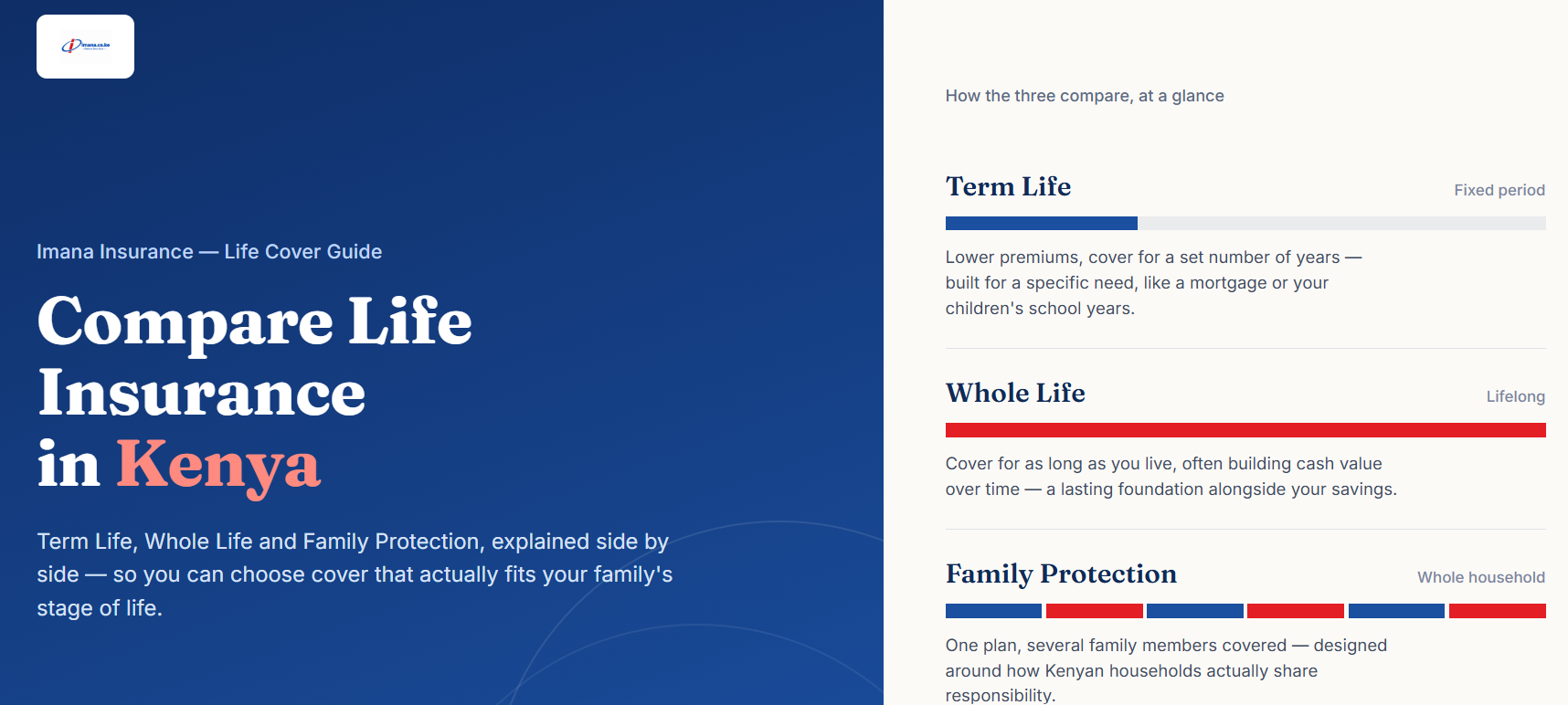
Compare Life Insurance in Kenya: Term Life, Whole Life and Family Protection
Life insurance is not really about death.
It is about what happens to the people, plans, debts and businesses that remain after someone dies.
Would a surviving family still pay rent or a mortgage? Would children remain in school? Would dependants have enough money for food and essential expenses? Could a business survive the death of its founder or another key person?
These are the questions life insurance is designed to address.
However, life insurance policies in Kenya are not all the same. Some provide protection for a fixed period. Others can provide longer-term protection, savings, investment or education benefits. Some secure a mortgage or loan, while others protect employees or businesses.
This guide explains how to compare life insurance in Kenya, including term life, whole life, education policies, mortgage protection, credit life, key person insurance, business succession, group life and life insurance for parents.
To request and compare insurance quotations, visit: https://imanainsurance.com
What Is Life Insurance?
Life insurance is an agreement between an insurer and a policyholder.
The policyholder pays the agreed premium. In return, the insurer pays the policy benefit when an insured event occurs, subject to the policy terms.
Under a standard life policy, the main insured event is the death of the insured person during the period of cover. Some policies may also include benefits for:
- Total and permanent disability
- Critical illness
- Accidental death
- Funeral expenses
- Premium waiver
- Terminal illness
- Maturity
- Savings or investment value
The precise benefits depend on the product selected.
Why Compare Life Insurance Policies?
Two policies may both be described as life insurance while serving completely different purposes.
One may provide pure protection for 10 years. Another may combine protection and long-term savings. A mortgage policy may reduce as the loan balance reduces. A group policy may end when employment ends.
When comparing life insurance quotations in Kenya, examine:
- The purpose of the policy
- Sum assured
- Policy term
- Premium
- Premium-payment period
- Covered events
- Exclusions
- Waiting periods
- Medical requirements
- Cash or surrender value
- Maturity benefit
- Beneficiary provisions
- Renewal conditions
- Claim requirements
- Policy charges
- Inflation and future family needs
The cheapest policy may not be the most suitable. The real question is whether the policy will meet the financial need it was purchased to protect.
Who Needs Life Insurance?
Life insurance is particularly relevant when another person or organisation would experience financial difficulty following the insured person’s death.
It may be suitable for:
- Parents with dependent children
- Married couples
- Sole-income households
- People supporting ageing parents
- Homeowners with mortgages
- Borrowers with significant debts
- Business owners
- Company founders
- Partners in professional firms
- Employers providing staff benefits
- Guardians responsible for school fees
- People planning their estates
- Individuals seeking long-term protection
- Families without sufficient emergency assets
A person without dependants may still need cover for debts, business obligations, funeral costs or future family plans.
How Much Life Insurance Does a Family Need?
There is no universal amount.
A practical calculation should consider:
- Outstanding mortgage and other debts
- Several years of family living expenses
- Children’s expected education costs
- Funeral and estate expenses
- Support required by ageing parents
- Emergency funds
- Business obligations
- Existing life insurance
- Savings and investments
- Benefits available through employment
A simple starting formula is:
Required life cover = debts + future family expenses + education funding + final expenses − existing assets and life cover
For example, a parent may have:
- KES 3 million outstanding on a mortgage
- KES 4 million in anticipated household-support needs
- KES 2 million in projected education costs
- KES 500,000 in other debts and final expenses
- KES 1.5 million in available savings and existing insurance
The estimated protection gap would be KES 8 million.
This is only a planning illustration. Inflation, investment returns, family structure and the length of support required should also be considered.
1. Term Life Insurance in Kenya
Term life insurance provides protection for a specified period, such as 5, 10, 15, 20 or more years.
If the insured person dies during the policy term and the claim is valid, the insurer pays the agreed death benefit.
If the insured survives the term, a pure term policy will ordinarily end without a maturity payment unless the product specifically includes a return-of-premium or savings feature.
Who May Need Term Life Insurance?
Term life may suit:
- Young parents
- Families with temporary income-protection needs
- Mortgage holders
- Business owners with fixed-term obligations
- People seeking a relatively high sum assured
- Borrowers
- Parents protecting children until financial independence
- People who want pure protection rather than savings
Advantages of Term Life Insurance
Potential advantages include:
- Straightforward protection
- A defined period of cover
- Potentially more affordable premiums than permanent cover
- Ability to align cover with a mortgage or education period
- A potentially higher sum assured for the available budget
What to Check
Before buying term life insurance, confirm:
- Whether premiums remain level
- Whether renewal is guaranteed
- The maximum entry and expiry ages
- Whether the policy can be converted
- Whether critical illness or disability is included
- Medical-examination requirements
- Whether accidental death has a separate benefit
- What happens if a premium is missed
Term life is protection-first insurance. It should not be sold as an investment where the policy does not have a savings or maturity value.
2. Whole Life Insurance in Kenya
Whole life insurance is designed to provide long-term or lifelong protection, provided the policy remains in force and all applicable terms are satisfied.
Depending on the insurer and product, it may include:
- A guaranteed death benefit
- Cash value
- Bonuses
- Savings components
- Policy-loan options
- Surrender value
- Additional riders
Whole life insurance is generally more expensive than comparable term cover because it may last longer and may include a cash-value component.
Who May Consider Whole Life Insurance?
It may be relevant to people who want:
- Long-term family protection
- Estate-liquidity planning
- Support for lifelong dependants
- A permanent death benefit
- Protection combined with a savings element
- Funds for estate obligations
- An inheritance for beneficiaries
Important Questions
Ask:
- Is the sum assured guaranteed?
- Are projected bonuses guaranteed or illustrative?
- How long are premiums payable?
- What happens when premiums stop?
- When does surrender value begin?
- What fees apply?
- Can money be borrowed against the policy?
- Does a withdrawal reduce the death benefit?
- What assumptions appear in the illustration?
Never treat projected returns as guaranteed unless the insurer expressly states that they are guaranteed.
Term Life Versus Whole Life Insurance
Term life and whole life solve different problems.
Term life is generally suited to temporary financial responsibilities—for example, protecting income until children complete school or a mortgage is repaid.
Whole life is designed for longer-term or permanent protection and may include a cash-value component.
A buyer should compare:
- Required duration
- Protection amount
- Budget
- Need for cash value
- Flexibility
- Long-term premium affordability
- Dependants’ future needs
- Estate-planning objectives
Some families may use both: a smaller permanent policy for long-term needs and a larger term policy during the years when financial responsibilities are highest.
3. Education Policies in Kenya
An education policy helps a parent or guardian accumulate money toward a child’s future education.
Depending on the product, it may combine:
- Life insurance
- Regular savings
- Maturity benefits
- Premium waiver following death or disability
- Staged payments during secondary school or university
- Additional accidental or critical-illness benefits
Why Families Consider Education Policies
Education costs do not pause when a parent dies, becomes disabled or experiences financial difficulty.
An education plan can create a structured funding path and may protect the education objective if the insured parent dies during the policy term.
What to Compare
Review:
- Guaranteed maturity value
- Projected bonuses
- Policy term
- Premium frequency
- Premium-waiver benefit
- Death benefit
- Partial-maturity payments
- Surrender value
- Charges
- Missed-premium consequences
- Inflation
An education policy should be compared with other savings and investment options. The insurance component, guarantees, charges, discipline and liquidity should all be considered.
4. Mortgage Protection Insurance
Mortgage protection insurance is intended to settle or reduce an outstanding home-loan balance if the insured borrower dies, subject to the policy conditions.
It may also include total and permanent disability or critical illness, depending on the product.
The cover often reduces as the mortgage balance falls.
Who Receives the Benefit?
The lender is commonly named as the policy beneficiary or assignee to the extent of the outstanding loan.
If the policy benefit exceeds the debt, the treatment of any balance depends on the policy and assignment arrangement.
What to Check
Confirm:
- Initial sum assured
- Whether cover reduces with the loan
- Interest-rate assumptions
- Disability benefit
- Critical-illness benefit
- Joint-borrower treatment
- Beneficiary or assignment arrangement
- Refinancing consequences
- What happens after early loan repayment
- Whether cover continues when changing lenders
A standard term-life policy can sometimes be used for broader family protection while also considering the mortgage. The right option depends on the family’s objectives and lender requirements.
5. Credit Life Insurance
Credit life insurance is linked to a loan or credit facility.
It may settle the outstanding insured debt following:
- Death
- Total and permanent disability
- Critical illness
- Retrenchment or loss of employment, where expressly included
Credit life protects the lender’s financial interest and may prevent eligible insured debt from passing as a burden to the borrower’s estate or family.
Credit Life Is Not Always Full Family Protection
If the benefit is paid directly toward the loan, the surviving family may receive no additional money for rent, food, education or income replacement.
Borrowers should therefore determine whether they also need an individual life policy.
6. Key Person Insurance
A key person is someone whose death or disability could cause serious financial loss to a business.
This could be:
- A founder
- Managing director
- Technical specialist
- Senior salesperson
- Business-development leader
- Professional partner
- Person holding critical customer relationships
- Person essential to production or operations
Under key person insurance, the business ordinarily owns the policy, pays the premium and receives the benefit.
What Can the Benefit Support?
The proceeds may help the business:
- Replace lost revenue
- Recruit and train a replacement
- Repay debt
- Maintain working capital
- Reassure lenders or investors
- Manage transition costs
- Survive the loss of specialised knowledge
- Continue operating during restructuring
How Is the Sum Assured Determined?
Possible approaches include:
- A multiple of the key person’s remuneration
- Estimated contribution to profits
- Replacement cost
- Outstanding business debt
- Expected transition period
- Contractual or investor requirements
The business should obtain accounting and tax advice on ownership, premiums and benefits.
7. Life Insurance for Business Succession
Business succession insurance helps business owners prepare for the death of a shareholder, partner or founder.
Without funding, surviving owners may be unable to buy the deceased owner’s interest. The family may inherit shares in a business it cannot manage, while surviving shareholders may lose control.
A properly structured arrangement may combine:
- A shareholders’ or partnership agreement
- A business valuation
- Life insurance on each owner
- A clear process for buying the deceased owner’s interest
- Instructions on who owns the policies
- Agreed valuation or valuation formula
- Legal, accounting and tax advice
Insurance alone does not create a succession plan. The legal agreement and policy structure must work together.
8. Group Life Insurance
Group life insurance is arranged by an employer, SACCO, chama, welfare association or another organisation for eligible members.
The benefit may be expressed as:
- A fixed amount
- A multiple of annual salary
- A graded amount based on membership category
- A combination of death and disability benefits
Optional benefits may include:
- Accidental death
- Total and permanent disability
- Critical illness
- Last expense
- Spouse cover
- Children’s cover
- Parents’ cover
Group Life for Employers
Group life can strengthen an employee-benefits programme and provide financial support to an employee’s nominated beneficiaries.
It may be arranged alongside:
- WIBA
- Group Personal Accident
- Group Medical Insurance
- Last Expense Insurance
- Pension or retirement benefits
Important Limitation
Employment-based group life may end when a person resigns, is retrenched, retires or otherwise leaves the eligible group.
Employees should not automatically treat employer-provided life insurance as a complete replacement for personal cover.
Corporate and group-life quotation: https://imana.co.ke/corporate-quote
9. Life Insurance for Parents
“Life insurance for parents” can mean two different things:
- A parent buying life insurance to protect children and dependants.
- An adult child arranging cover on an ageing parent.
Parents Protecting Children
A parent’s life policy may help fund:
- School fees
- University expenses
- Housing
- Daily living costs
- Debt repayment
- Medical needs
- Support for a surviving guardian
Stay-at-home parents should not automatically be excluded from planning. Their unpaid childcare, household management and caregiving work has a replacement cost.
Adult Children Covering Parents
An adult child may have a valid financial interest where the parent’s death would create funeral, debt or dependency costs.
However:
- The parent’s knowledge and consent will ordinarily be required.
- Entry-age restrictions may apply.
- Medical underwriting may be stricter.
- Available sums assured may be limited.
- Premiums generally increase with age.
- Existing health conditions must be disclosed.
For older parents, compare traditional life insurance with last-expense or funeral insurance depending on the actual need.
Life Insurance Versus Funeral Insurance
Life insurance and funeral insurance are related, but they are not identical.
Life Insurance
Life insurance commonly provides a larger lump-sum benefit intended for longer-term financial needs such as:
- Income replacement
- Mortgage repayment
- Education
- Family living expenses
- Business succession
- Estate planning
Funeral or Last-Expense Insurance
Funeral insurance is designed primarily to provide quicker, limited financial support for funeral and burial expenses.
It may cover:
- The principal member
- Spouse
- Children
- Parents
- Parents-in-law
- Extended-family members
- Members of a group, SACCO or chama
A family may need both: funeral cover for immediate costs and life insurance for long-term financial protection.
Read the Imana funeral-insurance authority article:
https://imana.co.ke/blog/Last-Expense-or-Funeral-Insurance-in-Kenya
Request a last-expense quotation:
https://imana.co.ke/last-expense-quote
Life Insurance Versus Personal Accident Insurance
Life insurance generally covers death from insured natural and accidental causes, subject to the policy terms.
Personal Accident insurance is triggered by accidental injury and may provide benefits for:
- Accidental death
- Permanent disability
- Temporary disability
- Accident-related medical expenses
A personal accident policy will ordinarily not pay for death caused purely by illness.
Life Insurance Versus Medical Insurance
Medical insurance pays or reimburses eligible healthcare expenses according to the selected benefits and provider rules.
Life insurance pays a stated benefit when an insured life event occurs.
Medical insurance helps a person obtain treatment while alive. Life insurance protects beneficiaries and financial obligations after death or another covered life event.
Life Insurance Versus Savings
Life insurance and savings are not interchangeable.
Savings provide accessible money owned by the saver. Life insurance transfers a defined financial risk to an insurer.
A person may have saved only a few premiums when death occurs, but a valid life policy may still pay the full sum assured.
Some life policies include savings or investment components, but buyers must distinguish between:
- Guaranteed benefits
- Projected benefits
- Bonuses
- Cash value
- Surrender value
- Death benefit
- Maturity benefit
What Determines the Cost of Life Insurance?
Life insurance premiums may be influenced by:
- Age
- Sum assured
- Policy term
- Health history
- Smoking status
- Occupation
- Income
- Lifestyle and hazardous activities
- Policy type
- Premium-payment frequency
- Additional benefits
- Medical examination results
- Family medical history
- Travel or residence
- Insurer’s underwriting rules
A young, healthy applicant may generally qualify for different terms from an older applicant with existing medical conditions.
Is a Medical Examination Always Required?
Not always.
The insurer may offer simplified underwriting for lower sums assured or certain group products. Higher benefits may require:
- Medical questionnaire
- Physical examination
- Blood tests
- Urine tests
- Blood-pressure reading
- HIV test
- Financial underwriting
- Doctor’s report
- Additional medical investigations
The insurer determines the requirements based on age, health, occupation and the requested benefit.
Why Financial Underwriting Matters
Insurers may ask about income, assets, debts and the intended purpose of the policy.
This helps establish whether the requested sum assured is financially reasonable.
For key person, business succession and creditor-related policies, the insurer may request:
- Audited financial statements
- Business valuation
- Loan documents
- Shareholding information
- Partnership agreements
- Employment or remuneration records
Beneficiary Versus Policy Owner
The insured person, policy owner and beneficiary can be different people.
- The insured person is the life covered.
- The policy owner controls the policy and normally pays the premium.
- The beneficiary is nominated to receive the policy benefit, subject to applicable law and policy terms.
These details should be completed carefully.
Beneficiary information should be reviewed after:
- Marriage
- Divorce
- Birth or adoption of a child
- Death of a beneficiary
- Change in dependency
- Major business restructuring
- Taking a mortgage
- Creating or changing an estate plan
What Happens When Premiums Are Missed?
Consequences vary by policy.
The policy may:
- Enter a grace period
- Lapse
- Become paid-up at a reduced value
- Use available cash value to support premiums
- Require reinstatement
- End without value
- Reduce benefits
A lapsed policy may leave the family without the expected protection.
Ask the insurer about:
- Grace periods
- Reinstatement deadlines
- Evidence of insurability
- Interest or unpaid premiums
- Automatic premium loans
- Reduced paid-up options
What Is Surrender Value?
Surrender value is the amount that may be payable when an eligible long-term policy is cancelled before maturity.
Pure term-life policies generally do not build surrender value.
Savings-linked or whole-life policies may build value gradually, but surrendering early can produce substantially less than the total premiums paid.
Before cancelling, request an official surrender-value quotation and understand which benefits will end.
Common Life Insurance Exclusions
Exclusions vary by insurer and product but may include:
- Material misrepresentation or nondisclosure
- Fraud
- Suicide within a specified initial period
- Certain hazardous activities
- Death connected to excluded criminal conduct
- War or restricted territories
- Uncovered pre-existing conditions
- Policy lapse
- Claims arising outside stated policy conditions
Applicants must answer proposal and medical questions truthfully.
A policy should never be purchased on the assumption that undisclosed information will remain undiscovered during a claim.
How to Compare Life Insurance Quotations in Kenya
Use the following process:
Step 1: Define the Financial Need
Decide whether the priority is:
- Family income protection
- Education
- Mortgage repayment
- Debt protection
- Funeral costs
- Business continuity
- Employee benefits
- Estate planning
- Long-term savings
Step 2: Calculate the Protection Gap
Estimate debts, future expenses and education costs, then subtract existing assets and insurance.
Step 3: Select the Appropriate Policy Type
Match the product to the need instead of starting with a brand or premium.
Step 4: Compare Like With Like
Do not compare term life with an education policy solely by premium. Their benefits and objectives differ.
Step 5: Examine Guarantees and Projections
Identify which values are guaranteed and which depend on future bonuses or investment performance.
Step 6: Check Exclusions and Underwriting
Understand medical requirements, exclusions, premium terms and lapse conditions.
Step 7: Verify the Insurer
Confirm that the insurer is licensed by Kenya’s Insurance Regulatory Authority:
https://www.ira.go.ke/licensed-insurers/
Step 8: Review Before Signing
Confirm the insured person, beneficiary, sum assured, policy term, premium and benefits.
Compare suitable insurance quotations at:
Documents Commonly Required
Depending on the policy, applicants may need:
- Completed proposal form
- National ID or passport
- KRA PIN
- Proof of income
- Beneficiary details
- Medical questionnaire
- Medical examination results
- Birth or marriage documents
- Loan documents
- Business financial statements
- Shareholding information
- Employer or group membership information
Additional documents may be requested during underwriting.
How to Make a Life Insurance Claim
The insurer or intermediary should be notified as soon as reasonably possible.
Common claim documents may include:
- Completed claim form
- Original or certified death certificate
- Identification documents
- Claimant’s identification
- Proof of relationship or beneficiary status
- Policy document or membership certificate
- Medical records
- Police abstract for accidental death
- Post-mortem report where required
- Burial permit
- Employer or group confirmation
- Bank details
- Grant of representation where applicable
Requirements depend on the claim circumstances and policy.
Do not alter documents or provide inconsistent information. Ask the insurer to explain any additional requirement in writing.
Common Reasons Life Claims Are Delayed
A claim may take longer where:
- Documents are incomplete
- Beneficiary information is outdated
- Names or identification details differ
- The death occurred soon after policy commencement
- Medical information requires investigation
- Premium status is unclear
- The policy was assigned to a lender
- Several people claim the benefit
- The death occurred outside Kenya
- Accidental or suspicious circumstances require investigation
- Material nondisclosure is alleged
- Estate documentation is required
Prompt notification and accurate records help reduce avoidable delays.
Life Insurance Quotation Pathway
The recommended permanent conversion page is:
/life-insurance-quote
It should ask for:
- Applicant’s name
- Date of birth
- Occupation
- Smoking status
- Required sum assured
- Preferred policy term
- Protection objective
- Monthly or annual budget
- Existing life cover
- Medical information
- Dependants
- Mortgage or debt amount
- Business-cover requirements
- Contact details
Until that dedicated pathway is published, quotations can be requested through:
Corporate key person, business succession and group-life enquiries can be submitted through:
https://imana.co.ke/corporate-quote
Frequently Asked Questions
Which life insurance is best in Kenya?
There is no single best policy for everyone. The right choice depends on the protection need, budget, age, health, dependants and preferred policy term.
Is term life cheaper than whole life?
Term life will often have a lower initial premium for a comparable death benefit because it provides cover for a defined period and usually has no cash value. Actual quotations vary.
Does term life pay if the insured survives?
A pure term-life policy ordinarily does not provide a maturity payment. Check whether the specific product includes a return-of-premium or savings feature.
Can life insurance pay school fees?
An education policy may provide scheduled or maturity benefits for education. A life policy’s death benefit can also help beneficiaries meet education expenses.
Does life insurance cover mortgage debt?
Mortgage protection or an appropriately structured life policy may provide funds to clear an insured mortgage balance.
Can someone have more than one life policy?
Yes, subject to financial underwriting and full disclosure of existing cover.
Can a person insure a parent?
It may be possible where insurable interest, consent, age and underwriting requirements are satisfied.
Is funeral insurance the same as life insurance?
No. Funeral insurance mainly addresses immediate funeral expenses, while life insurance may provide a larger benefit for longer-term family or business needs.
Does employer-provided group life continue after resignation?
It may end when employment or group eligibility ends. Employees should check the scheme rules.
Are life insurance payouts guaranteed?
A valid claim is subject to the policy remaining in force and all terms being satisfied. Savings projections and bonuses may not be guaranteed.
Can a life policy be cancelled?
Yes, but the financial consequences depend on the policy type. Pure term cover may end without value, while a long-term policy may have a surrender or paid-up value.
Get a Life Insurance Quotation in Kenya
Life insurance is most useful when it is arranged before the family, mortgage or business faces a crisis.
Begin by defining what needs to be protected. Then compare the sum assured, policy term, premium, exclusions, medical requirements and long-term affordability.
Imana Insurance Agency Kenya Ltd is a Westlands-based insurance intermediary helping individuals, families and businesses compare insurance quotations from licensed Kenyan insurers across Motor, Medical, WIBA, PSV, Travel, Motorcycle, Cyber, SME/Corporate and other insurance classes.
Compare life insurance quotations:
https://imanainsurance.com
Visit the Imana insurance authority centre:
https://imana.co.ke
Travel and insurance solutions:
https://mykava.co.ke
Request corporate, key person or group-life cover:
https://imana.co.ke/corporate-quote
Learn about funeral insurance:
https://imana.co.ke/blog/Last-Expense-or-Funeral-Insurance-in-Kenya
Request last-expense cover:
https://imana.co.ke/last-expense-quote
Office:
Imana Insurance Agency Kenya Ltd
4th Floor, Krishna Centre
Woodvale Grove, Westlands
Nairobi, Kenya
Call/WhatsApp: +254 745 218 460
Policy acceptance, premiums, benefits, exclusions and claim settlement remain subject to the insurer’s underwriting requirements and policy terms.
Author: Raymond Momanyi
Founder & CEO, Imana Insurance Agency Kenya Ltd
Raymond Momanyi is an insurance professional specialising in motor insurance, medical insurance, WIBA, PSV insurance comparison, claims support and business-risk solutions in Kenya.