
Blog Details
Diskava. Beta. Kava
02Aug
COMESA Yellow Card Insurance in Kenya: Complete 2026 Guide
Learn how COMESA Yellow Card Insurance works for Kenyan motorists travelling across participating African countries, including coverage, eligible vehicles, application documents, claims and verification.
Driving Outside Kenya? Your Kenyan Motor Policy May Not Be Enough
Driving from Kenya into another African country requires more than a valid passport, logbook and Kenyan motor-insurance certificate.
A standard Kenyan motor policy generally applies within the geographical territory stated in the policy. When the vehicle crosses an international border, the motorist may need recognised third-party insurance valid in the countries being visited.
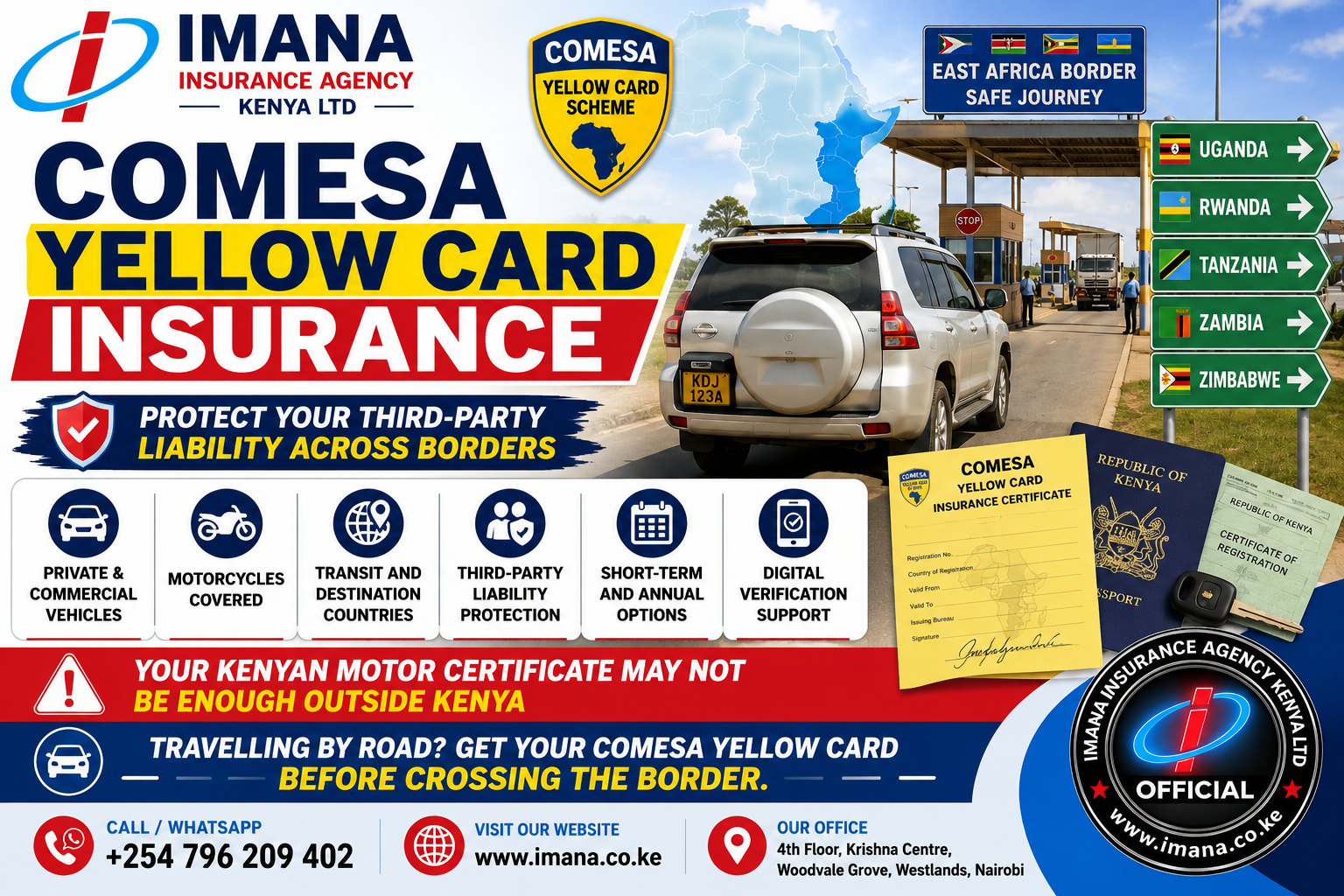
The COMESA Yellow Card is a regional motor-insurance certificate recognised by participating countries. It provides third-party motor liability protection according to the compulsory motor-insurance laws of the country where an accident occurs. (COMESA Yellow Card)
It is intended to make cross-border road travel easier by allowing motorists to carry one recognised certificate instead of purchasing separate third-party insurance at every participating border.
The COMESA Yellow Card extends third-party motor liability across participating countries. It does not automatically provide comprehensive protection for damage to your own vehicle.
What Is the COMESA Yellow Card?
The COMESA Yellow Card is a regional third-party motor-vehicle insurance certificate.
It provides evidence that a visiting motorist has the compulsory third-party insurance required while driving through participating countries.
The scheme is designed to:
- Protect third-party accident victims
- Facilitate cross-border road travel
- Support regional trade and transport
- Provide a coordinated claims-settlement system
- Help motorists comply with local compulsory motor-insurance laws
The COMESA Yellow Card Scheme describes the cover as a guarantee of compensation for third-party road-accident victims affected by foreign motorists visiting or transiting through a participating country. (COMESA Yellow Card)
What Does the COMESA Yellow Card Cover?
The core benefit is third-party motor liability.
Depending on the law of the country where the accident occurs, this may include eligible liability for:
- Bodily injury to third parties
- Accidental death of third parties
- Damage to third-party property
- Passenger liability where applicable
- Legal liability arising from the accident
The actual compensation limits and claims treatment are generally determined by the compulsory motor-insurance laws of the country in which the accident occurs—not simply by Kenyan limits. (COMESA Yellow Card)
Example
A vehicle insured in Kenya travels into Uganda and causes an accident there.
The resulting third-party claim would ordinarily be handled through the Yellow Card framework and assessed according to the applicable motor-insurance laws and procedures in Uganda.
The scheme’s system allows national bureaux and participating insurers to coordinate the claim across borders.
What Does the Yellow Card Not Automatically Cover?
A COMESA Yellow Card should not be confused with comprehensive motor insurance.
It does not ordinarily provide automatic protection for:
- Accidental damage to your own vehicle
- Theft of your vehicle
- Fire damage to your vehicle
- Mechanical breakdown
- Tyre damage
- Windscreen damage
- Personal belongings inside the vehicle
- Loss of use
- Roadside assistance
- Medical treatment for the driver
- Repatriation of the damaged vehicle
- Political violence or terrorism
- War-related incidents
These risks may require:
- A comprehensive Kenyan motor policy
- An extension of territorial limits
- Travel Insurance
- Personal Accident Insurance
- Road-rescue cover
- Political Violence and Terrorism protection
Before travelling, ask your insurer whether your comprehensive own-damage benefits remain valid outside Kenya.
The Yellow Card mainly protects other road users from the insured vehicle’s legal liability. Protecting your own vehicle abroad may require an additional extension.
Which Countries Accept the COMESA Yellow Card?
The official Yellow Card Scheme currently lists acceptance in countries including:
- Burundi
- Democratic Republic of the Congo
- Djibouti
- Eritrea
- Ethiopia
- Kenya
- Malawi
- Rwanda
- Sudan
- Tanzania
- Uganda
- Zambia
- Zimbabwe
The official scheme information also identifies Kenya among the countries where motorists can obtain the certificate through participating insurers. (COMESA Yellow Card)
Participation and operational arrangements can change. A motorist should confirm the current status of every intended destination and transit country before departure.
Important route consideration
A driver travelling from Kenya to a participating destination may pass through several countries.
The certificate should therefore include:
- The destination country
- Every transit country
- The complete travel period
For example, travelling to a destination through Uganda and Rwanda requires the insurance arrangement to recognise the full route—not only the final destination.
Is the COMESA Yellow Card Valid in Every African Country?
No.
The certificate only applies within participating countries and according to the scheme’s territorial arrangements.
It should not automatically be assumed to apply in:
- Every COMESA member state
- Every East African country
- Southern Africa generally
- West Africa
- Countries outside the listed scheme territory
Before driving, confirm:
- Whether the destination accepts the Yellow Card.
- Whether each transit country accepts it.
- Whether additional local motor insurance is required.
- Whether your own-damage policy extends to the route.
Who Needs a COMESA Yellow Card?
The cover may be required by Kenyan motorists travelling across participating borders using:
- Private cars
- SUVs
- Commercial vehicles
- Trucks
- Tour vehicles
- Company vehicles
- Motorcycles
- Buses
- Delivery vehicles
- Vehicles carrying goods
The official scheme states that Yellow Card protection can be arranged for private and commercial vehicles, although premiums may vary according to the vehicle type and intended use. (COMESA Yellow Card)
It may be relevant to:
- Families taking regional road trips
- Tour companies
- Cross-border traders
- Transport and logistics companies
- NGOs
- International organisations
- Contractors working across borders
- Businesses moving staff or equipment
- Motorcycle travellers
- Overland tourists
Does a Vehicle Need Kenyan Motor Insurance First?
A Yellow Card is normally connected to a valid underlying motor-insurance policy issued in the vehicle’s country of registration or residence.
Kenyan court decisions have discussed the Yellow Card as a cross-border extension associated with an underlying primary motor policy. (Kenya Law)
A motorist may therefore be asked to provide:
- Current Kenyan motor certificate
- Motor policy number
- Policy expiry date
- Vehicle details
- Insurer details
The Yellow Card should not be treated as a substitute for the vehicle’s normal Kenyan motor insurance.
Can Third-Party-Only Vehicles Obtain a Yellow Card?
Potentially, yes, subject to the issuing insurer’s requirements.
Because the Yellow Card’s core purpose is third-party liability, it may be available for vehicles holding a valid underlying Third-Party Only policy.
However, the motorist should understand that:
- The Kenyan policy does not cover own damage.
- The Yellow Card does not ordinarily add comprehensive own-damage protection.
- Damage to the insured vehicle may remain the owner’s responsibility.
The insurer must confirm eligibility before issuance.
Can Comprehensive Vehicles Obtain a Yellow Card?
Yes, subject to underwriting and a valid motor policy.
However, the motorist should separately confirm whether the comprehensive policy’s territorial limits include the destination.
A Kenyan comprehensive policy may require a written territorial extension before it can cover:
- Collision damage outside Kenya
- Fire
- Theft
- Recovery expenses
- Towing
- Windscreen damage
Do not rely on verbal assurances. Request the extension in writing and confirm that it appears on the policy endorsement.
How Long Is a COMESA Yellow Card Valid?
The period should correspond with the planned travel dates and the insurer’s available options.
It may be issued for:
- A short journey
- Several weeks
- Several months
- An annual period
The chosen period should cover the entire journey, including possible delays.
Example
A motorist plans to travel from Kenya on 10 August and return on 20 August.
Purchasing cover ending on 20 August creates a risk if:
- The vehicle breaks down
- Border processing is delayed
- The return journey changes
- The driver remains abroad unexpectedly
Including a reasonable time allowance may reduce the risk of the certificate expiring before re-entry into Kenya.
When Should You Apply?
Apply before reaching the border.
Early application allows time to:
- Confirm participating countries
- Correct vehicle information
- Review travel dates
- Obtain an own-damage extension
- Verify the certificate
- Carry the required documents
Waiting until the departure day may lead to:
- Incorrect travel dates
- Missing transit countries
- Payment delays
- Wrong registration details
- Failure to obtain the certificate on time
Documents Required for a COMESA Yellow Card
The exact requirements vary by insurer, but motorists may be asked for:
- National ID or passport
- KRA PIN
- Vehicle logbook
- Current Kenyan motor certificate
- Existing motor-policy schedule
- Vehicle registration number
- Vehicle make and model
- Vehicle class and use
- Travel dates
- Destination
- Transit countries
- Driver information
- Company documents for corporate vehicles
- Authority letter where the driver is not the owner
Financed or company-owned vehicles
Additional documents may include:
- Financier’s consent
- Employer authorisation
- Board or company authority
- Lease agreement
- Letter from the registered owner
Border authorities may also require separate travel and vehicle documents unrelated to insurance.
Information That Must Be Correct on the Certificate
Before travelling, confirm:
- Policyholder’s name
- Vehicle registration number
- Vehicle make
- Vehicle class
- Start date
- Expiry date
- Countries covered
- Issuing insurer
- Certificate number
Even a small registration error can create difficulties during:
- Border verification
- Police checks
- Claim processing
- Confirmation by the national bureau
Never edit an issued certificate manually.
Ask the insurer to issue a corrected version.
How to Verify a COMESA Yellow Card in Kenya
The scheme introduced a USSD verification facility for Kenya.
A Kenyan certificate can be checked without internet access by dialling:
*384*254#
The official scheme indicates that the Kenyan verification service is supported through Safaricom and is free of charge. (COMESA Yellow Card)
Verification can help confirm:
- Certificate authenticity
- Vehicle details
- Insurance status
- Validity period
A motorist should verify the certificate before departure rather than discovering an error at the border.
The COMESA Yellow Card Scheme also provides an online verification facility. (COMESA Yellow Card)
Digital vs Printed Yellow Card
The scheme has continued developing electronic and digital verification systems, including online and USSD-based verification. (COMESA Yellow Card)
Even where a digital certificate is issued, motorists should consider carrying:
- Printed Yellow Card
- Digital copy on the phone
- Current Kenyan motor certificate
- Policy schedule
- Insurer’s emergency contacts
- Vehicle logbook copy
- Driver’s licence
- Passport or national identification
Border and enforcement practices may differ between countries and checkpoints.
Who Manages the Yellow Card Scheme in Kenya?
The national bureau for Kenya is Kenya Reinsurance Corporation, commonly known as Kenya Re.
The official scheme identifies Kenya Re as the National Bureau of Kenya and provides it with a coordinating role under the regional framework. (COMESA Yellow Card)
The national bureau helps coordinate:
- Cross-border claims
- Participating insurers
- Verification
- Communication with other national bureaux
- Settlement procedures
Motorists normally purchase the Yellow Card through participating insurers or licensed insurance intermediaries—not directly as an ordinary retail policy from the national bureau.
What to Do After an Accident Outside Kenya
1. Protect life and prevent further injury
Check whether anyone is injured and contact the local emergency services.
Do not move seriously injured people unless necessary for immediate safety.
2. Report to the local police
Obtain:
- Police reference
- Accident report
- Police abstract or equivalent document
- Details of the investigating officer
Claims procedures depend on the country where the accident occurred.
3. Exchange information
Record:
- Driver names
- Registration numbers
- Telephone contacts
- Insurance details
- Identification details
- Vehicle owners
- Passenger information
4. Take photographs and videos
Capture:
- Vehicle positions
- Damage
- Road conditions
- Number plates
- Traffic signs
- Skid marks
- Surrounding area
- Third-party property damage
5. Obtain witness contacts
Record independent witness names and telephone numbers.
6. Notify the issuing insurer immediately
Provide:
- Certificate number
- Vehicle registration
- Location
- Date and time
- Nature of the accident
- Third-party details
- Police report information
7. Contact the relevant national bureau
The insurer or intermediary should guide you regarding the appropriate national bureau in the country where the accident occurred.
8. Avoid admitting liability
Do not:
- Sign documents you do not understand
- Promise payment
- Negotiate compensation privately
- Leave the scene unlawfully
- Accept responsibility before investigation
Cooperate with police and provide factual information.
Common Yellow Card Claim Documents
Depending on the country and accident, the claim may require:
- Yellow Card certificate
- Kenyan motor certificate
- Motor-policy schedule
- Police report
- Driver’s licence
- Vehicle logbook
- Driver’s passport or identification
- Photographs
- Witness statements
- Third-party demand
- Medical reports
- Treatment invoices
- Repair estimates
- Court documents
- Company-authority documents
- Claim form
Prompt reporting is essential because evidence can become difficult to obtain after returning to Kenya.
How Are Cross-Border Claims Settled?
The scheme operates through participating insurers and national bureaux.
A claim arising in another participating country may involve:
- The accident being reported locally.
- The host-country bureau receiving or coordinating the claim.
- The issuing insurer and home bureau being notified.
- Liability and damage being investigated.
- Compensation being considered under the host country’s law.
- The bureaux and insurer reconciling the settlement.
The scheme describes its centralised claims framework as a system for handling claims arising from motorists travelling between participating states. (COMESA Yellow Card)
Kenyan case law has also recognised the role of the Yellow Card operations framework and national bureaux in cross-border claims handling. (Kenya Law)
Does the Yellow Card Pay for Vehicle Repairs?
Not ordinarily for the insured vehicle.
Where the insured Kenyan vehicle is damaged abroad, repairs may only be considered where:
- The vehicle has comprehensive insurance.
- The insurer has extended own-damage cover to the relevant territory.
- The incident falls within the policy.
- The insurer authorises assessment and repairs.
- The applicable excess is paid.
Before authorising repairs abroad, contact the insurer.
Unauthorised repair work may create difficulties because the insurer may need to:
- Inspect the vehicle
- Appoint an assessor
- Approve repair estimates
- Decide whether repairs should occur locally or in Kenya
- Consider towing or repatriation
Does It Cover Road Rescue or Towing?
Not automatically.
Road rescue, towing and vehicle recovery may require:
- A motor-policy extension
- A roadside-assistance product
- A travel-support arrangement
- Direct payment by the vehicle owner
Confirm:
- Distance limits
- Countries covered
- Towing limits
- Breakdown exclusions
- Emergency contact numbers
Do not assume a Kenyan road-rescue benefit operates throughout the region.
Does It Cover Drivers and Passengers?
The Yellow Card’s principal function is third-party liability.
Treatment of drivers, passengers and occupants depends on:
- Local law
- Vehicle class
- Passenger-liability provisions
- Policy terms
- Whether the injured person legally qualifies as a third party
Motorists should consider separate:
- Personal Accident Insurance
- Travel Insurance
- Medical Insurance
- Emergency evacuation cover
This is especially important for long-distance family, tour and commercial journeys.
COMESA Yellow Card for Motorcycles
Motorcycles may qualify subject to insurer underwriting and current scheme arrangements.
The applicant may need to provide:
- Motorcycle logbook
- Valid Kenyan motorcycle insurance
- Rider’s licence
- Registration details
- Travel route
- Travel period
- Intended use
Motorcycle travellers should also consider:
- Rider Personal Accident
- Emergency medical cover
- Recovery arrangements
- Theft protection
- Protective clothing and safety equipment
A Yellow Card does not remove the need to comply with each country’s licensing, helmet and road-traffic requirements.
COMESA Yellow Card for Commercial Vehicles
Commercial vehicles may include:
- Trucks
- Delivery vans
- Tour vans
- Company vehicles
- Passenger vehicles
- Vehicles transporting goods
Underwriting may consider:
- Vehicle class
- Seating or carrying capacity
- Intended use
- Cargo
- Route
- Frequency of travel
- Countries visited
- Policy period
Commercial vehicle owners may also need:
- Goods in Transit Insurance
- Marine Cargo Insurance
- Carrier’s Liability
- Passenger Liability
- Commercial Motor Comprehensive Insurance
- Driver Personal Accident
The Yellow Card protects motor third-party liability. It does not automatically insure the goods being transported.
COMESA Yellow Card for Tour Operators
Tour operators carrying visitors across borders should confirm:
- Correct tour-service motor classification
- Passenger liability
- Comprehensive territorial extension
- Yellow Card
- Travel Insurance
- Emergency evacuation
- Road rescue
- Driver licensing
- Vehicle inspection requirements
The operator should also maintain:
- Passenger manifest
- Emergency contacts
- Travel itinerary
- Border documents
- Insurer contacts
- Alternative transport arrangements
How Much Does a COMESA Yellow Card Cost in Kenya?
The premium depends on factors such as:
- Vehicle class
- Private or commercial use
- Motorcycle or motor vehicle
- Period of cover
- Destination
- Transit countries
- Underlying motor policy
- Current approved rates and charges
The scheme confirms that pricing can vary according to vehicle type and use. (COMESA Yellow Card)
Because rates and administrative charges may be revised, motorists should request a current written quotation rather than relying on an old certificate or social-media price.
The quotation should show:
- Premium
- Certificate or card fee
- Applicable levies
- Total payable
- Period of cover
- Countries included
Can the Yellow Card Be Cancelled?
Cancellation terms depend on the country, issuing insurer and circumstances.
The official scheme notes that cancellation and potential refunds vary by provider and jurisdiction. (COMESA Yellow Card)
A motorist whose travel plans change should contact the insurer before the cover begins.
A refund should not be assumed after:
- Cover has started
- The certificate has been used
- The vehicle has crossed the border
- A claim has arisen
Common Mistakes Kenyan Motorists Make
Applying on the day of travel
This leaves little time to correct errors.
Covering only the destination
Transit countries must also be considered.
Assuming the Yellow Card is comprehensive insurance
It mainly protects third-party liability.
Failing to extend own-damage cover
The vehicle may remain uninsured for accidental damage abroad.
Using incorrect travel dates
The certificate may expire before the return journey.
Entering the wrong registration number
This can affect verification and claims.
Failing to verify the certificate
A verification check should be completed before departure.
Carrying no printed copy
Digital access may be disrupted at remote border points.
Repairing the vehicle without insurer approval
The insurer may require inspection before repairs begin.
Failing to report the accident locally
A police report from the country of accident may be essential.
Assuming cargo is covered
Goods require separate insurance.
Cross-Border Travel Checklist
Before leaving Kenya, confirm that you have:
- Valid passport or identification
- Required visas or entry permissions
- Valid driver’s licence
- Vehicle logbook or certified copy
- Owner’s authority where applicable
- Current Kenyan motor certificate
- COMESA Yellow Card
- Own-damage territorial extension
- Road-rescue contacts
- Travel Insurance
- Emergency medical cover
- Route and border information
- Printed and digital policy copies
- Insurer and intermediary contacts
Vehicle owners should also check:
- Tyres
- Brakes
- Lights
- Battery
- Fluids
- Spare wheel
- Tools
- Reflective triangles
- First-aid kit
- Required country-specific safety equipment
Questions to Ask Before Buying a Yellow Card
- Is my destination covered?
- Are all transit countries included?
- What is the exact start and expiry date?
- Does my Kenyan motor policy remain valid?
- Is own-vehicle damage covered abroad?
- Does the policy include theft and fire outside Kenya?
- Are passengers protected?
- Is road rescue available?
- How do I verify the certificate?
- Who should I contact after an accident?
- Which police and claim documents are required?
- Does the certificate cover my vehicle class?
- Are the goods carried insured?
- What happens if my trip is extended?
- Can the certificate be amended before travel?
Request the answers in writing.
How Imana Helps Arrange COMESA Yellow Card Insurance
Imana Insurance Agency Kenya Ltd helps Kenyan motorists obtain COMESA Yellow Card quotations and coordinate cross-border motor-insurance documentation through suitable participating insurers.
The process may include:
- Reviewing the vehicle’s existing motor policy.
- Confirming the vehicle class.
- Checking travel dates.
- Identifying destination and transit countries.
- Requesting a current quotation.
- Coordinating certificate issuance.
- Checking the vehicle and policy details.
- Guiding the client on verification.
- Reviewing own-damage territorial extensions.
- Supporting accident and claim notification.
Related insurance solutions may include:
- Comprehensive Motor Insurance
- Third-Party Motor Insurance
- Travel Insurance
- Personal Accident Insurance
- Goods in Transit
- Marine Cargo
- Road Rescue
- Political Violence and Terrorism
- Commercial Motor Insurance
COMESA Yellow Card Insurance in Westlands and Across Kenya
Imana Insurance Agency Kenya Ltd
4th Floor, Krishna Centre
Woodvale Grove, Westlands
Nairobi, Kenya
Website: www.imana.co.ke
Call or WhatsApp: +254 796 209 402
Crossing the border by road? Confirm the route, verify the certificate and protect your journey before leaving Kenya.
Frequently Asked Questions
What is a COMESA Yellow Card?
It is a regional motor-insurance certificate providing third-party liability protection for motorists visiting or transiting through participating countries. (COMESA Yellow Card)
Is it compulsory?
A motorist must comply with the compulsory third-party motor-insurance laws of the country being visited. The Yellow Card is the recognised regional mechanism for satisfying that requirement in participating countries.
Does it cover damage to my car?
Not ordinarily. Own-vehicle damage requires comprehensive insurance with an appropriate territorial extension.
Can a private car obtain a Yellow Card?
Yes, subject to a valid underlying motor policy and insurer requirements.
Can commercial vehicles obtain it?
Yes. The official scheme recognises both private and commercial vehicles, subject to appropriate pricing and underwriting. (COMESA Yellow Card)
Can motorcycles obtain the cover?
They may qualify subject to the issuing insurer’s current terms and scheme arrangements.
Where can I obtain it?
Kenyan motorists can obtain it through participating insurers and licensed insurance intermediaries. Kenya is listed as an issuing country under the scheme. (COMESA Yellow Card)
How do I verify a Kenyan Yellow Card?
Dial *384*254# on a supported Safaricom line or use the official scheme’s online verification facility. (COMESA Yellow Card)
Who is Kenya’s National Bureau?
Kenya Reinsurance Corporation is identified as the National Bureau of Kenya. (COMESA Yellow Card)
Does it cover goods carried in a truck?
No, not automatically. Goods may require Goods in Transit or Marine Cargo Insurance.
Does it include travel medical insurance?
No. Travellers should arrange separate medical or travel insurance.
Can Imana arrange the Yellow Card?
Yes. Imana can coordinate quotations, certificate issuance, verification guidance and related motor-policy extensions through suitable insurers.
The Bottom Line
The COMESA Yellow Card makes cross-border road travel easier by providing recognised third-party motor liability protection across participating countries.
Before travelling:
- Confirm that every destination and transit country participates.
- Maintain valid Kenyan motor insurance.
- Purchase the Yellow Card before reaching the border.
- Confirm the vehicle registration and travel dates.
- Verify the certificate.
- Ask whether own-damage cover applies abroad.
- Carry printed and digital copies.
- Obtain separate travel, medical and cargo protection where needed.
- Report accidents immediately in the country where they occur.
- Contact the insurer before authorising repairs.
A valid Kenyan motor certificate protects you at home. A correctly issued COMESA Yellow Card helps extend recognised third-party protection across participating borders.
Imana Insurance Agency Kenya Ltd
Call or WhatsApp: +254 796 209 402
Website: www.imana.co.ke
Plan the route. Insure the vehicle. Verify the certificate. Cross the border prepared.
COMESA Yellow Card participating countries, premium rates, verification procedures, territorial limits and claims requirements may change. Obtain a current written quotation and confirmation from the issuing insurer before travelling.