
Blog Details
Diskava. Beta. Kava
31Aug
Compare and Buy Car Insurance in Kenya | Complete Guide
Learn how to compare and buy Car Insurance in Kenya, including Private Third Party, one-month cover, Comprehensive, PSV Taxi, Matatu, Motorcycle and Commercial Insurance. Compare quotes through Imana.
Website: www.imana.co.ke
MyKava: www.mykava.co.ke
Compare Motor Insurance:
https://imana.co.ke/motor-quote
How to Compare and Buy Car Insurance in Kenya
Car Insurance in Kenya is not one product.
A family saloon, an Uber, a 14-seater Matatu, a boda boda and a commercial pickup all present different risks.
That means the first question should not be:
“Which insurer is cheapest?”
It should be:
“What is the correct insurance class for how this vehicle is actually being used?”
The uploaded guide correctly identifies Private Motor, PSV Taxi, PSV Matatu, Commercial and Motorcycle as distinct classes that should be quoted differently.
Imana Insurance Agency Kenya Ltd is a Westlands-based insurance intermediary helping individuals, families and businesses compare insurance quotations from licensed Kenyan insurers across Motor, Medical, WIBA, PSV, Travel, Motorcycle, Corporate and other insurance classes.
Start here:
https://imana.co.ke/
For Motor Insurance:
https://imana.co.ke/motor-quote
First Rule: Compare the Correct Vehicle Class
Insurers do not price a vehicle only by make and model.
They also price its use.
A Toyota Fielder used privately is a different insurance risk from the same Toyota Fielder being used for Uber.
Likewise, a pickup carrying a business's own stock is different from one carrying other people's goods for reward.
Use the following logic:
Personal and family driving
→ Private Motor Insurance
Uber, Bolt, taxi or private hire
→ PSV Taxi Insurance
Matatu carrying paying passengers
→ PSV Matatu Insurance
Pickup, van or truck used for business
→ Commercial Motor Insurance
Motorcycle used privately
→ Private Motorcycle Insurance
Motorcycle carrying passengers for reward
→ PSV/Boda Boda Motorcycle Insurance
A cheaper quotation in the wrong class is not a bargain.
It can become a serious problem when you need to claim.
What You Need Before Comparing Car Insurance
Have the basic vehicle information ready before requesting quotations.
Typically, you may need:
- National ID or Passport
- KRA PIN
- Vehicle logbook
- Registration number
- Make and model
- Year of manufacture
- Exact use
- Current market value for Comprehensive cover
- Seating capacity for PSV vehicles
For Matatus and other PSVs, additional underwriting information may be required.
The uploaded guide similarly identifies ID, KRA PIN, logbook, intended use, market value and PSV seating capacity as core quotation information.
1. Private Car Third Party Insurance
Third Party Only, commonly called TPO, is the basic Motor Insurance option for a privately used vehicle.
It primarily protects against eligible third-party liabilities.
It does not ordinarily pay for:
- Repairs to your own vehicle
- Theft of your own vehicle
- Fire damage to your own vehicle
When might Private Third Party make sense?
It may suit someone whose vehicle:
- Has relatively low market value
- Is older
- Can be repaired or replaced personally
- Does not justify the cost of Comprehensive cover
Budgeting guide
For many private cars, a useful working range is approximately:
KSh 4,500–8,000 annually
depending on insurer, vehicle category and applicable charges.
Compare Private Third Party Quotes
https://imana.co.ke/motor-quote
2. One-Month Third Party Car Insurance
Not every customer immediately needs a 12-month policy.
Short-period Motor Insurance may be available for some vehicle classes.
One-month Third Party cover can be useful where someone needs temporary insurance while arranging longer-term cover.
Examples can include:
- Temporary vehicle use
- Change-of-ownership transition
- Waiting for financing documentation
- Short-term commercial or PSV operation
The uploaded guide also identifies one-month Third Party as a bridge product rather than an alternative that should automatically be repeated for a full year.
Is One-Month Insurance Cheaper Than Annual Insurance?
Not necessarily.
A one-month policy may have a lower immediate cash cost, but repeatedly purchasing short periods can become more expensive than buying annual cover.
Before buying, compare:
- One-month premium
- Annual premium
- Actual period required
- Vehicle class
- Certificate validity
If you know you will use the vehicle continuously for a year, ask for the annual option too.
3. Comprehensive Car Insurance
Comprehensive Insurance provides broader protection than Third Party.
Depending on the policy, it may cover:
- Accidental damage
- Theft
- Fire
- Third-party liabilities
Optional benefits may also include:
- Excess Protector
- Windscreen
- Political Violence and Terrorism
- Road rescue
- Courtesy car
- Personal Accident
subject to insurer terms.
How Is Comprehensive Car Insurance Priced?
Comprehensive premiums are generally related to the vehicle's current market value.
A simple budgeting calculation is:
Vehicle value × applicable insurer rate
For example:
A KSh 1 million private car at an illustrative 4%:
KSh 40,000
A KSh 2 million car at 4%:
KSh 80,000
But the final premium may differ because of:
- Minimum premiums
- Vehicle age
- Claims history
- Vehicle make
- Theft exposure
- Security requirements
- Optional benefits
How Much Should You Budget for Comprehensive Insurance?
For a standard private car worth approximately:
KSh 1 million
A useful planning range is roughly:
KSh 30,000–55,000 annually
For a private car worth approximately:
KSh 2 million
A useful planning range is roughly:
KSh 60,000–100,000 annually
These are budgeting ranges, not guaranteed quotations.
Do Not Compare Comprehensive Insurance by Percentage Alone
Suppose Insurer A quotes:
3.2%
and Insurer B:
3.7%
Insurer B may include:
- Excess Protector
- Better windscreen cover
- PVT
- Road rescue
while Insurer A charges separately.
That means the apparently cheaper percentage may not be the better total package.
Compare:
Rate + Benefits + Excess + Exclusions + Final Premium
4. PSV Taxi Insurance
PSV Taxi Insurance applies to vehicles carrying passengers for hire or reward.
Examples include:
- Uber
- Bolt
- Little Cab
- Traditional taxis
- Airport taxis
- Private hire vehicles
A ride-hailing car should be declared as PSV Taxi rather than insured as an ordinary private car.
Why Is PSV Taxi Insurance Different?
A taxi:
- Carries paying passengers
- Usually travels more kilometres
- Operates commercially
- Has higher passenger exposure
This changes the insurer's risk.
The uploaded draft similarly emphasises that turning on a ride-hailing app does not convert a private Motor policy into PSV cover.
Third Party PSV Taxi Insurance
Observed PSV Taxi Third Party quotations may start from approximately:
KSh 7,574 annually
depending on insurer and vehicle category.
This should always be confirmed through a live quotation.
Comprehensive PSV Taxi Insurance
Comprehensive PSV Taxi Insurance may additionally cover:
- Own accidental damage
- Theft
- Fire
- Third-party liabilities
subject to policy terms.
Rates may be higher than ordinary private-car Comprehensive Insurance because usage and passenger exposure are greater.
5. PSV Matatu Insurance
A Matatu is a PSV, but not every PSV is a Matatu.
Matatus should therefore not be priced using ordinary PSV Taxi rates.
For Third Party Matatu Insurance, licensed seating capacity is a major pricing factor.
How Much Is Third Party Insurance for a 14-Seater Matatu?
On the more specific PSV seat-capacity quotation structure used for comparison:
14-Seater Matatu Annual Third Party: KSh 88,357
Shorter-period options may also be available subject to insurer terms.
This is a more useful budgeting reference than treating all PSV risks as though they share the same price.
Why Matatu Insurance Costs More
A Matatu:
- Carries multiple paying passengers
- Has higher road utilisation
- Operates commercially
- Has greater passenger-liability exposure
A 14-seater should therefore not be compared directly with:
- Private car
- Uber taxi
- Commercial pickup
Correct classification comes first.
Can a Matatu Get Comprehensive Insurance?
Yes, subject to insurer appetite.
Comprehensive Matatu Insurance may protect against:
- Accidental damage
- Theft
- Fire
- Third-party liabilities
Vehicle value becomes an important pricing factor for Comprehensive PSV cover.
The insurer may also consider:
- Route
- Seating capacity
- Claims history
- Vehicle age
- Operational structure
6. Motorcycle Insurance
Motorcycles have their own insurance classifications.
A motorcycle can be used for:
- Private transport
- Courier or delivery
- Commercial activity
- Passenger boda boda
These uses should not automatically receive the same quotation.
Private Motorcycle vs Boda Boda Insurance
A private motorcycle may be used simply for personal commuting.
A boda boda carries passengers for reward.
That creates a different liability exposure.
Where passengers are carried commercially, the correct PSV motorcycle class and passenger-related liability should be considered.
How Much Is Motorcycle Third Party Insurance?
A useful observed budgeting range is approximately:
KSh 1,500–4,000 annually
depending on insurer and actual use.
Comprehensive Motorcycle Insurance may also be available for qualifying bikes.
Does Comprehensive Motorcycle Insurance Cover Theft?
It may.
Depending on the insurer, Comprehensive cover can include:
- Accidental damage
- Theft
- Fire
- Third-party liabilities
subject to security conditions and policy wording.
7. Commercial Vehicle Insurance
Commercial Insurance is designed for vehicles used in business.
Examples include:
- Pickups
- Vans
- Canters
- Lorries
- Delivery vehicles
The actual business use matters significantly.
Own Goods vs General Cartage
One of the most important commercial distinctions is:
Own Goods
The vehicle carries goods belonging to the business itself.
General Cartage
The vehicle transports other people's goods for reward.
General Cartage is generally a different and potentially higher-risk use.
The uploaded guide correctly identifies this distinction as a key pricing factor.
Commercial Third Party Insurance
For lighter commercial pickups, a useful budgeting range may begin around:
KSh 5,000–15,000 annually
depending on:
- Tonnage
- Use
- Insurer
- Vehicle type
Heavier commercial vehicles can cost substantially more.
Comprehensive Commercial Insurance
Comprehensive commercial pricing is usually influenced by:
- Vehicle value
- Tonnage
- Own Goods vs General Cartage
- Claims history
- Vehicle age
- Insurer appetite
Commercial rates can be higher than private Motor Insurance.
Minimum premiums may also apply.
What Should You Compare Before Buying Car Insurance?
Once the vehicle is in the correct class, compare these factors:
1. Cover type
Third Party, short-term Third Party or Comprehensive.
2. Premium
Compare the final payable amount.
3. Excess
How much might you contribute during an admissible claim?
4. Exclusions
Which situations are not covered?
5. Add-ons
Examples:
- Excess Protector
- PVT
- Windscreen
- Road rescue
- Courtesy car
- COMESA
6. Security conditions
Is a tracker required?
7. Insurer appetite
Does the insurer actively write your particular risk?
8. Claims process
What documentation and procedures apply?
The uploaded guide uses a similar comparison framework: class, cover type, term, excess, exclusions, add-ons and claims/certificate considerations.
Which Insurance Companies Can You Compare?
Depending on vehicle class and insurer appetite, comparison options through Imana may include insurers such as:
- Pioneer
- CIC
- Definite
- Birdview
- APA
- Pacis
- ICEA
- Old Mutual
among others.
Not every insurer will necessarily quote every risk.
An insurer competitive for a private car may not be the preferred insurer for a Matatu or commercial vehicle.
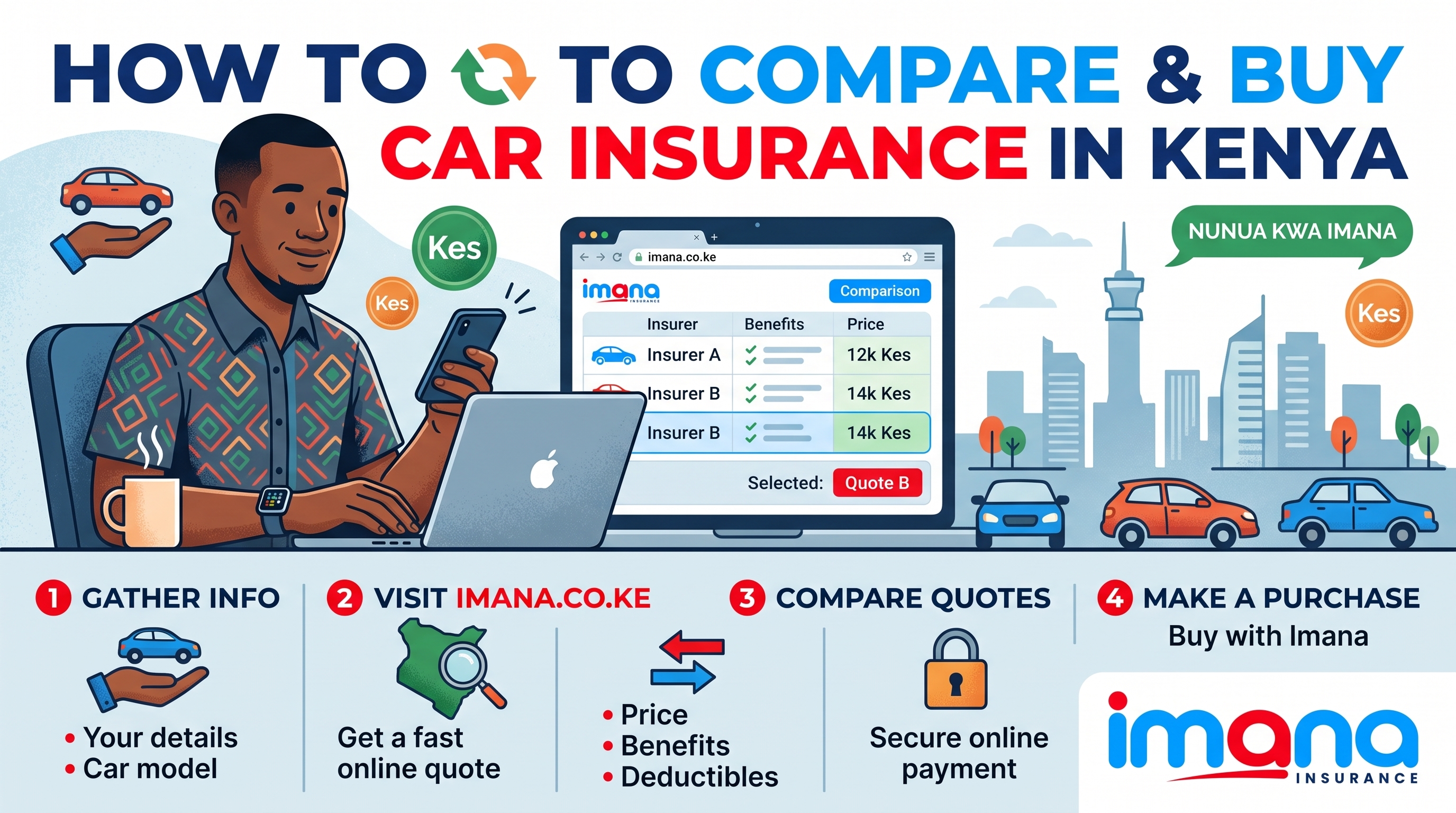
How to Buy Car Insurance Online in Kenya
The process can be straightforward.
Step 1: Start Online
Go to:
https://imana.co.ke/motor-quote
Step 2: Choose the Correct Vehicle Class
Select:
- Private
- PSV
- Motorcycle
- Commercial
as applicable.
Step 3: Provide Accurate Vehicle Information
Use details that match the logbook and actual use.
Step 4: Compare Quotations
Compare:
- Premium
- Excess
- Benefits
- Exclusions
Step 5: Choose the Suitable Option
Do not choose purely on price.
Step 6: Submit Required Documents
Provide the insurer or intermediary with requested documents.
Step 7: Complete Payment
Pay according to the approved quotation.
Step 8: Receive Your Policy Documentation
The certificate and/or policy documents are processed subject to:
- Payment confirmation
- Complete documentation
- Insurer underwriting
- System availability
How Quickly Can Motor Insurance Be Processed?
Straightforward Motor quotations can often be produced quickly where complete details are provided.
Certificates may also be processed shortly after:
- The insurer accepts the risk
- Payment is confirmed
- Required documentation is complete
Special risks can take longer.
Examples include:
- Matatus
- Large commercial vehicles
- High-value cars
- Unusual vehicle uses
Fast processing is useful.
Correct processing is more important.
Does Imana Charge for Motor Insurance Quotations?
There is no separate ordinary quotation fee for requesting and comparing Motor Insurance quotations through Imana.
Customers can compare available options before deciding which one to purchase.
Can You Buy Insurance Without Visiting an Office?
Yes, many Motor Insurance transactions can be handled digitally.
Customers can:
- Request quotations
- Send documents
- Compare options
- Make payment
- Receive policy documentation
without necessarily visiting an office.
What Happens if You Insure the Vehicle in the Wrong Class?
This is one of the biggest mistakes to avoid.
Examples include:
- Uber insured as private
- Matatu insured as ordinary private vehicle
- Boda boda insured as private motorcycle
- General Cartage declared as Own Goods
A cheaper premium is not useful if the policy does not correctly describe the risk.
Always disclose actual use.
What Happens After a Motor Accident?
Following an accident:
- Attend to injured persons
- Take reasonable steps to prevent further loss
- Report the accident where required
- Notify the insurer or intermediary promptly
- Preserve photographs and evidence
- Complete required claims documentation
The insurer then assesses the claim according to:
- Policy terms
- Circumstances
- Documentation
- Applicable excesses
Can Imana Help With a Motor Insurance Claim?
Yes, an intermediary can assist with:
- Claim notification
- Documentation guidance
- Follow-up
- Communication with the insurer
The insurer remains responsible for deciding claim admissibility and settling eligible claims.
Frequently Asked Questions
Where can I compare Car Insurance quotes in Kenya?
Visit:
https://imana.co.ke/motor-quote
Can I compare quotes from several Motor insurers?
Yes, subject to insurer appetite for your vehicle class.
Can I buy one-month Third Party Insurance?
Short-term Motor Insurance may be available for some classes and insurers.
How much is Private Third Party Insurance?
A practical budgeting range is approximately:
KSh 4,500–8,000 annually
for many private cars.
How much is Comprehensive Insurance for a KSh 1 million car?
A useful budgeting range is approximately:
KSh 30,000–55,000 annually
subject to insurer underwriting.
How much is Comprehensive Insurance for a KSh 2 million car?
A practical planning range is approximately:
KSh 60,000–100,000 annually
depending on vehicle and benefits.
Can Uber use Private Car Insurance?
A ride-hailing vehicle should be insured according to its actual PSV use.
How much is Third Party Insurance for a 14-seater Matatu?
On the observed seat-capacity rate structure:
KSh 88,357 annually
subject to current confirmation.
Is Boda Boda Insurance different from Private Motorcycle Insurance?
Yes.
Passenger-for-hire use represents a different risk.
Can Commercial vehicles get Comprehensive Insurance?
Yes, subject to insurer appetite and underwriting.
Does Third Party Insurance repair my own vehicle?
No, not ordinarily.
Is Comprehensive Insurance compulsory?
Third Party protection is the statutory baseline for qualifying road use. Comprehensive Insurance provides broader protection and may also be required by a financier.
How to Compare and Buy Car Insurance in Kenya: Final Guide
The best Motor Insurance comparison starts with one question:
“What is this vehicle actually used for?”
If it is a:
Private car
→ Compare Private Third Party or Comprehensive
Vehicle needing temporary cover
→ Ask about short-term Third Party options
Uber, Bolt or taxi
→ Compare PSV Taxi Insurance
Matatu
→ Compare PSV Matatu Insurance according to seating capacity
Motorcycle
→ Declare private, delivery, commercial or passenger use accurately
Commercial pickup, van or truck
→ Declare Own Goods, General Cartage or other actual use
Only after the correct class is established should you compare:
Cover → Benefits → Excess → Exclusions → Insurer → Price
That is how you avoid buying the cheapest certificate but the wrong insurance.
Compare the class first. Then compare the price.
Compare Motor Insurance
https://imana.co.ke/motor-quote
Imana Insurance Agency Kenya Ltd:
www.imana.co.ke
MyKava:
www.mykava.co.ke
Author:
Raymond Momanyi – Founder & CEO, Imana Insurance Agency Kenya Ltd
Insurance premiums, short-term options, policy benefits and insurer appetite can change. The figures above are budgeting references rather than guaranteed quotations. Always confirm the correct vehicle class, final premium, policy terms, excesses and exclusions before purchasing cover.